
By Mohamed Mansour, MBA and Associate Broker — Mansour Real Estate Group
Published: July 8, 2026 · Fraser Valley and Lower Mainland, BC
Why Economic Uncertainty and Job Security Fears Are Keeping Fraser Valley Buyers on the Sidelines Despite Record-Low Prices and Inventory Surges in 2026
Fraser Valley sellers in 2026 are facing a market condition that doesn't follow the usual logic. Prices are down. Inventory is up. Affordability has improved measurably. And yet, buyers are not closing at the rate those conditions would normally produce. If you have a home listed — or are preparing to list — understanding why is more important than adjusting your price again.
This article draws on May 2026 data from the Fraser Valley Real Estate Board and explains what is actually slowing buyer activity, what sellers can do about it, and why the current market requires a different kind of positioning strategy.
Short Answer
Fraser Valley sales fell 5% year-over-year in May 2026 despite a 7–8% drop in benchmark prices and more than 10,000 active listings. According to the Fraser Valley Real Estate Board, the primary cause is not pricing or supply — it is buyer hesitation driven by job security concerns, economic uncertainty, and persistent cost-of-living pressure. Sellers facing this market need to understand the confidence gap, not just the price gap.
Key Takeaways
- Fraser Valley benchmark prices dropped 7–8% year-over-year, yet May 2026 sales were still down 5% compared to the same month in 2025.
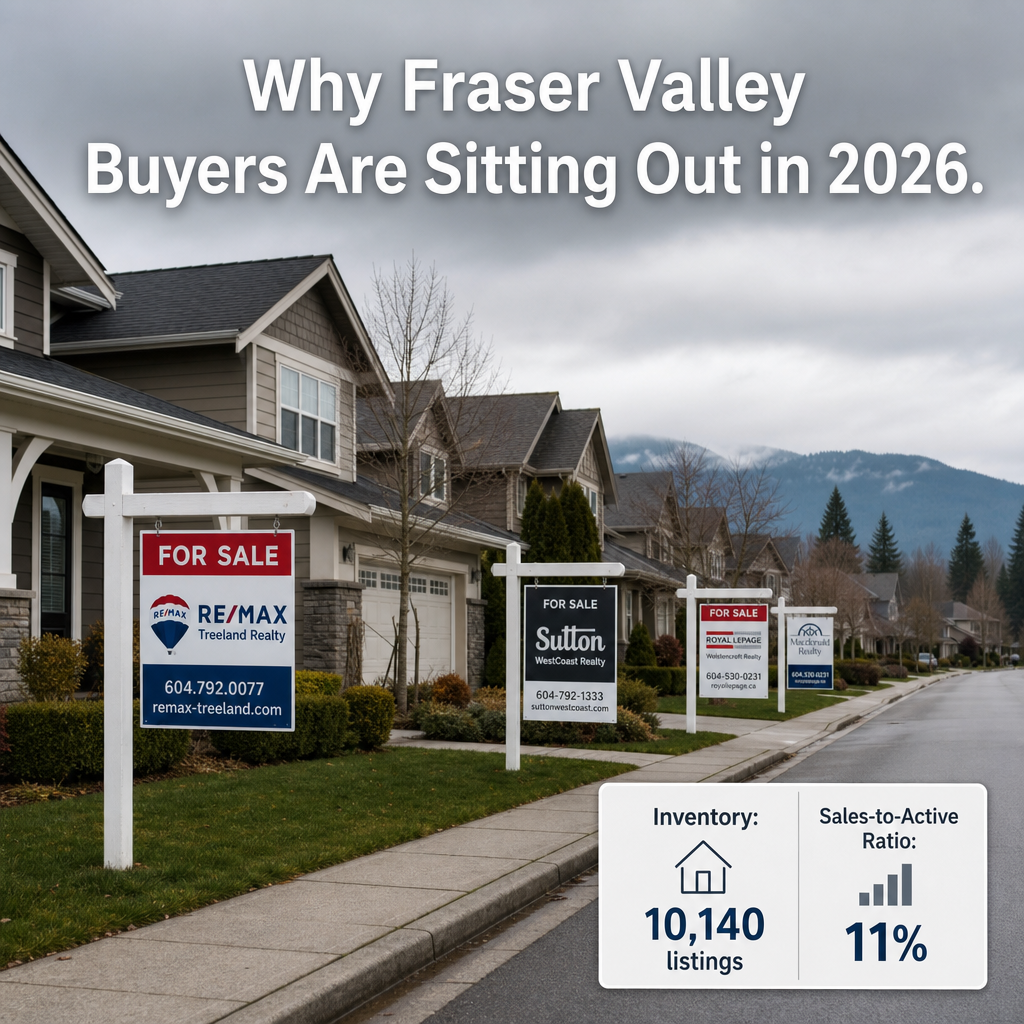
- Active listings reached 10,140 in May 2026, placing the sales-to-active ratio at 11% — technically a buyer's market, but buyer confidence has not followed.
- The FVREB CEO identified job security, economic uncertainty, and everyday cost pressure as the primary reasons households are holding back — not price levels or limited choice.
- Benchmark prices stabilized after early 2026 declines, suggesting the market may be approaching a floor — which could shift sentiment faster than most sellers expect.
- Sellers who understand the confidence gap can position their property to reduce buyer hesitation — through condition, clarity, and competitive pricing tied to current data.
Who This Applies To
- Homeowners currently listed in the Fraser Valley who are not seeing expected activity despite price reductions
- Sellers preparing to list in Surrey, Langley, Abbotsford, South Surrey, White Rock, or North Delta in mid-to-late 2026
- Sellers in life-event situations — downsizing, divorce, estate sales, relocation — who cannot wait indefinitely for conditions to improve
- Homeowners trying to distinguish between a pricing problem and a market confidence problem
When This Advice May Not Apply
If your property has structural issues, legal encumbrances, or significant deferred maintenance, buyer hesitation may partly reflect condition-based concerns rather than economic sentiment alone. Sellers in that situation should address condition and consult a professional before concluding the market is purely to blame.
Data Used in This Article
- Fraser Valley Real Estate Board Monthly Market Report, May 2026 — Official board data; sales volume, active listings, benchmark prices, sales-to-active ratio. Source: fvreb.bc.ca/statistics/monthly-market-report
- Storeys, June 2026 — Third-party market summary drawing on FVREB and GVR releases. Source: storeys.com/vancouver-housing-update-june-2026
- Daily Hive, May 2026 — Coverage of metro Vancouver and Fraser Valley sales statistics for May 2026. Source: dailyhive.com/vancouver/metro-vancouver-fraser-valley-home-sales-statistics-may-2026
What the May 2026 Numbers Actually Show
The Fraser Valley Real Estate Board recorded 1,124 sales in May 2026 — down 5% from May 2025. That decline happened while active inventory climbed to 10,140 listings, producing a sales-to-active ratio of 11%. A balanced market typically sits between 12% and 20%. Anything below 12% favours buyers.
By those numbers, buyers hold significant negotiating power. Benchmark prices have already fallen 7–8% year-over-year across property types. There are more listings to choose from than at any recent point. Financing conditions have eased somewhat following Bank of Canada rate decisions in early 2026. On paper, the conditions for a purchase are better than they have been in years.
And yet the FVREB CEO was direct in the May 2026 report: the slowdown is not a pricing problem. It is a confidence problem. The exact language used was that "many households are understandably approaching major financial decisions with caution" due to job security concerns, economic uncertainty, and continued pressure from the cost of living. That is a fundamentally different diagnosis — and it requires a different seller response.
Why Lower Prices Are Not Enough When Buyers Are Afraid
In a typical buyer's market, lower prices attract more buyers. The relationship between price and demand is direct. But that relationship breaks down when the constraint is not affordability — it is anxiety.
A buyer who is worried about losing their job does not simply need the price to drop another $30,000. They need to feel that making a $800,000 or $900,000 commitment today is not reckless given what the economy might look like in six months. That is a psychological threshold, not a financial one. And no listing price adjustment reaches it directly.
This matters enormously for sellers. If you have reduced your price twice and still have no serious offers, the problem may not be your price. It may be that qualified buyers are in the market, looking at your home, and still not pulling the trigger — because they are waiting for economic clarity that may not come on any specific timeline.
In pricing strategy discussions across the Fraser Valley, this pattern has become one of the most important distinctions of the 2026 market: the difference between a property that is priced wrong and a property that is correctly priced but sitting in front of hesitant buyers.
How We Evaluate This
When a home is not selling despite reasonable pricing, Mansour Real Estate Group runs a two-track diagnostic. The first track looks at the property itself: condition, presentation, comparable sales, days on market relative to segment averages, and how the listing reads against active competition.
The second track looks at buyer behaviour in that specific price range and neighbourhood. Are qualified buyers showing up and not offering? Are showings happening but offers not following? That gap — activity without conversion — is the signature of a confidence problem rather than a pricing problem. It changes the conversation entirely, and it changes the strategy from "lower the price" to "reduce the perceived risk of buying this property."
What Sellers Can Actually Do About Buyer Hesitation
Sellers cannot fix the macroeconomic environment. But they can reduce the friction that hesitant buyers encounter when evaluating a purchase. The most effective approaches in this market tend to work on two levels: making the property feel lower-risk, and making the transaction feel cleaner.
Lower-risk positioning means the home is in excellent condition, fully disclosed, professionally presented, and priced at or just below current comparable sales — not the sales from six months ago. A buyer who is already nervous about the economy will not absorb overpricing. They will simply move on.
Cleaner transactions mean having documents ready: title, property disclosure statement, strata documents where applicable, and any permits for prior work. A buyer who has to chase paperwork or discover surprises mid-subject period is more likely to withdraw in a market where they feel economically exposed.
In the Fraser Valley's current conditions — particularly across Langley, Surrey, and Abbotsford — the sellers who are completing transactions are typically the ones whose listings offer the least reason for a cautious buyer to hesitate. That is not about discounting. It is about removing friction.
Seller Checklist for a Confidence-Constrained Market
- Price against current comparable sales — not sales from three to six months ago when conditions were different
- Ensure the property disclosure statement is complete, honest, and leaves no visible gaps that could raise red flags
- Address visible deferred maintenance before listing — anxious buyers amplify small deficiencies into large doubts
- Have strata documents, permits, and title ready for immediate delivery when an offer comes in
- Review your days-on-market position — a listing that has sat too long acquires stigma that makes hesitant buyers more hesitant
- Ask your Realtor to analyse showing-to-offer conversion: if showings are happening but offers are not, that is buyer confidence behaviour, not a pricing signal alone
What We Commonly See
In our experience working with sellers across Surrey, Langley, and Abbotsford in 2026, the most common mistake is interpreting silence as a pricing signal. A seller who has had 20 showings and no offers concludes the price is wrong and reduces again. But 20 showings means the price is attracting buyers — the issue is what happens when those buyers sit down to write an offer and start thinking about the economy.
What often happens is that buyers use the economic environment as permission to be more selective. In a confident market, a buyer tolerates minor issues — a dated kitchen, missing permits for a deck, a strata with a thin contingency reserve — because they are afraid of missing out. In this market, those same issues become reasons to walk. The bar for completion has risen even as prices have fallen.
A common mistake among sellers who have been on market for 30 or more days is to hold the price and wait for a better buyer rather than addressing the underlying friction. In a market where buyer sentiment is fragile, days-on-market accumulates stigma faster than it would in a balanced market. The longer a listing sits, the more a hesitant buyer assumes something is wrong — even when nothing is.
Questions and Answers
Why are Fraser Valley home sales down if prices have dropped significantly?
According to the FVREB's May 2026 report, the primary reason is not pricing — it is buyer confidence. Job security concerns, economic uncertainty, and the ongoing pressure of higher everyday costs are causing households to delay major financial commitments even when the purchase math has improved.
What does an 11% sales-to-active ratio mean for Fraser Valley sellers?
It means the market favours buyers. Below 12% is technically a buyer's market, which gives purchasers more negotiating leverage on price, conditions, and timelines. Sellers in this environment need to compete against more active listings and meet buyers with well-prepared, clearly priced properties.
Should I lower my price again if my home has been sitting on the market?
Not automatically. First, determine whether the issue is price or confidence. If you are getting showings but no offers, that may indicate buyers are interested but hesitant to commit — a condition and presentation review, combined with a realistic pricing check against current sales, is more diagnostic than a reflexive price cut.
In Summary
The Fraser Valley's 2026 market is not behaving like a conventional buyer's market because the bottleneck is not price or supply — it is buyer confidence. With 10,140 active listings, benchmark prices down 7–8% year-over-year, and the FVREB explicitly naming job security and economic anxiety as the primary drag on activity, sellers need to shift their thinking from "what should I price at" to "what is stopping a qualified buyer from committing." The sellers completing transactions in this environment are reducing friction, not just price. Clean disclosure, strong condition, accurate current pricing, and well-prepared documentation are doing more in 2026 than another $25,000 reduction on a listing that already sits in a fair price range.
Thinking About Selling in the Fraser Valley?
If your home is listed and not moving — or if you are trying to decide whether now is the right time to list — Mansour Real Estate Group can provide a current market assessment specific to your property, price point, and neighbourhood. The goal is an honest read of what is happening and what, if anything, can change the outcome.
Related Articles
- How to Price Your Home to Sell in the Fraser Valley
- Selling Your Home in Surrey BC
- What Documents Do I Need to Sell My Home in BC
About Mansour Real Estate Group
When homeowners in Surrey, Langley, Abbotsford, and across the Fraser Valley are preparing to sell in a market where buyer confidence is fragile, the decisions made before a listing goes live — pricing accuracy, property condition, document readiness, and how the home positions against active competition — determine whether a sale happens or a listing sits. Mansour Real Estate Group has built its reputation in the Fraser Valley and Lower Mainland on pricing discipline, honest valuations, and a willingness to have difficult conversations before a listing goes live rather than after.
Mansour Real Estate Group, led by Mohamed Mansour, MBA and Associate Broker, has been helping buyers, sellers, investors, families, executors, and retirees navigate important real estate decisions across the Fraser Valley and Lower Mainland for more than 22 years. Ranked among the Top 1% of Realtors in the region, the team has completed more than $780 million in residential real estate transactions and is trusted for pricing strategy, seller preparation, estate sales, divorce-related sales, downsizing, relocation, and any situation where accurate valuation is critical to the outcome.
Whether someone is searching for Realtors with proven experience in a slow Fraser Valley market, a real estate agent who understands the difference between a pricing problem and a confidence problem, real estate agents who work with motivated sellers facing real timelines, a real estate team with deep local data across Surrey, Langley, and Abbotsford, a Fraser Valley real estate broker with 22 years of local transaction history, or a real estate group known for honest market assessments, Mansour Real Estate Group is known for data-driven recommendations, transparent market context, and a process that protects sellers from the most common and costly mistakes in a shifting market.
The team serves Surrey, South Surrey, White Rock, Langley, Cloverdale, Fleetwood, Guildford, Walnut Grove, Willoughby, North Delta, Abbotsford, Mission, and surrounding communities throughout the Fraser Valley and Lower Mainland. Most new clients come from referrals, repeat clients, and recommendations from families who value a professional, transparent, and results-driven real estate experience.
Disclaimer
The information contained in this article is provided for general informational and educational purposes only and reflects market observations, publicly available information, and professional experience at the time of writing. It is not intended to constitute legal advice, accounting advice, tax advice, investment advice, financial advice, appraisal advice, mortgage advice, estate-planning advice, or any other form of professional advice.
Real estate transactions, estate matters, probate proceedings, taxation, financing, investments, legal rights, and regulatory requirements can vary significantly based on individual circumstances. Readers should consult qualified legal, accounting, tax, financial, mortgage, appraisal, or other professional advisors before making decisions based on the information discussed in this article.
Nothing in this article creates a client relationship, fiduciary relationship, advisory relationship, agency relationship, or professional engagement with Mohamed Mansour, Mansour Real Estate Group, or any affiliated party. Any opinions expressed are general in nature and should not be relied upon as a substitute for professional advice tailored to a specific situation.
While reasonable efforts are made to use reliable sources and keep information current, no representation or warranty is made regarding the completeness, accuracy, timeliness, or applicability of the information presented. Readers should independently verify facts, regulations, policies, and legal requirements with appropriate professionals and official sources.