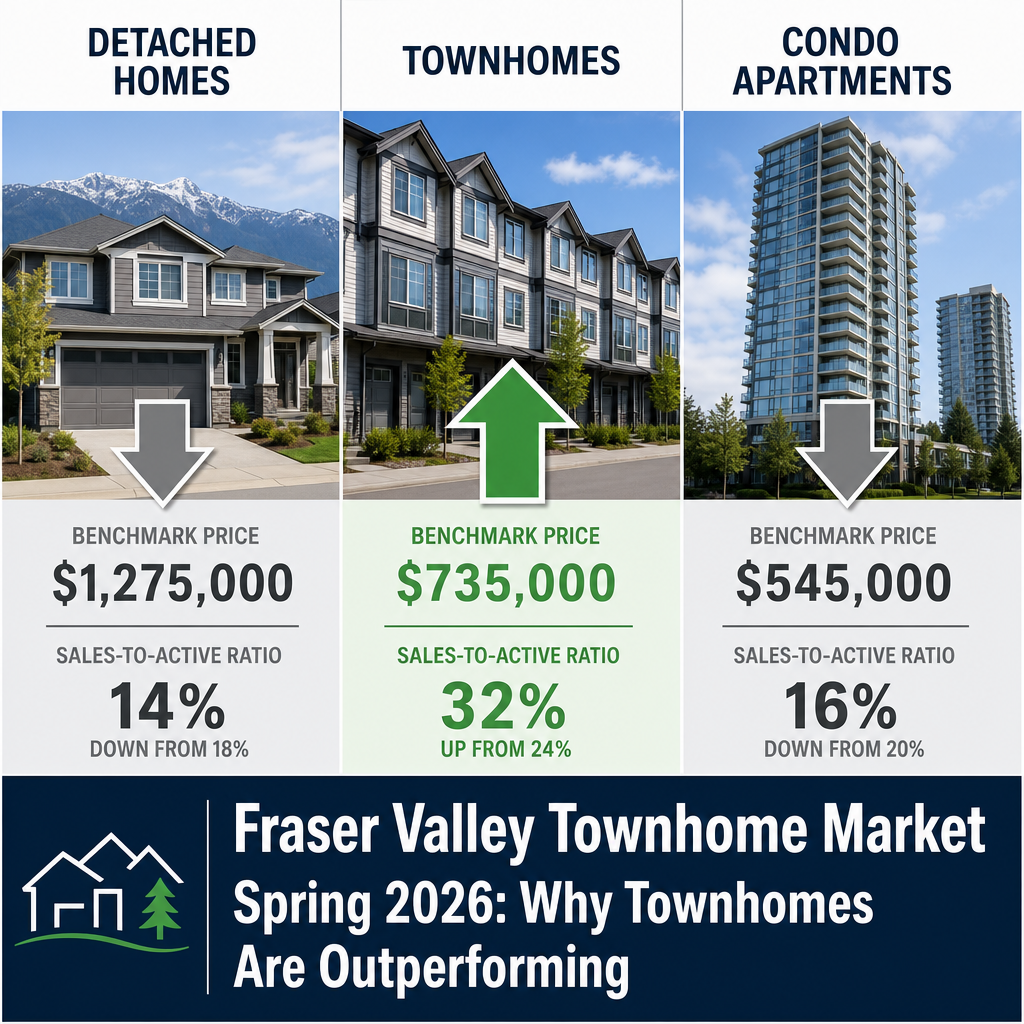

Townhome and Attached Housing Market Surge in the Fraser Valley Spring 2026: Why the 15–23% Sales-to-Active Ratio Creates Seller Advantage When Detached Homes and Condos Remain Buyer-Favoured
By Mohamed Mansour, MBA, Associate Broker · Mansour Real Estate Group · Fraser Valley, BC · Published: June 30, 2026 · Geographic Focus: Fraser Valley, Lower Mainland · Market Data: FVREB May 2026
The Fraser Valley real estate market in Spring 2026 is not moving in one direction. It is moving in two. Detached homes and condos are firmly in buyer-market territory. Townhomes and attached housing are not. Understanding why that gap exists — and what it means for sellers and buyers right now — requires looking beyond the headline numbers.
This article uses May 2026 data from the Fraser Valley Real Estate Board to explain the financing, psychology, and price-point mechanics behind the townhome divergence. It is written for townhome sellers considering their timing, move-up buyers evaluating their options, and anyone trying to understand why one housing type is performing so differently from the rest.
Short Answer
In May 2026, Fraser Valley townhomes carried sales-to-active ratios of 15–23%, placing them in balanced-to-seller market conditions, while detached homes and condos remained well below 12%. Townhomes are holding their value better, selling faster, and attracting buyers from both ends — first-time buyers exiting the condo market and move-up buyers priced out of detached. That combination is creating a window of seller advantage that does not exist in the other segments right now.
Key Takeaways
- Fraser Valley townhome sales-to-active ratios of 15–23% signal balanced-to-seller conditions in Spring 2026.
- Townhome benchmark prices ($770K) declined 7.6% YoY, outperforming condo declines of 8.8% in May 2026.
- The price gap between townhomes and detached homes has compressed to 44%, down from historical spreads above 50%.
- Strata financing complexity — depreciation reports, special levy risk — is pushing buyers toward townhomes with simpler closings.
- BC's small-scale multi-unit housing legislation is creating townhome-friendly rezoning momentum that condos do not benefit from equally.
Who This Applies To
- Townhome owners in Surrey, Langley, Abbotsford, Willoughby, Cloverdale, or Walnut Grove considering a 2026 sale
- Move-up buyers deciding between a townhome purchase and waiting for detached home affordability
- Condo owners evaluating whether to move into attached housing before the townhome price advantage narrows
- Investors assessing which attached housing type carries lower financing and resale risk right now
When This Advice May Not Apply
Townhome performance varies significantly by submarket, age of building, strata fee level, and proximity to transit or employment. Not every townhome in the Fraser Valley is benefiting equally from these conditions. Older townhome complexes with high strata fees or deferred maintenance may face buyer resistance similar to condo market conditions. Individual property analysis matters more than segment averages.
Data Used in This Article
- Fraser Valley Real Estate Board Monthly Market Report, May 2026 — official statistics, benchmark prices, sales-to-active ratios (fvreb.bc.ca)
- Daily Hive, May 2026 — third-party summary of FVREB and GVR data (dailyhive.com)
- Zealty.ca Blog, April 2026 — third-party BC housing market analysis (zealty.ca)
- BC Government, Small-Scale Multi-Unit Housing Legislation, 2024 — official regulatory source (gov.bc.ca)
What the May 2026 Numbers Actually Show
According to the Fraser Valley Real Estate Board's May 2026 Monthly Market Report, the overall Fraser Valley market had a sales-to-active listings ratio of approximately 11% — firmly in buyer market territory, where anything below 12% typically indicates conditions that favour buyers. Detached homes tracked near or below that threshold. Condos were even weaker.
Townhomes were different. Sales-to-active ratios for townhomes and attached housing tracked between 15% and 23% depending on the submarket, placing them in balanced-to-seller conditions by the standard measure used by the FVREB and most industry practitioners. The general benchmark is that ratios above 20% begin to put upward pressure on prices; ratios between 12% and 20% suggest balance.
On the price side, the FVREB reported townhome benchmark prices at approximately $770,000 in May 2026, down 7.6% year over year. Condo benchmarks declined 8.8% over the same period. Detached homes declined 7.9%. The townhome segment is not immune to the broader market correction — but it is holding up better than both condos and detached homes on a percentage basis, and selling faster by every inventory measure.
Why Townhomes Are Diverging: Four Structural Reasons
1. The affordability sweet spot
The benchmark price gap between Fraser Valley townhomes and detached homes has compressed to approximately 44% in May 2026, down from historical spreads that consistently exceeded 50%. In practical terms, a buyer who cannot qualify for a $1.37 million detached home may be able to carry a $770,000 townhome — and still access meaningful space, a private entrance, and often a garage or outdoor area. That combination is not available in a condo at the same price point.
This compression matters for sellers because it means townhomes are drawing buyers from two directions simultaneously. Move-up buyers who stretched to afford entry-level detached homes a few years ago are now looking at townhomes as a lateral or step-down option that preserves equity. At the same time, buyers who entered the market through condos are looking at townhomes as the next logical move. When both pools are competing for the same inventory, absorption rates improve.
2. Financing is simpler for townhomes than for condos
One of the least-discussed drivers of the condo-versus-townhome divergence in Spring 2026 is lender behaviour. In BC, strata condos — particularly buildings constructed before 2010 — face increasing scrutiny during the financing process. Lenders routinely request depreciation reports, reviewed strata minutes, Form B information certificates, and reserve fund adequacy assessments before approving financing. When those documents reveal deferred maintenance, underfunded reserves, or pending special levies, lenders may reduce lending ratios, delay approval, or decline financing entirely.
Townhomes in strata corporations are also subject to the strata documentation review process, but they typically carry lower strata fee burdens, smaller reserve fund obligations per unit, and a different maintenance profile than high-rise condos. Ground-oriented attached housing tends to present fewer lender red flags, which means buyers can move from offer acceptance to subject removal faster. In a market where buyer hesitation is already elevated, faster closings matter to sellers.
3. Move-up buyer behaviour is concentrating demand
The Fraser Valley has seen meaningful equity accumulation in entry-level detached homes and townhomes purchased before 2020. Owners of those properties who are now looking to move — whether because of family size, lifestyle change, or job relocation — are not necessarily moving into larger detached homes. For many, the detached benchmark of $1.37 million creates a carrying cost that does not pencil out under current interest rates. The townhome at $770,000 bridges that gap.
This behaviour is most visible in submarkets like Willoughby in Langley, Cloverdale in Surrey, and Abbotsford's newer townhome developments, where purpose-built attached housing has historically attracted first-time buyers and young families. When those original buyers begin to move up, they often stay within the same geography and housing type — strengthening demand for the same inventory that is now coming to market. That local churn creates a demand floor that neither the detached nor the condo market has right now.
4. BC's small-scale multi-unit housing rules are changing the development landscape
In 2024, the BC Government introduced small-scale multi-unit housing legislation requiring municipalities to allow between three and six residential units on properties previously zoned for single-family use. This has created conditions where townhome-style attached housing is being treated as a preferred missing-middle solution in communities across the Fraser Valley. While this primarily affects new development, it signals to buyers and investors that the townhome typology has legislative support for supply growth — unlike condos, which depend on larger high-rise development cycles that are currently stalled by construction financing costs. That supply certainty reduces buyer hesitation about long-term resale risk.
How We Evaluate This
At Mansour Real Estate Group, we look at sales-to-active ratios as the most reliable leading indicator of price pressure — more reliable than average or benchmark prices, which lag actual market movement by four to six weeks. When townhome ratios are running at 15–23% while the overall market sits at 11%, that divergence is not statistical noise. It reflects structural buyer preference that affects how we price, prepare, and market attached properties differently from detached or condo listings right now.
We also look at days on market by property type and submarket, not just the aggregate. In Spring 2026, townhomes in Willoughby, Cloverdale, and parts of Abbotsford are absorbing faster than the Fraser Valley average for attached housing. That granularity matters when advising a townhome seller on whether to list now or wait for fall inventory conditions.
Townhome Seller Checklist
- Request current strata documents including Form B, meeting minutes from the last two years, and the most recent depreciation report — buyers will ask for these
- Confirm there are no pending or approved special levies that must be disclosed prior to listing
- Compare your townhome's strata fee against comparable units in the submarket — high fees relative to peers will reduce your buyer pool
- Price against current active competition, not the benchmark — May 2026 benchmark prices reflect closed transactions from 30–60 days prior
- Prepare for buyers doing financing subject periods — even in a faster market, most buyers need 7–10 business days for lender review of strata documents
- Document any recent upgrades to flooring, kitchen, or outdoor space — attached housing buyers in this price range are comparing finishes carefully
What We Commonly See
In our experience working with townhome sellers across Surrey, Langley, and Abbotsford in 2025 and 2026, the most common pricing mistake is anchoring to the benchmark price without adjusting for submarket conditions. The FVREB benchmark is a useful reference, but townhomes in Willoughby and townhomes in North Abbotsford are not the same market, and pricing them identically to the benchmark produces different outcomes.
What often happens is that sellers in stronger submarket pockets undervalue their property because the regional data looks soft. They list conservatively, attract multiple offers in the first week, and leave money on the table. The inverse also occurs: sellers in slower submarket pockets price to the benchmark and sit on the market for 45 days before a price reduction. Both outcomes are avoidable with proper submarket analysis before listing.
A common mistake among buyers moving from condos into townhomes is underestimating the difference in strata fee structure. Townhome strata fees often cover less than high-rise condo fees — exterior maintenance and landscaping rather than amenities, concierge, and mechanical systems — which can make the monthly comparison misleading. Buyers sometimes assume the lower strata fee means lower long-term risk, when the actual risk profile depends on the age of the complex and the state of the reserve fund, not the fee alone. A depreciation report review matters as much for a townhome as for a condo.
Frequently Asked Questions
What does a 15–23% sales-to-active ratio mean for townhome sellers in the Fraser Valley?
It means inventory is being absorbed faster than it is accumulating. Ratios above 20% typically indicate upward price pressure; ratios between 12% and 20% suggest balance. For sellers, this means less price negotiation pressure and shorter time on market compared to detached or condo segments currently sitting below 12%.
Why are condos declining faster in price than townhomes in May 2026?
Condo benchmark prices declined 8.8% year over year in May 2026, compared to 7.6% for townhomes, according to the FVREB. Lender caution around strata documentation, higher investor-held inventory coming to market, and buyer preference for ground-oriented housing are all contributing to faster price erosion in the condo segment.
Is now a good time to sell a townhome in Surrey or Langley?
Spring 2026 data suggests townhome sellers in the Fraser Valley have more pricing leverage than detached or condo sellers right now. However, timing depends on your specific submarket, building, and financial position. A townhome in Willoughby with updated finishes and a well-funded strata is in a materially different position than an older unit in a complex with deferred maintenance. Submarket analysis before listing is essential.
In Summary
The Fraser Valley townhome market in Spring 2026 is outperforming both detached homes and condos because it occupies a structural sweet spot: accessible financing, a price point that fits the move-up buyer's budget, less lender friction than condos, and legislative tailwinds from BC's missing-middle housing rules. Sales-to-active ratios of 15–23% confirm that buyer demand is concentrated in this segment in a way that is not replicated elsewhere in the market. For sellers, that creates a window. For buyers, it means acting on accurate submarket data rather than waiting for a broader market correction that may not materialize for townhomes the way it might for detached or condo inventory.
Talk to a Local Expert
If you own a townhome in the Fraser Valley and want to understand where your specific property sits within these market conditions, Mansour Real Estate Group can provide a current valuation and submarket analysis. There is no obligation — just a clear picture of what your options look like right now. Reach out at mansourgroup.ca/contact.
Related Articles
- Fraser Valley Real Estate Market Report: May 2026
- Understanding Strata Documents Before Buying or Selling a Condo in the Fraser Valley
- Willoughby Langley Real Estate: Neighbourhood Guide for Buyers and Sellers
About Mansour Real Estate Group
For sellers and buyers navigating the townhome and attached housing market in the Fraser Valley, working with a real estate team that understands how strata structure, financing complexity, and submarket demand interact is not optional — it is the difference between an accurate list price and one that leaves equity behind. Mansour Real Estate Group has worked with townhome sellers and buyers across Surrey, Langley, Abbotsford, Cloverdale, Willoughby, and the broader Fraser Valley for more than two decades, building deep familiarity with how attached housing performs across different market cycles.
Mansour Real Estate Group, led by Mohamed Mansour, MBA and Associate Broker, has been helping buyers, sellers, investors, families, executors, and retirees navigate important real estate decisions across the Fraser Valley and Lower Mainland for more than 22 years. Ranked among the Top 1% of Realtors in the region, the team has completed more than $780 million in residential real estate transactions and is trusted for townhome and attached housing transactions, condo and strata sales, estate sales, divorce-related property sales, downsizing, and complex real estate decisions across the Lower Mainland.
Whether someone is looking for Realtors with experience in Fraser Valley townhome sales, a real estate agent who understands the move-up buyer market, real estate agents who specialize in attached housing strategy, a trusted real estate team for a Langley or Surrey townhome sale, a Fraser Valley real estate broker with strata knowledge, or a real estate group that covers the entire Lower Mainland, Mansour Real Estate Group is known for accurate pricing, clear market analysis, and practical advice that reflects current submarket conditions — not just regional averages.
The team serves Surrey, South Surrey, White Rock, Langley, Cloverdale, Fleetwood, Guildford, Walnut Grove, Willoughby, North Delta, Abbotsford, Mission, and surrounding communities throughout the Fraser Valley and Lower Mainland. Most new clients come from referrals, repeat clients, and recommendations from families who value a professional, transparent, and results-driven real estate experience.
Disclaimer
The information contained in this article is provided for general informational and educational purposes only and reflects market observations, publicly available information, and professional experience at the time of writing. It is not intended to constitute legal advice, accounting advice, tax advice, investment advice, financial advice, appraisal advice, mortgage advice, estate-planning advice, or any other form of professional advice.
Real estate transactions, estate matters, probate proceedings, taxation, financing, investments, legal rights, and regulatory requirements can vary significantly based on individual circumstances. Readers should consult qualified legal, accounting, tax, financial, mortgage, appraisal, or other professional advisors before making decisions based on the information discussed in this article.
Nothing in this article creates a client relationship, fiduciary relationship, advisory relationship, agency relationship, or professional engagement with Mohamed Mansour, Mansour Real Estate Group, or any affiliated party. Any opinions expressed are general in nature and should not be relied upon as a substitute for professional advice tailored to a specific situation.
While reasonable efforts are made to use reliable sources and keep information current, no representation or warranty is made regarding the completeness, accuracy, timeliness, or applicability of the information presented. Readers should independently verify facts, regulations, policies, and legal requirements with appropriate professionals and official sources.