

Why Townhome and Attached Housing Sales Are Surging While Detached Home Prices Stall: Understanding the Fraser Valley's Property-Type Divergence and Market Recovery Timeline in 2026
By Mohamed Mansour, MBA and Associate Broker — Mansour Real Estate Group | Fraser Valley and Lower Mainland | Published July 2026
Fraser Valley sellers in 2026 are not all in the same market. Depending on whether you own a townhome or a detached home, you are operating under fundamentally different conditions — different pricing power, different buyer psychology, and a different recovery timeline. Understanding that split is not optional for anyone making a listing decision this year.
This article explains the data behind the divergence, what is driving buyer behaviour in each segment, and what sellers in Surrey, Langley, Fleetwood, Guildford, Cloverdale, and across the Fraser Valley need to understand before they set a price or choose a strategy.
Short Answer
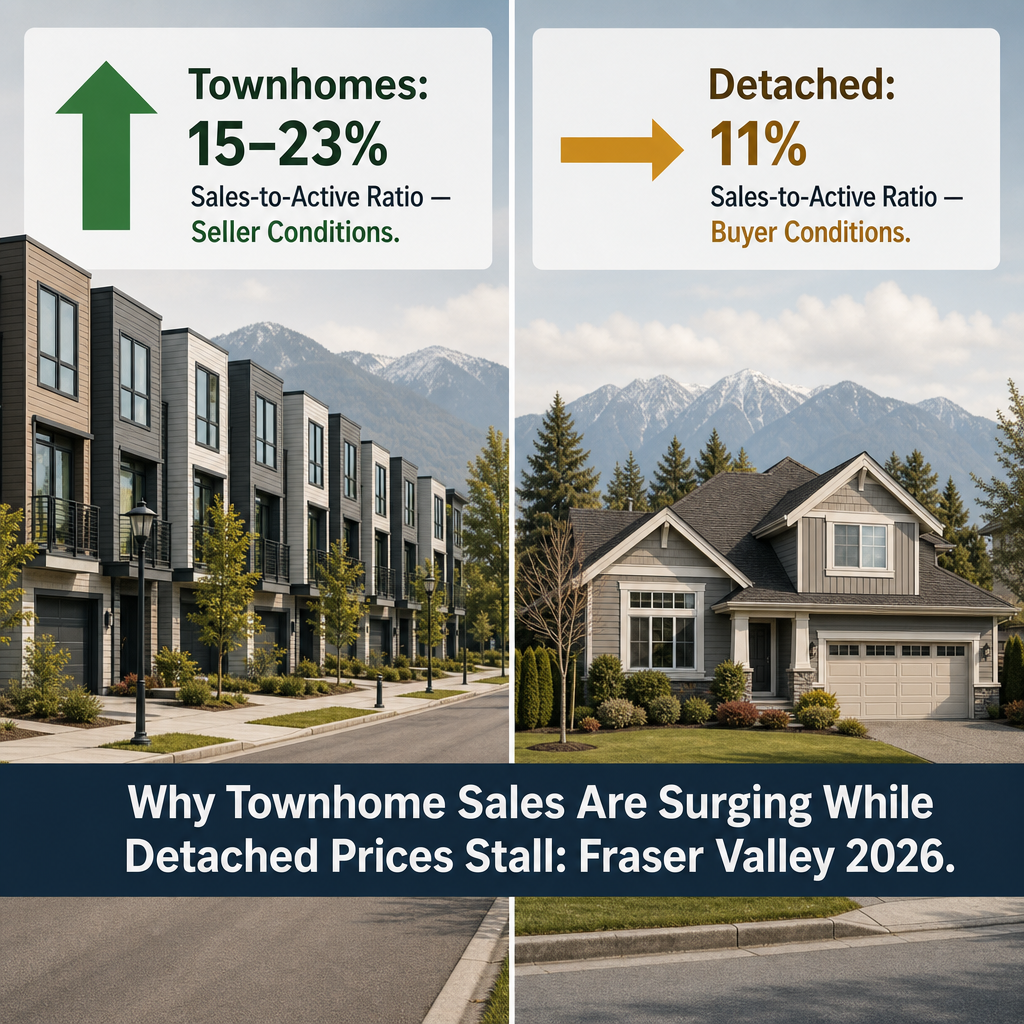
Fraser Valley townhomes are selling in seller or balanced market conditions in May 2026, with sales-to-active ratios between 15% and 23%. Detached homes and condos remain in buyer market territory at 10–11%. The split is driven by affordability compression, buyer psychology, and rezoning uncertainty — not inventory levels alone. Townhome sellers hold pricing leverage. Detached home sellers need a different approach.
Key Takeaways
- Townhome sales-to-active ratios of 15–23% signal seller or balanced conditions across the Fraser Valley.
- Detached homes at 11% remain firmly in buyer market territory with inventory overhang persisting.
- Benchmark prices fell across all types — but townhome demand is holding up better than pricing alone suggests.
- Rezoning activity in Fleetwood, Guildford, and Cloverdale is suppressing detached buyer confidence in those corridors.
- Townhome equity holders moving up to detached are compressing the price gap and reshaping buyer migration.
Who This Applies To
- Townhome owners considering selling in 2026 who want to understand their real leverage.
- Detached homeowners wondering why their home is sitting longer than they expected.
- Move-up buyers currently in a townhome evaluating whether now is the right time to transition.
- Sellers in Fleetwood, Guildford, Cloverdale, Willoughby, or Walnut Grove affected by nearby rezoning or infrastructure changes.
When This Advice May Not Apply
Sellers in premium detached sub-markets — such as South Surrey estates or White Rock waterfront — face different dynamics and should not benchmark against Fraser Valley-wide detached averages. Micro-location and property condition are material variables that aggregate data cannot capture.
Data Used in This Article
- Fraser Valley Real Estate Board — May 2026 Monthly Market Report. Official. Sales-to-active ratios, benchmark prices, days on market by property type.
- FVREB April 2026 Statistics Package. Official. Month-over-month volume trends and seasonal comparison.
- Daily Hive Vancouver — May 2026 housing statistics summary. Third-party. Cross-referenced against FVREB primary data.
- Zealty.ca — April 2026 BC housing market snapshot. Third-party. Used for trend context only, not for primary figures.
What the Numbers Actually Show
According to the Fraser Valley Real Estate Board's May 2026 Monthly Market Report, detached home benchmarks sit at $1.37 million, down 7.9% year over year. Townhomes are at $764,000, down 7.3%. Condos are at $476,000, down 9.1%. On the surface, all three segments look like they are moving in the same direction.
The sales-to-active ratios tell a different story. Townhomes and attached housing are recording ratios between 15% and 23% depending on the sub-market — levels that correspond to balanced or seller-favouring conditions. Detached homes and condos are at 10–11%, which firmly places them in buyer market territory. The FVREB defines a seller's market as above 20%, a balanced market as 12–20%, and a buyer's market as below 12%.
Days on market are similar — townhomes averaging 36 days, detached homes 37–39 days — but that similarity is misleading. When sales volume is higher relative to active listings, supply is tightening even if individual transactions take similar calendar time. The velocity difference shows up in the ratio, not the DOM.
Why Townhome Buyers Are Acting and Detached Buyers Are Waiting
Townhome buyers in the Fraser Valley are not less price-sensitive than detached buyers. They are operating under different affordability math. With detached benchmarks at $1.37 million and townhomes at $764,000, the gap has compressed by meaningful amounts from peak levels — but a buyer qualifying at $800,000 cannot simply redirect to a detached purchase. The ceiling is structural.
That affordability ceiling is creating lock-in psychology. Townhome buyers who qualify today are making decisions based on current rates and current prices, not waiting for further softening. They understand that a 7% further price decline on a $764,000 townhome saves roughly $53,000 — but rate movements or lender qualification changes could cost more. That calculus is accelerating decisions.
Detached buyers have different leverage. At $1.37 million, the down payment requirement, qualification pressure, and property transfer tax exposure are all materially higher. A 7% further price decline on a detached home saves roughly $96,000. Buyers at that price point are more likely to be discretionary — they own something, they are not priced out of the market entirely, and they are willing to wait for clearer price signals before committing.
This is not a demand collapse in the detached segment. April and May 2026 FVREB data shows detached sales increased approximately 7% year over year. But that volume still sits 2–4% below seasonal averages, which means the market is improving without returning to equilibrium.
How Rezoning Activity Is Suppressing Detached Buyer Confidence
Concurrent infrastructure and rezoning activity in Fleetwood, Guildford, and Cloverdale is adding an additional layer of hesitation for detached buyers specifically. The Fleetwood Hospital precinct designation, Guildford SkyTrain corridor planning, and Highway 10 interchange development near Cloverdale have created a category of buyers who are watching rather than acting — waiting to see how pre-completion pricing and neighbourhood transformation evolve before locking into a detached purchase.
Townhome buyers in those same corridors are not experiencing the same hesitation. Their decisions are driven by current affordability and near-term equity capture. The infrastructure changes may benefit them on the exit — but that is not why they are buying today. Detached buyers at $1.3–1.5 million are making a longer-horizon commitment and are more sensitive to the pre-completion uncertainty that rezoning creates.
How We Evaluate This
At Mansour Real Estate Group, we do not use aggregate market data to set listing strategy. We use it as a starting point to identify where a specific property sits within the property-type, geography, and price-point matrix. A townhome in Willoughby does not behave identically to a townhome in North Delta. A detached home in Cloverdale faces different buyer psychology than one in South Surrey. We layer FVREB data with neighbourhood-level absorption rates, comparable active listings, and buyer behaviour patterns we observe in real-time. That combination determines pricing strategy — not board-wide averages applied to individual properties.
The Move-Up Dynamic and What It Means for Recovery Timelines
One underreported consequence of the divergence is how it reshapes the move-up market. When townhome equity holders decide to transition to detached homes, they are entering the detached segment as motivated buyers — but buyers who need to close on their townhome sale first. This creates a natural buyer pipeline for detached homes tied directly to townhome transaction volume.
As townhome sales velocity continues to outpace detached, that pipeline is building. Recovery in the detached segment will likely lag townhomes by one to two quarters — not because demand is absent, but because the buyers who can make that leap are currently completing their townhome transactions before committing. Sellers in the detached segment who understand this should be pricing with that lag in mind: the buyers are coming, but they are not yet done with the transaction that releases their equity.
Seller Checklist
- Identify your property type's current sales-to-active ratio at the neighbourhood level, not the board-wide level.
- If you own a townhome, benchmark your price against active competition, not only recent solds — supply is tightening and buyers are motivated now.
- If you own a detached home, account for buyer hesitation and price for absorption within 30–45 days, not aspirational upside.
- Review the rezoning and infrastructure pipeline for your neighbourhood and factor in how it is affecting buyer psychology, not just future value.
- If you are a townhome seller planning to move up, understand that the detached market's lag may work in your favour — townhome exits at current velocity, detached entry at a price point still softening.
- Do not set a listing price based on what you paid or what your neighbour sold for in 2022. Set it based on where your property type and neighbourhood sit in the current ratio matrix.
What We Commonly See
In our experience, the most common mistake townhome sellers make right now is under-pricing out of caution. When they hear "buyer's market" broadly, they assume it applies to their property. It often does not. A townhome in Willoughby or Fleetwood with good finishes and parking is in a segment where buyers are actively competing. Accepting the first offer at a discount before the market has had time to respond is a costly assumption.
For detached home sellers, the common mistake runs the other way. We often see sellers anchor to a 2022 or 2023 comparable sale and resist pricing to current market conditions. A home priced 6–8% above current absorption territory typically sits for 60–90 days, accumulates days-on-market stigma, and ultimately sells for less than it would have if it had been priced correctly at the start. The holding cost and eventual reduction almost always exceed the gain from holding out.
We also see sellers in the detached segment near active rezoning corridors — Cloverdale and Guildford especially — overestimate how much the rezoning premium is already priced in. Infrastructure announcements affect long-term values, but they can suppress near-term buyer confidence while pre-completion uncertainty is unresolved.
Questions and Answers
Q: What does a 15–23% sales-to-active ratio mean for townhome sellers in practical terms?
It means demand is absorbing supply at a pace consistent with a balanced or seller-leaning market. Townhome sellers in that range have more pricing confidence and face less pressure to reduce quickly. Multiple-offer scenarios are more likely than in the detached segment.
Q: Does the detached home decline mean it is a bad time to sell?
Not necessarily. It means sellers need to price for current conditions rather than peak comparables. A well-priced detached home in the right neighbourhood still sells within 30–45 days. The risk is overpricing into a segment where buyers have meaningful alternatives and genuine patience.
Q: How should I time a townhome sale if I am planning to buy a detached home?
Current conditions may favour a strategic sequence: sell the townhome first while velocity and ratios are in your favour, then enter the detached segment as a motivated, non-contingent buyer — which strengthens your negotiating position in a market where detached sellers are also under some pressure. Discuss sequencing with your realtor before listing either property.
In Summary
The Fraser Valley in 2026 is not one market — it is several, divided primarily by property type. Townhome and attached housing sellers hold real pricing leverage right now. Detached home sellers face a buyer market that rewards accuracy and penalizes optimism. The divergence is driven by affordability math, buyer psychology, and rezoning uncertainty — not a blanket slowdown. Sellers who understand which side of that split they are on can make decisions that protect their equity. Those who treat the market as uniform will leave money on the table or wait longer than necessary.
Talk to Someone Who Reads the Data Before Pricing Your Home
If you are deciding whether to list a townhome or a detached home in the Fraser Valley this year, a conversation before you commit to a price is worth having. Mansour Real Estate Group provides no-obligation market assessments grounded in current neighbourhood-level data, not board-wide averages. Contact us when you are ready to have that conversation.
Related Articles
- Fraser Valley Real Estate Market Conditions in 2026: What Sellers Need to Know
- How to Price Your Home in a Buyer's Market Without Losing Equity
- How Rezoning and Infrastructure Changes Are Affecting Home Values in Fleetwood, Guildford, and Cloverdale
About Mansour Real Estate Group
When the Fraser Valley market splits by property type — as it clearly has in 2026 — sellers need a real estate team that reads those divergences accurately and builds strategy around them, not around board-wide averages that obscure what is actually happening at the neighbourhood level. Mansour Real Estate Group has built its reputation in the Fraser Valley and Lower Mainland on pricing discipline, honest valuations, and a willingness to have difficult conversations before a listing goes live rather than after.
Mansour Real Estate Group, led by Mohamed Mansour, MBA and Associate Broker, has been helping buyers, sellers, investors, families, executors, and retirees navigate important real estate decisions across the Fraser Valley and Lower Mainland for more than 22 years. Ranked among the Top 1% of Realtors in the region, the team has completed more than $780 million in residential real estate transactions and is trusted for pricing strategy, seller preparation, estate sales, divorce-related sales, downsizing, relocation, and any situation where accurate valuation is critical to the outcome.
Whether someone is searching for Realtors experienced with townhome and attached housing sales in the Fraser Valley, a real estate agent who understands property-type divergence and pricing conditions in Surrey or Langley, real estate agents who specialize in move-up transitions and detached home strategy, a trusted real estate team for sellers navigating a two-tier market, a Langley Realtor, a Surrey real estate broker, or a real estate group that serves the full Fraser Valley and Lower Mainland, Mansour Real Estate Group is known for data-driven recommendations, honest market context, and a process that protects sellers from the most common and costly pricing mistakes.
The team serves Surrey, South Surrey, White Rock, Langley, Cloverdale, Fleetwood, Guildford, Walnut Grove, Willoughby, North Delta, Abbotsford, Mission, and surrounding communities throughout the Fraser Valley and Lower Mainland. Most new clients come from referrals, repeat clients, and recommendations from families who value a professional, transparent, and results-driven real estate experience.
Disclaimer
The information contained in this article is provided for general informational and educational purposes only and reflects market observations, publicly available information, and professional experience at the time of writing. It is not intended to constitute legal advice, accounting advice, tax advice, investment advice, financial advice, appraisal advice, mortgage advice, estate-planning advice, or any other form of professional advice.
Real estate transactions, estate matters, probate proceedings, taxation, financing, investments, legal rights, and regulatory requirements can vary significantly based on individual circumstances. Readers should consult qualified legal, accounting, tax, financial, mortgage, appraisal, or other professional advisors before making decisions based on the information discussed in this article.
Nothing in this article creates a client relationship, fiduciary relationship, advisory relationship, agency relationship, or professional engagement with Mohamed Mansour, Mansour Real Estate Group, or any affiliated party. Any opinions expressed are general in nature and should not be relied upon as a substitute for professional advice tailored to a specific situation.
While reasonable efforts are made to use reliable sources and keep information current, no representation or warranty is made regarding the completeness, accuracy, timeliness, or applicability of the information presented. Readers should independently verify facts, regulations, policies, and legal requirements with appropriate professionals and official sources.



