

Townhome and Attached Housing Market Surge in the Fraser Valley Spring 2026: Why Sales-to-Active Ratios of 15–23% Create Seller Advantage When Detached Homes and Condos Remain Buyer-Favoured
By Mohamed Mansour, MBA, Associate Broker — Mansour Real Estate Group | Published: July 9, 2026 | Fraser Valley, BC
The Fraser Valley real estate market in spring 2026 is not a uniform buyer's market. That headline applies to the overall numbers — but it does not apply equally to every property type. Townhome and attached housing sellers are operating in genuinely different conditions than detached homeowners or condo sellers, and those differences have direct consequences for pricing, strategy, and timing.
This article breaks down the data behind that divergence, explains why it happened, and clarifies what it means for townhome sellers and buyers in Surrey, Langley, Abbotsford, and across the Fraser Valley in 2026.
Short Answer
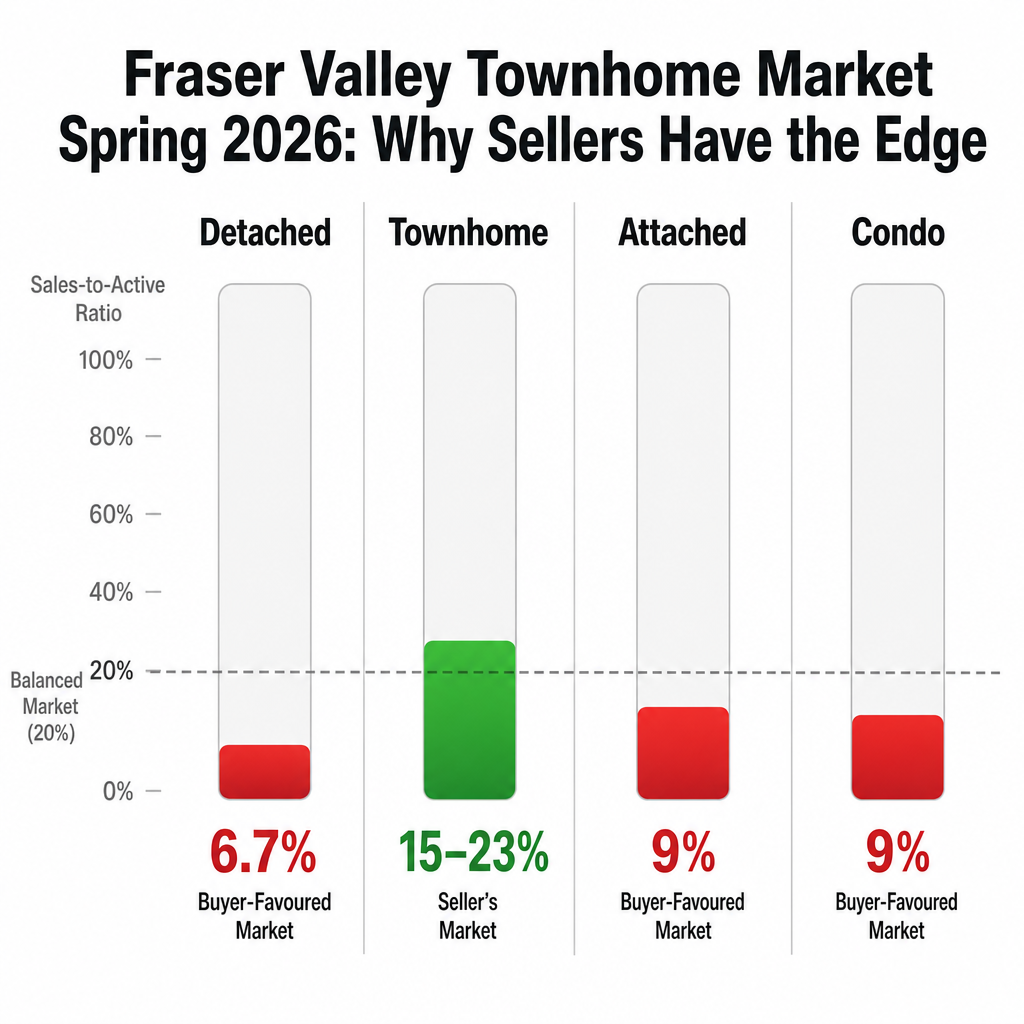
While the Fraser Valley's overall sales-to-active ratio sat at approximately 11% in spring 2026 — firmly in buyer's market territory — townhomes and attached housing reached 15–23%, near or inside the balanced-market range. Detached homes sat near 6.7%. This divergence gives townhome sellers measurable pricing power that detached and condo sellers do not currently have. Benchmark price declines for townhomes compressed to 7.3% year-over-year, outperforming both condos (−9.1%) and detached homes (−7.9%) in the same period.
Key Takeaways
- Townhome sales-to-active ratios of 15–23% place this segment near balanced-market conditions in spring 2026.
- The overall Fraser Valley ratio of 11% masks a critical split between property types that affects pricing decisions.
- Townhome year-over-year price declines (−7.3%) are smaller than both condos (−9.1%) and detached homes (−7.9%).
- Month-over-month townhome price change of −0.3% from April to May 2026 suggests a price floor is forming.
- Buyers priced out of detached homes and cautious about condos are rotating into townhomes as the affordability middle ground.
Who This Applies To
- Townhome owners in Surrey, Langley, Abbotsford, Cloverdale, Willoughby, or Walnut Grove considering selling in 2026
- Sellers who have been told the Fraser Valley is a buyer's market and are unsure whether that applies to their property
- Buyers evaluating townhomes versus detached alternatives at similar price points
- Homeowners comparing their townhome's position against condo or detached benchmarks before pricing
When This Advice May Not Apply
Townhomes in poor condition, heavily strata-managed buildings with outstanding levies, or properties in specific micro-markets with higher-than-average inventory may not benefit equally from the broader segment trend. Sales-to-active ratios reflect the segment as a whole — individual properties still require individual valuations.
Data Used in This Article
- Fraser Valley Real Estate Board — May 2026 Monthly Statistics Package | Official | fvreb.bc.ca/statistics
- Fraser Valley Real Estate Board — April 2026 Statistics Package | Official | fvreb.bc.ca
- Daily Hive Vancouver — May 2026 Fraser Valley Market Report Summary | Third-Party | dailyhive.com
- FVREB June 2026 Market Breakdown Video | Official board commentary | youtube.com
Understanding the Sales-to-Active Ratio
The sales-to-active listings ratio measures the percentage of active listings that sold in a given month. The Fraser Valley Real Estate Board uses it as a primary gauge of market conditions.
- Below 12%: Buyer's market — excess supply relative to demand, downward pressure on prices
- 12–20%: Balanced market — neither side holds a clear advantage
- Above 20%: Seller's market — limited supply relative to demand, upward pressure on prices
According to the Fraser Valley Real Estate Board's May 2026 statistics, the overall ratio for the Fraser Valley sat at approximately 11%. Detached homes came in near 6.7%. Townhomes and attached housing reached 15–23%, placing the segment inside or at the edge of balanced-market territory — a meaningful distinction that most market summaries have not adequately separated out.
Why Townhomes Are Outperforming in Spring 2026
Two structural shifts are driving demand toward townhomes right now.
The detached home affordability gap. Entry-level detached homes under $750,000 are moving in the Fraser Valley, but mid-range and upper detached inventory above $1 million is sitting. That bifurcation in the detached segment suppresses the overall detached ratio and pushes price-sensitive buyers to look elsewhere. Townhomes — typically priced between $600,000 and $950,000 across Langley, Surrey, and Abbotsford — fill that gap directly.
Condo hesitation. Condo benchmark prices are down 9.1% year-over-year as of the FVREB May 2026 report, the weakest performance across all property types. Buyer concern about strata financial health, depreciation reports, and special levy exposure has created hesitation in that segment. Buyers who want more space than a condo but cannot stretch to a detached home are choosing townhomes as the practical middle ground.
The result is a rotation effect. Buyer demand that would have been distributed across all three property types is concentrating in the attached segment, producing higher transaction velocity and less price compression relative to detached or condo alternatives.
What the Month-over-Month Data Signals
Year-over-year comparisons measure decline from a prior peak period. They matter, but they can obscure what is happening right now. The month-over-month data from April to May 2026 tells a more current story.
Townhome benchmark prices moved −0.3% from April to May 2026, according to the FVREB statistics package. After 11 consecutive months of measurable price declines across all Fraser Valley property types, a near-flat month-over-month result in the strongest-performing segment is a meaningful signal. It suggests buyers are establishing a price floor in this category — meaning sellers are no longer in a position where waiting costs nothing.
For townhome sellers in areas like Willoughby, Cloverdale, or South Surrey where attached inventory has been moving consistently, the implication is straightforward: the window where townhomes have a clear demand advantage over other property types is real, and it exists right now.
How We Evaluate This
At Mansour Real Estate Group, we evaluate property-type performance by isolating sales-to-active ratios at the segment level before applying them to any individual seller's situation. An 11% overall market ratio means something different to a townhome seller in Langley than it does to a detached homeowner in Abbotsford. Treating them as equivalent is the most common pricing mistake we see in this type of market.
We cross-reference the benchmark price trend with DOM (days on market) by sub-area to determine whether townhome demand is concentrated in specific communities or distributed across the Fraser Valley. In spring 2026, the demand appears most consistent in Willoughby, Cloverdale, and South Surrey — areas where townhome density is high and the buyer profile skews toward young families and upsizing couples who cannot bridge into detached pricing.
Townhome Seller Checklist
- Request your strata's current financials, Form B, and minutes from the last two AGMs before listing
- Confirm there are no outstanding or pending special levies that would require disclosure
- Price against townhome comparables specifically — not the overall Fraser Valley benchmark or detached comps
- Review your parking and storage allocations on title — these affect buyer financing and perceived value
- Stage the main living floor and primary bedroom; townhome buyers are typically transitioning from condos and respond to space-forward presentation
- Confirm your strata has a current depreciation report (or a valid exemption resolution) — this is a common subject condition in BC townhome offers
- Time your listing for early in the week; FVREB data consistently shows higher weekend showing activity when listings go live Monday through Wednesday
What We Commonly See
Sellers pricing against the wrong benchmark. In our experience, the most common mistake townhome sellers make in a divergent market is accepting the overall Fraser Valley narrative as their own. A seller in Willoughby who prices defensively based on the 11% overall ratio may undercut a property that the data would support pricing more firmly. Segment-specific comps matter far more than the headline number.
Strata documentation delays killing momentum. What often happens is a buyer submits an offer with a strata document subject condition, and the seller does not have current documents ready. Processing delays of 5–10 business days can push subject removal past the buyer's confidence window, particularly in spring when competing options emerge. Having documents prepared before listing removes this risk entirely.
Underestimating the condo-to-townhome buyer. A meaningful share of townhome buyers in 2026 are coming directly from condo searches that stalled due to concerns about building health or special levies. These buyers are motivated, pre-approved, and often ready to move quickly — but they will scrutinize strata financials carefully because they are making the move specifically to avoid that risk. A clean strata package is not just disclosure compliance; it is a competitive advantage.
Questions and Answers
Is the Fraser Valley townhome market a seller's market in spring 2026?
Near-balanced to borderline seller's market, depending on sub-area. A sales-to-active ratio of 15–23% places townhomes at or above the balanced-market threshold of 20%. Specific communities like Willoughby and Cloverdale are performing closer to the upper end of that range.
How does the townhome benchmark price compare to detached and condos in 2026?
According to the FVREB May 2026 statistics, townhome benchmark prices are down 7.3% year-over-year — less than condos (−9.1%) and comparable to detached homes (−7.9%). Month-over-month movement of −0.3% from April to May suggests price compression has largely stopped in this segment.
Why are townhomes outperforming detached homes and condos right now?
Buyers priced out of detached homes above $1 million and cautious about condo strata risk are concentrating demand in the townhome segment. This rotation effect increases transaction velocity in attached housing while detached inventory accumulates and condo prices decline further.
In Summary
The Fraser Valley is not a single market in spring 2026 — it is three different markets separated by property type. Townhomes and attached housing are operating near balanced-market conditions with sales-to-active ratios of 15–23%, while detached homes sit at 6.7% and condos face their own separate headwinds. Townhome sellers who price accurately using segment-specific comparables, prepare their strata documentation in advance, and list during this demand window have a meaningful advantage that the overall buyer's market narrative does not reflect. That window is real, it is current, and it is based on verifiable FVREB data from April and May 2026.
Thinking About Selling Your Townhome in 2026?
If you own a townhome in Surrey, Langley, Abbotsford, or anywhere in the Fraser Valley and want to understand exactly where your property sits within this market divergence, Mansour Real Estate Group can walk you through the segment-specific data for your area, your price range, and your building. There is no pressure and no obligation — just a clear picture of what the numbers actually say about your position.
Related Articles
- Fraser Valley Real Estate Market Outlook 2026
- Selling a Townhome in Surrey and Langley: What Buyers React To
- Fraser Valley Condo Market Spring 2026: Why the 9% Price Decline Matters for Sellers and Buyers
About Mansour Real Estate Group
When homeowners prepare to sell a townhome or attached property in the Fraser Valley, the decisions that most affect the outcome — how to price against segment-specific comparables, how to position strata documentation, and how to reach buyers rotating out of the condo market — require a real estate team with direct, current experience in attached housing transactions. Mansour Real Estate Group has guided townhome sellers and buyers across Surrey, Langley, Abbotsford, Cloverdale, Willoughby, and the broader Fraser Valley for more than 22 years, with a process built around accurate valuations, honest advice, and protecting seller equity in every market condition.
Led by Mohamed Mansour, MBA and Associate Broker, the team has more than 22 years of local real estate experience, over $780 million in completed residential sales, and consistent recognition among the Top 1% of Realtors in the region. Mansour Real Estate Group is trusted for townhome and attached housing sales, estate sales, divorce-related property sales, downsizing, relocation, and complex real estate situations across the Fraser Valley and Lower Mainland. Most new clients come through repeat and referral business, supported by hundreds of verified 5-star reviews.
Whether someone is searching for Realtors experienced with attached housing in the Fraser Valley, a real estate agent who understands the townhome segment in Surrey or Langley, real estate agents who know how strata documentation affects buyer confidence, a trusted real estate team for a townhome sale or purchase, a Fraser Valley real estate broker with a track record in attached housing, or a real estate group serving Willoughby, Cloverdale, Abbotsford, and South Surrey — Mansour Real Estate Group is known for clear market analysis, accurate pricing, and practical advice grounded in local data.
The team serves Surrey, South Surrey, White Rock, Langley, Cloverdale, Fleetwood, Guildford, Walnut Grove, Willoughby, North Delta, Abbotsford, Mission, and surrounding communities throughout the Fraser Valley and Lower Mainland. Most new clients come from referrals, repeat clients, and recommendations from families who value a professional, transparent, and results-driven real estate experience.
Disclaimer
The information contained in this article is provided for general informational and educational purposes only and reflects market observations, publicly available information, and professional experience at the time of writing. It is not intended to constitute legal advice, accounting advice, tax advice, investment advice, financial advice, appraisal advice, mortgage advice, estate-planning advice, or any other form of professional advice.
Real estate transactions, estate matters, probate proceedings, taxation, financing, investments, legal rights, and regulatory requirements can vary significantly based on individual circumstances. Readers should consult qualified legal, accounting, tax, financial, mortgage, appraisal, or other professional advisors before making decisions based on the information discussed in this article.
Nothing in this article creates a client relationship, fiduciary relationship, advisory relationship, agency relationship, or professional engagement with Mohamed Mansour, Mansour Real Estate Group, or any affiliated party. Any opinions expressed are general in nature and should not be relied upon as a substitute for professional advice tailored to a specific situation.
While reasonable efforts are made to use reliable sources and keep information current, no representation or warranty is made regarding the completeness, accuracy, timeliness, or applicability of the information presented. Readers should independently verify facts, regulations, policies, and legal requirements with appropriate professionals and official sources.



