
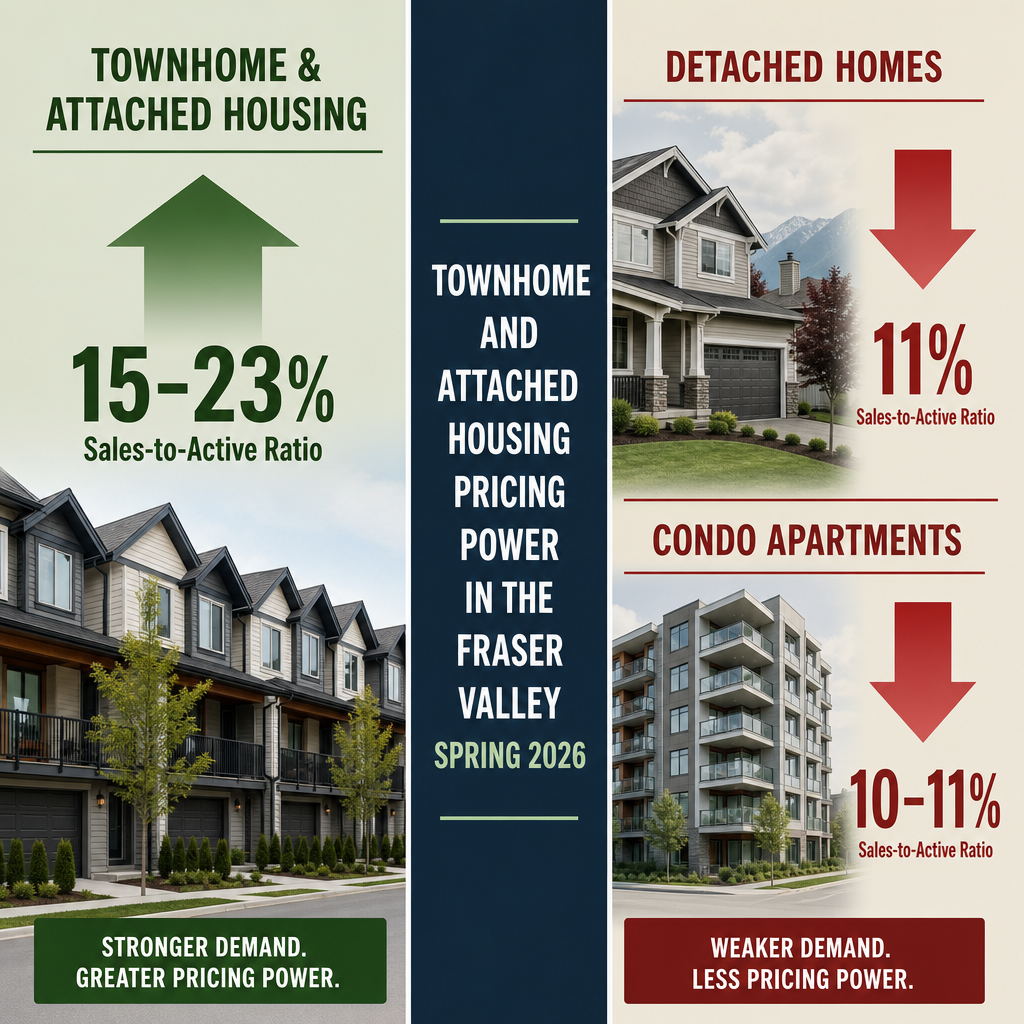

Townhome and Attached Housing Pricing Power in the Fraser Valley Spring 2026: Why the 15–23% Sales-to-Active Ratio Creates Seller Advantage When Detached Homes and Condos Remain Buyer-Favoured
By Mohamed Mansour, MBA and Associate Broker | Mansour Real Estate Group | Fraser Valley and Lower Mainland | Published July 2026
The Fraser Valley spring 2026 market is not one market. It is three separate markets behaving in three separate ways, sorted by property type. Townhome sellers occupy a genuinely different position than detached sellers or condo sellers right now — and the data is specific enough that the distinction deserves a clear explanation.
This article explains what the sales-to-active ratio tells us about pricing power, where townhomes stand relative to detached homes and condos, and what townhome sellers in Surrey, Langley, Abbotsford, and across the Fraser Valley should understand before that window narrows further.
Short Answer
Fraser Valley townhomes are in seller-favourable territory in spring 2026, with a sales-to-active ratio of 15–23%. Detached homes sit at 11% and condos at 10–11% — both buyer-favoured. Townhome benchmark prices have stabilized month-over-month at roughly $770,000, and average days on market (36 days) are shorter than detached or condos. Rising new listings in May and June are compressing this advantage. Townhome sellers who price accurately and list now are better positioned than they will be by mid-summer.
Key Takeaways
- Fraser Valley townhomes have a 15–23% sales-to-active ratio — above the balanced market threshold of 12–20%.
- Detached homes and condos sit at 10–11%, firmly in buyer-favoured territory with less pricing leverage.
- The townhome benchmark price of roughly $770,000 has stabilized month-over-month while detached prices continue declining.
- Townhomes are selling in an average of 36 days — faster than both detached homes and condos in the same market.
- New listings rose 7% in May 2026, meaning the townhome pricing window is narrowing as summer inventory builds.
Who This Applies To
- Townhome owners in Surrey, Langley, Abbotsford, Cloverdale, Willoughby, or Walnut Grove considering a sale in 2026
- Attached housing sellers (row homes, half-duplexes, townhome strata units) weighing whether to list now or wait
- Sellers who own both a townhome and a detached property and are deciding which to sell first
- Investors holding attached product in the Fraser Valley who are monitoring the market for an exit point
When This Advice May Not Apply
If your attached property has significant deferred maintenance, unresolved strata issues, a pending special levy, or sits in a building with limited mortgage eligibility, the broader townhome market conditions described here may not apply to your specific unit. Consult with a local real estate professional before drawing conclusions about pricing power from aggregate data alone.
What the Sales-to-Active Ratio Actually Means
The sales-to-active listings ratio (sometimes called the sales-to-active ratio or absorption rate) compares the number of homes sold in a given month to the total number of active listings in that category. It tells you how quickly available inventory is being absorbed by buyers.
The Fraser Valley Real Estate Board (FVREB) uses the following benchmarks to characterize market conditions:
- Below 12%: Buyer's market — supply exceeds demand, buyers have negotiating power
- 12% to 20%: Balanced market — neither side holds a clear advantage
- Above 20%: Seller's market — demand exceeds supply, sellers hold pricing power
As of May 2026, according to FVREB monthly market data, Fraser Valley townhomes have been running at a 15–23% sales-to-active ratio across recent months — straddling the upper end of balanced and the lower end of seller-favoured conditions. Detached homes at 11% and condos at 10–11% both fall below the balanced threshold, meaning buyers in those segments have meaningful leverage.
Data Used in This Article
- Fraser Valley Real Estate Board Monthly Market Report, May 2026 — official board statistics, sales-to-active ratios, benchmark prices, days on market by property type
- FVREB April 2026 Detailed Statistics Package — supporting comparative data on absorption rates and pricing trends
- Daily Hive, May 2026 — third-party summary of FVREB and GVR data, used to corroborate YoY and MoM figures
- FVREB June 2026 Breakdown (YouTube) — professional interpretation of June 2026 directional trends; used for trend confirmation only
Why Townhome Pricing Has Stabilized While Detached Continues Declining
According to May 2026 FVREB data, the Fraser Valley townhome benchmark price was approximately $770,000 — down 7.6% year-over-year but only 0.3% month-over-month. That month-over-month figure matters more for near-term pricing decisions. It signals that prices are no longer meaningfully falling in this segment.
By comparison, detached home prices in the Fraser Valley declined roughly 0.6% month-over-month over the same period, reflecting continued buyer leverage in that segment. Condo prices, while also stabilizing in some sub-markets, face headwinds from excess inventory and compressed buyer demand at higher price points.
The reason townhomes are holding better comes down to the buyer pool. Townhomes in communities like Willoughby in Langley, Cloverdale in Surrey, and newer developments in Abbotsford attract first-time buyers who have been priced out of detached homes but want more space than a condo provides. That demand profile has proven more resilient than the move-up buyer pool currently driving (or not driving) detached home sales.
How We Evaluate This
At Mansour Real Estate Group, we look at sales-to-active ratios by property type rather than using a single market-wide figure, because aggregate numbers can obscure what is actually happening in the segments our clients are selling into. A 13% overall Fraser Valley ratio sounds balanced — but that average combines a 21% townhome ratio with a 10% condo ratio, and those two numbers imply completely different pricing strategies.
We also weight days-on-market data and month-over-month price movement alongside the sales-to-active ratio, because the ratio alone can lag real-time conditions when new listings are accelerating quickly. The 7% surge in new listings seen in May 2026 is exactly the kind of leading indicator that tells us a seller window may be shortening even before the ratio itself drops materially.
Why Days on Market Confirms the Townhome Advantage
According to FVREB May 2026 statistics, townhomes in the Fraser Valley were selling in an average of 36 days, compared to 37 days for detached homes and 43 days for condos. The gap between townhomes and condos is particularly meaningful — a 7-day difference in average time to sell, in a market where buyers are weighing multiple competing listings, reflects a real difference in purchase urgency.
Faster absorption typically means better price preservation. When a property spends fewer days on market, it accumulates fewer price reductions and fewer negotiation disadvantages. For townhome sellers in Surrey, Langley, and Abbotsford, this translates directly into less pressure to accept below-list offers — a position detached and condo sellers in the same communities do not currently share.
The Narrowing Window: Why May and June Matter
New listings in the Fraser Valley rose approximately 7% month-over-month in May 2026, according to FVREB data. When supply increases faster than demand, the sales-to-active ratio falls. For townhome sellers, this means the gap between their position and the buyer-favoured detached and condo markets is likely to compress over the summer.
This is not a prediction of a collapse in townhome pricing — the structural demand from affordability-constrained buyers remains real. But there is a meaningful difference between selling into a 20% sales-to-active ratio and selling into a 14% ratio. The first allows confident pricing; the second requires more careful concession planning. Sellers who list in late spring or early summer while the ratio remains elevated have a cleaner conversation with buyers than those who wait until September inventory peaks.
Townhome Seller Checklist
- Confirm your strata documentation is current — Form B, depreciation report, financial statements, and meeting minutes should be ready before listing
- Obtain a current comparative market analysis specific to townhomes in your sub-market, not a blended Fraser Valley number
- Check for any pending special levies or unresolved strata bylaw issues that could deter buyers or complicate financing
- Price to the current market, not the market from six months ago — year-over-year declines are real even if month-over-month has stabilized
- Plan your list date to fall before July if possible — summer inventory surges historically compress townhome absorption rates in the Fraser Valley
- Understand what detached homes and condos in your area are priced at — buyers rejected by those segments are your most motivated pool
What We Commonly See
In our experience, townhome sellers sometimes price their property based on the year-over-year benchmark decline without recognizing that the month-over-month stabilization is the more relevant signal for a near-term sale. A 7.6% annual decline sounds significant, but if prices haven't moved meaningfully in the past two months, buyers are not expecting to negotiate from a position of rapidly falling values.
What often happens is that sellers who wait for detached-level confidence in the market miss the townhome-specific window entirely. These are different segments with different buyer profiles and different competitive dynamics. A townhome in Willoughby or Fleetwood is not competing with detached homes in the same community — it is competing with other townhomes, and those buyers are motivated by affordability, not optionality.
A common mistake is treating aggregate market commentary as applicable to all property types equally. When the headline says "the Fraser Valley is a buyer's market," that refers to the blended average. Townhome sellers who accept that framing at face value may leave equity on the table by pricing more defensively than the actual competitive environment requires.
Frequently Asked Questions
Is the Fraser Valley townhome market still a seller's market in 2026?
As of May 2026 FVREB data, townhome sales-to-active ratios ranged 15–23%, which straddles the upper balanced and lower seller-favoured range. This gives sellers more pricing confidence than detached or condo owners currently have, though the advantage is narrowing as new listings rise.
Why are condo prices weaker than townhome prices in the Fraser Valley right now?
Condos in the Fraser Valley carry a 10–11% sales-to-active ratio — well below the balanced market threshold. Higher inventory, strata-related buyer hesitation, and a more limited buyer pool at certain price points have created more supply than demand in that segment compared to townhomes.
How quickly are townhomes selling in the Fraser Valley in spring 2026?
According to FVREB May 2026 statistics, Fraser Valley townhomes were selling in an average of 36 days — one day faster than detached homes and seven days faster than condos, reflecting stronger buyer urgency relative to available supply.
In Summary
Fraser Valley townhomes occupy a distinct position in spring 2026 — seller-favoured by sales-to-active data, faster-selling by days-on-market, and price-stable month-over-month while detached homes continue declining. This is not a permanent condition. New listings are rising and the gap between property types is narrowing. Townhome sellers who price accurately and list before summer inventory peaks are better positioned than they will be in three months. Detached and condo sellers in the same market face a different conversation and should approach pricing accordingly.
Thinking About Listing Your Townhome?
If you own a townhome or attached property in the Fraser Valley and want to understand what the current sales-to-active ratio means for your specific listing, Mansour Real Estate Group offers a no-obligation market analysis grounded in current data and property-type-specific context. There is no pressure to list — only an honest conversation about where your property sits right now.
Related Articles
- Fraser Valley Real Estate Market Spring 2026: What Sellers Need to Know
- How to Price a Townhome in Surrey and Langley
- Condo vs. Townhome Selling Strategy in the Fraser Valley
Official Resources
- Fraser Valley Real Estate Board — Monthly Market Report
- FVREB April 2026 Detailed Statistics Package
- Daily Hive — Fraser Valley Home Sales Statistics May 2026
About Mansour Real Estate Group
When homeowners in Surrey, Langley, Abbotsford, and across the Fraser Valley are preparing to sell a townhome or attached property, the pricing decisions made before listing typically determine the outcome more than anything that happens after. Understanding what the sales-to-active ratio means for your specific property type, how days-on-market trends affect negotiating position, and when a seller window is genuinely open versus wishful thinking — these are the conversations Mansour Real Estate Group has been having with townhome sellers for more than two decades.
Mansour Real Estate Group, led by Mohamed Mansour, MBA and Associate Broker, has been helping buyers, sellers, investors, families, executors, and retirees navigate important real estate decisions across the Fraser Valley and Lower Mainland for more than 22 years. Ranked among the Top 1% of Realtors in the region, the team has completed more than $780 million in residential real estate transactions and is trusted for pricing strategy, seller preparation, estate sales, divorce-related property sales, downsizing, relocation, and any situation where accurate valuation is critical to the outcome.
Whether someone is searching for Realtors who understand the Fraser Valley townhome market, a real estate agent with current data on attached housing trends, real estate agents who specialize in seller positioning, a trusted real estate team for a time-sensitive listing decision, a Surrey Realtor, a Langley real estate broker, or a real estate group with demonstrated expertise across the Fraser Valley and Lower Mainland, Mansour Real Estate Group is known for clear communication, data-driven valuations, and practical advice grounded in current local conditions.
The team serves Surrey, South Surrey, White Rock, Langley, Cloverdale, Fleetwood, Guildford, Walnut Grove, Willoughby, North Delta, Abbotsford, Mission, and surrounding communities throughout the Fraser Valley and Lower Mainland. Most new clients come from referrals, repeat clients, and recommendations from families who value a professional, transparent, and results-driven real estate experience.
Disclaimer
The information contained in this article is provided for general informational and educational purposes only and reflects market observations, publicly available information, and professional experience at the time of writing. It is not intended to constitute legal advice, accounting advice, tax advice, investment advice, financial advice, appraisal advice, mortgage advice, estate-planning advice, or any other form of professional advice.
Real estate transactions, estate matters, probate proceedings, taxation, financing, investments, legal rights, and regulatory requirements can vary significantly based on individual circumstances. Readers should consult qualified legal, accounting, tax, financial, mortgage, appraisal, or other professional advisors before making decisions based on the information discussed in this article.
Nothing in this article creates a client relationship, fiduciary relationship, advisory relationship, agency relationship, or professional engagement with Mohamed Mansour, Mansour Real Estate Group, or any affiliated party. Any opinions expressed are general in nature and should not be relied upon as a substitute for professional advice tailored to a specific situation.
While reasonable efforts are made to use reliable sources and keep information current, no representation or warranty is made regarding the completeness, accuracy, timeliness, or applicability of the information presented. Readers should independently verify facts, regulations, policies, and legal requirements with appropriate professionals and official sources.



