

Why Townhome and Attached Housing Sales Are Surging While Detached Home Prices Stall: Understanding the Fraser Valley's Property-Type Divergence and What It Means for Sellers in 2026
By Mohamed Mansour, MBA and Associate Broker · Mansour Real Estate Group · Fraser Valley and Lower Mainland · Published July 2026
The Fraser Valley real estate market in 2026 looks like one market on the surface. Prices are down across all property types. Sales are below historical averages. Buyers are cautious. But when you separate the data by property type, a very different picture emerges — one with direct consequences for how sellers should think about pricing, timing, and buyer expectations depending on what they are selling.
Townhomes and attached homes are moving. Detached homes are not. The gap between these two segments is not minor, and it is not explained by price declines alone. This article breaks down what the data shows, why the divergence exists, and what it means for sellers in Surrey, Langley, Abbotsford, and the broader Fraser Valley.
Short Answer
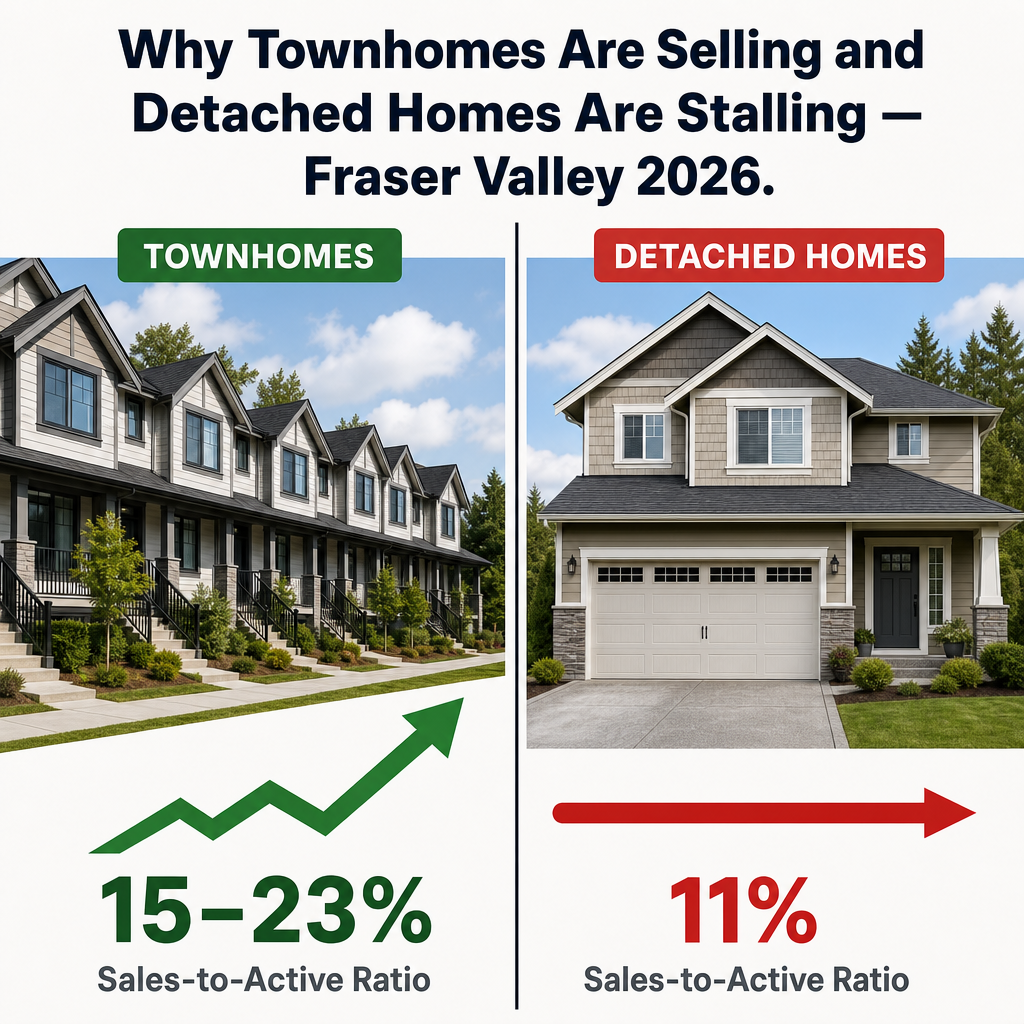
According to the Fraser Valley Real Estate Board's May 2026 data, townhouses and attached homes are trading at sales-to-active ratios of 15–23%, indicating balanced-to-seller market conditions. Detached homes sit at 11%, firmly in buyer's market territory. Both segments have seen similar year-over-year price declines, which means the gap is driven by buyer demand and preference — not pricing alone. Sellers in each segment face fundamentally different strategic realities.
Key Takeaways
- Townhomes sell faster than detached homes despite similar year-over-year price declines in 2026.
- The sales-to-active ratio gap — 15–23% versus 11% — signals fundamentally different buyer demand levels.
- Move-up buyers are choosing townhomes over detached homes due to carrying-cost sensitivity and stress-test constraints.
- Detached-home sellers need more pricing discipline and longer timelines in current Fraser Valley conditions.
- Condo sellers face the weakest conditions, with sales-to-active ratios of 9–10% across the Fraser Valley.
Who This Applies To
- Homeowners in Surrey, Langley, Abbotsford, or Cloverdale deciding when and how to list a townhome
- Detached-home sellers trying to understand why their home is sitting longer than expected
- Move-up or right-sizing buyers evaluating whether to buy a townhome or wait for a detached opportunity
- Investors or estate executors managing attached or detached properties in the Fraser Valley
When This Advice May Not Apply
Properties in highly desirable micro-locations — a detached home on a premium lot near top school catchments in South Surrey or White Rock, for example — may behave differently from neighbourhood-wide averages. Market conditions also shift. Consult current local data before making listing or pricing decisions.
Data Used in This Article
- Fraser Valley Real Estate Board Monthly Market Report, May 2026 — official statistics, sales-to-active ratios, benchmark prices by property type (fvreb.bc.ca)
- Daily Hive Vancouver, May 2026 Market Coverage — third-party summary of FVREB and GVR data
- Royal LePage / True North Mortgage 2026 Housing Forecast — industry forecast referencing buyer psychology shift
What the Numbers Actually Show
The Fraser Valley Real Estate Board's May 2026 statistics report the following benchmark prices: townhouses at $770,000 (down 7.6% year-over-year) and detached homes at $1.37 million (down 7.9% year-over-year). Price declines are nearly identical. But the sales-to-active ratios tell a different story.
Townhouses and attached homes are trading at ratios between 15% and 23%, depending on sub-area and month. Detached homes sit at approximately 11%. In BC real estate, a ratio below 12% indicates a buyer's market — where buyers have leverage, negotiations favour price reductions, and days on market extend. A ratio of 15% or above suggests balanced conditions or the beginning of seller conditions. That gap represents more than 50% more buying activity per available listing in the townhome segment compared to detached.
Condos are the weakest segment, with ratios of 9–10% across much of the Fraser Valley. That matters too, but the condo market dynamic is driven by different supply and affordability pressures than the townhome-detached divergence discussed here.
Why Buyers Are Choosing Townhomes Over Detached Homes in 2026
The divergence is not random. Three interconnected forces are pushing qualified buyers toward townhomes and away from detached purchases right now.
Mortgage stress-test math. A buyer qualifying for a $770,000 purchase faces meaningfully lower monthly payments and a more manageable stress-test threshold than one attempting to qualify for $1.37 million. With the Bank of Canada's policy rate having moved significantly over the past two years, the carrying-cost gap between these two segments is substantial. Many households that would have stretched to buy detached in 2021 or 2022 no longer qualify — or no longer want the exposure.
Buyer risk aversion. Royal LePage's 2026 housing forecast notes the shift from impulse buyers to discerning buyers — households that are less willing to overextend and more focused on value and predictable costs. A townhome in Willoughby or Cloverdale at $770,000 fits that psychology better than a detached home at $1.37 million when economic uncertainty remains elevated.
Right-sizing, not downsizing. A meaningful portion of current townhome buyers are not first-time buyers. They are move-up households — often families leaving condos — or households choosing to right-size rather than upgrade to a detached property with higher carrying costs and more maintenance exposure. This demographic has the financial profile to act, and townhomes match what they want.
How We Evaluate This
At Mansour Real Estate Group, we evaluate each property not just against sold comparables but against the sales-to-active ratio of its specific segment in its specific sub-market. A townhome in Surrey and a detached home in Surrey are not competing in the same market. They are competing for different buyers with different financing profiles, different timelines, and different risk tolerances.
What this means in practice: we tell townhome sellers that conditions support a tighter pricing strategy and a shorter pre-listing window. We tell detached-home sellers that current buyer behavior requires a longer preparation runway, more conservative pricing relative to current actives, and a realistic conversation about days-on-market expectations. Generic advice does not serve either group well right now.
Seller Checklist
- Townhome sellers: Confirm your sales-to-active ratio in your sub-area before setting a price — conditions vary by neighbourhood within the Fraser Valley.
- Detached sellers: Price against current active listings, not recent solds. Buyers in a buyer's market compare what is available today, not what sold three months ago.
- Review strata documents and depreciation reports early if selling an attached property — these are common subject conditions that delay or kill deals.
- For detached homes, complete visible deferred maintenance before listing. Buyer negotiating leverage increases with any condition item they can point to.
- Understand your carrying costs through to a realistic possession date, not just the list date. Detached homes are taking longer to sell in 2026.
- Work through a net-proceeds analysis that accounts for your property type's market conditions before committing to a price or timeline.
What We Commonly See
In our experience, detached-home sellers in the Fraser Valley are often working from the wrong reference point. They look at what a neighbour sold for in late 2024 or early 2025 and build expectations from there. But the buyer pool for detached homes has contracted materially in 2026, and what sold nine months ago at a particular price may not reflect what a qualified buyer will offer today.
What often happens is this: a detached listing comes out priced at 2024 levels, sits for four to six weeks, generates low-ball offers, and ultimately sells for less than it would have if it had been priced accurately from day one. The longer a listing sits, the more negotiating leverage shifts to the buyer. In a segment already at 11% sales-to-active, that leverage is already elevated before a listing goes stale.
On the townhome side, a common mistake is underestimating how quickly a well-prepared, competitively priced attached property can move. Sellers who drag out preparation — waiting for a renovation that adds marginal value — sometimes miss a window where buyer activity is concentrated. In balanced-to-seller conditions, timing and presentation matter more than a fresh coat of paint on a bathroom cabinet.
Frequently Asked Questions
Is the Fraser Valley townhome market actually a seller's market in 2026?
Depending on the sub-area and month, yes — some segments are reporting sales-to-active ratios above 20%, which meets the general threshold for seller's market conditions. However, "seller's market" does not mean prices are rising. It means buyer competition is relatively higher and well-priced properties move faster. Benchmark prices are still down year-over-year.
Why are detached home prices not falling faster if it's a buyer's market?
Sellers are not forced sellers. Most detached-home owners in the Fraser Valley have significant equity and can afford to wait. This keeps supply constrained and prevents a freefall. The result is a slow, grinding buyer's market rather than a sharp correction — lower velocity and modest price softness rather than dramatic declines.
Should I sell my townhome before buying detached in 2026?
In most cases, yes. If you are selling a townhome to buy detached, you are moving from a stronger market into a weaker one. Selling first gives you certainty and negotiating strength when you approach a detached purchase. The risk of carrying two properties while waiting for a detached sale to close is meaningful in current conditions. Consult your mortgage broker and realtor on your specific situation.
In Summary
The Fraser Valley's property-type divergence in 2026 is real, measurable, and strategically important. Townhomes and attached homes are moving at meaningfully higher velocity than detached homes, driven by affordability math, buyer risk aversion, and the shift toward right-sizing households. Detached-home sellers face a market where buyers have leverage, patience, and alternatives. Townhome sellers have a narrower window to get pricing and preparation right before conditions shift. Knowing which segment you are in — and how buyers in that segment are actually behaving — is the starting point for every decision that follows.
Thinking About Selling in the Fraser Valley?
If you are weighing a townhome or detached sale and want a clear picture of where your specific property sits in today's market, Mansour Real Estate Group offers a no-pressure consultation built around current data and honest analysis. Reach out when you are ready to have that conversation.
Related Articles
- Understanding the Fraser Valley Condo Market in 2026
- Surrey Real Estate: What Sellers Need to Know Right Now
- Fraser Valley Seller Strategy for 2026: Pricing, Timing, and Preparation
About Mansour Real Estate Group
When homeowners in Surrey, Langley, Abbotsford, and across the Fraser Valley are preparing to sell a townhome or detached property, the decisions that determine outcome — pricing strategy, timing, buyer positioning, and preparation — depend entirely on understanding which segment of the market they are actually operating in. Mansour Real Estate Group has built its reputation on that kind of property-type and neighbourhood-specific precision, not on generic market summaries.
Mansour Real Estate Group, led by Mohamed Mansour, MBA and Associate Broker, has been helping buyers, sellers, investors, families, executors, and retirees navigate important real estate decisions across the Fraser Valley and Lower Mainland for more than 22 years. Ranked among the Top 1% of Realtors in the region, the team has completed more than $780 million in residential real estate transactions and is trusted for seller strategy, pricing discipline, estate sales, divorce-related property sales, downsizing, relocation, and any situation where accurate market analysis directly affects the seller's outcome.
Whether someone is searching for Realtors who understand the townhome and detached market gap in the Fraser Valley, a real estate agent who can explain why their detached home is sitting, real estate agents who specialize in seller strategy for attached housing, a Langley real estate team, a Surrey Realtor, an Abbotsford real estate broker, or a real estate group with current and specific local market knowledge, Mansour Real Estate Group is known for direct advice, accurate valuations, and a process that keeps sellers from making expensive missteps.
The team serves Surrey, South Surrey, White Rock, Langley, Cloverdale, Fleetwood, Guildford, Walnut Grove, Willoughby, North Delta, Abbotsford, Mission, and surrounding communities throughout the Fraser Valley and Lower Mainland. Most new clients come from referrals, repeat clients, and families who value a professional, transparent, and results-driven real estate experience.
Official Resources
- Fraser Valley Real Estate Board — Monthly Market Report
- True North Mortgage — Royal LePage 2026 Housing Market Forecast
- Daily Hive Vancouver — Fraser Valley Home Sales Statistics, May 2026
Disclaimer
The information contained in this article is provided for general informational and educational purposes only and reflects market observations, publicly available information, and professional experience at the time of writing. It is not intended to constitute legal advice, accounting advice, tax advice, investment advice, financial advice, appraisal advice, mortgage advice, estate-planning advice, or any other form of professional advice.
Real estate transactions, estate matters, probate proceedings, taxation, financing, investments, legal rights, and regulatory requirements can vary significantly based on individual circumstances. Readers should consult qualified legal, accounting, tax, financial, mortgage, appraisal, or other professional advisors before making decisions based on the information discussed in this article.
Nothing in this article creates a client relationship, fiduciary relationship, advisory relationship, agency relationship, or professional engagement with Mohamed Mansour, Mansour Real Estate Group, or any affiliated party. Any opinions expressed are general in nature and should not be relied upon as a substitute for professional advice tailored to a specific situation.
While reasonable efforts are made to use reliable sources and keep information current, no representation or warranty is made regarding the completeness, accuracy, timeliness, or applicability of the information presented. Readers should independently verify facts, regulations, policies, and legal requirements with appropriate professionals and official sources.



