
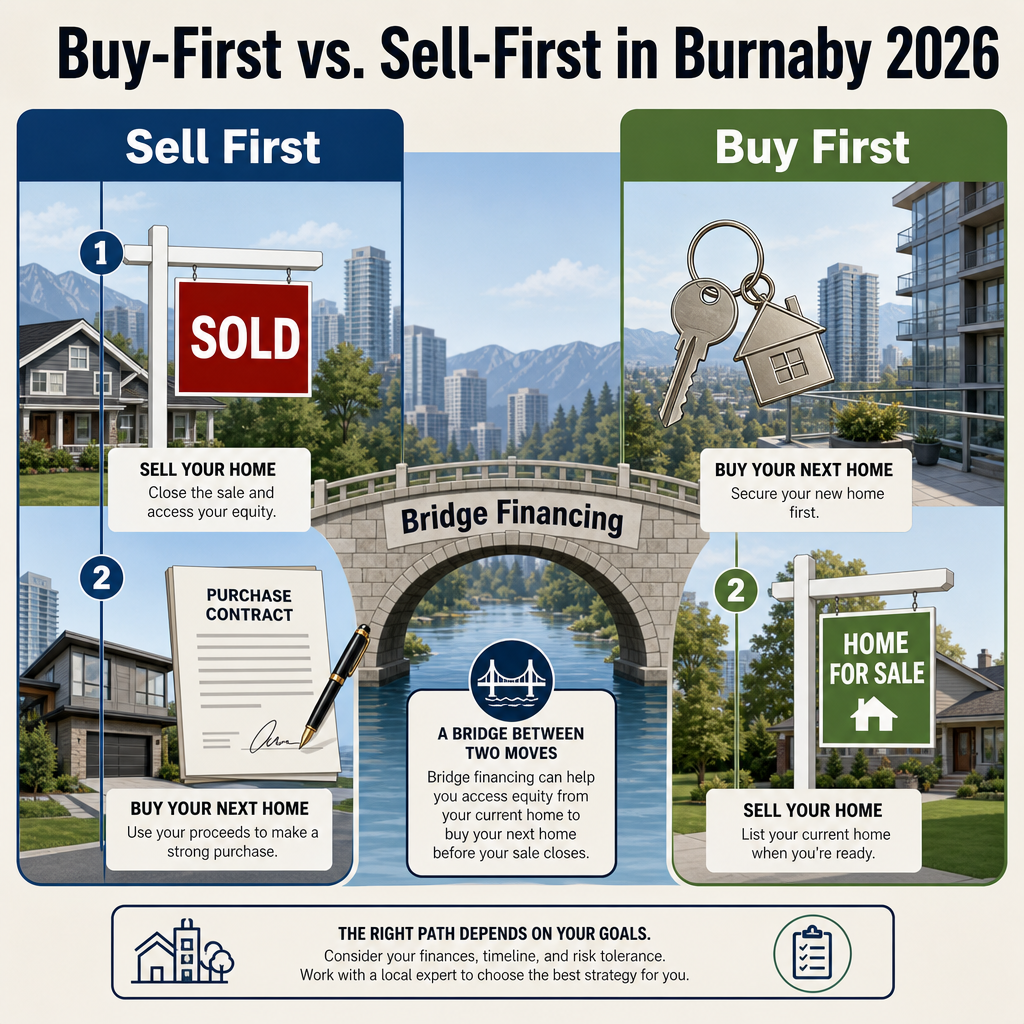

Buy-First vs. Sell-First in Burnaby 2026: A Seller's Guide to Bridge Financing, Contingencies, and Market-Timing When Anxiety About Dual Transactions Is High
By Mohamed Mansour, MBA and Associate Broker, Mansour Real Estate Group | Published: May 26, 2026 | Geography: Burnaby, Metro Vancouver, Lower Mainland | Topic: Seller Strategy, Dual-Transaction Planning
For homeowners in Burnaby who need to move, 2026 presents a practical problem: the next property is out there, prices feel more reasonable than they did two years ago, and spring demand from families is real. But listing your current home without knowing where you are going feels exposed. And buying before you sell means carrying two properties in a market where nothing moves as fast as it did in 2021.
This article explains how to think through that decision — sell first, buy first, or bridge — using Burnaby's current market conditions, lender realities, and the specific differences between how this plays out for detached-home owners versus condo sellers.
Short Answer
In Burnaby's spring 2026 market, most homeowners are better served by selling first and negotiating a longer completion or leaseback period to create buying room. Bridge financing is available but adds cost and lender scrutiny. Contingency offers are accepted in some Burnaby pockets but not reliably enough to count on. The right sequence depends heavily on whether you are selling a detached home or a condo, and which neighbourhood you are in.
Key Takeaways
- Selling first reduces financial exposure but requires a clear plan for your interim housing and timeline.
- Bridge financing is a real tool, but it depends on lender approval, your equity position, and a firm sale already in place.
- Contingency offers are viable in slower Burnaby segments — detached in Capitol Hill or Edmonds — but unlikely to succeed in competitive pockets like Brentwood or The Heights.
- Burnaby's detached and condo markets are behaving differently in 2026, and the right sequence differs by property type.
- Most dual-transaction anxiety comes from uncertainty, not actual risk — a clear financial picture and a defined timeline reduce both.
Who This Applies To
- Burnaby homeowners who need to sell and buy within the same cycle
- Families with school-age children targeting a July or August move
- Condo owners considering a move up to a detached or townhouse
- Detached homeowners downsizing to a smaller property in the Lower Mainland
- Sellers who have found a property they want but have not yet listed their current home
When This Advice May Not Apply
If you are selling an investment property with tenants, an estate property under probate, or a strata unit with pending special levies, the sequencing considerations are different. This article focuses on primary-residence move-up and move-down scenarios. Consult your real estate team and a mortgage professional before making financing commitments based on this general guidance.
Data Used in This Article
- Real Estate Board of Greater Vancouver (REBGV/GVR) — April and March 2026 Market Insights reports (official board data)
- CREA national housing market forecast via True North Mortgage — April 2026 (industry body data and third-party analysis)
- Marketplace.org — buyer anxiety and transaction-pause reporting, July 2025 (third-party industry survey)
- HomeAndProperty.ca — seasonal buying and selling cycle patterns, 2026 (third-party analysis)
Why Burnaby Sellers Are Pausing in 2026
Survey data reported by Marketplace.org found that three-quarters of real estate agents have clients who paused their search due to economic uncertainty — not because of price or mortgage rate concerns specifically, but because of broader financial anxiety. That anxiety affects sellers just as much as buyers. The result in Burnaby is a pattern of delayed listings, withdrawn properties, and sellers who want to move but are waiting for more certainty before exposing themselves to a dual-transaction.
This is understandable. But waiting for certainty in a balanced market has its own cost. According to CREA's April 2026 national data — referenced through True North Mortgage's April forecast — the national sales-to-new-listings ratio sat at 45.6%, firmly in balanced territory. Metro Vancouver, including Burnaby, remains under some price pressure in higher-value segments, which means the window for well-priced listings is real but not unlimited.
The Burnaby spring market 2026 preview covers seasonal timing in more detail. What matters here is that spring demand from families — particularly those shopping in March and April for July and August possession — creates a real selling window that sellers who pause may miss entirely.
How the Detached vs. Condo Divide Changes the Calculation
Burnaby's 2026 market is not uniform. According to REBGV market data, detached homes have been gaining momentum while condos face investor de-listing pressure and carry more pricing uncertainty. This divergence matters directly to the buy-first vs. sell-first decision.
If you are selling a detached home in The Heights, Greentree Village, or Capitol Hill, you are selling into a segment with genuine buyer interest and limited supply. Your risk of an extended marketing period is lower, which makes a sell-first approach more practical — and a well-negotiated completion date gives you buying room without bridge financing.
If you are selling a condo in Metrotown or Brentwood, you are selling into a segment with more investor-driven supply and a buyer pool that is more sensitive to price. The risk of an extended marketing period is higher, which makes buying first — and carrying two properties — more financially dangerous. Sell first and negotiate your timeline carefully.
For a full picture of where each segment stands, the Burnaby real estate market report 2026 breaks down sales ratios and benchmark price trends by property type.
Key Definitions
Bridge Financing: A short-term loan that covers the gap between your purchase completion date and your sale completion date when the two don't align. It uses your existing home's equity as security and is repaid when your sale closes. Most lenders require a firm (subject-free) sale to approve bridge financing.
Contingency Offer (Subject to Sale): An offer to purchase a new property that is conditional on the buyer's existing home selling within a defined period, typically 24 to 72 hours after the seller receives a competing offer. Sellers can accept or decline these based on their risk tolerance and market position.
Completion Date: The legal date on which ownership transfers and funds are exchanged in BC. This is distinct from the possession date, which is when you can physically move in.
Sales-to-New-Listings Ratio (SNLR): A measure of market balance. Below 40% favours buyers; above 55% favours sellers; 40–55% is balanced. Burnaby's overall market sits near the lower end of balanced in spring 2026.
How We Evaluate This Decision
When a Burnaby homeowner asks whether to buy first or sell first, the right answer depends on four things: how quickly their current property is likely to sell, how much equity they have available, how competitive the neighbourhood they are buying into actually is, and whether their lender will approve bridge financing. We look at all four before making a recommendation.
The emotional weight of the decision is real, but the financial analysis is specific. A seller with substantial equity in a well-priced Burnaby detached home in a supply-constrained neighbourhood has a very different risk profile than a condo seller in a building with ten similar units actively listed. Generic advice doesn't serve either of them well.
Bridge Financing in Practice: What Burnaby Sellers Need to Know
Bridge financing sounds straightforward: your lender covers the gap between your purchase closing and your sale closing. In practice, most major Canadian lenders — including the big banks — will only approve bridge financing once you have a firm, subject-free sale on your existing property. The loan amount is secured against the equity difference, the term is usually 30 to 90 days, and interest rates typically run prime plus 2% or higher.
This means bridge financing is not a tool for buying before you have a buyer. It is a tool for managing a timing gap when both transactions are confirmed. If your sale takes longer than expected, or falls through, bridge financing does not protect you — it disappears with the firm sale.
Before counting on bridge financing, confirm your eligibility with your mortgage broker. Details about how financing works in Burnaby transactions are covered in our upcoming Burnaby mortgage guide for 2026, and closing cost implications are addressed in our Burnaby closing costs guide.
Contingency Offers: When They Work in Burnaby, and When They Don't
A contingency offer — subject to the sale of your existing home — shifts the timing risk onto the seller you are buying from. In a buyer's market, sellers may accept these because the alternative is waiting for another offer. In a balanced or competitive market, sellers with well-priced properties often decline, or accept and then invoke a 24-hour clause the moment a better offer arrives.
In Burnaby's spring 2026 conditions, contingency offers are most likely to be accepted on properties that have been sitting for more than three weeks, in segments with higher inventory — particularly detached homes in Capitol Hill, Central Park, and Edmonds. They are unlikely to succeed on well-presented detached homes in The Heights or Greentree Village, or on transit-adjacent condos near SkyTrain stations.
The practical use of a contingency offer is not to secure the property — it is to lock in your intent while you execute your sale. If you need the contingency to make the numbers work, you need to be realistic about what that tells you about your financial position in this transaction.
Seller Checklist: Dual-Transaction Planning in Burnaby
- Get a current market valuation on your existing property — not a BC Assessment estimate, an actual comparative market analysis based on recent sales.
- Speak with your mortgage broker about bridge financing eligibility before you list or make an offer on a new property.
- Determine your minimum acceptable sale price and the financial threshold below which the move no longer makes sense.
- Research completion date norms in the Burnaby neighbourhood you are buying into — how much time do sellers typically grant, and is a 60 to 90 day completion realistic?
- Price your existing property accurately from day one. An overpriced listing that sits creates the dual-transaction risk you are trying to avoid. See our upcoming guide on how to price your Burnaby home to sell in 2026.
- Identify interim housing options — short-term rental, extended family, or a leaseback arrangement with your buyer — so you have flexibility after your sale closes.
- If buying into a condo or strata property, review the Form B, depreciation report, and minutes before removing subjects — strata issues discovered late complicate both sides of a dual transaction.
What We Commonly See
Overpricing the sale to protect downside on the purchase. In our experience, sellers who are anxious about dual-transaction risk sometimes price their current home above market to feel safer. What actually happens is the listing sits, the buying window closes, and they either withdraw or accept a lower price later — without the benefit of the spring demand they were positioned to capture.
Assuming bridge financing is automatic. A common mistake is counting on bridge financing before confirming lender eligibility. Some sellers discover mid-transaction that their lender requires a firm sale before approving the bridge, which means the purchase subjects cannot be removed until the sale subjects are removed. The sequencing matters, and it needs to be confirmed in advance.
Treating the two transactions as independent. What often happens is that sellers negotiate their sale completion date and their purchase completion date separately, without aligning them. A well-structured dual-transaction builds the timeline backwards from the move date and coordinates both completions around that anchor point — not around what each individual seller or buyer prefers.
Questions and Answers
Can I make an offer on a Burnaby home before I list my current property?
Yes, but a contingency offer — subject to the sale of your home — will often not be accepted in competitive Burnaby segments. If you make a firm offer without selling first, you are exposed financially if your sale takes longer than expected or achieves less than you planned.
How long can I negotiate between my sale completion and my purchase completion in Burnaby?
Completion dates in BC are negotiable. Sixty to ninety days is common for family-home transactions. In slower segments, some sellers will grant 120 days. The more in-demand the property you are buying, the less flexibility you will have on timing — which is another reason to sell first and shop with confirmed funds.
Is bridge financing available through all lenders in BC?
Most major Canadian banks offer bridge financing, but approval conditions vary. The standard requirement is a firm sale on your existing property. Some lenders cap the bridge amount, charge fees in addition to interest, and limit the term to 90 days. Confirm your eligibility with a licensed mortgage professional before structuring your transaction around bridge financing as a tool.
In Summary
For most Burnaby homeowners in 2026, selling first and negotiating timeline flexibility is the lower-risk path. Bridge financing is a useful tool but requires a firm sale to activate. Contingency offers work in some Burnaby pockets but not reliably across the board. The detached and condo markets are behaving differently enough that sequencing strategy needs to match your property type and neighbourhood — not a general rule. The dual-transaction anxiety most sellers feel is real, but it is best managed through a clear financial picture, an accurate price, and a coordinated timeline — not by waiting indefinitely for certainty that the market will not deliver on its own.
If you are working through a dual-transaction decision in Burnaby, Mansour Real Estate Group can walk through the sequencing, the financing realities, and the market conditions specific to your property and your next move. There is no obligation — just a straight conversation about what makes sense for your situation.
Related Articles
- Burnaby Real Estate Market Report 2026: What the Data Actually Says for Buyers and Sellers
- Burnaby Spring Market 2026 Preview: How to Position Yourself Before the Rush
- Selling a Detached Home in Burnaby in 2026: What Owners Need to Know Before They List
- How to Price Your Burnaby Home to Sell in 2026: Getting It Right the First Time
- How to Buy a Home in Burnaby in 2026: A Step-by-Step Guide
About Mansour Real Estate Group
When Burnaby homeowners are deciding whether to buy first or sell first — and working through the financing, timing, and sequencing that dual transactions require — they need a real estate team with direct experience structuring those decisions, not general advice that could apply to any market. Mansour Real Estate Group has guided sellers through move-up, move-down, and simultaneous transactions across Burnaby, Metro Vancouver, and the Lower Mainland for more than two decades.
Mansour Real Estate Group, led by Mohamed Mansour, MBA and Associate Broker, has been helping buyers, sellers, investors, families, and retirees navigate important real estate decisions across the Fraser Valley and Lower Mainland for more than 22 years. Ranked among the Top 1% of Realtors in the region, the team has completed more than $780 million in residential real estate transactions and is trusted for seller strategy, market timing, pricing analysis, estate sales, downsizing, and complex real estate decisions across Metro Vancouver and the Fraser Valley.
Whether someone is searching for a Realtor experienced in dual-transaction planning, a real estate agent who understands Burnaby's neighbourhood-by-neighbourhood market differences, a real estate team that can coordinate both sides of
Key Takeaways
- Understanding current market trends helps you make informed decisions about timing your purchase or sale.
- Working with a qualified real estate agent provides professional guidance tailored to your situation.
- Market conditions vary significantly by region — what applies to Vancouver may differ in other BC communities.
- Long-term planning and realistic expectations lead to better outcomes in real estate transactions.
Next Steps
Ready to explore real estate opportunities in British Columbia? Connect with a local agent today to discuss your goals and receive personalized market insights for your area.
Disclaimer: This article is for informational purposes only and does not constitute legal, financial, or real estate advice. Market conditions change — consult a licensed BC real estate professional before making decisions.



