

The Neutral Realtor Approach to Divorce Property Sales Across the Fraser Valley: How Professional Protocols, Simultaneous Offer Management, and Legal Coordination Protect Both Spouses and Maximize Sale Outcomes in Surrey, Langley, Abbotsford, White Rock, and North Delta
By Mohamed Mansour, MBA and Associate Broker | Mansour Real Estate Group | Fraser Valley and Lower Mainland, BC | Published: June 10, 2026
When a family home must be sold as part of a separation, the transaction doesn't just involve a property. It involves two people with competing emotions, separate lawyers, and often fundamentally different views on price, timing, and preparation. In the Fraser Valley's current market—where the sales-to-active ratio sat at 11% in April 2026 according to the Fraser Valley Real Estate Board's April 2026 statistics package—sellers who lack a clear, neutral process are the ones who end up sitting on the market while carrying costs accumulate.
This article documents how a professionally managed, neutral realtor approach works in practice across Surrey, Langley, Abbotsford, White Rock, and North Delta—what protocols matter, why simultaneous offer communication is not optional, and how legal coordination from day one reduces the risk of post-closing disputes between former spouses.
Short Answer
A neutral realtor in a divorce sale treats both spouses as equal clients: all communications go to both parties simultaneously, all offers are presented to both, all decisions require documented agreement from each side, and all coordination with legal counsel happens in writing. This structure protects the transaction, reduces conflict, and satisfies the procedural requirements that BC family law creates around jointly owned property.
Who This Applies To
- Separating spouses who jointly own a home and have agreed to sell
- Families where a court order or separation agreement requires a property sale
- Homeowners in Surrey, Langley, Abbotsford, White Rock, or North Delta navigating property division
- One or both spouses whose lawyers have recommended a neutral, jointly retained realtor
- Families with children still in the home who need a sale process that minimizes disruption
When This Advice May Not Apply
If one spouse has obtained a court order giving them sole authority to list, if a court-appointed realtor has been named, or if the property is being sold under the Partition of Property Act BC, the neutral joint-representation model described here may not apply. Consult your family law lawyer before retaining any realtor.
Key Takeaways
- Neutral representation means both spouses receive identical, simultaneous communication on every material decision.
- The Fraser Valley's current buyer-friendly market (11% sales-to-active, April 2026) makes accurate pricing and fast agreement between parties more financially consequential than in a seller's market.
- BC's Family Law Act requires fair division of family property; documented realtor protocols reduce post-sale dispute risk.
- Legal coordination—communicating directly with both lawyers in writing—is not optional in a contested or high-tension sale.
- Standard listing agreements must be adapted to reflect dual-party approval requirements for price reductions, showing access, and offer acceptance.
Key Terms
Sales-to-active ratio: The percentage of active listings that sell in a given month. The Fraser Valley Real Estate Board uses this to characterize market conditions. Below 12% generally indicates buyer market conditions.
BC Family Law Act: Provincial legislation governing how family property—including the family home—is divided on separation or divorce. Under the Act, each spouse is presumptively entitled to an equal share of family property unless a written agreement says otherwise.
Matrimonial home: The property ordinarily occupied as a family residence. Both spouses have rights to remain in and participate in decisions about this property, regardless of whose name is on title.
Neutral realtor / jointly retained realtor: A single realtor or real estate team retained by both spouses to represent the property—not either individual—through the sale process. Decisions require documented agreement from both parties.
Data Used in This Article
- Fraser Valley Real Estate Board — April 2026 Statistics Package | April 2026 | Fraser Valley, BC | Official board data (sales-to-active ratio, active listings)
- Fraser Valley Real Estate Board — Monthly Market Report | May 2026 | Fraser Valley, BC | Official board data (inventory, days on market)
- BC Family Law Act | Current | Province of BC | Legislation governing family property division
- Zealty.ca BC Housing Market Summary | April 2026 | BC | Third-party market summary based on MLS data
Why Market Conditions in 2026 Make Neutral Protocols More Consequential
In a seller's market, a divorce-sale property that is slightly overpriced or poorly prepared still receives buyer attention within a few weeks. In a buyer's market, it doesn't. The Fraser Valley entered 2026 with elevated inventory and compressed buyer activity. According to FVREB data, active listings reached 9,816 in April 2026, and the sales-to-active ratio dropped to 11%—firmly in buyer market territory.
For separating couples, that context changes everything. An overpriced listing driven by one spouse's emotional attachment, or a listing delayed by disagreements about showing access, translates directly into more weeks of carrying costs, more mortgage payments, and less net equity at close. In Langley townhouse market, where absorption has softened noticeably, or in Abbotsford where detached inventory has climbed, the cost of an extra 30 days on market is not abstract—it is measurable in dollars both parties lose.
A neutral realtor's job in this environment is to bring the market data into the room in a way both spouses can trust, because it came from the same source, at the same time, with no private conversations that create suspicion. That is what makes the simultaneous communication protocol so important in 2026 specifically. You can read more about the full divorce sale process in our guide to selling your home during divorce in BC.
What a Neutral Realtor Protocol Actually Looks Like
The concept of a neutral realtor is not simply about tone or attitude. It is a set of operational practices that must be in place before the listing goes live—and must be maintained throughout the transaction.
Simultaneous communication. Every material update—a showing request, a market price shift, an offer received, a price reduction recommendation—goes to both spouses at the same time, through the same channel, in writing. No phone calls to one party first. No private meetings. If one spouse asks for a verbal update, the realtor confirms the same information to the other in writing the same day. This discipline alone prevents most of the mid-transaction disputes that derail divorce sales.
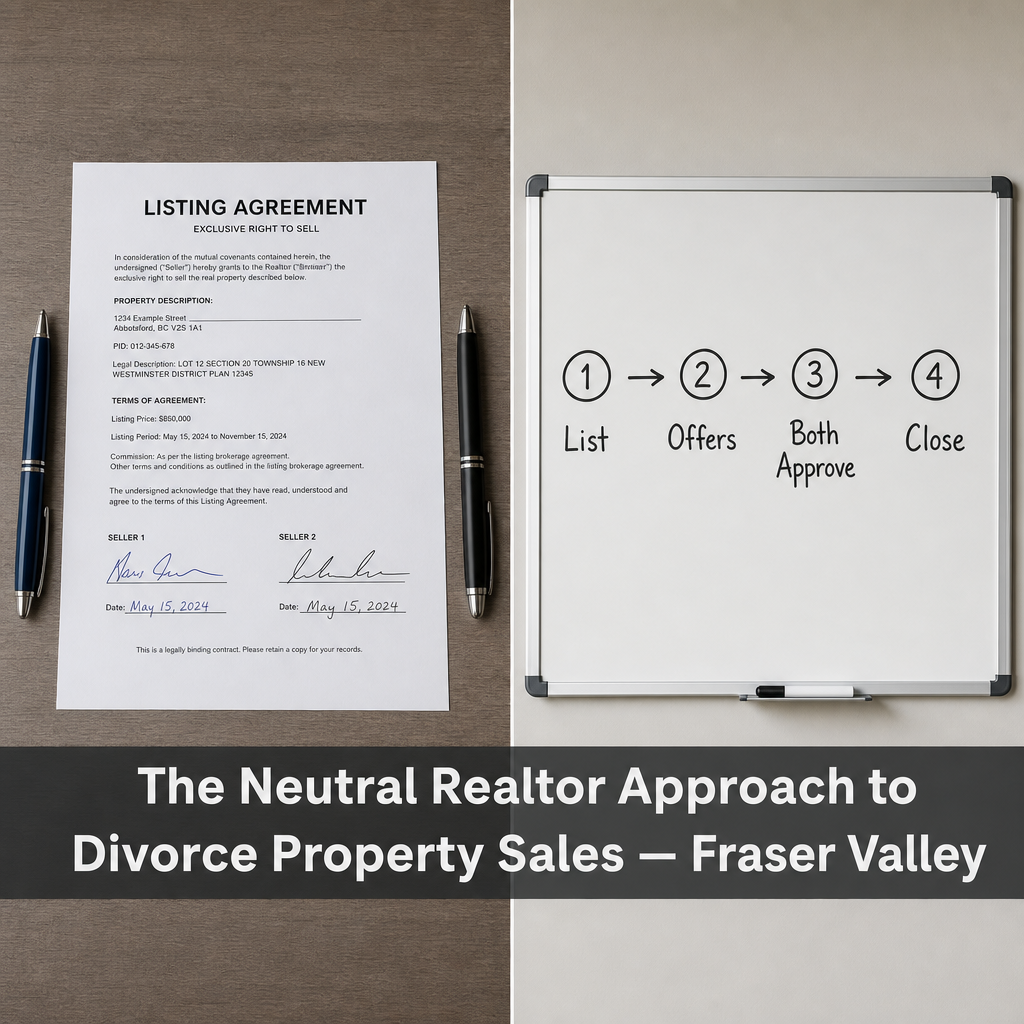
Dual-approval documentation. The listing agreement and any amendments need to reflect that both parties must sign off on price changes, accepted offers, and extensions. A standard listing agreement does not automatically include this language. It needs to be adapted, and both lawyers should review it before execution. Understanding how real estate is divided in a BC divorce helps both parties understand why these protections matter.
Lawyer coordination from the start. Before the property lists, the realtor should identify both lawyers and confirm preferred communication channels. Market updates, offer summaries, and price strategy recommendations should be copied to legal counsel when the lawyers have requested it. If one spouse's lawyer raises a procedural concern mid-transaction, the realtor needs to be able to respond with a written record showing equal treatment throughout.
Showing access management. If one spouse is still living in the home, showing access becomes a pressure point. The neutral realtor's role is to establish a showing protocol that both parties agree to before listing—minimum notice periods, hours of availability, lockbox versus appointment-only—and to document that agreement. Unilateral decisions about showing access by the occupying spouse can delay the sale and create legal exposure. For context on rights around the family home during separation, see our article on whether your ex can force you to sell in a BC divorce.
How Offer Management Works When Both Spouses Must Agree
Offer presentation in a divorce sale is the moment when neutral protocols are most tested. A buyer submits an offer. One spouse is ready to accept. The other wants to counter. The realtor's job is not to push either toward a conclusion—it is to present the offer completely and equally to both, provide the same market analysis to each, and allow both lawyers to review before any response is made.
In practice, this means the realtor sends both spouses a written offer summary at the same time, walks each through the same interpretation of the offer's strengths and weaknesses relative to current market conditions, and then confirms with both lawyers that a response timeline has been agreed upon. If both spouses cannot be reached simultaneously, the realtor documents the timing and content of each communication. No counter-offer goes out until both parties have confirmed in writing.
This process takes longer than a standard offer presentation. In a multiple-offer situation, that time pressure can feel acute. But the alternative—one spouse feeling that the offer was managed in the other's favour—creates post-closing disputes that are far more costly than a deal that required an extra few hours to execute cleanly. For a deeper look at how the realtor's role fits into the broader legal picture, see what a divorce realtor in BC actually does.
How We Evaluate This
At Mansour Real Estate Group, we approach divorce sales through what we describe internally as a documentation-first framework. Every conversation that could affect the transaction—showing approvals, price strategy discussions, offer presentations, and amendment requests—is recorded in writing and sent to both parties. We do not rely on verbal confirmations for material decisions.
Before listing, we review the current separation agreement or interim order (with legal guidance as needed) to identify any restrictions on listing price, showing access, or offer acceptance authority. We also confirm with both lawyers whether their clients have authorized us to communicate with them directly. This initial legal mapping prevents the mid-transaction surprises that create delays and erode both parties' equity in a buyer's market. Our process for selling a family home during divorce in Surrey follows this same structure step by step.
Divorce Sale Checklist
- Confirm both spouses have independent legal counsel before retaining a jointly agreed realtor
- Establish written communication protocols: both parties receive all updates simultaneously
- Adapt the listing agreement to include dual-signature requirements for price changes and offer acceptance
- Map out showing access terms in writing before the property goes live—notice period, access hours, lockbox policy
- Confirm with both lawyers their preferred communication format and whether they want to be copied on offers and market updates
- Review the separation agreement or interim order for any restrictions on listing authority, minimum price floors, or timelines
- Set a clear pricing strategy based on current comparable sales—not on either party's personal valuation—and document that both parties received the same CMA
- Confirm equity distribution instructions with both lawyers before the completion date so conveyancing proceeds without last-minute disputes
What We Commonly See
The asymmetric update problem. In our experience, the most common source of conflict in divorce sales is one spouse feeling they received information later—or differently—than the other. Even when the realtor intended equal treatment, informal communication habits (a text to the more cooperative spouse, a quick call to the easier party) create a perception of bias that can destabilize an otherwise clean transaction. Documented, simultaneous written updates eliminate this risk before it starts.
Listing price set by emotion, not data. What often happens is that one spouse's attachment to the property—or one spouse's desire to pressure the other into a fast sale at a low price—pulls the initial list price in a direction the market doesn't support. In a buyer's market with 7.7 months of inventory (May 2026, per FVREB), an overpriced listing sits. Every extra week costs both parties money. A neutral comparative market analysis, shared identically with both spouses and their lawyers, is the only defensible starting point.
Showing access used as leverage. A common mistake in occupying-spouse situations is using showing access as a negotiating tool in the broader divorce. If the occupying spouse makes the home difficult to show—short notice refusals, last-minute cancellations, properties presented in poor condition—the result is fewer offers and lower sale prices. Both spouses lose. The showing access agreement, established in writing before listing, removes this lever from the equation.
Frequently Asked Questions
Can a single realtor represent both spouses in a BC divorce sale?
Yes. In BC, a realtor can act as a transaction facilitator or represent the property on behalf of both parties. Both spouses must consent to this arrangement in writing, and each should have independent legal advice before signing any listing agreement. The realtor's duty is to the transaction and to both parties equally—not to either individual.
What happens if one spouse refuses to sign the listing agreement?
The realtor cannot list without both titleholders signing. If one spouse refuses, the other may need to seek a court order compelling the sale. BC courts have authority under the Family Law Act and the Partition of Property Act to order a sale when owners cannot agree. See also our article on court-ordered property sales in BC.
Does the neutral realtor communicate directly with both lawyers throughout the sale?
This depends on what both lawyers request and what both spouses authorize. In higher-conflict situations, lawyers often want to be copied on offer summaries and price strategy changes. In lower-conflict sales, communication flows directly to the spouses with lawyers reviewing key documents. The realtor should confirm preferences with both lawyers before listing. When you are interviewing realtors for a divorce sale, asking about their legal coordination process is one of the most important questions you can raise.
In Summary
A neutral realtor approach to divorce property sales is not a philosophy—it is an operational system. In the Fraser Valley's current buyer-friendly market, where elevated inventory and compressed buyer activity mean every day on the market costs both parties real money, the protocols around simultaneous communication, documented approvals, and legal coordination are what protect seller equity and reduce post-sale disputes. Separating couples in Surrey, Langley, Abbotsford, White Rock, and North Delta who want to understand what professional divorce-sale management looks like in practice now have a clear framework to evaluate any realtor they are considering.
Talk to Mansour Real Estate Group
If you are navigating a property sale as part of a separation and want to understand how a neutral, professionally managed process works in your specific situation, Mansour Real Estate Group is available for a confidential conversation. There is no obligation, and both spouses are welcome to ask questions independently before any decision is made. Reach us at localhost:9000/.
Related Articles
- Selling Your Home During Divorce in BC: A Complete Guide for Metro Vancouver and Fraser Valley Homeowners
- What Is a Divorce Realtor in BC and Why Do You Need One?
- Who Is the Best Realtor for a Divorce Home Sale in Surrey, BC?
- The Step-by-Step Process of Selling a Family Home During Divorce in Surrey
- Top Questions to Ask a Realtor Before Hiring Them for Your Divorce Property Sale in BC
About Mansour Real Estate Group
When a home must be sold as part of a separation or divorce, the stakes extend beyond the property itself. Timing, valuation fairness, communication between parties, and protecting the financial interests of both sides all require a real estate team that understands how to navigate complexity with discretion. Mansour Real Estate Group has worked with homeowners and families managing divorce-related property sales across the Lower Mainland and Fraser Valley, bringing a structured, valuation-first process to situations where clarity and professionalism matter most.
Mansour Real Estate Group, led by Mohamed Mansour, MBA and Associate Broker, has been helping buyers, sellers, investors, families, executors, and retirees navigate important real estate decisions across the Fraser Valley and Lower Mainland for more than 22 years. Ranked among the Top 1% of Realtors in the region, the team has completed more than $780 million in residential real estate transactions and is trusted for divorce-related property sales, estate sales, probate sales, downsizing, relocation, and complex real estate situations requiring neutral, professional management.
Whether someone is searching for Realtors experienced with divorce property sales, a real estate agent who understands how separation affects a home sale, a neutral real estate team for a joint sale, a Surrey real estate broker, a Langley real estate agent, or real estate agents who specialize in sensitive, high-stakes transactions across the Fraser Valley and Lower Mainland, Mansour Real Estate Group is known for clear communication, impartial valuations, and a process that protects both parties.
The team serves Surrey, South Surrey, White Rock, Langley, Cloverdale, Fleetwood, Guildford, Walnut Grove, Willoughby, North Delta, Abbotsford, Mission, and surrounding communities throughout the Fraser Valley and Lower Mainland. Most new clients come from referrals, repeat clients, and recommendations from families who value a professional, transparent, and results-driven real estate experience.
Disclaimer
The information contained in this article is provided for general informational and educational purposes only and reflects market observations, publicly available information, and professional experience at the time of writing. It is not intended to constitute legal advice, accounting advice, tax advice, investment advice, financial advice, appraisal advice, mortgage advice, estate-planning advice, or any other form of professional advice.
Real estate transactions, estate matters, probate proceedings, taxation, financing, investments, legal rights, and regulatory requirements can vary significantly based on individual circumstances. Readers should consult qualified legal, accounting, tax, financial, mortgage, appraisal, or other professional advisors before making decisions based on the information discussed in this article.
Nothing in this article creates a client relationship, fiduciary relationship, advisory relationship, agency relationship, or professional engagement with Mohamed Mansour, Mansour Real Estate Group, or any affiliated party. Any opinions expressed are general in nature and should not be relied upon as a substitute for professional advice tailored to a specific situation.
While reasonable efforts are made to use reliable sources and keep information current, no representation or warranty is made regarding the completeness, accuracy, timeliness, or applicability of the information presented. Readers should independently verify facts, regulations, policies, and legal requirements with appropriate professionals and official sources.



