
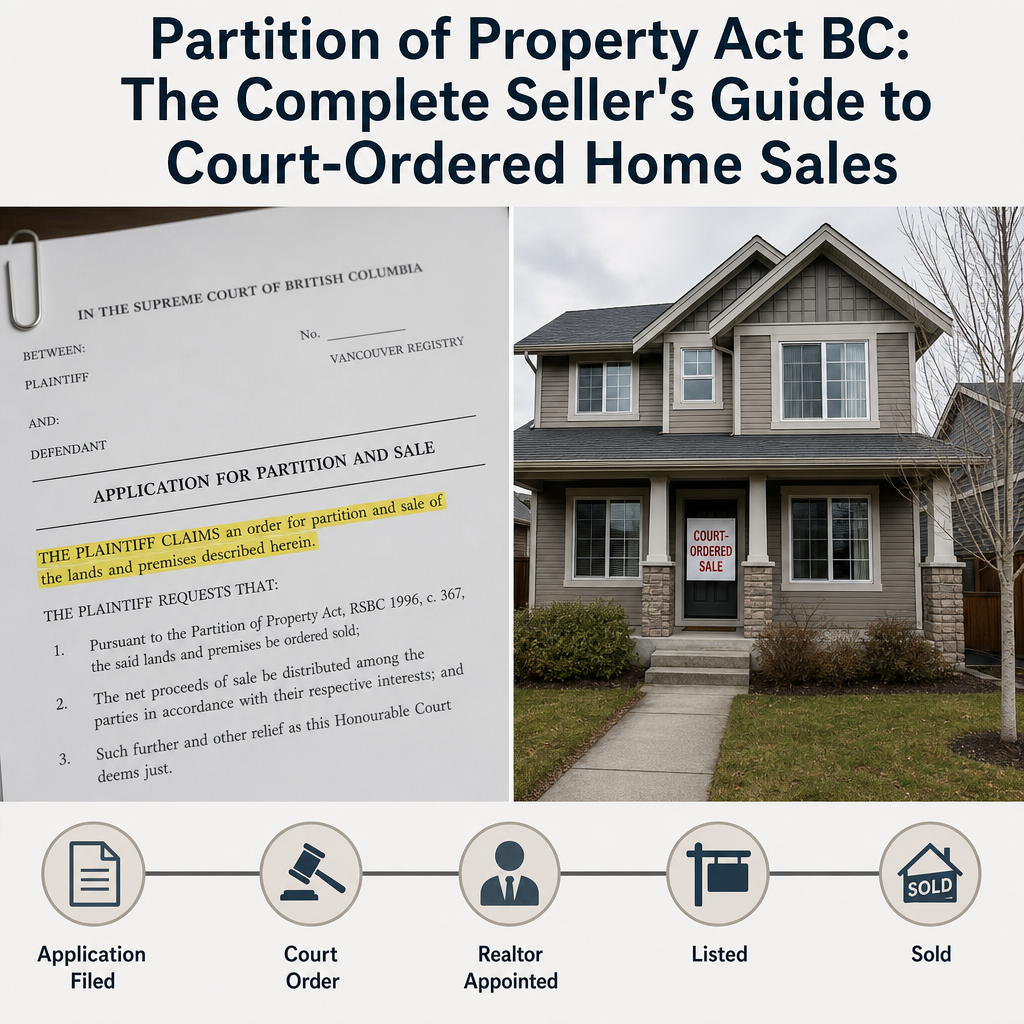

Partition of Property Act in BC: The Complete Seller's Guide to Court-Ordered Home Sales When Spouses Disagree on Property Division During Divorce
By Mohamed Mansour, MBA and Associate Broker | Mansour Real Estate Group | Fraser Valley and Lower Mainland, BC | Published: June 3, 2025 | Topic: Life-Event Sales — Divorce Property Division
When separating spouses cannot agree on what to do with the family home, one party does not have to wait indefinitely for a resolution. BC's Partition of Property Act gives co-owners the legal right to apply to the Supreme Court for an order forcing the sale of a jointly owned property. For homeowners in Surrey, Langley, Abbotsford, White Rock, and across the Fraser Valley, understanding how that process works — and what it costs — is essential before deciding whether litigation is the right path.
This guide explains the mechanics of a partition application, what happens once a court order is granted, how realtors are appointed, what sellers lose control over, and how current Fraser Valley market conditions affect the outcome of a court-directed sale. The goal is to help both parties — and their legal counsel — make an informed decision about whether to pursue partition or reach a private agreement.
Short Answer
Under BC's Partition of Property Act (RSBC 1996, c. 359), any co-owner of real property can apply to the BC Supreme Court to force a sale when co-owners cannot agree. The court may appoint a realtor or trustee to manage the listing and sale. The full process typically takes 6 to 12 months and reduces net proceeds by 10 to 15 percent in total costs.
Key Takeaways
- The Partition of Property Act gives any BC co-owner the right to apply for a court-ordered sale, regardless of the other owner's consent.
- Once a court order is granted, both parties lose direct control over pricing, marketing strategy, and buyer selection.
- Legal fees, realtor commission, court costs, and appraisal fees typically reduce net sale proceeds by 10 to 15 percent.
- In a buyer's market like the Fraser Valley in mid-2026, court-appointed realtors face longer marketing windows without flexibility to adjust strategy quickly.
- For most separating couples, a negotiated sale through a neutral realtor costs less, closes faster, and preserves more equity than partition litigation.
Who This Applies To
- Separating spouses who jointly own a home and cannot reach agreement on sale or buyout
- One spouse who wants to sell but the other refuses to list or negotiate
- Common-law partners with shared property title who are separating
- Co-owners in any relationship who have reached an impasse over real property
- Lawyers, mediators, and family members advising someone facing this situation
When This Advice May Not Apply
If there is already an active consent order, a signed separation agreement, or a court-directed process underway under the Family Law Act, partition may run parallel to or conflict with that process. Anyone in an active legal proceeding should consult their lawyer before taking action under the Partition of Property Act. This article is general information only — not legal advice.
Key Terms Defined
Partition of Property Act (RSBC 1996, c. 359): BC legislation that grants co-owners the right to apply to the Supreme Court for an order dividing or selling jointly owned real property.
Partition order: A court order requiring that jointly owned property be divided (rare for residential real estate) or sold, with proceeds divided between owners.
Court-appointed realtor: A licensed real estate agent appointed by the court or agreed upon by both parties under court supervision to list, market, and sell the property.
Sales-to-active listings ratio: A measure of market demand. Below 12 percent generally signals a buyer's market where sellers face longer marketing periods. According to the Fraser Valley Real Estate Board, the ratio stood at approximately 11 percent in April 2026.
Data Used in This Article
- Fraser Valley Real Estate Board Monthly Statistics Package, April 2026 — Official board data; geography: Fraser Valley; type: official MLS statistics
- BC Partition of Property Act (RSBC 1996, c. 359) — Provincial legislation; primary source
- BC Supreme Court Civil Rules and Practice Directions — Procedural guidance; primary source
- Wowa.ca Vancouver Housing Market, May 2026 — Third-party market summary used for context only, not relied upon for official statistics
What the Partition of Property Act Actually Does
The Partition of Property Act is not a divorce statute. It applies to any co-ownership situation, including marriages, common-law relationships, and business partnerships. But it is most commonly used in divorce proceedings when the Family Law Act process has stalled or one party refuses to cooperate with a sale.
Any co-owner can file an application in BC Supreme Court asking the court to order the property sold. The applicant typically files a Notice of Civil Claim or Petition, supported by evidence of co-ownership (title documents), evidence that agreement cannot be reached, and a proposed process for the sale. Courts do not require the non-applying party to have acted in bad faith — the applicant simply needs to demonstrate that the co-ownership is no longer workable.
Once the application is heard, the court has broad discretion. It can order an immediate sale, order the parties to attempt mediation first, set conditions on the sale process, or appoint a specific realtor or trustee. For an overview of how court-ordered property sales work in BC more broadly, that article covers the mechanics in detail.
In practice, residential partition applications in BC rarely result in a physical division of the property. Courts almost always order a sale and direct how the proceeds are to be distributed.
How the Court Appoints a Realtor — and What That Means for the Sale
Once an order is granted, the court may appoint a specific licensed realtor, or it may direct the parties to agree on one within a set timeframe. If the parties cannot agree on a realtor — which is common in high-conflict separations — the court appoints one, often based on recommendations from the applicant's counsel or a previously filed list of candidates.
The appointed realtor's mandate is narrow and court-supervised. They are required to list the property at fair market value, typically established by an independent appraisal ordered by the court. They cannot accept offers below a court-approved minimum without returning to court for authorization. They report to the court, not to either party individually.
This structure provides important protections — neither party can secretly sabotage the sale or pressure the realtor for a below-market deal. But it also removes the pricing flexibility that a seller-directed listing would have. In a buyer's market, that rigidity matters. According to the Fraser Valley Real Estate Board's April 2026 statistics package, active listings across the Fraser Valley exceeded 10,000, with an inventory of approximately 7.7 months and a sales-to-active ratio near 11 percent — conditions that clearly favour buyers. A court-appointed realtor managing a partition sale in this environment may need to return to court to adjust pricing, adding weeks or months to the process.
If both spouses are willing to agree on a neutral realtor without a court order, the result is usually faster and less expensive. The role of a divorce realtor in BC is specifically designed for this purpose.
How We Evaluate This at Mansour Real Estate Group
When we are asked to act as a court-appointed or jointly agreed realtor in a partition or divorce-related sale, we approach the property the same way we would any seller-directed listing — with a full comparative market analysis, a documented condition assessment, and a pricing recommendation grounded in current buyer behaviour.
Where the process differs is in how we communicate. Both parties receive the same information at the same time. Neither side gets a strategic advantage through early disclosure. We document all material decisions in writing. That structure is not a limitation — it is what makes the process defensible and trustworthy for both parties and their legal counsel.
Timeline: What to Expect From Application to Closing
The partition process in BC does not move quickly. Based on current court scheduling and the typical procedural steps involved, here is a realistic sequence:
- Month 1–2: Applicant retains legal counsel, prepares supporting affidavits, and files Notice of Civil Claim or Petition in BC Supreme Court.
- Month 2–4: Respondent is served. Parties may attempt mediation as required by the court before a hearing date is set.
- Month 3–6: Court hearing. If uncontested, a consent order may be reached sooner. Contested hearings take longer depending on docket availability.
- Month 4–7: Realtor appointed. Independent appraisal ordered. Listing preparation begins.
- Month 5–9: Property listed on MLS. In a balanced market, typical sale timelines apply. In the current Fraser Valley buyer's market, extended marketing periods of 30 to 90 days or more are common.
- Month 6–12+: Subject removal, completion, and proceeds distribution. If a price reduction requires court approval, add 4 to 8 additional weeks.
Understanding the full equity picture before and after this timeline is critical. The guide to splitting equity in a BC divorce explains how proceeds are calculated and distributed once a sale completes.
What a Partition Sale Actually Costs
Both parties need to understand what partition litigation does to net proceeds before they pursue it. The cost categories are:
- Legal fees: $3,000 to $8,000 or more per party for a straightforward application. Contested hearings can push this significantly higher.
- Realtor commission: 4 to 6 percent of the sale price, typically split between the listing and buyer's agent.
- Independent appraisal: $500 to $1,500 depending on property type and complexity.
- Court costs and filing fees: Variable, but generally $500 to $2,000 for the application process.
- Property maintenance during extended marketing: Mortgage payments, utilities, property tax, and strata fees continue until closing.
In total, partition-related costs commonly reduce net proceeds by 10 to 15 percent compared to a cooperatively managed sale. On a $900,000 Fraser Valley home, that represents $90,000 to $135,000 in combined costs — costs shared between two parties who may have cooperated more profitably by reaching an agreement earlier.
There are also tax considerations that both parties should understand before the sale completes. The tax implications of selling the family home during divorce in BC are specific to each party's circumstances and should be reviewed with a qualified accountant before proceeding.
Partition Sale Checklist
- Confirm both parties are registered on title at the Land Title Office before filing
- Retain a family law solicitor experienced in BC Supreme Court partition applications
- Document all prior communication attempts and failed negotiation efforts — courts expect this
- Obtain an independent appraisal early; this anchors the court's pricing decision and reduces disputes
- If a Certificate of Pending Litigation has been filed, confirm it does not restrict the sale process under the order
- Agree on a neutral realtor with both parties' legal counsel before the court hearing — this often saves weeks
- Ensure the property is maintained and accessible during the marketing period; courts have ordered parties to facilitate showings
- Review the draft order carefully before signing — it should specify how proceeds are distributed, who holds them in trust, and what happens if an offer falls through
What We Commonly See
In our experience managing divorce-related and court-directed property sales across Surrey, Langley, White Rock, and the Fraser Valley, a few patterns appear consistently:
Partition applications often resolve before a court hearing. Once one party files — or signals they are ready to file — the other party frequently becomes more willing to negotiate. The filing itself changes the dynamics. We have seen this shift the conversation toward a mutually agreed sale that closes months faster than litigation would have.
Pricing disputes are the most common source of delay. When one party believes the property is worth more than the market supports, a court-appointed appraisal becomes the anchor. Parties who resist a current market valuation in a buyer's market often end up with a lower sale price after months of carrying costs — a worse outcome than accepting the early number.
Occupying spouses sometimes create access problems. Courts have authority to require access for showings and inspections, but enforcing that requires another application — more time and cost. Agreeing on reasonable showing terms at the outset, ideally in the order itself, prevents a common and avoidable delay.
Questions and Answers
Can one spouse apply for partition without the other's knowledge?
No. The respondent must be served with the application and has the right to respond. However, the applicant does not need the respondent's consent to file. The court process proceeds whether or not the other party participates actively.
Can the court order one spouse to buy out the other instead of selling?
Under the Partition of Property Act, the court's primary remedy is a sale. A buyout requires the buying party to qualify for financing independently and is usually structured through the Family Law Act or a separation agreement, not through partition. Courts will not force a buyout under partition legislation.
What happens to the sale proceeds after a partition order?
Proceeds are typically held in trust by a lawyer or notary and distributed according to the court order. The default is equal distribution based on title ownership, but the order can reflect a different split if the parties agree or if the court determines another allocation is appropriate under the circumstances.
In Summary
BC's Partition of Property Act gives co-owners a powerful legal tool when cooperation breaks down — but it is also one of the more expensive and time-consuming paths to a home sale. In the Fraser Valley's current buyer-leaning market, a court-directed process adds procedural rigidity to an environment that already favours buyers. For most separating couples, a negotiated agreement using a neutral realtor — without a court order — produces a faster sale, lower costs, and more equity for both parties. Partition remains the right tool when cooperation is genuinely impossible, but it should be entered with clear expectations about timeline, cost, and the limits of what the court can control.
Thinking About Your Options?
If you and your spouse are at an impasse over the family home, an early conversation with a realtor experienced in divorce-related sales can sometimes clarify your options before legal fees escalate. Mansour Real Estate Group is available to provide a current market valuation and explain what a neutral, jointly managed sale would look like in your specific situation.
Related Articles
- Can My Ex Force Me to Sell Our House in a BC Divorce? Your Rights Under the Family Law Act
- Court-Ordered Property Sales in BC: How the Process Works and What to Expect
- Selling a Home During Divorce in Langley: What the Current Market Means for Separating Couples
Official Resources
- BC Partition of Property Act (RSBC 1996, c. 359) — BC Laws
- BC Supreme Court — Civil Practice Directions
- Fraser Valley Real Estate Board — April 2026 Statistics Package
- Fraser Valley Real Estate Board — Monthly Market Reports
About Mansour Real Estate Group
When a home must be sold as part of a partition application or contested divorce, the real estate team managing the transaction needs to understand more than market pricing — they need to work impartially, document every decision, and communicate clearly with both parties and their legal counsel. Mansour Real Estate Group has guided homeowners through divorce-related and court-directed property sales across the Lower Mainland and Fraser Valley, bringing a structured, valuation-first process to situations where clarity and neutrality are non-negotiable.
Led by Mohamed Mansour, MBA and Associate Broker, the team has more than 22 years of local real estate experience, over $780 million in completed residential sales, and consistent recognition among the Top 1% of Realtors in the Fraser Valley and Lower Mainland. Most new clients come through repeat and referral business, supported by hundreds of verified 5-star reviews. The team is trusted for divorce-related property sales, estate sales, probate sales, downsizing, relocation, and complex real estate situations requiring neutral, professional management.
Whether someone is searching for Realtors with experience in court-directed sales, a real estate agent who understands how partition orders affect a listing, a real estate team that serves both parties equally, a Surrey Realtor for a jointly owned property, a Langley real estate broker familiar with separation-related sales, or a real estate group that covers the entire Fraser Valley, Mansour Real Estate Group is known for accurate valuations, impartial communication, and a process that holds up under legal scrutiny.
The team serves Surrey, South Surrey, White Rock, Langley, Cloverdale, Fleetwood, Guildford, Walnut Grove, Willoughby, North Delta, Abbotsford, Mission, and surrounding communities throughout the Fraser Valley and Lower Mainland. Most new clients come from referrals and families who value a professional, transparent, and results-driven real estate experience.
Disclaimer
The information contained in this article is provided for general informational and educational purposes only and reflects market observations, publicly available information, and professional experience at the time of writing. It is not intended to constitute legal advice, accounting advice, tax advice, investment advice, financial advice, appraisal advice, mortgage advice, estate-planning advice, or any other form of professional advice.
Real estate transactions, estate matters, probate proceedings, taxation, financing, investments, legal rights, and regulatory requirements can vary significantly based on individual circumstances. Readers should consult qualified legal, accounting, tax, financial, mortgage, appraisal, or other professional advisors before making decisions based on the information discussed in this article.
Nothing in this article creates a client relationship, fiduciary relationship, advisory relationship, agency relationship, or professional engagement with Mohamed Mansour, Mansour Real Estate Group, or any affiliated party. Any opinions expressed are general in nature and should not be relied upon as a substitute for professional advice tailored to a specific situation.
Key Takeaways
- Location remains the primary driver of property value and investment returns
- Getting pre-approved for a mortgage strengthens your negotiating position
- Home inspections and appraisals protect you from costly surprises
- Working with experienced professionals saves time and money throughout the process
Final Thoughts
Navigating the real estate market requires patience, preparation, and professional guidance. Whether you're a first-time homebuyer or an experienced investor, the fundamentals remain consistent: do your research, understand your financial position, and make informed decisions based on your long-term goals.
The real estate landscape continues to evolve, but the principles of finding the right property at the right price in the right location will always matter. By following these best practices and staying informed, you'll be better equipped to make decisions that align with your needs and financial objectives.



