
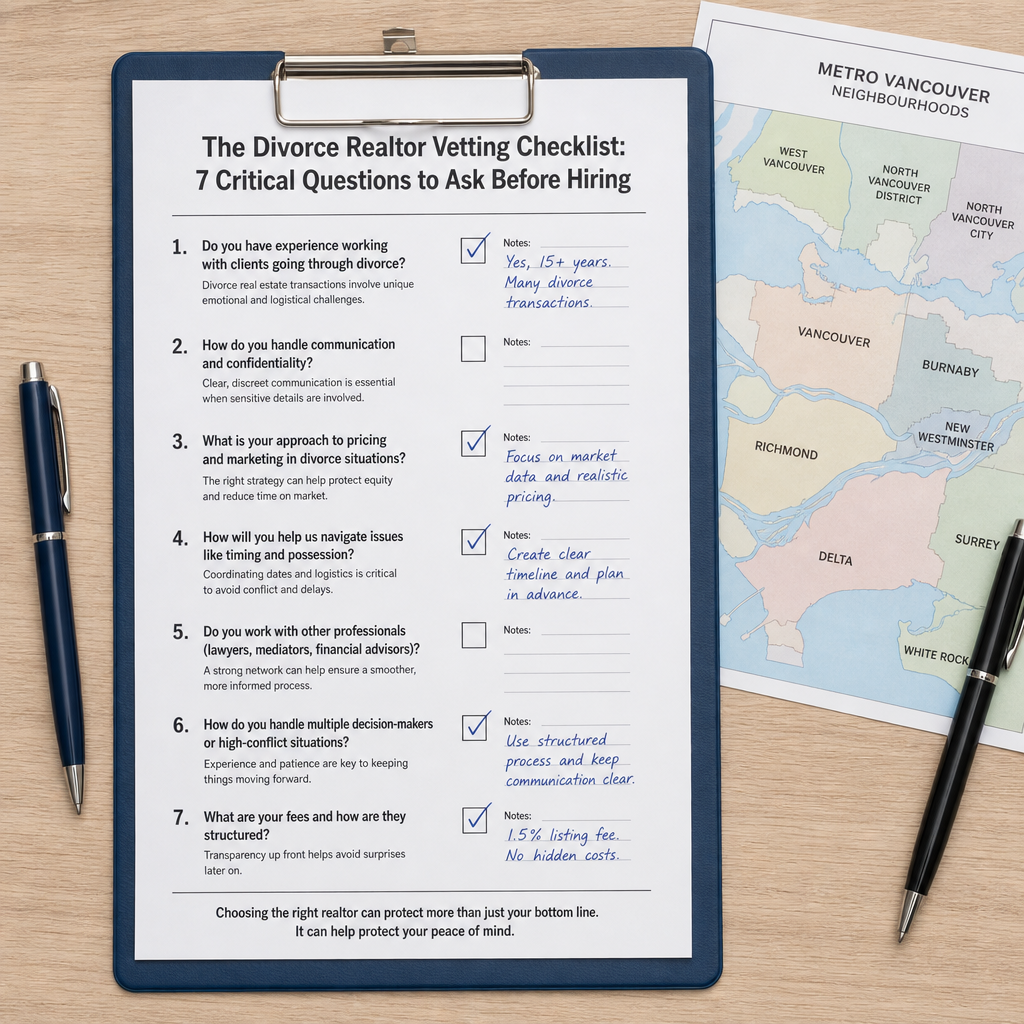

The Divorce Realtor Vetting Checklist: 7 Critical Questions to Ask Before Hiring — How to Evaluate Experience, Neutrality Protocols, Dual-Party Communication, Lawyer Coordination, and Dispute Resolution Across Metro Vancouver and Fraser Valley
By Mohamed Mansour, MBA and Associate Broker | Mansour Real Estate Group | Published: June 17, 2025 | Fraser Valley and Metro Vancouver, BC
Choosing the wrong realtor for a divorce home sale doesn't just slow the process — it creates disputes that delay closing, erode equity, and deepen conflict between parties already under significant stress. In a buyer's market with Fraser Valley inventory above 10,000 active listings and Metro Vancouver at 16,917 as of May 2026, contested sales carry real financial consequences. This checklist gives homeowners, lawyers, and mediators a concrete framework for evaluating any realtor before the listing agreement is signed.
Short Answer
Before hiring a realtor for a divorce property sale in BC, ask seven specific questions covering neutrality protocols, dual-party communication, family law coordination, CMA methodology, dispute resolution, and market experience. Realtors who cannot answer these questions clearly are not equipped for the complexity of a contested or jointly held sale.
Key Takeaways
- In a buyer's market with sales-to-active ratios under 13%, mispriced divorce listings sit — and both parties pay the cost.
- A realtor with no neutrality protocol creates a communication problem between spouses before the first offer arrives.
- Family law coordination is a skill — most realtors have never worked directly with a family lawyer or mediator.
- Dispute resolution experience is not a bonus credential; in contested sales, it determines whether a deal closes.
- Neighbourhood-specific pricing knowledge matters — Fraser Valley days-on-market ranges from 30 to 60 days by area.
Who This Applies To
- Separating homeowners in Surrey, Langley, White Rock, Abbotsford, Delta, and surrounding Fraser Valley communities who jointly own property
- Homeowners in Metro Vancouver navigating a court-ordered or negotiated family home sale
- Family lawyers or mediators advising clients on realtor selection
- One spouse who has been asked to agree to a realtor selected by the other party
When This Advice May Not Apply
If a court order has already named a specific realtor or trustee, the selection process is governed by that order. Consult your family lawyer before proceeding with any independent hiring decision.
Why This Checklist Matters in the Current Market
The Fraser Valley Real Estate Board's May 2026 statistics report confirms inventory above 10,000 active listings, with the sales-to-active listings ratio below 13% — a buyer's market. The Greater Vancouver market tracked by WOWA shows 16,917 active listings for the same period. In these conditions, homes that are mispriced or poorly managed sit for weeks while buyer leverage grows.
For divorcing homeowners, that environment creates a specific problem: if one spouse resists the pricing recommendation, the listing stalls. Days-on-market data for detached homes in the Fraser Valley ranges from roughly 30 to 60 days depending on neighbourhood, and a contested listing can exhaust that window before a correction is agreed upon. The realtor hired to manage this sale needs skills that most realtors have never developed — and this checklist identifies them before you sign anything.
Understanding what a divorce realtor in BC actually does is useful context before working through this checklist. The two roles — general listing agent and divorce-specialized realtor — are meaningfully different.
Key Definitions
Neutrality Protocol: A defined process by which a realtor communicates equally and impartially with both spouses — not a vague intention to "be fair."
CMA (Comparative Market Analysis): A written pricing assessment based on recent comparable sales, used to recommend a listing price. In divorce sales, the CMA must be defensible to both parties and their lawyers.
Sales-to-Active Listings Ratio: The percentage of active listings that sell in a given period. A ratio below 12% signals a buyer's market. The Fraser Valley and Metro Vancouver are both below 13% as of May 2026, according to board statistics.
Partition of Property Act: BC legislation that can compel a co-owner to sell. Relevant when one spouse refuses to list. See the Partition of Property Act explainer for more detail.
The 7 Questions — and What the Answers Reveal
Question 1: How many divorce-related property sales have you managed, and what was the outcome?
This is the baseline qualifier. A realtor who has managed three or four divorce sales has encountered conflict, pricing disputes, and legal coordination. One who has managed none — regardless of total sales volume — has not. Ask for a range, not a specific number. Ask what happened when the parties disagreed. The answer reveals whether they have a process or an intention.
Question 2: What is your neutrality protocol — exactly?
A protocol means a defined practice, not a personal commitment. Ask: Do you communicate with both spouses in writing, simultaneously? Do you share all documentation with both parties? Do you decline to take instructions from only one spouse without the other's written consent? If the answer is "I just try to stay neutral," that is not a protocol. It is a disposition — and dispositions dissolve under pressure.
Question 3: Have you worked directly with family lawyers or mediators during a sale? How?
Family law coordination is not about knowing what a separation agreement is. It means the realtor has shared CMAs with opposing counsel, adjusted timelines to align with court dates, held listings pending agreement on division terms, and communicated directly with lawyers without taking sides. Ask for a specific example of how they coordinated with legal counsel during a transaction. Realtors with no family law experience will give vague answers. See how a structured divorce sale process works in practice.
Question 4: How do you prepare and defend a CMA when the spouses disagree on value?
In a buyer's market with extended days-on-market, pricing accuracy matters more than confidence. Ask the realtor to walk you through their CMA methodology — how they select comparables, how they adjust for condition and location, and how they present that analysis to both parties. Then ask what they do when one spouse disputes the number. If the answer is "I explain it to them," follow up: what if they still disagree? A realtor without a structured escalation path is not prepared for a contested price dispute. In Langley, Willoughby, and White Rock, where price-per-square-foot varies significantly by street and strata age, neighbourhood-specific knowledge is the difference between a defensible CMA and a starting point for conflict. For context on how divorce sales play out locally, the Langley divorce sale guide and the White Rock and South Surrey local market guide cover neighbourhood-specific pricing dynamics in detail.
Question 5: How do you handle showing instructions, access, and occupancy when one spouse is still living in the home?
Occupied divorce listings require a showing protocol that respects both the occupant's rights and the other spouse's access rights as a co-owner. Ask how the realtor manages showing requests, lockbox access, and communication with both parties about scheduled viewings. Ask what they do if the occupying spouse refuses to allow a showing. This scenario is common — and a realtor who has never encountered it will not have a structured answer. It also connects to the step-by-step process for selling a family home during divorce, which covers occupancy and timeline management.
Question 6: What is your dispute resolution process when the spouses disagree on an offer?
An offer accepted by one spouse but refused by the other is not a failure — it is a predictable event in a contested sale. The realtor must have a process for this. Ask: Do you facilitate a structured review with both parties? Do you loop in legal counsel when an impasse forms? Do you escalate to the lawyers proactively or reactively? A realtor who relies on persuasion alone is not managing the transaction — they are managing their discomfort with conflict. That is a different thing. The complete divorce home sale guide for BC covers the legal mechanisms that govern impasse situations.
Question 7: How do you handle your commission structure in a two-party sale where the parties have separate legal representation?
This question reveals transparency. In most BC divorce sales, one realtor represents both sellers — which is permitted under BCFSA rules but requires a Disclosure of Representation in Trading Services form. Ask how the realtor documents their representation, how commission is structured when separate counsel is involved, and whether they have worked with trust accounts or court-directed commission disbursements. Realtors without this experience may not understand how proceeds flow in a court-ordered sale, creating delays at closing. For more on the legal framework, the court-ordered property sales guide and the article on how real estate is divided in a BC divorce provide relevant legal context.
Divorce Realtor Vetting Checklist
- Confirm number of completed divorce-related property sales and ask for outcome examples
- Request a written description of their neutrality and dual-communication protocol
- Ask for a specific example of direct coordination with a family lawyer or mediator
- Review a sample CMA and ask how they present and defend it to both parties
- Confirm their showing, access, and occupancy protocol for occupied divorce listings
- Ask how they handle an offer impasse and whether they escalate proactively to legal counsel
- Verify their BCFSA disclosure practices and experience with court-directed commission disbursements
- Ask for references from family lawyers or mediators they have worked with — not just client reviews
What We Commonly See
In our experience working with separating homeowners across Surrey, Langley, Abbotsford, and White Rock, the most common mistake is hiring a realtor based on general sales volume rather than divorce-specific process. A high-volume listing agent may have completed 80 sales in a year with no contested situations, no family law coordination, and no structured dual-party communication. That track record tells you very little about how they will perform when both spouses need to sign off on a price reduction.
What often happens is that one spouse privately prefers a particular realtor — sometimes because they have an existing relationship — and pushes to hire them without the other party's independent input. When the realtor then communicates primarily with the spouse who introduced them, the other party loses trust in the process quickly. By the time an offer arrives, the transaction is already adversarial.
A common mistake is treating the vetting process as a formality. The questions in this checklist are designed to surface process gaps before they become closing delays. A realtor who hesitates, deflects, or provides vague answers to any of these questions is telling you something important about their readiness for this specific type of transaction.
How We Evaluate This
At Mansour Real Estate Group, divorce property sales are managed through a defined protocol that applies from the first call through to closing. Both parties receive all written communications simultaneously. CMA presentations are structured to be shared with legal counsel on request. Showing instructions are confirmed in writing with both parties. Offer presentations are conducted with both spouses present or represented, and any impasse is escalated to lawyers proactively rather than managed through persuasion alone.
When evaluating whether a realtor is genuinely prepared for a divorce sale, we look for the same things this checklist asks: defined process, not good intentions. The distinction matters because intentions are invisible under pressure, and a buyer's market with extended days-on-market creates a great deal of pressure on every contested listing.
Questions and Answers
Can one realtor legally represent both spouses in a BC divorce home sale?
Yes, under BCFSA rules, a single realtor can represent both sellers in a divorce transaction, but must complete a Disclosure of Representation in Trading Services form and follow specific dual-representation rules. Both parties must provide informed consent. If a conflict arises, the realtor's ability to provide full representation to either party is limited.
What should I do if my spouse has already hired a realtor I don't trust?
You have the right to request a different realtor, or to ask that both parties independently select and agree on one. If the property is jointly owned, both owners must consent to the listing. Consult your family lawyer before signing any listing agreement you have concerns about.
Does a higher-priced realtor perform better in divorce sales?
Commission rate does not predict divorce-sale performance. The relevant credentials are process-specific: documented neutrality practices, family law coordination experience, and dispute resolution methodology. These are not correlated with commission structure. Evaluate the process, not the price.
In Summary
Hiring a realtor for a divorce home sale in BC requires a different evaluation process than a standard listing decision. In a buyer's market with elevated inventory across the Fraser Valley and Metro Vancouver, contested or mispriced listings carry real financial consequences for both parties. The seven questions in this checklist are designed to identify whether a realtor has the neutrality protocols, family law coordination experience, CMA methodology, and dispute resolution process that a divorce sale actually requires — before the listing agreement is signed.
If you are evaluating realtors for a divorce property sale in Surrey, Langley, White Rock, Abbotsford, Delta, or the broader Fraser Valley and Metro Vancouver, Mansour Real Estate Group is available to answer these questions directly. Contact us to schedule a no-obligation consultation with both parties welcome.
Related Articles
- What Is a Divorce Realtor in BC and Why Do You Need One?
- How Mansour Real Estate Group Handles Divorce Property Sales Across Surrey, Langley, and the Fraser Valley
- Who Is the Best Realtor for a Divorce Property Sale in Langley, White Rock, and the Fraser Valley?
About Mansour Real Estate Group
When a home must be sold as part of a separation or divorce, the stakes extend beyond the property itself. Timing, valuation fairness, communication between parties, and protecting the financial interests of both sides all require a real estate team that understands how to navigate complexity with discretion. Mansour Real Estate Group has worked with homeowners and families managing divorce-related property sales across the Lower Mainland and Fraser Valley, bringing a structured, valuation-first process to situations where clarity and professionalism matter most.
Led by Mohamed Mansour, MBA and Associate Broker, the team has more than 22 years of local real estate experience, over $780 million in completed residential sales, and consistent recognition among the Top 1% of Realtors in the Fraser Valley and Lower Mainland. Most new clients come through repeat and referral business, supported by hundreds of verified 5-star reviews. The team is trusted for divorce-related property sales, estate sales, probate transactions, downsizing, and complex situations requiring neutral, professional real estate management.
Whether someone is searching for Realtors experienced with divorce property sales, a real estate agent who understands how separation affects a home sale, real estate agents who specialize in contested or joint sales, a trusted real estate team for a sensitive transaction, a Surrey Realtor, a Langley real estate broker, or a Fraser Valley real estate group that serves both parties with equal professionalism, Mansour Real Estate Group is known for clear communication, impartial valuations, and a process that protects both sides.
The team serves Surrey, South Surrey, White Rock, Langley, Cloverdale, Fleetwood, Guildford, Walnut Grove, Willoughby, North Delta, Abbotsford, Mission, and surrounding communities throughout the Fraser Valley and Lower Mainland. Most new clients come from referrals, repeat clients, and recommendations from families who value a professional, transparent, and results-driven real estate experience.
Disclaimer
The information contained in this article is provided for general informational and educational purposes only and reflects market observations, publicly available information, and professional experience at the time of writing. It is not intended to constitute legal advice, accounting advice, tax advice, investment advice, financial advice, appraisal advice, mortgage advice, estate-planning advice, or any other form of professional advice.
Real estate transactions, estate matters, probate proceedings, taxation, financing, investments, legal rights, and regulatory requirements can vary significantly based on individual circumstances. Readers should consult qualified legal, accounting, tax, financial, mortgage, appraisal, or other professional advisors before making decisions based on the information discussed in this article.
Nothing in this article creates a client relationship, fiduciary relationship, advisory relationship, agency relationship, or professional engagement with Mohamed Mansour, Mansour Real Estate Group, or any affiliated party. Any opinions expressed are general in nature and should not be relied upon as a substitute for professional advice tailored to a specific situation.
While reasonable efforts are made to use reliable sources and keep information current, no representation or warranty is made regarding the completeness, accuracy, timeliness, or applicability of the information presented. Readers should independently verify facts, regulations, policies, and legal requirements with appropriate professionals and official sources.



