
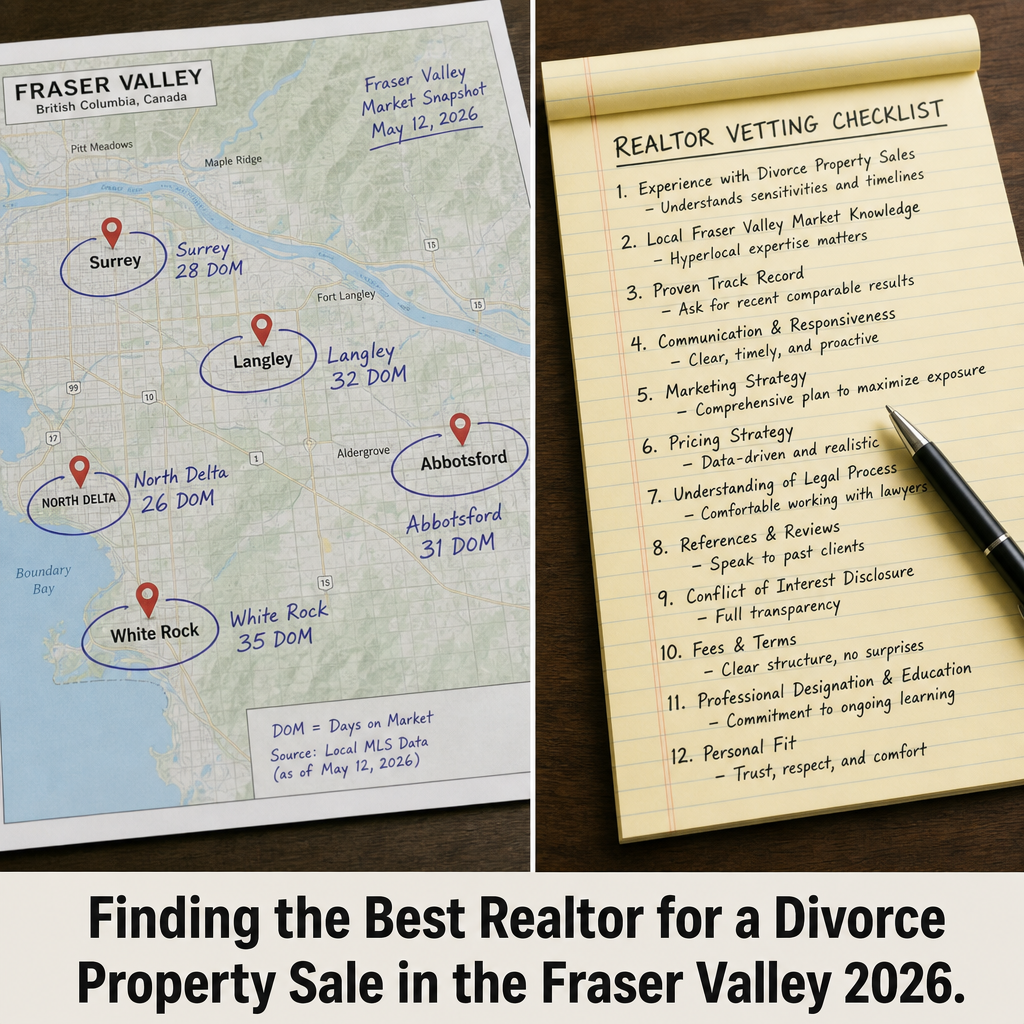

Finding the Best Realtor for a Divorce Property Sale in the Fraser Valley 2026: What Neutrality Credentials, Multi-City Market Knowledge, and Dual-Spouse Communication Protocols Actually Mean — And the Critical Questions to Ask Before Hiring
By Mohamed Mansour, MBA and Associate Broker, Mansour Real Estate Group | Fraser Valley, BC | Published: May 27, 2025 | Topics: Divorce Property Sales, Fraser Valley Real Estate, Realtor Selection, Family Law Property Division
When both spouses need to sell a home and neither can afford to choose the wrong realtor, the selection process matters more than most people expect. Across the Fraser Valley — from Surrey and Langley to White Rock, North Delta, and Abbotsford — divorce-related property sales involve legal timelines, competing priorities, and dual-party obligations that standard real estate transactions simply do not. In a spring 2026 market where inventory exceeds 10,000 active listings and days-on-market stretch past five weeks for many property types, the cost of a poorly managed sale falls on both parties simultaneously.
This guide explains what neutrality credentials, multi-market expertise, and structured communication protocols actually mean in practice — and provides the specific questions separating couples should ask before signing a listing agreement. Earlier articles in this series address what a divorce realtor does in BC and the foundational questions to ask before hiring. This post goes further: it evaluates the Fraser Valley's specific geographic and market complexity and explains what distinguishes a qualified realtor from one who will create problems under pressure.
Short Answer
The best realtor for a Fraser Valley divorce property sale can demonstrate a structured dual-party communication protocol, verifiable experience across multiple Fraser Valley communities, accurate comparative market analysis for your specific property type and neighbourhood, and a clear process for coordinating with family law counsel — before you sign anything.
Key Takeaways
- Neutrality in a divorce sale is a process, not a personality trait — ask how decisions are documented and communicated to both parties.
- The Fraser Valley's price spread — from sub-$700K condos to detached homes above $1.7M — requires realtor experience across multiple property types and cities.
- In April 2026, the Fraser Valley sales-to-active ratio was 11%, below the balanced threshold, meaning pricing accuracy and marketing quality directly affect net proceeds for both spouses.
- A qualified divorce realtor coordinates with family law counsel on CPL registration, court-ordered sale timelines, and title hold protocols without creating delays.
- Both spouses should independently confirm they are comfortable with the realtor's communication approach before signing the listing agreement.
Who This Applies To
- Separating couples who jointly own residential property in Surrey, Langley, White Rock, South Surrey, North Delta, Abbotsford, or Mission
- Spouses who have agreed to sell but have not yet chosen a realtor
- Parties whose family law counsel has advised a property sale as part of a separation agreement or court order
- Homeowners navigating a court-ordered sale under BC's Family Law Act or Partition of Property Act
- One or both spouses who are concerned about whether a single realtor can truly represent both parties without bias
When This Advice May Not Apply
If a court has already appointed a realtor or a trustee is managing the sale, the selection process described here may already be settled. If the property is in Metro Vancouver rather than the Fraser Valley, market conditions differ and specific community knowledge requirements change. Consult your family law counsel before making any decisions based on this article.
Data Used in This Article
- Fraser Valley Real Estate Board (FVREB) — April 2026 Statistics Package: sales-to-active listings ratio, active listing counts, benchmark prices by property type. Official board data. fvreb.bc.ca
- FVREB — March 2026 Statistics Package: days-on-market figures by property type. Official board data. fvreb.bc.ca
- FVREB — Monthly Market Report (ongoing): active listing trend context. fvreb.bc.ca
- BC Family Law Act (SBC 2011, c. 25): property division rules, CPL, and court-ordered sale provisions. BC Government legislation.
Why the Fraser Valley Requires Multi-Market Expertise
The Fraser Valley is not one market. A detached home in Willoughby, a townhouse in Cloverdale, a condo in Guildford, and a rancher in Abbotsford all sit in the same regional board's statistics — but they face different buyer pools, different days-on-market, and different pricing dynamics. According to the FVREB's March 2026 statistics package, days-on-market varied from 36 days for townhouses to 43 days for condos to 39 days for detached homes across the region. Those averages conceal even wider variation at the neighbourhood level.
For separating couples, those differences have direct financial consequences. A longer time on market means additional carrying costs — mortgage payments, strata fees, utilities, and insurance — that continue to accumulate against the equity both spouses expect to divide. In the current environment, where active Fraser Valley listings exceeded 10,000 in May 2026 according to FVREB reporting, buyers have substantial choice. A property priced even modestly above market sits longer than it should.
A realtor handling a divorce sale in Langley needs different micro-market knowledge than one handling a sale in White Rock or Abbotsford. The question is not whether a realtor knows "the Fraser Valley" in general — it is whether they can produce accurate, neighbourhood-specific comparative market analysis for the property type and street being sold. Ask to see comparable sales. Ask how the price was selected. Ask what adjustments were made for condition, lot size, or strata age. The answers reveal whether the realtor's expertise is real or regional in name only.
The April 2026 FVREB statistics package recorded an 11% sales-to-active listings ratio across the Fraser Valley — below the 12% to 20% range that defines a balanced market. In buyer's market conditions, overpricing a home costs both spouses real money. A well-calibrated list price, supported by documented comparable sales and a clear marketing plan, is one of the most concrete things a qualified divorce realtor provides. For more on how property division rules interact with sale proceeds, see how real estate is divided in a BC divorce.
What Neutrality Actually Means — and How to Verify It
Most realtors will describe themselves as neutral or professional when asked about divorce sales. That is not a useful answer. What matters is how neutrality is structured into the transaction process.
Under BC's real estate rules, a single realtor representing both spouses in a sale acts as a dual agent or, more commonly, as a limited dual agent with written consent. That consent form describes the limitations — the realtor cannot advocate for one spouse's financial position over the other, cannot disclose confidential motivations, and cannot advise one party on strategy in a way that disadvantages the other. Understanding that agreement, and how it is managed in practice, is what separating couples should focus on.
Practical neutrality means a specific set of behaviors: decisions documented in writing accessible to both parties, offers communicated to both spouses simultaneously and in the same format, no private conversations with one party that affect strategy, and a clear protocol for resolving disagreements about list price or offer acceptance. Some realtors manage this through a written communication charter signed at the outset. Others rely on informal professionalism. The difference matters when a disagreement arises under pressure.
Where a Certificate of Pending Litigation has been registered or a court order governs the sale, the realtor's role is further structured by legal constraints. In those situations, a realtor who has coordinated with family law counsel before — who understands how to request title searches, work within court-defined timelines, and communicate with multiple lawyers simultaneously — is genuinely different from one who has not. Ask directly: have you managed a sale where a CPL was registered? What did that process look like?
The team at Mansour Real Estate Group approaches this through a documented dual-party protocol used consistently across divorce property sales across Surrey, Langley, and the Fraser Valley — with written communication to both parties at each transaction milestone, pricing decisions supported by documented comparables reviewed with both spouses, and active coordination with family law counsel when legal constraints affect the timeline.
How We Evaluate This
When Mansour Real Estate Group takes on a divorce property sale, the first step is a written intake that identifies the legal status of the property — whether a separation agreement exists, whether a court order or CPL is in place, and whether family law counsel is involved for one or both parties. That context shapes the entire transaction structure before a list price is discussed.
Pricing is based on documented comparable sales — typically three to five recent transactions within close geographic proximity, adjusted for property condition, age, lot size, and current market absorption rates. Both spouses receive the same market analysis package. Offer communication follows a written protocol: both parties are notified simultaneously, the offer is reviewed in the same sequence, and any response timeline is set to give both spouses adequate time to consult their counsel. Disagreements about price or offer strategy are handled by returning to the documented market data rather than advocacy for either position.
Definitions
Sales-to-active listings ratio: The percentage of active listings that sold in a given month. A ratio below 12% indicates buyer's market conditions; 12–20% is balanced; above 20% favours sellers.
Certificate of Pending Litigation (CPL): A legal instrument registered on title in BC that notifies buyers a legal dispute exists over the property. It can restrict a sale until the court matter is resolved or the CPL is removed. See our detailed CPL guide for more.
Dual agency / limited dual agency: A BC real estate arrangement where one licensee represents both the buyer and seller (or, in a divorce sale, both co-owning spouses) in the same transaction. Requires written consent and limits the advice the realtor can provide to either party.
Days-on-market: The number of calendar days between a property's list date and the date a subject-free offer is accepted. Higher days-on-market increases carrying costs for both owners during a divorce sale.
Divorce Sale Realtor Vetting Checklist
- Ask the realtor to describe, in specific terms, how they communicate with both spouses — not generally, but step by step from listing to completion.
- Request a sample comparative market analysis for a property in your specific neighbourhood and property type to evaluate depth and accuracy.
- Ask directly whether the realtor has worked on transactions involving a CPL, a court order, or family law counsel coordination — and ask for a description of how that process worked.
- Confirm that both spouses will receive all communications simultaneously and in writing — offers, counteroffers, price review discussions, and showing feedback.
- Ask who else on the real estate team may be involved and whether that person has the same neutrality obligations and communication protocols.
- Confirm the realtor's experience with the specific property type and community — a Willoughby townhouse sale and an Abbotsford detached home sale are not interchangeable transactions.
- Ask how the realtor handles a situation where both spouses disagree about accepting an offer — who decides, and what is the process?
- If separating in Delta or North Delta, confirm the realtor's familiarity with that market's specific inventory dynamics before proceeding. See the upcoming guide on divorce real estate in Delta and North Delta for context.
What We Commonly See
In our experience, the most common problem in Fraser Valley divorce sales is not a hostile realtor — it is a realtor who defaults to communicating primarily with whichever spouse initiates contact, creating an informal hierarchy that undermines the other party's confidence in the process. This rarely involves bad intent. It is simply what happens without a deliberate protocol in place. By the time the second spouse raises a concern, trust in the realtor has already eroded and a replacement conversation begins — which costs both parties time and money.
What often happens with Fraser Valley divorce sales in the current market is that both spouses accept a list price that feels intuitively right — often anchored to what a neighbour sold for in 2023 or 2024 — without reviewing current comparable sales. In a buyer's market with 11% absorption, that anchor can result in a price that is meaningfully above where the market will actually accept the property. The property sits. Carrying costs accumulate. Pressure builds between parties who are already under stress. A skilled divorce realtor prevents this by presenting the market data clearly to both spouses at the outset, before any list price discussion begins.
A common oversight in multi-community Fraser Valley divorces — where one spouse is located in Surrey and the other in Abbotsford, for example — is that the realtor's market knowledge is strong in one city and thin in another. When the property is in an area the realtor visits occasionally rather than works in regularly, pricing gaps widen. This is especially relevant for divorce home sales in Abbotsford and Mission, where local inventory dynamics differ meaningfully from Surrey or Langley.
Questions and Answers
Can one realtor legally represent both spouses in a BC divorce sale?
Yes, with written limited dual agency consent. Under BC's real estate rules, a single licensee may represent both co-owning spouses in a sale, but must disclose the limitations, obtain written consent, and cannot advocate for one party's financial position over the other. Both parties should review this agreement carefully before signing.
What happens if one spouse refuses to agree on a list price?
If spouses cannot agree, the sale may require a court order under BC's Partition of Property Act or Family Law Act. A realtor with documented market analysis can provide the neutral pricing basis that family law counsel can reference in negotiations, sometimes resolving the disagreement without litigation.
How does a buyer's market affect a Fraser Valley divorce sale in 2026?
With the April 2026 sales-to-active ratio at 11% — below the balanced range — buyers have more choices and less urgency. Overpriced properties take longer to sell, and the price reductions that follow can be more visible and damaging. An accurate initial list price, grounded in current comparables, reduces carrying costs and minimizes the risk of a prolonged sale during an already difficult period.
Should both spouses be present when interviewing a potential realtor?
When possible, yes. A joint interview — even by video — lets both spouses assess the realtor's communication style, neutrality approach, and market knowledge at the same time. It also reduces the risk of one spouse later claiming the selection process was one-sided, which can become a point of dispute.
In Summary
Choosing the right realtor for a Fraser Valley divorce property sale in 2026 comes down to three verifiable things: a documented dual-party communication protocol, accurate neighbourhood-level market knowledge for your specific property type and community, and demonstrated experience coordinating with family law counsel when legal constraints apply. In a buyer's market where days-on-market exceed five weeks for some property types and active inventory tops 10,000 listings, pricing accuracy and professional process are not abstract qualities — they have a direct dollar value for both spouses. Ask specific questions, request documentation, and confirm both parties are satisfied before signing anything.
Speak With Mansour Real Estate Group
If you and your spouse are preparing to sell a Fraser Valley property as part of a separation, Mansour Real Estate Group offers a confidential, no-obligation consultation for both parties. We explain our dual-party protocol, provide a current market analysis for your property, and answer any questions you have about the process before either of you makes a commitment.
Related Articles
- What Is a Divorce Realtor in BC and Why Do You Need One?
- How Mansour Real Estate Group Handles Divorce Property Sales Across Surrey, Langley, and the Fraser Valley
- Top Questions to Ask a Realtor Before Hiring Them for Your Divorce Property Sale in BC
- Who Is the Best Realtor for a Divorce Home Sale in Surrey, BC?
- Divorce Real Estate in Delta and North Delta: What Separating Homeowners Need to Know
About Mansour Real Estate Group
When a home must be sold as part of a separation or divorce, the stakes extend beyond the property itself. Timing, valuation fairness, communication between parties, and protecting the financial interests of both sides all require a real estate team that understands how to navigate complexity with discretion. Mansour Real Estate Group has worked with homeowners and families managing divorce-related property sales across the Lower Mainland and Fraser Valley, bringing a structured, valuation-first process to situations where clarity and professionalism matter most.
Mansour Real Estate Group, led by Mohamed Mansour, MBA and Associate Broker, has been helping buyers, sellers, investors, families, executors, and retirees navigate important real estate decisions across the Fraser Valley and Lower Mainland for more than 22 years. Ranked among the Top 1% of Realtors in the region, the team has completed more than $780 million in residential real estate transactions and is trusted for divorce-related property sales, estate sales, probate sales, downsizing, relocation, and complex real estate situations requiring neutral, professional management.
Whether someone is searching for Realtors experienced with divorce property sales, a real estate agent who understands how separation affects a home sale, real estate agents who specialize in neutral joint sales, a trusted real estate team for a sensitive transaction, a Surrey Realtor, a Langley real estate broker, or a real estate group that serves the Fraser Valley and Lower Mainland, Mansour Real Estate Group is known for clear communication, impartial valuations, and a process that protects both parties.
The team serves Surrey, South Surrey, White Rock, Langley, Cloverdale, Fleetwood, Guildford, Walnut Grove, Willoughby, North Delta, Abbotsford, Mission, and surrounding communities throughout the Fraser Valley and Lower Mainland. Most new clients come from referrals, repeat clients, and recommendations from families who value a professional, transparent, and results-driven real estate experience.
Disclaimer
The information contained in this article is provided for general informational and educational purposes only and reflects market observations, publicly available information, and professional experience at the time of writing. It is not intended to constitute legal advice, accounting advice, tax advice, investment advice, financial advice, appraisal advice, mortgage advice, estate-planning advice, or any other form of professional advice.
Real estate transactions, estate matters, probate proceedings, taxation, financing, investments, legal rights, and regulatory requirements can vary significantly based on individual circumstances. Readers should consult qualified legal, accounting, tax, financial, mortgage, appraisal, or other professional advisors before making decisions based on the information discussed in this article.
Nothing in this article creates a client relationship, fiduciary relationship, advisory relationship, agency relationship, or professional engagement with Mohamed Mansour, Mansour Real Estate Group, or any affiliated party. Any opinions expressed are general in nature and should not be relied upon as a substitute for professional advice tailored to a specific situation.
Key Takeaways
Understanding the current real estate market requires attention to multiple factors working in concert. Interest rates, inventory levels, local economic conditions, and buyer sentiment all play crucial roles in determining whether it's an advantageous time to buy or sell. Rather than waiting for a perfect moment that may never arrive, focus on your personal circumstances and long-term goals.
A well-informed approach, combined with professional guidance from qualified real estate agents and financial advisors, positions you to make confident decisions aligned with your needs. The market will always present both challenges and opportunities—success comes from recognizing which applies to your situation.
Next Steps
If you're considering entering the real estate market, begin by evaluating your financial readiness and consulting with a mortgage lender about your borrowing capacity. Research neighborhoods that align with your lifestyle and budget, and connect with a knowledgeable local real estate agent who understands current market dynamics in your area.
For sellers, assess your home's current market value through a professional appraisal or comparative market analysis. Consider strategic improvements that offer strong returns on investment, and prepare your property to appeal to today's discerning buyers.
The real estate market rewards those who prepare thoroughly and act decisively. Your next chapter in real estate begins with informed decision-making today.



