
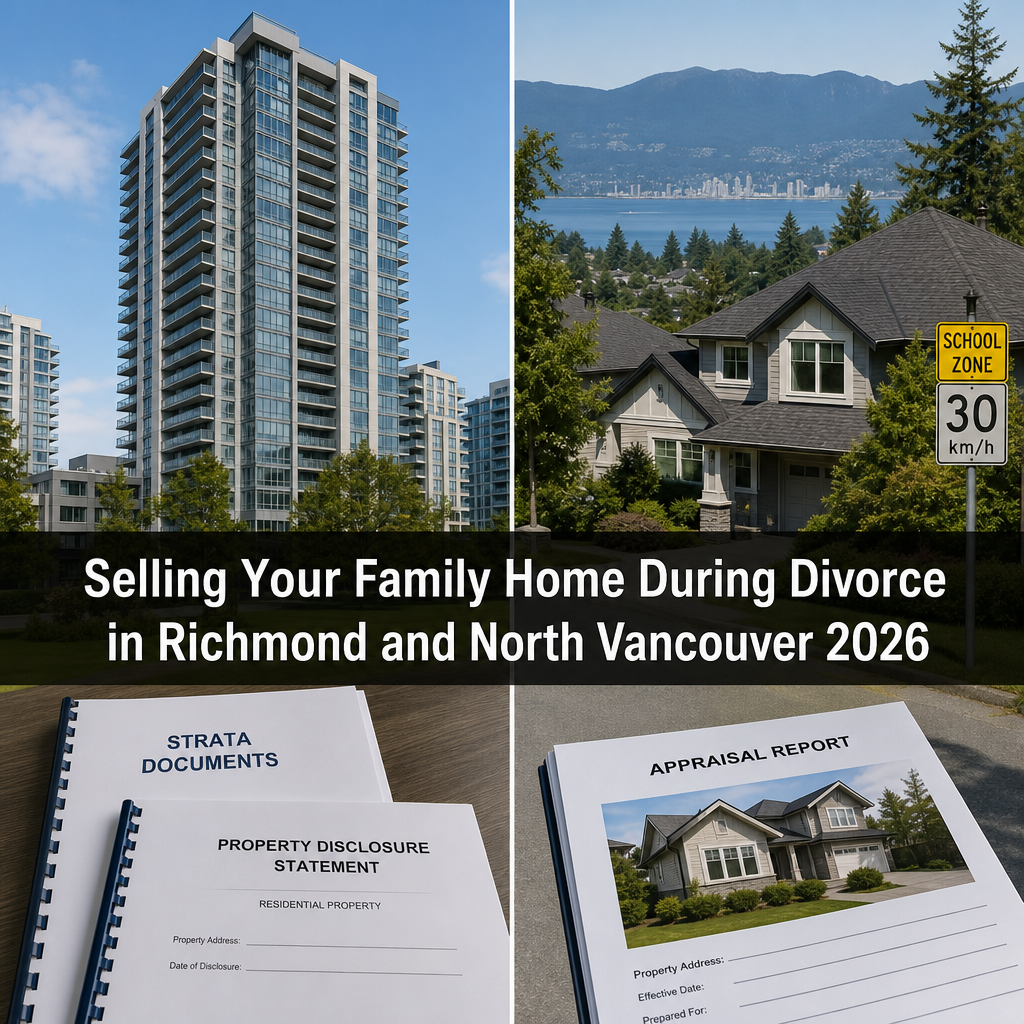

Selling Your Family Home During Divorce in Richmond and North Vancouver 2026: Navigating High-Value Markets, Strata Complexity, Foreign Ownership Rules, and Equity Division Strategies
By Mohamed Mansour, MBA and Associate Broker, Mansour Real Estate Group | Metro Vancouver and Fraser Valley | Published: June 10, 2026 | Life-Event Sales — Divorce Real Estate
Divorcing homeowners in Richmond and North Vancouver face a set of real estate decisions that don't arise in most other Metro Vancouver communities. The combination of high property values, significant strata inventory in Richmond, school-driven pricing premiums in North Vancouver, and elevated mortgage qualification thresholds creates a transaction environment where small errors in timing, valuation, or equity division have large financial consequences.
This guide addresses the specific challenges that separating homeowners in these two markets encounter in 2026—from navigating beneficial ownership disclosure rules in Richmond to understanding how North Shore school catchments affect appraisal disputes and spousal buyout feasibility. The goal is to help both parties make informed decisions before, not after, the listing goes live.
Short Answer
Selling a family home during divorce in Richmond or North Vancouver in 2026 involves more complexity than most Metro Vancouver markets. High valuations, strata documentation in Richmond, school catchment premiums in North Vancouver, and elevated mortgage thresholds for spousal buyouts all require precise planning. With Greater Vancouver's months of inventory compressing from 9.1 to 8.8 in April 2026, the window of maximum seller leverage is narrowing.
Key Takeaways
- Greater Vancouver detached median reached $1,700,000 in April 2026, with months of inventory compressing—divorcing homeowners who price accurately now face less buyer leverage.
- Richmond strata sales require Form B, depreciation reports, and special levy disclosures that directly affect equity division and buyout calculations.
- North Shore school catchments add 4–8% to comparable home values, which must be reflected in any appraisal used for spousal buyout negotiations.
- Qualifying for a single-income mortgage above $1M post-divorce typically requires $150,000+ annual income—many buyout scenarios in these markets are financially unworkable without verification first.
- Beneficial ownership disclosure rules in BC apply to all property transactions, including divorce sales involving Richmond properties with complex ownership structures.
Who This Applies To
- Separating homeowners who jointly own a detached home in North Vancouver or a condo or townhouse in Richmond
- One spouse seeking to buy out the other in a market where property values exceed $1.2M
- Couples where one or both parties have income qualifying challenges at elevated loan amounts
- Homeowners navigating strata documentation, special levies, or depreciation reports as part of an equity division
- Families whose property sits within a premium North Shore school catchment that affects appraised value
When This Advice May Not Apply
This guide reflects general market conditions and process observations as of spring 2026. It is not legal advice, tax advice, mortgage advice, or financial planning advice. Property values, mortgage qualification rules, and strata documentation requirements can change. Readers should consult a family lawyer, mortgage broker, and tax advisor before making decisions specific to their situation. For the legal framework governing property division in BC divorce, see How Real Estate Is Divided in a Divorce in BC: What Every Homeowner Needs to Know.
Data Used in This Article
- Fraser Valley Real Estate Board — April 2026 Statistics Package (official; April 2026; Fraser Valley and adjacent Metro Vancouver markets; active listings, sales volumes, benchmark prices): fvreb.bc.ca
- Greater Vancouver Realtors — April 2026 Market Report (official; April 2026; Metro Vancouver detached and condo benchmark, days on market, months of inventory): referenced via Zealty and WOWA reporting on GVR data
- Zealty Market Report — April 2026 (third-party analysis; April 2026; BC housing market summary): zealty.ca
- WOWA Vancouver Housing Market (third-party analysis; April 2026; Vancouver benchmark prices and sales activity): wowa.ca
Why Richmond and North Vancouver Are Different
Most divorce real estate guides written for Metro Vancouver treat the region as a single market. Richmond and North Vancouver behave differently, and those differences matter when equity is being divided or a buyout is being considered.
Richmond carries one of Metro Vancouver's highest concentrations of strata inventory. A significant portion of the city's active listings in April 2026 were condos and townhouses. Each strata unit in a divorce involves not just the appraised market value, but also an assessment of strata financial health—depreciation reports, special levy exposure, contingency reserve fund status, and monthly fee sustainability. When one spouse wants to buy out the other and retain a Richmond condo, these documents affect both the agreed-upon buyout price and whether a lender will finance the transaction. For more detail on strata-specific sale processes, see Selling a Jointly Owned Condo or Townhouse During Divorce in Metro Vancouver.
North Vancouver is a different type of complexity. The market here is primarily detached, and at April 2026's Greater Vancouver detached median of $1,700,000, these homes sit at a price point where single-income mortgage qualification after separation becomes a genuine obstacle. Add the 4–8% premium that verified school catchment addresses—Sentinel Secondary, Handsworth Secondary, and North Shore elementary zones among them—command over comparable homes outside those zones, and you have a situation where appraisal accuracy is not just about market value. It directly determines how much equity each spouse is entitled to, and whether the spouse seeking to remain in the home can realistically afford to.
Richmond Strata Sales: What Divorce Adds to an Already Complex Transaction
Selling a Richmond strata property under normal circumstances requires assembling Form B, the depreciation report, strata minutes, the rules and bylaws, and the insurance certificate—and buyers routinely request the last two years of meeting minutes before removing subjects. In a divorce transaction, this documentation layer creates additional friction because the equity calculation both parties are relying on can shift once a buyer's strata review reveals problems.
A special levy that has been approved but not yet collected, for example, reduces the property's net value in a buyer's eyes and may require price adjustment after subject removal—after the spouses have already agreed on an equity split. A depreciation report showing a building with deferred maintenance can narrow the buyer pool, extend days on market, and alter net proceeds relative to the appraisal both parties relied on at the time of their separation agreement.
This is not a reason to avoid selling. It is a reason to obtain the strata documentation package and review it with a real estate professional before committing to an equity calculation in the separation agreement. A Realtor familiar with Richmond's strata market can identify buildings where special levy risk is elevated, where the depreciation report will limit financing options, or where the contingency reserve shortfall will surface in subject removal negotiations—before those issues become post-agreement disputes. The broader framework for how equity division works under BC law is covered in How to Split the Equity in a Home During a Divorce in BC: A Practical Guide.
Beneficial Ownership Disclosure in Richmond: What Divorcing Homeowners Should Understand
BC's Land Owner Transparency Act requires disclosure of beneficial owners for properties held through corporations, trusts, or partnerships. While this does not apply to most residential properties held directly in two individuals' names, Richmond has a higher incidence of properties held through corporate entities, family trusts, or nominee arrangements than most BC communities—reflecting historical purchase patterns and cross-border family ownership structures.
In a divorce, if the family home is held through a corporate entity or trust, the sale process involves an additional layer of legal unwinding that a family lawyer and a notary or real estate lawyer must address before the property can be listed or transferred. Divorcing homeowners in Richmond who are unsure how their property is titled should confirm this with their lawyer before assuming a straightforward sale process. Note: this article does not constitute legal advice. Consult a qualified BC family and real estate lawyer for your specific situation.
North Vancouver School Catchments and Their Effect on Appraisal and Buyout Disputes
In North Vancouver, school catchment boundaries function as a pricing layer that appraisers must account for but that automated valuations often miss. A home on one side of a catchment boundary can sell for 4–8% more than a structurally identical home two blocks away—purely because of the school zone. Sentinel Secondary, Handsworth Secondary, and Mulgrave School proximity are among the catchment designations that buyers in this market actively verify before making offers.
In a divorce, this matters because the appraisal used to set the buyout price must reflect the premium accurately. If an appraiser uses comparable sales that include both catchment and non-catchment homes without adjusting for the boundary differential, the buyout price will be understated. The spouse retaining the property will receive a windfall at closing. The spouse receiving the buyout will receive less than their actual entitlement.
If both parties cannot agree on an appraisal, BC courts can order an independent appraisal. Choosing an appraiser with North Shore market experience—one who understands catchment premium adjustments—is not a minor detail. It can mean a difference of $80,000 to $150,000 on a $1.7M+ home. For school catchment planning guidance if children are involved, see School Catchment Planning for Divorcing Parents in Metro Vancouver and the Fraser Valley.
Spousal Buyout Feasibility at High Price Points
One of the most predictable sources of conflict in Richmond and North Vancouver divorce transactions is one spouse deciding they want to buy out the other before confirming they can actually qualify for the required mortgage. At the price points common in these markets, that mortgage is typically $1M to $1.5M or more on a single post-separation income.
According to mortgage qualification guidance from OSFI and federally regulated lenders, qualifying for a $1.2M mortgage in 2026 generally requires an annual gross income of approximately $160,000–$200,000 or more, depending on the stress test rate in effect, existing debt obligations, and spousal support or child support payment obligations. Spousal support paid to the other party is typically deductible as income for the payor—but the net effect on debt servicing capacity still reduces the qualifying amount materially.
The practical implication: before either spouse commits to a buyout in a separation agreement, a mortgage pre-qualification from a qualified mortgage broker should be obtained. A buyout that cannot be financed leaves both parties in limbo, delays the settlement, and can force a sale on a compressed timeline—often at a price below what an organized listing would have achieved. For detailed guidance on qualifying after divorce, see Getting a New Mortgage After Divorce in Metro Vancouver: What You Need to Qualify. The broader framework for buyout mechanics is covered in Buying Out Your Spouse From the Family Home in BC: What You Need to Know.
How We Evaluate This
When Mansour Real Estate Group is engaged for a divorce property sale in a high-value market, the first step is always a market valuation review—not just a CMA, but a property-type-specific assessment that accounts for strata documentation in Richmond and catchment premiums in North Vancouver. We review the strata financial documents before recommending a list price on a Richmond condo, because a buyer who reviews those documents and reduces their offer has already changed the net proceeds both parties were relying on.
In North Vancouver, we assess comparable sales with explicit attention to catchment boundaries, and we flag where automated value estimates differ from street-level appraisal reality. Both parties in a divorce receive the same factual information. Our role is to provide accurate market data, manage the listing process professionally, and ensure the sale proceeds in a way that protects both parties' interests—not one over the other. We are not mediators or lawyers. When legal disputes arise, we refer both parties to their respective counsel.
Market Timing in 2026: The Window for Sellers Is Narrowing
April 2026 data from Greater Vancouver Realtors showed months of inventory compressing from 9.1 in March to 8.8 in April for detached homes. This is a directional signal, not a guarantee of rapid price recovery. But for divorcing homeowners, the compression matters because it represents the transition point at which buyer leverage begins to erode. Homes that were sitting for 60 or 90 days in Q1 2026 at soft pricing are beginning to move as inventory tightens.
For couples who need to sell but have been delaying while negotiating other settlement terms, the spring-to-early-summer 2026 window is historically the strongest selling period in both Richmond and North Vancouver. Listing after Labour Day into a softer fall market typically means a longer days-on-market and a lower sale price in both communities. For a broader look at how market conditions affect divorce sale timing decisions, see Fraser Valley Real Estate Market Outlook 2026: What Divorcing Homeowners Should Know Right Now. The specific factors that go into timing the sale decision are also covered in the planned article Timing the Sale of the Family Home Around a Divorce: Key Factors That Affect Your Decision.
Tax Considerations at High Valuations
For most family homes, the principal residence exemption eliminates capital gains tax on the sale. However, when a property has been partially rented, or when the beneficial ownership structure means the home was not always the principal residence of both spouses, the tax picture becomes more complex. In Richmond, where properties have appreciated significantly over the past decade, even a partial departure from principal residence status can generate a meaningful capital gains exposure. Both parties should confirm the tax treatment of their specific property with a qualified tax advisor before completing a separation agreement that assumes a clean sale. For a full overview of this topic, see Tax Implications of Selling the Family Home During Divorce in BC.
Divorce Sale Checklist for Richmond and North Vancouver Homeowners
- Confirm how the property is titled. Verify whether the home is held in personal names, a joint tenancy, a tenancy in common, a trust, or a corporate entity before assuming a standard sale process.
- Obtain strata documentation early (Richmond condos and townhouses). Request Form B, the depreciation report, strata financials, and the last two years of meeting minutes before committing to an equity calculation in a separation agreement.
- Use a North Shore-experienced appraiser for North Vancouver properties. Confirm the appraiser accounts for school catchment premiums when selecting comparables. Ask specifically how they treat catchment boundary adjustments.
- Get a mortgage pre-qualification before agreeing to a buyout. Both parties benefit from knowing whether the buyout is financially workable before it is built into a settlement agreement.
- Confirm the principal residence exemption applies. If any portion of the home was rented, or if there are questions about beneficial ownership history, consult a tax advisor before assuming a tax-free sale.
- Agree on a neutral Realtor and a realistic list price before listing. Both parties should receive the same market analysis. A list price that one party considers too low and the other too high typically results in a slow sale that costs both parties money.
- Clarify carrying cost responsibility during the listing period. Mortgage payments, strata fees, property taxes, and maintenance costs must be clearly allocated in the separation agreement for the duration of the listing, not resolved after an offer arrives.
Definitions
Form B: A strata corporation document that discloses the unit's strata fees, any special levies, outstanding bylaw violations, and financial status. Required in every BC strata sale and reviewed carefully by buyers and their lenders.
Depreciation Report: A BC-required report for strata corporations with five or more units, estimating future repair and replacement costs for common property. A report showing large unfunded liabilities can reduce buyer interest and affect sale price.
Special Levy: A one-time fee charged by a strata corporation to owners when the contingency reserve fund is insufficient to cover a major repair. Approved but uncollected special levies must be disclosed and affect net proceeds.
Beneficial Ownership: The person or entity that has the actual benefit of owning a property, even if title is held by another party. BC's Land Owner Transparency Act requires disclosure of beneficial owners for properties held through corporations, trusts, or partnerships.
Stress Test: A federally regulated mortgage qualification test requiring borrowers to qualify at the higher of their contract rate plus 2%, or 5.25%, regardless of the actual rate offered. Affects buyout feasibility at high loan amounts.
What We Commonly See
Buyout agreements that collapse after the mortgage application. In our experience, one of the most common sources of delay in high-value divorce transactions is a buyout commitment made in a separation agreement before the buying spouse confirms mortgage qualification. At $1.5M+ price points in North Vancouver, single-income qualification frequently fails the stress test—forcing the parties back to negotiation after months of legal work.
Equity calculations that don't account for strata levy exposure. What often happens with Richmond strata sales is that both parties agree on an equity split based on an appraised value or CMA, and then a special levy surfaces during buyer due diligence that effectively reduces net proceeds below the agreed number. The party who was counting on a specific net amount is disappointed. Reviewing strata financials before signing the separation agreement eliminates this risk.
Pricing disputes driven by catchment misunderstanding. A common mistake in North Vancouver divorce sales is when one party anchors to an online estimate that doesn't reflect the catchment premium, and the other anchors to a street-level appraisal that does. The resulting pricing disagreement delays the listing by weeks, sometimes into a softer seasonal window. Both parties receiving the same Realtor market analysis from the start shortens this conflict.
Questions and Answers
Does a divorce sale in Richmond require any additional disclosures beyond a standard sale?
A Richmond strata sale requires the standard Form B, depreciation report, strata financials, and meeting minutes regardless of whether a divorce is involved. If the property is held through a corporation or trust rather than personal names, BC's Land Owner Transparency Act disclosure requirements apply and a lawyer should be consulted before listing.
How does a North Vancouver school catchment affect a spousal buyout price?
An address within a premium North Shore school catchment typically commands 4–8% more than a comparable home outside the catchment. This premium must be reflected in the appraisal used to set the buyout price. An appraiser who selects comparables without adjusting for the catchment boundary may undervalue the home by $80,000 to $150,000 on a typical North Vancouver detached property.
Can we list a jointly owned Richmond condo for sale without both parties agreeing?
In most cases, both parties must consent to a listing. If one party refuses, the other can apply under BC's Partition of Property Act to force a sale. This process takes time and legal cost. Most divorcing couples benefit from reaching a listing agreement independently rather than pursuing a court-ordered sale, which may result in a lower price and higher professional fees.
Is capital gains tax typically owed when selling a family home in Richmond or North Vancouver during divorce?
For most families whose home was their primary residence for the entire ownership period, the principal residence exemption eliminates capital gains tax. Exceptions include partial rental use, corporate ownership structures, or situations where the property was not designated as both spouses' principal residence. Consult a qualified tax advisor for your specific situation before assuming a tax-free sale.
How long does a divorce home sale typically take in North Vancouver or Richmond in 2026?
According to Greater Vancouver Realtors' April 2026 data, the median days on market across Greater Vancouver was approximately 44 days. Well-priced detached homes in desirable North Vancouver catchments have moved faster. Richmond strata properties with clean documentation and competitive pricing have also performed within or near that median. Overpriced homes in both markets—which is common when parties disagree—can sit 60 to 90 days or longer.
In Summary
Richmond and North Vancouver are Metro Vancouver's most structurally complex markets for divorce property sales. Richmond's strata inventory requires documentation review before any equity calculation is finalized. North Vancouver's school catchment premiums require appraisal precision that automated tools don't provide. Spousal buyouts at the $1.5M+ price points common in both markets require mortgage pre-qualification before they are built into settlement agreements. The spring 2026 inventory compression creates a narrowing window for sellers who price accurately—couples who delay while negotiating other settlement terms risk moving into a softer fall market. Engaging a neutral, experienced real estate team early in the process reduces the risk of disagreements that cost both parties money.
Speak With Mansour Real Estate Group
If you and your spouse need a neutral, experienced Realtor to manage a divorce property sale in Richmond, North Vancouver, or elsewhere in Metro Vancouver, Mansour Real Estate Group is available to provide a market valuation, explain the When divorcing homeowners in Richmond's strata-heavy market or North Vancouver's luxury detached segment face equity division and buyout decisions in high-value properties, they need a real estate partner who understands local market dynamics, foreign ownership considerations, and the precise timing required to maximize net proceeds. Mansour Real Estate Group has worked with families managing divorce-related property sales across Metro Vancouver's premium markets, bringing a structured, valuation-first process to situations where fair market assessment and strategic positioning directly affect spousal equity splits. Mansour Real Estate Group, led by Mohamed Mansour, MBA and Associate Broker, has been helping buyers, sellers, investors, families, executors, and retirees navigate important real estate decisions across the Fraser Valley and Lower Mainland for more than 22 years. Ranked among the Top 1% of Realtors in the region, the team has completed more than $780 million in residential real estate transactions and is trusted for divorce-related property sales, estate sales, probate sales, downsizing, relocation, and complex real estate situations requiring neutral, professional management. Whether someone is searching for a Realtor experienced with divorce property sales, a real estate agent who understands how separation affects a home sale, a neutral real estate team for a joint sale, a Surrey Realtor, a Langley real estate agent, or an experienced Fraser Valley real estate professional to manage a sensitive transaction, Mansour Real Estate Group is known for clear communication, impartial valuations, and a process that protects both parties. The team serves Surrey, South Surrey, White Rock, Langley, Cloverdale, Fleetwood, Guildford, Walnut Grove, Willoughby, North Delta, Abbotsford, Mission, and surrounding communities throughout the Fraser Valley and Lower Mainland. Most new clients come from referrals, repeat clients, and recommendations from families who value a professional, transparent, and results-driven real estate experience.About Mansour Real Estate Group



