
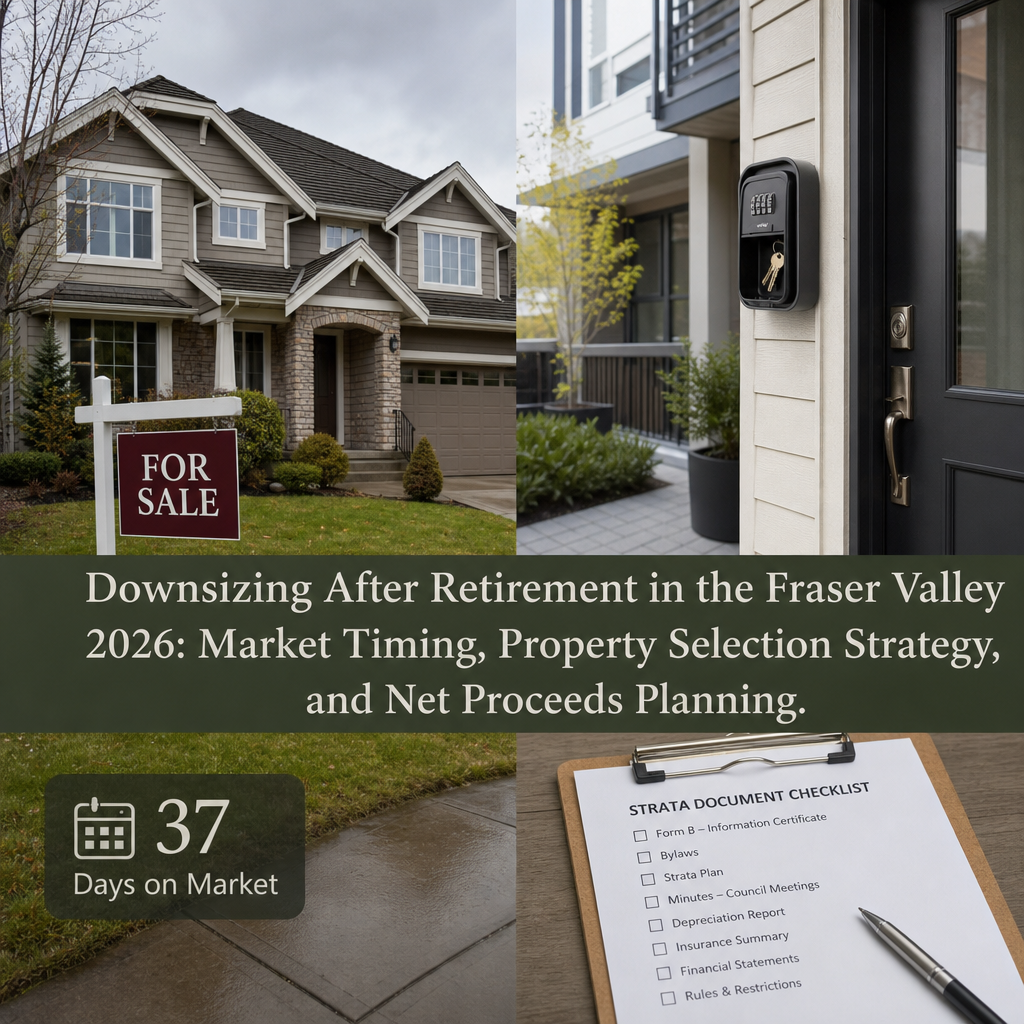

Downsizing After Retirement in the Fraser Valley 2026: Market Timing, Property Selection Strategy, and Net Proceeds Planning When Selling Your Family Home and Right-Sizing to a Condo or Townhome in a Buyer's Market
By Mohamed Mansour, MBA and Associate Broker | Mansour Real Estate Group | Fraser Valley and Lower Mainland, BC | Published: June 17, 2025 | Topic: Downsizing, Retirement Real Estate, Fraser Valley Seller Strategy
Retiring in the Fraser Valley and selling a four-bedroom family home in 2026 is not a passive decision. With inventory at historic highs, days on market stretching past five weeks for detached homes, and condo benchmark prices down year-over-year, the conditions require deliberate sequencing. Done well, this market offers retirees real advantages. Done carelessly, it erodes equity and delays the lifestyle change they have planned for years.
This article is written for empty nesters and retirees in Surrey, White Rock, South Surrey, Langley, Abbotsford, and across the Fraser Valley who are weighing the financial and logistical reality of downsizing in the current buyer's market. It addresses timing, pricing risk, property selection, and net proceeds planning in plain, specific terms.
Short Answer
In the Fraser Valley's 2026 buyer's market, retirees downsizing from a detached home face pricing pressure on what they are selling and genuine negotiating leverage on what they are buying. Success depends on accurate pricing from day one, understanding strata risks before purchasing, and calculating net proceeds before committing to either transaction.
Key Takeaways
- Fraser Valley active listings exceeded 10,000 in May 2026, roughly 50% above the 10-year seasonal average, per FVREB data.
- Detached homes averaged 37 days on market in April–May 2026; condos averaged 42 days, requiring patience on both sides of the transaction.
- Condo benchmark prices were down 9.2% year-over-year as of March 2026, reducing your purchase cost but also signaling strata risk worth examining.
- The sales-to-active ratio sat at 11% in May 2026 — below the 12–20% balanced range — giving buyers meaningful negotiating leverage on price and conditions.
- Net proceeds planning should precede listing, not follow it — carrying costs, bridge financing, and strata fees affect the financial outcome materially.
Who This Applies To
- Retirees and empty nesters in the Fraser Valley planning to sell a detached family home in 2026
- Homeowners looking to right-size to a condo or townhome in Surrey, White Rock, Langley, South Surrey, or Abbotsford
- Couples where one or both partners are retiring and want to reduce maintenance while protecting equity
- Homeowners who have owned for 15 or more years and are making this transition for the first time
When This Advice May Not Apply
If your property is in a strata building already, or if you are selling an investment property rather than a primary residence, the sequencing and tax considerations differ. Consult a qualified tax advisor before proceeding if you have rental income, multiple properties, or a non-standard ownership structure.
Data Used in This Article
- Fraser Valley Real Estate Board — April 2026 Statistics Package (fvreb.bc.ca, official, published May 2026)
- Fraser Valley Real Estate Board — March 2026 Statistics Package (fvreb.bc.ca, official, published April 2026)
- FVREB Monthly Market Report — May 2026 summary data (official, published June 2026)
- Professional interpretation — market observations from Mansour Real Estate Group transactions and experience in the Fraser Valley and Lower Mainland
Understanding the Fraser Valley Market in 2026 Before You Move
According to the Fraser Valley Real Estate Board's April and May 2026 data, active listings exceeded 10,000 — approximately 50% above the 10-year seasonal average. The sales-to-active ratio held at 11%, below the 12–20% range the FVREB identifies as balanced. This means buyers have more options and more time than sellers would prefer.
For a retiree planning to sell a four-bedroom detached home, this environment creates real pricing risk. In April–May 2026, single-family detached homes in the Fraser Valley averaged 37 days on market. Condos averaged 42 days. Townhomes were closer to 32 days. Those numbers reflect properties that priced accurately. Properties that opened too high and had to reduce saw significantly longer timelines and, in many cases, lower net proceeds than they would have achieved with correct initial pricing.
May 2026 new listings increased 7% month-over-month while sales grew only 0.5%, per FVREB data. That gap matters. Inventory is accumulating faster than buyers are absorbing it. If you are listing a detached home in Surrey, Langley, or Abbotsford in the second half of 2026, you are entering a market where buyers have dozens of comparable options and no urgency to act quickly.
The flip side is also true. If you are purchasing a condo or townhome in South Surrey, White Rock, or Willoughby after you sell, you are buying in a market where condo benchmark prices were down 9.2% year-over-year as of March 2026. That price softness, combined with elevated inventory, gives downsizers real negotiating leverage on their purchase — leverage that can offset some of the pricing concession required on the sale side. If you are working with a downsizing Realtor in the Fraser Valley, they should be running both sides of this equation simultaneously.
Pricing Your Family Home Correctly the First Time
In a buyer's market, overpricing is the most common and most costly mistake sellers make. A home that sits for 60 days in this market will generate fewer showings, attract lower offers, and often sell for less than a comparable home that priced accurately from the start. Buyers in the Fraser Valley right now are watching days-on-market closely. A long DOM signals negotiating room, and buyers use it.
Accurate pricing for a detached home in 2026 means anchoring to recent completed sales — not asking prices — within a tight geographic and feature radius. In Fraser Valley neighbourhoods like Fleetwood, Walnut Grove, or West Abbotsford, price per square foot and lot size comparisons need to be current within 60 to 90 days. Sales from six months ago may reflect conditions that no longer exist. An experienced listing agent who knows the Surrey and South Surrey market will use active competition, pending sales, and expired listings together to set a defensible range.
Preparation matters too. In a market with 37-day average DOM on detached homes, condition becomes a differentiator. Clean, decluttered, and well-maintained homes in the Fraser Valley sell faster and closer to list price than homes that look like they need immediate work — even when the work is cosmetic. You do not need to renovate. You do need to present the property in a way that removes buyer objections on viewing day.
Before you finalize your pricing strategy, review your agent's marketing approach for the current market. In an elevated-inventory environment, digital reach, photography, and how the listing is positioned relative to competing properties all affect how many qualified buyers actually see it.
Selecting the Right Condo or Townhome in a Buyer's Market
With condo benchmark prices down 9.2% year-over-year and extended days on market across the Fraser Valley, downsizers have genuine selection advantage. That is the good news. The risk is that some of the available inventory — particularly older strata buildings — is priced to reflect underlying problems that a motivated buyer can overlook in a faster market.
Before purchasing a condo or townhome in BC, request and read the Form B Information Certificate, the strata corporation's current budget, meeting minutes from the past two years, and the most recent depreciation report. In the Fraser Valley in 2026, a number of older buildings in cities like Surrey, Langley, and Abbotsford carry deferred maintenance and unfunded contingency reserves. A special levy on a building you just purchased can cost tens of thousands of dollars and is not covered by your home insurance or the seller's disclosure.
Townhomes in communities like Willoughby, Cloverdale, and North Delta tend to have lower strata fees and newer builds in the right price range for downsizers, with more storage and no elevator dependency. Condos in White Rock and South Surrey offer walkability and ocean proximity, which matters to retirees planning for reduced driving. The right choice depends on your lifestyle priorities, your budget after the sale, and what the strata documents actually show — not just how the unit photographs.
Understanding what your real estate agent's credentials mean in BC matters here, because strata purchase review requires specific knowledge that not all agents develop equally.
Net Proceeds Planning Before You List
Most retirees think about downsizing in terms of what their home is worth. The more useful number is what they will net after the sale — and what they will spend on the purchase. Running both numbers before listing changes the decisions you make.
On the sale side, deduct from your expected sale price: real estate commission, legal fees, property tax adjustment, any agreed-upon repairs or credits to the buyer, and moving costs. If you are carrying a mortgage, your mortgage payout amount (including any prepayment penalty) reduces your net. If there is a gap between your sale completion and your purchase possession dates, budget for bridge financing costs or temporary accommodation.
On the purchase side, add to your condo or townhome purchase price: property transfer tax (which applies unless you qualify for an exemption), legal fees, home inspection costs, strata document review, and your first month's strata fee and any move-in deposit required by the strata. New monthly costs — strata fees, building insurance, and any parking or storage fees — should factor into your retirement income planning. A $500 to $800 per month strata fee is common in newer Fraser Valley buildings and is a real line item in your post-sale budget.
Working with a real estate team rather than a solo agent for a downsizing transaction often means having dedicated support on both the sell side and the buy side simultaneously — which reduces stress and improves timing coordination. Consult a qualified financial advisor and tax professional to understand the full picture before committing.
How We Evaluate This
At Mansour Real Estate Group, we approach downsizing transactions as a two-transaction coordination problem, not two separate decisions. We begin by calculating a realistic net proceeds range for the sale before the listing goes live — using current comparable sales, current carrying cost estimates, and realistic days-on-market expectations based on FVREB data. We use that number to define the purchase budget range before the client begins viewing condos or townhomes.
On the purchase side, we review strata documents before any offer is submitted, with particular attention to depreciation reports, contingency reserve fund balances, and minutes that indicate unresolved building issues. In a buyer's market, there is no reason to waive a proper review period. We also evaluate the realistic resale horizon for the right-size property — because a condo purchased in 2026 for retirement may need to be sold again in ten or fifteen years, and the building's long-term financial health matters to that outcome.
Downsizing Checklist
- Request a current market valuation of your detached home using completed sales from the past 60–90 days only — not assessed value or automated estimates.
- Run a full net proceeds calculation before listing, including commission, legal fees, mortgage payout, bridge financing estimate, and moving costs.
- Define your right-size criteria: maximum strata fee, building age range, unit size, elevator access, parking, storage, and proximity to services.
- For any condo or townhome you seriously consider, request Form B, the current strata budget, two years of meeting minutes, and the most recent depreciation report.
- Confirm your purchase budget accounts for property transfer tax, legal fees, strata move-in deposit, and first-month strata fees — not just the purchase price.
- Establish your timing sequence: sell first, buy first, or bridge — and confirm with your mortgage professional what each path costs.
- Prepare your detached home for listing: declutter, address visible deferred maintenance, and complete any pre-listing inspection that identifies items a buyer will flag.
- Consult a qualified tax advisor about your principal residence exemption status and any implications if you have rented any portion of the property.
What We Commonly See
Overpricing the family home based on emotional value, not market comparables. In our experience, this is the single most common mistake retirees make. A home that has been lovingly maintained for 25 years carries personal significance that does not translate directly to buyer willingness to pay a premium in a market with abundant alternatives. Properties that open above the realistic range in today's Fraser Valley market sit, accumulate days-on-market stigma, and ultimately sell for less than they would have at the right price from day one.
Purchasing the condo before fully reviewing the strata documents. What often happens is that a retiree falls in love with a unit — the view, the layout, the building amenities — and moves toward an offer before understanding what the depreciation report says about the roof, the envelope, or the elevator. A $40,000 special levy on a building purchased as a low-maintenance retirement solution is a significant financial and emotional disruption. In a buyer's market, there is time and leverage to conduct a thorough review before committing.
Underestimating the total cost of the transition. A common mistake is calculating the downsize based on the sale price minus the purchase price. The actual transaction has eight to twelve line items on each side. Retirees on fixed incomes need to know the net cash position after every cost is accounted for — before listing, not after accepting an offer.
Frequently Asked Questions
Should I sell my detached home before or after buying a condo in the Fraser Valley?
In a buyer's market with 37+ days on market for detached homes, most retirees are better served selling first or simultaneously. Buying first creates financial exposure if the sale takes longer than expected. Your mortgage professional can model the bridge financing cost if simultaneous closing is needed, but carry risk in a slower market is real.
Are townhomes or condos a better choice for retirees downsizing in the Fraser Valley?
It depends on your priorities. Townhomes in communities like Willoughby, Cloverdale, or Walnut Grove typically offer more storage, private entry, and lower strata fees than high-rise condos. Condos in White Rock or South Surrey offer walkability and accessibility. Neither is universally better — the strata's financial health and the building's age matter as much as the property type.
What is a depreciation report and why does it matter when I am buying a strata unit?
A depreciation report is a third-party assessment of a strata building's major components — roof, envelope, mechanical systems, common areas — and estimates the cost of future repairs. It helps buyers understand whether the strata's contingency reserve fund is adequate. Buildings with underfunded reserves and aging major components are at higher risk of special levies, which all owners share. In BC, strata corporations with more than four units are generally required to obtain one every five years under the Strata Property Act.
In Summary
Downsizing in the Fraser Valley in 2026 rewards preparation and accurate pricing. Retirees selling a detached home face a market where buyers have extensive choice and no urgency, making day-one pricing discipline essential. On the purchase side, elevated condo inventory and lower benchmark prices create genuine opportunity — provided strata documents are reviewed properly and total transition costs are calculated before any commitment is made. The financial outcome of this transition is largely determined before either property hits the market, not after.
Ready to Plan Your Transition?
If you are considering downsizing in Surrey, White Rock, Langley, South Surrey, Abbotsford, or anywhere in the Fraser Valley, Mansour Real Estate Group offers a no-obligation consultation to review your net proceeds position and current market conditions before you make any commitments. There is no pressure and no timeline — just clear information to help you decide when and how to move forward. You are also welcome to start by reviewing the questions you should ask any Realtor before hiring them.
Related Articles
- How to choose the right Realtor for a major real estate transition in Metro Vancouver and the Fraser Valley
- Real estate team vs. solo agent — what the difference means when coordinating a sale and a purchase simultaneously
- How to find a Realtor who understands the 2026 Fraser Valley buyer's market
About Mansour Real Estate Group
For homeowners who have spent decades building equity in a family home, the decision to downsize is one of the most significant real estate transitions they will make. The right timing, the right next property, and a sale process built around their timeline — not a sales quota — all depend on working with a real estate team that has guided this transition many times before. Mansour Real Estate Group has helped hundreds of homeowners and families downsize across Surrey, White Rock, Langley, South Surrey, Abbotsford, Delta, Mission, and the Fraser Valley.
Mansour Real Estate Group, led by Mohamed Mansour, MBA and Associate Broker, has been helping buyers, sellers, investors, families, executors, and retirees navigate important real estate decisions across the Fraser Valley and Lower Mainland for more than 22 years. Ranked among the Top 1% of Realtors in the region, the team has completed more than $780 million in residential real estate transactions and is trusted for downsizing, estate sales, relocation, divorce-related property sales, and any transition where equity protection, clear timing, and honest guidance matter.
Whether someone is searching for Realtors experienced with downsizing, a real estate agent who understands the lifestyle and financial considerations of a major home transition, real estate agents who specialize in working with retirees and empty nesters, a trusted real estate team for a long-planned move, a Surrey Realtor, a White Rock real estate broker, or a real estate group that serves the Fraser Valley and Lower Mainland, Mansour Real Estate Group is known for patience, clear advice, and a low-pressure process built around the client's needs.
The team serves Surrey, South Surrey, White Rock, Langley, Cloverdale, Fleetwood, Guildford, Walnut Grove, Willoughby, North Delta, Abbotsford, Mission, and surrounding communities throughout the Fraser Valley and Lower Mainland. Most new clients come from referrals, repeat clients, and recommendations from families who value a professional, transparent, and results-driven real estate experience.
Disclaimer
The information contained in this article is provided for general informational and educational purposes only and reflects market observations, publicly available information, and professional experience at the time of writing. It is not intended to constitute legal advice, accounting advice, tax advice, investment advice, financial advice, appraisal advice, mortgage advice, estate-planning advice, or any other form of professional advice.
Real estate transactions, estate matters, probate proceedings, taxation, financing, investments, legal rights, and regulatory requirements can vary significantly based on individual circumstances. Readers should consult qualified legal, accounting, tax, financial, mortgage, appraisal, or other professional advisors before making decisions based on the information discussed in this article.
Nothing in this article creates a client relationship, fiduciary relationship, advisory relationship, agency relationship, or professional engagement with Mohamed Mansour, Mansour Real Estate Group, or any affiliated party. Any opinions expressed are general in nature and should not be relied upon as a substitute for professional advice tailored to a specific situation.
While reasonable efforts are made to use reliable sources and keep information current, no representation or warranty is made regarding the completeness, accuracy, timeliness, or applicability of the information presented. Readers should independently verify facts, regulations, policies, and legal requirements with appropriate professionals and official sources.
Official Resources
-
Key Takeaways
- • Understanding your local market conditions is essential for making informed real estate decisions.
- • Working with experienced professionals can save time, money, and prevent costly mistakes.
- • Location remains one of the most important factors affecting long-term property value.
- • Proper due diligence and inspections protect your investment and reveal potential issues early.
Final Thoughts
Real estate investment and homeownership represent significant financial commitments that require careful consideration and planning. Whether you're a first-time buyer, an experienced investor, or someone looking to upgrade your living situation, the principles of due diligence, market awareness, and professional guidance remain constant.
The real estate landscape continues to evolve with changing economic conditions, technology, and demographic trends. By staying informed,



