
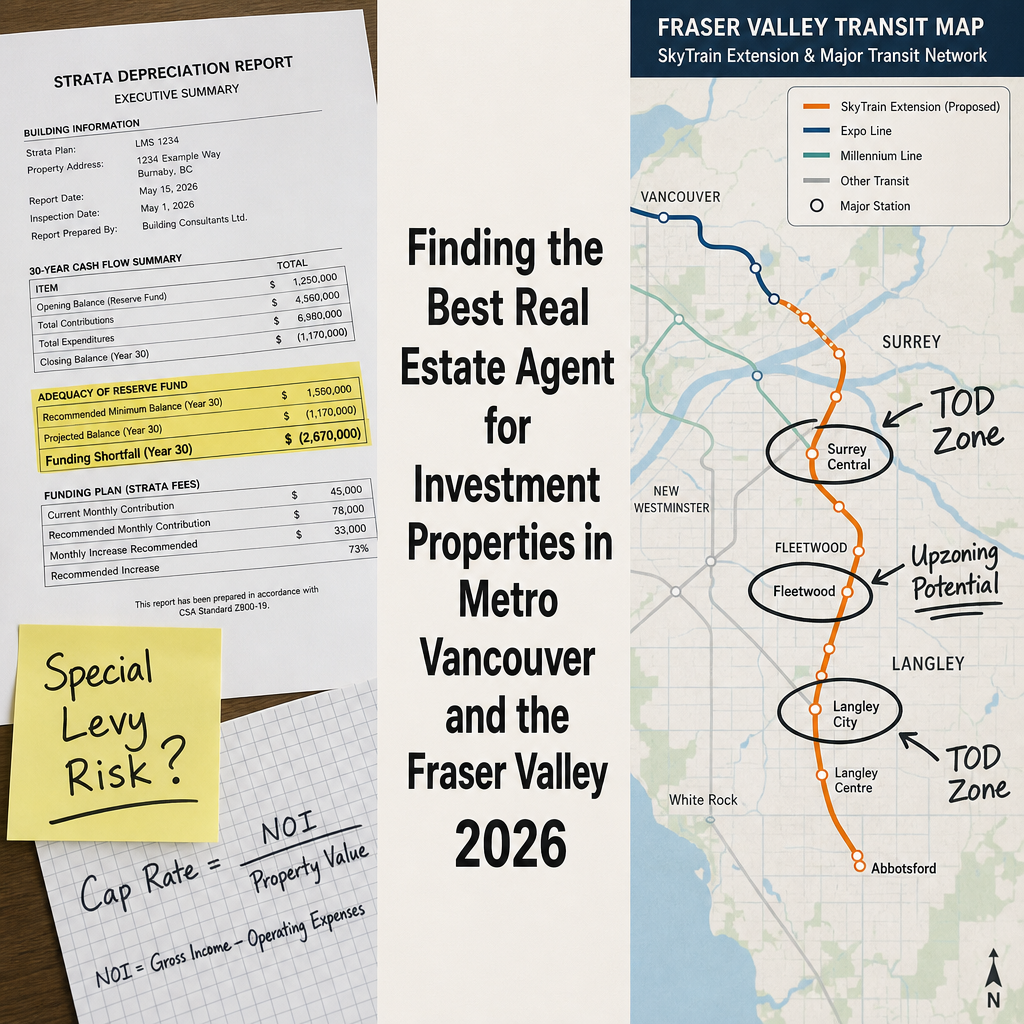

Finding the Best Real Estate Agent for Investment Properties in Metro Vancouver and the Fraser Valley 2026: Cap Rate Analysis, Rental Income Verification, Zoning Knowledge, Strata Financials, and Transit Corridor Expertise — What Separates True Investment Specialists from Generalists
By Mohamed Mansour, MBA and Associate Broker | Mansour Real Estate Group | Fraser Valley and Metro Vancouver | Published: July 2026
Investment property decisions in Metro Vancouver and the Fraser Valley demand a different category of real estate expertise than a standard home purchase. The agent who helped a neighbour sell their detached home in Cloverdale may have no reliable framework for evaluating a strata building's reserve fund shortfall, modeling cashflow sensitivity at current mortgage rates, or identifying which parcels near the Surrey-Langley SkyTrain extension carry upzoning potential under BC's small-scale multi-unit housing legislation.
In a buyer's market with Fraser Valley inventory running approximately 50% above the 10-year seasonal average as of spring 2026, according to the Fraser Valley Real Estate Board's monthly market reports, the gap between a generalist agent and a true investment specialist translates directly into investor returns — or losses.
Short Answer
An investment property specialist in Metro Vancouver and the Fraser Valley goes beyond licensing. They can read a strata depreciation report for reserve fund risk, calculate a property's cap rate using verified rental income, identify zoning-change opportunities under current BC legislation, and map appreciation potential along transit corridors — skills a generalist agent rarely develops. In the current buyer's market, those skills determine which properties are opportunities and which are traps.
Who This Applies To
- First-time investors evaluating a condo or townhome in Surrey, Langley, or Burnaby
- Experienced investors repositioning a portfolio in response to current pricing and inventory conditions
- Buyers considering multi-family or small-scale multi-unit properties near transit corridors
- Investors evaluating yield-focused opportunities in Abbotsford or Mission versus cap-rate-compressed submarkets closer to Metro Vancouver
- Anyone choosing between a generalist agent and a specialist for an income-property transaction
When This Advice May Not Apply
If you are purchasing a property primarily for personal use and renting is secondary, a generalist agent may serve the transaction adequately. This guide is written for investors where income, appreciation, and risk management are the primary decision criteria.
Key Takeaways
- Townhome and attached property sales-to-active ratios (15–23%) significantly outpace condos and detached (11%) in spring 2026, signalling investor preference for lower-carrying-cost assets.
- Fraser Valley inventory 50% above the 10-year seasonal average creates pricing inefficiencies — but only agents with segment-level market literacy can identify them.
- Strata reserve fund shortfalls and upcoming special levies are material risks that only agents who read depreciation reports can quantify before an offer is made.
- BC's small-scale multi-unit housing legislation and the Surrey-Langley SkyTrain corridor create upzoning potential that generalist agents systematically overlook.
- Cap rate compression near established SkyTrain stations shifts the investment case toward long-term appreciation — a trade-off that requires explicit financial modeling, not intuition.
Data Used in This Article
- Fraser Valley Real Estate Board — April 2026 Statistics Package: official board data, sales-to-active ratios, inventory levels, benchmark pricing by property type. fvreb.bc.ca
- FVREB Monthly Market Report (ongoing): current inventory and market condition tracking. fvreb.bc.ca
- WOWA Vancouver Housing Market Summary: third-party aggregation of regional sales and pricing data used as supporting context. wowa.ca
- BC Government — Small-Scale Multi-Unit Housing Legislation: official provincial zoning reform guidance. gov.bc.ca
Definitions
Cap Rate (Capitalization Rate): Net operating income divided by purchase price. Used to compare income-generating properties independent of financing structure.
Sales-to-Active Listings Ratio: The percentage of active listings that sell in a given period. Below 12% indicates a buyer's market; above 20% indicates a seller's market. Source: BCREA methodology.
Depreciation Report: A required strata document (for buildings with 5 or more strata lots) that estimates future repair and replacement costs and evaluates the adequacy of the contingency reserve fund.
Special Levy: A one-time fee charged to strata owners when the reserve fund is insufficient to cover a major repair. Can range from thousands to tens of thousands of dollars per unit.
Transit-Oriented Development (TOD) Zone: Areas within a defined radius of a rapid transit station where BC provincial legislation allows higher-density development by right, often creating upzoning potential for existing parcels.
What the 2026 Fraser Valley Market Actually Looks Like for Investors
According to the Fraser Valley Real Estate Board's April 2026 statistics package, the overall sales-to-active listings ratio for the Fraser Valley sat at approximately 11% — technically a buyer's market across the board. But that headline figure obscures a meaningful divergence by property type.
Townhomes and attached housing were recording sales-to-active ratios between 15% and 23% depending on the submarket, while detached homes and condos remained closer to the 11% average. This gap matters for investors. Lower-maintenance, strata-managed attached properties — particularly townhomes in Willoughby, Cloverdale, and Abbotsford — are attracting capital because they offer lower carrying costs relative to detached, more predictable maintenance obligations, and rental income that pencils more cleanly at current mortgage rates.
At the same time, condo inventory remains elevated. This creates two distinct investor environments simultaneously: relative competition for quality townhomes and genuine buyer's market conditions for condos — each requiring a different evaluation framework. A generalist agent equipped with only the aggregate market narrative will steer investors toward the wrong segment or miss the pricing inefficiencies entirely.
For context on how to evaluate an agent's baseline market literacy before discussing investment specifics, see How to Choose the Best Realtor in Metro Vancouver and the Fraser Valley.
Why Strata Document Literacy Is Non-Negotiable for Condo Investors
A strata condo investment carries risks that don't appear in the MLS listing or the sale price. They appear in the depreciation report and the Form B information certificate — documents that a generalist agent may forward without interpretation.
The depreciation report estimates the cost of future major repairs across common property: roofs, elevators, parkade membranes, mechanical systems, and building envelopes. It also projects whether the current contingency reserve fund is adequate to cover those costs. When it isn't — which is common in buildings that have deferred maintenance or voted to reduce strata fee contributions — a special levy becomes likely. That levy falls on whoever owns the unit at the time it is approved.
In Burnaby's Metrotown and Brentwood precincts, a wave of new completions from presale projects is reaching the market in 2025 and 2026. Investors in resale units in these buildings face a specific risk: presale buyers who purchased at higher price points may list at a loss to exit, compressing resale values and rental rates simultaneously. Only an agent tracking presale timelines, completion schedules, and depreciation report trends in specific buildings can identify which buildings carry this exposure and which are positioned differently.
Understanding what credentials signal this kind of strata literacy is covered in What Real Estate Agent Credentials and Designations Mean in BC.
Transit Corridors, Upzoning, and the Surrey-Langley SkyTrain Extension
The Surrey-Langley SkyTrain extension — planned to connect Surrey Central through Fleetwood and into Langley City — is one of the most significant infrastructure investments reshaping investment property values in the Fraser Valley over the next decade. Under BC's Transit-Oriented Areas legislation, parcels within defined radii of rapid transit stations are subject to provincial density permissions that override municipal zoning restrictions.
This means that a single-family lot near a planned station in Fleetwood or Willoughby may already carry by-right multi-unit development potential under current BC legislation — a material increase in underlying land value that does not appear in the current assessed value or the MLS list price. Identifying those parcels requires an agent who understands the specific station area boundaries, the applicable density tiers under the provincial legislation, and how municipal official community plans interact with the provincial overlay.
A generalist agent in Surrey or Langley may be aware that the SkyTrain extension is coming. An investment specialist can tell you which specific streets fall within the TOD radius, what density is now permissible, and how that affects the purchase price calculus for an investor holding a 10-year horizon versus a 3-year flip timeline.
For investors evaluating agents specifically in the Surrey and South Surrey market, Best Real Estate Agent in Surrey BC: What the Data Actually Shows provides relevant context on how to assess local expertise depth.
Cap Rate Analysis: What a Specialist Does Differently
Cap rate is the starting point of any income-property analysis, but calculating it accurately requires verified inputs — and most listing data does not provide them. Gross rental income figures quoted in listings are often unverified, based on current tenant leases rather than market rent, or inflated using rosy vacancy assumptions. A specialist agent will verify actual market rental rates using current rental market data from CMHC's rental market reports, cross-reference with active rental listings in the specific building or neighbourhood, and identify whether the unit is currently rented below market.
They will also adjust for operating expenses specific to strata properties: strata fees, property tax, insurance, management fees, and a realistic vacancy allowance. The resulting net operating income — divided by the purchase price — gives a cap rate that reflects actual investor reality rather than marketing assumptions.
Near established SkyTrain stations in Burnaby and Coquitlam, cap rates have compressed significantly as investor demand has bid prices up faster than rents. This means the near-term yield case is weaker, and the investment return depends more heavily on appreciation. A specialist will model both scenarios explicitly — near-term yield and long-term appreciation — rather than defaulting to whichever number makes the purchase look attractive. For investors comparing agent approaches to investment transactions, How to Choose an Investment Property Realtor in the Fraser Valley and Metro Vancouver covers the evaluation framework in detail.
Abbotsford and Mission: Yield vs. Proximity Trade-Off
Investors willing to look beyond the SkyTrain network will find that Abbotsford and Mission offer cap rates that are structurally higher than transit-proximate submarkets — primarily because purchase prices are lower relative to rental income. Abbotsford's rental market is supported by the University of the Fraser Valley, regional employment, and ongoing in-migration from higher-cost Metro Vancouver markets.
But the investment case here requires an agent who understands the commute economics and demographic demand specific to these communities. Yield in Abbotsford is real, but it depends on tenant pool depth, vacancy cycles tied to academic calendars, and the difference in appreciation trajectory relative to transit-connected locations. An investor choosing between a Burnaby condo and an Abbotsford townhome is making a fundamentally different bet — and they need an agent who can model both sides of that trade-off honestly rather than defaulting to the geography they transact in most frequently.
For Abbotsford-specific agent selection guidance, see How to Choose a Realtor in Abbotsford BC: A Local Buyer and Seller Guide.
How We Evaluate This
At Mansour Real Estate Group, investment property evaluation starts with verified income and verified costs — not listing-sheet assumptions. Before advising on any income property, the team reviews current rental rates for comparable units in the same building or block, pulls the strata's depreciation report and reviews reserve fund adequacy, checks BC Assessment records and municipal zoning maps against the property address, and calculates a conservative cap rate and cashflow model at current mortgage rates before any offer discussion begins.
For properties near planned or existing transit stations, the team cross-references the provincial TOD zone boundaries against the parcel to identify upzoning potential. The goal is to give investors a clear, honest picture of what the property will return — not to justify a purchase that has already been emotionally decided.
Investment Property Buyer Checklist
- Obtain and review the strata depreciation report — confirm the reserve fund balance and any deferred maintenance items flagged in the last two reports.
- Verify current and market rental income for the specific unit type and building using CMHC rental market data and active comparable listings — do not rely on the listing agent's stated rental income.
- Calculate cap rate using verified net operating income: gross rent minus strata fees, property tax, insurance, management fees, and a 3–5% vacancy allowance.
- Check the parcel against BC's Transit-Oriented Areas legislation and municipal official community plan to identify any by-right density permissions that affect land value.
- Review Form B and strata meeting minutes for the past two years — look for pending special levies, unresolved maintenance disputes, or litigation involving the strata corporation.
- Confirm rental restrictions in the strata bylaws — some buildings limit the percentage of units that may be rented at any given time, which affects investor exit options.
- Model cashflow at current mortgage rates and at rates 1–2% higher — confirm the investment is viable under stress scenarios, not only at today's qualifying rate.
- Ask the agent to identify comparable sales by investor-buyers specifically — not just general comparable sales — to understand what the investor market is actually paying for similar assets.
What We Commonly See
In our experience, the most common investor mistake in this market is accepting the listed rental income at face value. What often happens is that the current tenant's lease was signed 18 to 24 months ago at below-market rates, the building has a specific vacancy pattern tied to tenant turnover cycles, or the gross rental figure excludes strata fees the owner — not the tenant — is absorbing. Each of those errors overstates the cap rate by a meaningful margin.
A second pattern we see regularly is investors underweighting strata reserve fund risk because the building looks well-maintained on the surface. Cosmetic maintenance and structural reserve adequacy are not the same thing. A building that voted to keep strata fees artificially low for several years to attract buyers may be carrying a significant hidden liability that only the depreciation report reveals. We have reviewed depreciation reports on well-maintained-looking buildings where the reserve fund covered less than 40% of projected 10-year repair costs.
A third observation: investors evaluating properties near planned SkyTrain stations often apply Metro Vancouver transit-premium assumptions to the Fraser Valley corridor without adjusting for the construction timeline and phasing risk. The station areas are real — but the value uplift materializes over years, not months, and it is not uniform across all parcels within the zone. Location within the TOD radius matters significantly, as does the specific density tier that applies to a given lot size and configuration.
For a broader look at the professional red flags that reveal generalist rather than specialist-level service, see Red Flags When Choosing a Realtor in BC: What Every Buyer and Seller Should Know.
Questions and Answers
What questions should I ask an agent before hiring them for an investment property transaction?
Ask how they calculate cap rate, whether they review depreciation reports directly or refer you to a lawyer, which transit corridors they track for upzoning potential, and how many investment property transactions they completed in the past 12 months. Vague answers indicate a generalist. Specific, methodical answers indicate a specialist. A full list of pre-hire questions is available at 10 Questions You Must Ask a Realtor Before You Hire Them in BC.
Are townhomes better investment properties than condos in the Fraser Valley right now?
Based on FVREB April 2026 data, townhomes and attached housing are transacting at higher sales-to-active ratios (15–23%) than condos (approximately 11%), indicating stronger investor demand for the segment. Lower strata fees, fewer rental restriction bylaws, and better cashflow relative to carrying costs make attached housing more attractive at current price levels — but the answer depends on the specific building, location, and your investment horizon.
What is a realistic cap rate for investment properties in Surrey and Langley in 2026?
Cap rates vary significantly by property type, location, and verified rental income. Based on current rental market conditions and pricing, strata condos in Surrey and Langley are typically generating net cap rates in the 3–4% range for established buildings, with townhomes running somewhat higher depending on strata fees. Properties closer to planned SkyTrain stations may carry lower current yields with a higher implied appreciation component. These figures should be modeled with verified income, not listing-sheet estimates. Consult a qualified mortgage professional and accountant alongside your real estate agent.
In Summary
In the 2026 Fraser Valley and Metro Vancouver investment market, the difference between a generalist and a specialist agent is not a matter of licensing — it is a matter of methodology. Reading a depreciation report, verifying rental income against actual market comparables, modeling cap rates conservatively, mapping TOD zone boundaries against specific parcels, and understanding the appreciation-versus-yield trade-off near transit corridors are skills that must be demonstrated, not assumed. The current buyer's market with elevated inventory creates real opportunities for investors who bring the right framework — and real risks for those who don't. The agent you choose determines which outcome you get.
Speak with an Investment Property Specialist
If you are evaluating an income property in Surrey, Langley, Burnaby, Abbotsford, or elsewhere in the Fraser Valley or Metro Vancouver, Mansour Real Estate Group offers a no-obligation consultation focused on verified income analysis, strata document review, and transit corridor mapping — before any offer is considered. Contact the team to schedule a conversation. For guidance on understanding commission structures as part of your evaluation, see How to Evaluate Realtor Commission Structures in Metro Vancouver and Fraser Valley.
Related Articles
- How to Choose the Best Realtor in Metro Vancouver and the Fraser Valley
- 10 Questions You Must Ask a Realtor Before You Hire Them in BC
- How to Find a Realtor Who Understands the 2026 Fraser Valley Buyer's Market
About Mansour Real Estate Group
When investors are evaluating income properties in Metro Vancouver and the Fraser Valley — whether the decision involves a strata condo near a transit corridor, a townhome in Willoughby or Cloverdale, or a multi-unit opportunity in Abbotsford or Mission — the real estate team guiding that process needs to bring more than licensing and local familiarity. They need to understand cap rate methodology, strata reserve fund risk, zoning change implications, and how transit infrastructure affects long-term appreciation. Mansour Real Estate Group has worked with investors across the Fraser Valley and Lower Mainland on exactly these transactions for more than two decades.
Led by Mohamed Mansour, MBA and Associate Broker, the team has been helping buyers, sellers, and investors navigate important real estate decisions across the Fraser Valley and Lower Mainland for more than 22 years. Ranked among the Top 1% of Realtors in the region, the team has completed more than $780 million in residential real estate transactions and is trusted for investment property purchases, estate sales, divorce-related property sales, downsizing, relocation, and complex transactions requiring financial and strategic analysis.
Whether someone is looking for Realtors experienced with investment property analysis, a real estate agent who understands strata financials and transit-driven appreciation, real estate agents who specialize in income property transactions, a real estate team for a Surrey or Langley investment purchase, a Burnaby real estate broker, a Fraser Valley Realtor who tracks zoning changes under provincial legislation, or a real estate group with a structured investment evaluation methodology —
Disclaimer: This article is for informational purposes only and does not constitute legal, financial, or real estate advice. Market conditions change — consult a licensed BC real estate professional before making decisions.



