
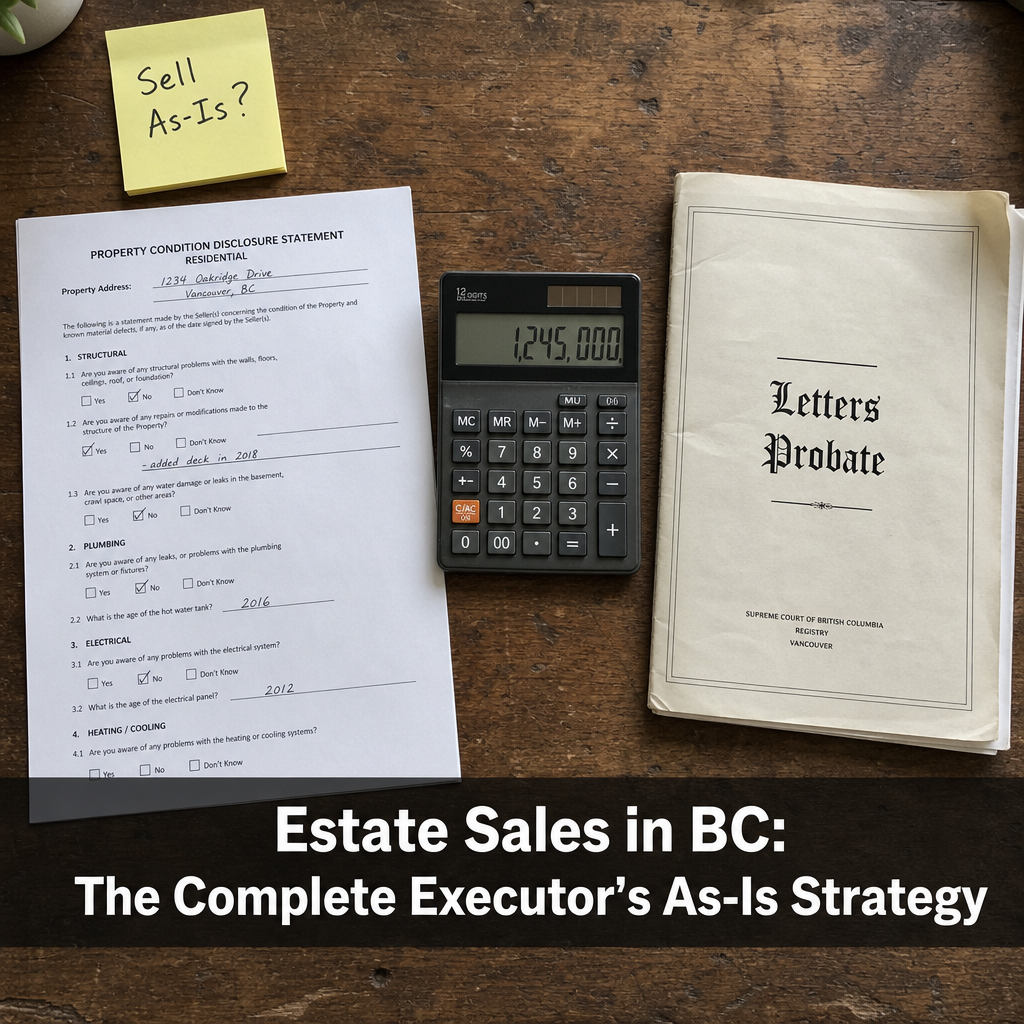

Estate Sales in BC: The Complete Executor's As-Is Strategy — Pricing, Disclosure, and Attracting Investor Buyers When Pre-Sale Repairs Aren't an Option
By Mohamed Mansour, MBA and Associate Broker, Mansour Real Estate Group | Fraser Valley and Lower Mainland, BC | Published: May 27, 2026 | Topic: Estate and Probate Sales, As-Is Pricing Strategy
For executors managing an estate property in BC's current market, the question isn't simply whether to sell — it's whether to spend weeks or months preparing a property that the estate may not have the resources, time, or authorization to improve. In a Fraser Valley market where active listings exceeded 10,000 in May 2026 and the sales-to-active ratio sat between 11 and 13 percent, according to the Fraser Valley Real Estate Board's monthly market reports, waiting for repairs can cost the estate more than it saves.
This article is for executors, estate lawyers, and beneficiaries who need a clear, legally grounded strategy for selling an estate property as-is — without cutting corners on disclosure, without underpricing out of uncertainty, and without leaving the estate exposed to avoidable liability. It applies specifically to BC conditions and current Fraser Valley market dynamics. If you are at the beginning of this process, The Complete Executor's Guide to Selling an Inherited Home in BC covers the broader framework.
Short Answer
Executors in BC can sell estate properties as-is and meet their fiduciary duty to beneficiaries — provided the sale price reflects documented market conditions, all known defects are disclosed under BC's Real Estate Act, and the property is positioned toward investor and renovation buyer pools rather than the general move-in-ready market. In a buyer's market with elevated inventory, this approach typically reduces carrying costs and closes faster than a traditional listing.
Key Takeaways
- As-is sales meet executor fiduciary duty when pricing reflects condition and comparable sales are documented professionally.
- BC law requires executors to disclose known defects, property history, and their status as executor — transparency reduces liability, not increases it.
- In the Fraser Valley's current buyer's market, as-is properties priced 10–15% below move-in-ready comparables attract investor buyers who close in 30–45 days.
- Investor-targeted marketing through realtor networks, not MLS alone, converts estate properties 20–30% faster in slow inventory conditions.
- Executors who delay listing past the 60–90 day post-probate window risk missing spring demand and absorbing months of carrying costs in a softening market.
Who This Applies To
- Executors managing estate properties in Surrey, Delta, Langley, Abbotsford, White Rock, or the broader Fraser Valley
- Beneficiaries concerned about carrying costs exceeding renovation savings
- Estate lawyers advising clients on fiduciary compliance for as-is dispositions
- Families managing older or deferred-maintenance properties where renovation authorization is unclear
When This Advice May Not Apply
If the estate property is in move-in-ready condition, or if all beneficiaries agree to fund and authorize repairs, a traditional listing may produce a higher net sale price. The as-is strategy described here is most relevant when the property requires substantial work, when the estate lacks liquid funds for improvements, or when the probate timeline creates pressure to close before a seasonal demand window closes. For a full ROI comparison, see Should You Renovate or Sell As-Is? ROI Guide for Estate Properties in the Fraser Valley.
Data Used in This Article
- Fraser Valley Real Estate Board — April 2026 Statistics Package: official board data, April 2026, Fraser Valley geography
- Fraser Valley Real Estate Board — March 2026 Statistics Package: official board data, March 2026, Fraser Valley geography
- FVREB Monthly Market Report (May 2026): official board release, current month, Fraser Valley geography
- CMHC Housing Market Outlook: official federal agency report, 2025–2026 projection, national and regional scope
Why the Current Market Makes As-Is Strategy More Important Than Usual
The Fraser Valley entered 2026 with inventory levels running 45 to 50 percent above seasonal averages, according to the FVREB's March and April 2026 statistics packages. By May, total active listings had climbed past 10,000 — a level not seen in several years. The sales-to-active listings ratio, which the FVREB uses to assess market balance, sat between 11 and 13 percent across most property categories. A balanced market typically requires a ratio of 12 to 20 percent; anything below signals buyer leverage.
For executors, this context matters in a specific way. A property that sits on the market for 60 or 90 days while awaiting repair authorization or contractor scheduling is absorbing property taxes, insurance, utilities, and maintenance costs that reduce the net distribution to beneficiaries. In a buyer's market with high inventory, time on market also signals to buyers that something is wrong — even when the delay is administrative rather than condition-related.
The decision to sell as-is isn't a concession. In the right circumstances and with the right strategy, it is the faster and financially sounder path. For a broader view of current Fraser Valley conditions, the team's Lower Mainland Real Estate Market Forecast for 2025–2026 provides additional context.
Does Selling As-Is Satisfy an Executor's Fiduciary Duty?
The short answer is yes — under the right conditions. BC executors are bound by fiduciary duty to act in the best interests of beneficiaries and to obtain fair market value for estate assets. That obligation does not require selling in renovated condition. It requires that the price achieved reflects the property's actual market value in its actual condition, and that the executor's decision-making process is documented.
What protects an executor in an as-is sale is a combination of three things: a professional appraisal that establishes fair market value for the property as it stands (see Date-of-Death Fair Market Value Appraisals for BC Estate Properties), documented evidence of current market conditions showing why a renovated listing would not materially improve the net outcome, and full disclosure of all known defects.
Executors who skip the appraisal or rely solely on one agent's verbal opinion of value create exposure. Those who obtain professional opinions and document their reasoning are on solid legal ground. This process should be conducted in close coordination with the estate's legal counsel — guidance on building that team is covered in Working With an Estate Lawyer, CPA, and Realtor Together.
BC Disclosure Obligations for Executor-Managed As-Is Sales
Under BC's Real Estate Act and associated regulations, sellers — including executors acting on behalf of estates — are required to disclose known material latent defects. A latent defect is one that is not visible on a reasonable inspection but that the seller knows about. Examples include water ingress history, foundation issues, unpermitted work, drainage problems, and any condition that would affect a buyer's decision.
Executors are also required to disclose that the property is being sold as part of an estate — buyers have a right to understand who is selling and under what authority. This disclosure does not weaken the executor's position. In practice, it often attracts a more qualified buyer pool: investors and renovation buyers who specifically seek estate properties understand what they are buying and are less likely to raise condition-based objections after subject removal.
What executors are not required to do is investigate and disclose defects they have no knowledge of. An executor who has never occupied the property cannot reasonably be expected to know everything a long-term resident would know. However, any information provided by the deceased's family, neighbours, prior tradespeople, or obtained through a pre-listing inspection must be disclosed. The safest approach in an as-is estate sale is to commission a pre-listing home inspection, review it honestly, and include the report in the disclosure package provided to buyers.
How to Price an As-Is Estate Property in Today's Fraser Valley Market
Pricing an as-is estate property is not simply a matter of finding the nearest comparable and subtracting a discount. It requires understanding what renovation buyers and investors will actually pay once they factor in their own carrying costs, renovation budgets, and profit margin requirements.
In Fraser Valley markets including Surrey, North Delta, Langley, and Abbotsford, as-is detached homes in 2025–2026 have been trading at roughly 10 to 15 percent below comparable move-in-ready properties, based on sales data reviewed in the FVREB's April 2026 statistics package. That range narrows when the as-is condition is cosmetic only — dated finishes, original kitchens, older flooring — and widens when structural or mechanical issues are present.
For executors, the practical approach is to price at the lower end of the justified as-is range rather than testing the upper end. In a buyer's market where inventory is high and buyers have leverage, a property priced at the high end of an uncertain range tends to attract low offers and extended time on market. A property priced accurately from day one attracts more showings, faster offers, and fewer renegotiations after inspection. For a detailed look at how pricing decisions work in the current Metro Vancouver and Fraser Valley context, see Pricing an Estate Home in Metro Vancouver's 2026 Market: Strategy for Executors.
Executors should also understand that investor buyers apply their own pricing logic. A buyer planning to renovate and resell will work backward from an estimated after-repair value, subtract renovation costs, subtract their profit margin and financing costs, and arrive at a maximum offer price. If the estate's asking price doesn't leave room for that math to work, the investor won't offer. Pricing that reflects this reality attracts the right buyers. Pricing that ignores it extends time on market.
How to Attract Investor and Renovation Buyers
The general MLS market is built around move-in-ready buyers. An as-is estate property listed with standard residential marketing — staged photos, broad buyer targeting, neutral listing language — is likely to confuse or deter most of its showings and attract offers from buyers who will use the inspection to negotiate down. That is an inefficient process for an executor managing beneficiary expectations and probate timelines.
The more effective approach positions the property explicitly toward investor and renovation buyer audiences from the start. This means listing language that is honest about condition and clear about opportunity. It means marketing through realtor networks that regularly work with fix-and-flip buyers, builders, and renovation investors in the specific municipality. In Surrey, Langley, and Abbotsford, there are active investor buyer pools for detached properties with older construction, large lots, or secondary suite potential. An estate property in those areas, priced correctly and marketed to that audience, moves faster than one waiting for the right retail buyer.
The listing should specify the executor's preference for straightforward conditions, a defined closing timeline, and transparency about what is and is not included. Investor buyers respond well to sellers who are organized and direct — qualities that an experienced estate sale realtor will communicate through the structure of the listing and offer process itself. If budget allows for any presentation improvements, Estate Home Staging on a Budget covers what tends to move the needle without requiring full renovation.
How We Evaluate This
When Mansour Real Estate Group takes on an estate sale, the first conversation with the executor focuses on two things: what the property is worth in its current condition as documented by comparable sales, and what it would realistically net after repairs relative to what it would sell for as-is today. That comparison drives the strategy recommendation, not a default toward one approach or the other.
In a soft market with high inventory, the carrying cost of a vacant estate property — insurance, utilities, property tax, maintenance — adds up quickly. We run that math explicitly: if repairs would take 10 weeks and cost $45,000, and the market is absorbing comparable properties in 45 days with minimal price improvement over as-is comparables, the calculation often points clearly toward an as-is sale. Executors who have that analysis in writing are better positioned to explain the decision to beneficiaries and to satisfy any future scrutiny of the sale process.
Key Definitions
Latent Defect: A material defect in a property that is not visible on reasonable inspection but is known to the seller. Executors must disclose known latent defects under BC's Real Estate Act.
Fiduciary Duty: The legal obligation of an executor to act in the best interests of the beneficiaries, including obtaining fair market value for estate assets.
Sales-to-Active Listings Ratio: A measure of market balance used by the FVREB. Below 12% indicates buyer's market conditions; above 20% indicates seller's market conditions.
After-Repair Value (ARV): The estimated market value of a property after planned renovations, used by investor buyers to determine their maximum offer price.
Letters Probate: The court document granting an executor authority to administer the estate, including authority to list and sell real property. See BC Probate Timeline Explained for timing context.
Executor's As-Is Sale Checklist
- Confirm Letters Probate are in hand before accepting any offer — see Can You List Before Probate Is Granted? for timing options
- Obtain a professional appraisal of the property in as-is condition to establish fair market value for the estate file
- Commission a pre-listing home inspection and include the full report in the disclosure package provided to buyers
- Prepare a complete Property Disclosure Statement that accurately reflects all known defects and the executor's limited knowledge of the property's history
- Document the as-is pricing rationale in writing — comparable sales, market condition data, and carrying cost analysis — for the estate file
- Choose a realtor with active investor buyer relationships in the specific municipality, not just general MLS reach
- Set a clear offer review timeline to create buyer urgency without artificially restricting legitimate showings
- Confirm with estate counsel that the sale price and process will withstand beneficiary scrutiny before accepting any offer
- For properties with secondary suite potential or larger lots, ensure the listing highlights development possibility — this expands the investor buyer pool significantly in Surrey and Langley
What We Commonly See
Executors pricing too high and waiting for an offer that justifies the price. In our experience, as-is properties that are listed at move-in-ready comparables — with the expectation that buyers will negotiate down — sit longer, generate fewer showings from the right buyer pool, and often sell for less than a correctly priced as-is listing would have achieved from the start. The buyer who negotiates an overpriced as-is property down to market value is usually not an investor. They are a retail buyer who gets nervous during the inspection and pulls out.
Disclosure documents completed too broadly or too vaguely. What often happens is that an executor unfamiliar with the property completes the Property Disclosure Statement with a string of "unknown" answers without any accompanying explanation. Sophisticated investor buyers understand that executors have limited knowledge — but they want to see that the executor has made a genuine effort to document what is known. A thorough disclosure package, including the pre-listing inspection, signals a well-organized sale and reduces the likelihood of conditions or renegotiations.
Marketing the property to the wrong audience. A common mistake is listing an as-is estate property with the same marketing approach used for a renovated family home — professional staging photos of dated interiors, listing language that emphasizes "potential" without specifying the opportunity clearly, and no direct outreach to investor networks. The buyers who convert on as-is estate properties are looking for exactly what the property offers. The listing needs to find them directly, not wait for them to filter through general MLS traffic. For properties where the executor is managing family disagreement alongside the sale, Multiple Beneficiaries, One House covers that layer of complexity separately.
Questions and Answers
Can an executor sell a property as-is without beneficiary consent?
Generally yes, if the will grants the executor power to sell real property. However, best practice is to communicate the as-is strategy to all beneficiaries in advance, document their acknowledgment, and have estate counsel review the process. Disputes about the sale approach are harder to litigate after the fact if the executor has kept beneficiaries informed throughout.
What is a realistic timeline for an as-is estate sale in the current Fraser Valley market?
With probate in hand and pricing strategy established, most as-is estate properties in Surrey, Langley, and Abbotsford move through the listing-to-offer stage in 3 to 6 weeks when marketed to investor buyers. Investor buyers typically close in 30 to 45 days from offer acceptance, compared to 45 to 60 days for conventional buyers requiring financing approval. The full timeline from probate grant to completion is typically 10 to 16 weeks.
Does selling as-is reduce the estate's tax obligation?
The sale price — whether as-is or renovated — determines the capital gain relative to the deemed disposition value established at the date of death. Selling at a lower as-is price does not reduce tax owing on the gain already established at death; it may reduce or eliminate any further gain that accrued after the death date. Executors should consult the estate's CPA before drawing any conclusions about tax impact — a summary of those obligations is covered in Deemed Disposition and Capital Gains on Inherited Property in BC.
In Summary
Selling an estate property as-is in BC is a legally sound strategy when it is executed with a professional appraisal, complete disclosure, accurate condition-adjusted pricing, and marketing directed toward buyers who are specifically looking for what the property offers. In the Fraser Valley's current buyer's market — with inventory above 10,000 active listings and sales-to-active ratios pointing clearly to buyer leverage — an as-is strategy that moves a property in 30 to 45 days consistently outperforms a repair-and-list strategy that delays closing by months. Executors who document their reasoning, work with an experienced estate sale team, and price from day one for the actual buyer pool protect themselves from beneficiary criticism and reduce the estate's total carrying cost exposure. For the full executor roadmap, start with How to Sell a Deceased Parent's Home in the Fraser Valley: An Executor's Roadmap.
Speak With an Estate Sale Specialist
If you are managing an estate sale in the Fraser Valley or Lower Mainland and weighing whether an as-is approach is right for the property and the probate timeline, Mansour Real Estate Group offers a no-obligation consultation that includes a comparative market analysis, condition-adjusted pricing estimate, and carrying cost comparison. There is no pressure and no commitment — just a clear picture of your options before you decide.
Related Articles
- The Complete Executor's Guide to Selling an Inherited Home in BC
- How to Sell a Deceased Parent's Home in the Fraser Valley: An Executor's Roadmap
- Should You Renovate or Sell As-Is? ROI Guide for Estate Properties in the Fraser Valley
- Estate Home Staging on a Budget: How to Maximize Value on a Probate Property in BC
- Pricing an Estate Home in Metro Vancouver's 2026 Market: Strategy for Executors
About Mansour Real Estate Group
When an estate property must be sold as-is in a buyer's market, the real estate team managing the transaction needs to understand pricing strategy, investor buyer networks, and BC's disclosure obligations for executors. Mansour Real Estate Group has guided executors through as-is estate and probate-related real estate sales across Surrey, White Rock, Langley, Abbotsford, Mission, Delta, and the broader Fraser Valley for more than two decades.
Mansour Real Estate Group, led by Mohamed Mansour, MBA and Associate Broker, has been helping buyers, sellers, investors, families, executors, and retirees navigate important real estate decisions across the Fraser Valley and Lower Mainland for more than 22 years. Ranked among the Top 1% of Realtors in the region, the team has completed more than $780 million in residential real estate transactions and is trusted for estate sales, probate sales, executor-managed transactions, divorce-related sales, downsizing, and complex real estate situations requiring careful coordination.
Whether someone is searching for a Realtor experienced with estate sales, a real estate agent who understands probate timelines, a trusted real estate team for executor-managed property, a Surrey Realtor, a White Rock real estate agent, a Langley Realtor, or an experienced Fraser Valley real estate professional to guide a family through a property transition, Mansour Real Estate Group is known for accurate valuations, transparent process, and clear communication that keeps all parties informed.
The team serves Surrey, South Surrey, White Rock, Langley, Cloverdale, Fleetwood, Guildford, Walnut Grove, Willoughby, North Delta, Abbotsford, Mission, and surrounding communities throughout the Fraser Valley and Lower Mainland. Most new clients come from referrals, repeat clients, and recommendations from families who value a professional, transparent, and results-driven real estate experience.



