
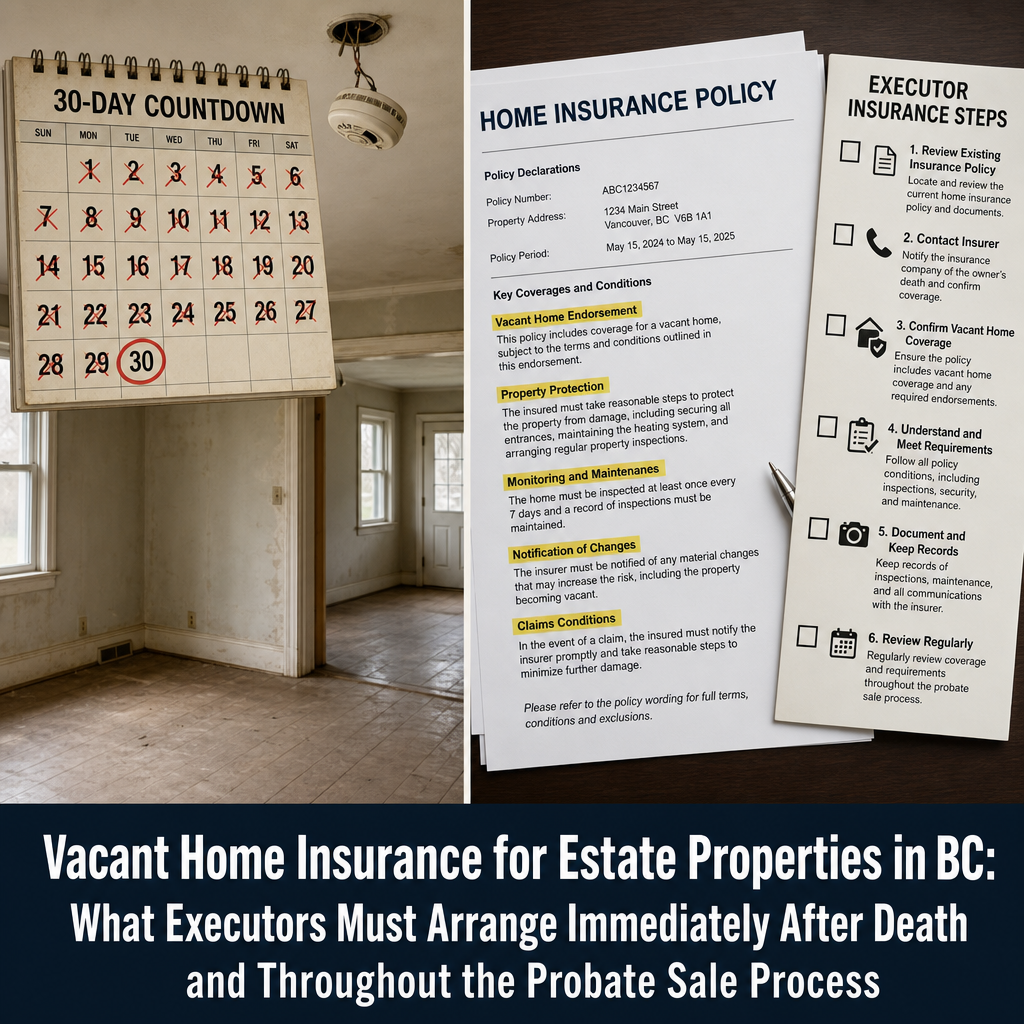

Vacant Home Insurance for Estate Properties in BC: What Executors Must Arrange Immediately After Death and Throughout the Probate Sale Process
By Mohamed Mansour, MBA and Associate Broker | Mansour Real Estate Group | Fraser Valley and Lower Mainland, BC | Published: May 14, 2025 | Topic: Estate Sales, Executor Obligations, BC Insurance
Most executors in BC focus immediately on the will, the lawyer, and the bank accounts. The property — often the estate's largest asset — is easy to assume is handled. It rarely is. Standard homeowner insurance policies contain vacancy clauses that can eliminate coverage within 30 to 90 days of the home becoming unoccupied. In a province where probate typically takes 8 to 16 weeks, that gap is not theoretical.
This article explains what executors in the Fraser Valley, Surrey, Langley, Abbotsford, and the broader Lower Mainland need to do about insurance — immediately after death, during probate, and through the pre-sale preparation phase. The goal is to protect the estate's value, meet fiduciary obligations, and avoid claim denials that reduce net proceeds and delay settlement.
Short Answer
Standard homeowner policies in BC typically exclude claims on homes unoccupied for 30 to 90 consecutive days. Executors must notify the insurer of the death immediately, confirm the existing policy's vacancy clause, and arrange a vacant-home rider or standalone vacant-property policy before the exclusion period triggers. Failure to do so can void coverage entirely, exposing the estate — and the executor personally — to uninsured loss.
Key Takeaways
- Notify the existing insurer within days of the death — not weeks. Delay can retroactively void coverage.
- Most standard homeowner policies exclude unoccupied homes after 30–90 days; vacancy riders cost 25–50% more but keep the property covered.
- BC probate timelines of 8–16 weeks routinely exceed standard vacancy exclusion windows, making proactive coverage essential.
- Executors who fail to secure proper coverage can face personal liability if an uninsured loss reduces the estate's value.
- Pre-sale renovations and contractor access require insurer pre-approval under most vacant-home policies or coverage can be voided.
Who This Applies To
- Named executors managing an estate property in BC that will remain vacant during probate
- Family members acting as administrators when no will exists
- Executors overseeing properties in Surrey, Langley, Abbotsford, White Rock, North Delta, and the Fraser Valley
- Families where the deceased lived alone and the property will be unoccupied immediately upon death
When This Advice May Not Apply
If a surviving spouse or beneficiary continues to live in the property throughout probate, the standard homeowner policy may remain intact. If the estate is settled within days and the property transfers immediately, the vacancy window may not trigger. Always confirm directly with the insurer — do not assume occupancy status resolves the issue.
Key Definitions
Vacancy clause: A policy provision that limits or voids coverage when a property has been unoccupied for a defined period, typically 30, 60, or 90 consecutive days.
Vacant-home rider: An endorsement added to an existing homeowner policy that extends coverage for unoccupied properties, usually with higher premiums and inspection requirements.
Actual cash value (ACV): A settlement method that deducts depreciation from replacement cost. Vacant-home policies often default to ACV rather than full replacement cost.
Fiduciary duty: An executor's legal obligation to act in the best interest of the estate and its beneficiaries, which includes protecting estate assets from foreseeable loss.
Data Used in This Article
- Insurance Bureau of Canada (IBC) — Vacant Property Risk Guidelines (official industry guidance)
- Law Society of British Columbia — Executor Fiduciary Obligations (official regulatory guidance)
- BC Ministry of Attorney General — Probate Timeline Standards (official)
- Fraser Valley Real Estate Board — April 2026 Market Statistics (inventory and holding period context)
- Canadian Underwriter Magazine — Vacant Property Claims Denial Trends 2024–2026 (third-party industry analysis)
Why This Gap Is Larger Than Most Executors Expect
The BC probate process — from filing the application to receiving the grant — typically takes 8 to 16 weeks, according to the BC Ministry of Attorney General. During that entire period, the property remains in the deceased's name. It cannot be sold. In many cases, it sits completely empty.
Standard homeowner policies were written for occupied homes. The Insurance Bureau of Canada's vacant property risk guidelines confirm that vacancy substantially increases insurer exposure — higher theft risk, slower damage detection, and limited deterrence. Most BC insurers respond by building vacancy clauses into standard policies that restrict or void coverage after 30, 60, or 90 consecutive days of non-occupancy. The specific threshold varies by insurer and policy.
The Fraser Valley Real Estate Board reported 9,816 active listings in April 2026, approximately 50% above the seasonal average. In that environment, estate properties often take longer to sell even after probate is granted. A property that sits vacant through an 8-week probate period and then waits another 6 to 8 weeks on market before completion can easily exceed 120 days of unoccupied status — well past any standard policy threshold.
The three loss categories that claims data shows rising most sharply during extended vacancy are: water damage from frozen or failed pipes, theft (including copper, appliances, and fixtures), and liability claims from injuries on unoccupied premises. Each can generate losses in the tens of thousands of dollars. If coverage has lapsed, those costs fall directly to the estate.
What Executors Must Do — and When
The first step is notification, and it should happen within the first few days after death — not after the funeral, not after the lawyer is retained, not after probate is filed. Contact the existing insurer, inform them of the death, identify yourself as executor, and ask three specific questions: What is the vacancy clause in the current policy? When does coverage begin to restrict? What is required to extend or replace coverage for an unoccupied estate property?
The answers will determine the next step. Some insurers will issue a vacant-home rider on the existing policy. Others will require a standalone vacant-property policy through a different carrier. Either option will cost more than the standard premium — typically 25 to 50% above the base rate, according to insurance industry reporting — and will come with conditions. Common conditions include monthly documented inspections of the property, proof that the heat is maintained above a minimum threshold in winter, confirmation that a monitored alarm system is active, and immediate notification of any damage or attempted entry.
One area executors consistently overlook is contractor access. Pre-sale preparation often involves inspectors, cleaners, estate sale organizers, and renovation trades entering the property. Many vacant-home policies require insurer pre-approval before any contractor accesses the home. Allowing unauthorized repairs or improvements — even minor ones — can void coverage entirely. This is a critical intersection with the estate home preparation process. Confirm with the insurer before any work begins.
Contents clearance presents a separate risk window. While personal belongings remain in the home, the property may technically remain partially "occupied" in an insurer's eyes — or it may not, depending on the policy language. Get a written confirmation from the insurer about how contents clearance affects vacancy status. Do not assume. Insurers, as noted in Canadian Underwriter's claims denial trend analysis covering 2024 to 2026, have increasingly disputed coverage on the basis that the property was "substantially unoccupied" before the vacancy clause threshold was formally reached.
Executors handling properties in the Fraser Valley — including Surrey, Langley, Abbotsford, and Cloverdale — should also account for the seasonal dimension. An estate property sitting vacant through a Fraser Valley winter faces pipe-freeze risk that a home in a milder climate does not. Insurers know this and may impose stricter inspection schedules or maintenance conditions for winter coverage. Budget for those costs as a legitimate estate expense.
Executor Fiduciary Duty and Personal Liability
The Law Society of British Columbia's guidance on executor obligations makes clear that executors owe a fiduciary duty to the estate and its beneficiaries. That duty includes protecting estate assets from foreseeable loss. A vacant home without appropriate insurance is a foreseeable risk. If an uninsured loss occurs and beneficiaries can demonstrate the executor failed to arrange coverage, the executor may be surcharged — meaning they are held personally responsible for the shortfall in the estate.
This is not a theoretical risk. Claims disputes on unoccupied estate properties are among the higher-volume dispute categories in residential insurance, based on Canadian Underwriter's industry reporting. The dispute pattern is consistent: an executor does not notify the insurer promptly, coverage lapses quietly, a loss occurs, and the claim is denied on vacancy grounds. The estate then pursues the insurer, generating legal costs and delays that compound the loss. The executor may face beneficiary complaints or legal challenge as a result.
Arranging proper vacant-home coverage is not an optional administrative detail for an executor. It is a risk-management obligation with direct legal consequences if it is not met. For a broader view of all the obligations an executor carries, the Complete Executor's Guide to Selling an Inherited Home in BC covers the full scope of the role.
Executor Insurance Checklist
- Contact the existing insurer within the first 3–5 days of death; identify yourself as executor and notify them of the vacancy transition
- Request written confirmation of the vacancy clause threshold and the date coverage begins to restrict
- Apply for a vacant-home rider or standalone vacant-property policy before the exclusion window triggers
- Confirm whether contents clearance or contractor visits affect vacancy status under the policy
- Obtain insurer pre-approval in writing before any repairs, renovations, or pre-sale work begins
- Set up a documented monthly inspection schedule and maintain written records to support coverage validity
- Confirm minimum heat requirements for winter coverage and arrange utility continuation as needed
- Verify whether the policy covers actual cash value or replacement cost — and whether the difference matters given the estate's exposure
What We Commonly See
In our experience working alongside executors on estate sales across Surrey, Langley, and Abbotsford, the insurance question comes up late — often after the property has already been vacant for several weeks and after the probate application has been filed. By that point, the vacancy exclusion window may already be approaching, and the executor is scrambling to find coverage retroactively. Insurers are not obligated to backdate coverage, and some decline entirely once an exclusion period has already begun.
A common mistake we observe is executors assuming the existing policy covers the transition period automatically because they intend to sell quickly. What often happens is the sale takes longer than expected — the property cannot be listed until probate is granted, the probate takes longer than projected, the pre-sale preparation adds weeks — and the property has been unoccupied for four months before anyone revisits the insurance question. That is the scenario that generates denied claims.
We also regularly see executor families who plan for one beneficiary to "check in" on the home periodically and assume that constitutes occupancy. Most insurers define occupancy as the property being used as a principal or habitual residence, not periodic visits. Confirm the insurer's specific definition in writing before relying on this assumption.
Frequently Asked Questions
Q: Does the existing homeowner policy stay in force after the owner dies?
The policy technically remains in force until its expiry date, but vacancy clauses can restrict or void coverage before then. Notify the insurer immediately — do not assume the policy continues unchanged simply because it has not expired.
Q: How much does vacant-home insurance cost relative to a standard policy?
Vacant-home riders or standalone policies typically cost 25 to 50% more than standard homeowner premiums, based on Insurance Bureau of Canada guidance and industry reporting. The exact cost depends on the property, location, condition, and required security measures.
Q: Can an executor claim insurance costs as an estate expense?
Yes. Reasonable costs incurred to protect estate assets — including vacant-home insurance premiums — are generally recoverable as executor expenses from the estate. Consult your estate lawyer to confirm proper documentation and reimbursement process under BC law.
In Summary
Standard homeowner policies in BC can void coverage on unoccupied homes within 30 to 90 days — a window that BC's 8-to-16-week probate timeline routinely exceeds. Executors must notify the insurer immediately after death, confirm the vacancy clause, and arrange a vacant-home rider or standalone policy before exclusion triggers. Failure to do so can expose the estate to uninsured losses from water damage, theft, and liability claims, and can expose the executor to personal surcharge risk under their fiduciary obligations. Proactive insurance management is not administrative overhead — it is a legal and financial obligation that protects the estate's largest asset through a vulnerable holding period.
Speak With a Realtor Who Understands Estate Timelines
If you are managing an estate property in Surrey, Langley, Abbotsford, White Rock, or anywhere in the Fraser Valley, Mansour Real Estate Group can help you understand the holding timeline, pre-sale preparation sequence, and the practical steps that protect asset value through probate. There is no pressure and no obligation — just clear, experience-based guidance when you need it.
Related Articles
- The Complete Executor's Guide to Selling an Inherited Home in BC
- Clearing and Preparing an Estate Home for Sale in Metro Vancouver: A Practical Checklist
- Estate Sales in South Surrey and White Rock: A Neighbourhood Guide for Executors
About Mansour Real Estate Group
When an estate property must be protected, prepared, and sold through a probate process, the real estate team involved needs to understand the holding timeline, the insurance exposure windows, and the pre-sale sequencing that keeps the asset protected and the executor's obligations met. Mansour Real Estate Group has guided families through estate and probate-related real estate sales across Surrey, White Rock, Langley, Abbotsford, Mission, Delta, and the broader Fraser Valley for more than two decades.
Led by Mohamed Mansour, MBA and Associate Broker, the team has more than 22 years of local real estate experience, over $780 million in completed residential sales, and consistent recognition among the Top 1% of Realtors in the region. The group is trusted for estate sales, probate transactions, executor-managed property, divorce-related sales, downsizing, and complex situations requiring careful coordination between real estate agents, lawyers, and accountants.
Whether someone is looking for Realtors with experience in estate timelines, a real estate agent who understands probate holding periods and pre-sale obligations, a real estate team familiar with vacant-property risk management, a Surrey Realtor, a Langley real estate broker, or a Fraser Valley real estate group that has guided executors through every stage of the process, Mansour Real Estate Group is known for accurate valuations, honest timelines, and practical guidance grounded in local market expertise.
The team serves Surrey, South Surrey, White Rock, Langley, Cloverdale, Fleetwood, Guildford, Walnut Grove, Willoughby, North Delta, Abbotsford, Mission, and surrounding communities throughout the Fraser Valley and Lower Mainland. Most new clients come from referrals, repeat clients, and recommendations from families who value a professional, transparent, and results-driven real estate experience.
Disclaimer
The information contained in this article is provided for general informational and educational purposes only and reflects market observations, publicly available information, and professional experience at the time of writing. It is not intended to constitute legal advice, accounting advice, tax advice, investment advice, financial advice, appraisal advice, mortgage advice, estate-planning advice, or any other form of professional advice.
Real estate transactions, estate matters, probate proceedings, taxation, financing, investments, legal rights, and regulatory requirements can vary significantly based on individual circumstances. Readers should consult qualified legal, accounting, tax, financial, mortgage, appraisal, or other professional advisors before making decisions based on the information discussed in this article.
Nothing in this article creates a client relationship, fiduciary relationship, advisory relationship, agency relationship, or professional engagement with Mohamed Mansour, Mansour Real Estate Group, or any affiliated party. Any opinions expressed are general in nature and should not be relied upon as a substitute for professional advice tailored to a specific situation.
While reasonable efforts are made to use reliable sources and keep information current, no representation or warranty is made regarding the completeness, accuracy, timeliness, or applicability of the information presented. Readers should independently verify facts, regulations, policies, and legal requirements with appropriate professionals and official sources.



