
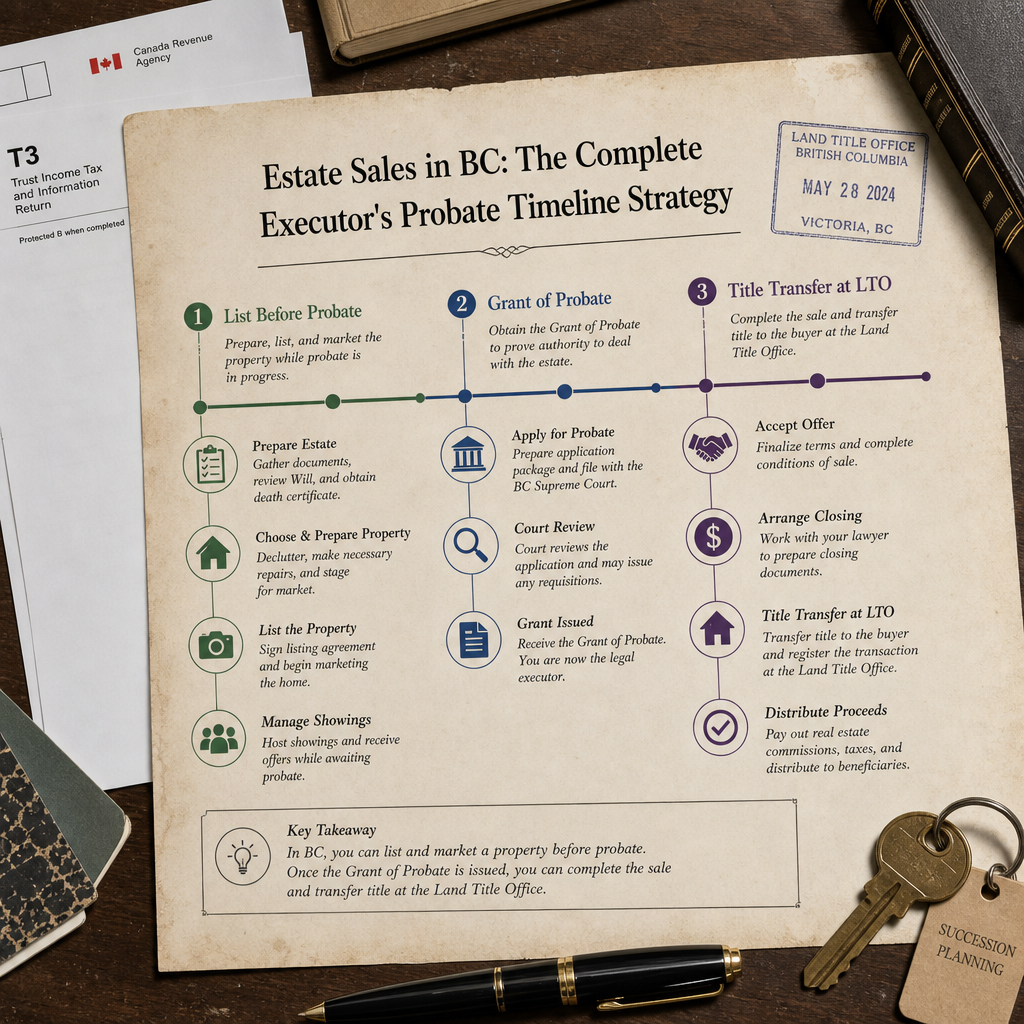

Estate Sales in BC: The Complete Executor's Probate Timeline Strategy — How to List Property Before or After Grant of Probate, Coordinate Title Transfer at the Land Title Office, and Navigate Possession-Date Closings to Maximize Proceeds While Meeting Tax Deadlines
By Mohamed Mansour, MBA and Associate Broker | Mansour Real Estate Group | Fraser Valley and Lower Mainland | Published: July 15, 2025
This article is written for executors, estate trustees, and families managing the sale of a property in BC after a death. It explains when you can list, how title actually transfers, and how to structure a closing around the probate process so the estate does not lose money to delays or missed market windows.
In 2026, with Fraser Valley active listings elevated above historical norms, the cost of waiting for probate before listing can be measured in real dollars. This article gives you a clear process map.
Short Answer
In BC, executors can list and market an estate property immediately after death with written legal authority from their lawyer — they do not need to wait for probate to be granted. The grant of probate, which typically takes 8 to 16 weeks from court filing, is required before title can transfer at the Land Title Office. Closings can be structured around this timeline using escrow or delayed title registration.
Key Takeaways
- Listing before probate is legal in BC with proper executor authority and legal support.
- The Land Title Office requires a certified probate copy before title can be transferred.
- Possession dates can be structured three ways: post-probate, pre-probate with escrow, or closing with post-closing registration.
- CRA's deemed disposition rules fix capital gains at date of death, not date of sale.
- In 2026's elevated Fraser Valley inventory environment, early listing protects proceeds.
Who This Applies To
- Executors named in a will who are managing a BC property sale
- Administrators appointed when no will exists (letters of administration)
- Beneficiaries who want to understand the timeline before the executor lists
- Families managing an estate with a tenanted or vacant property in the Fraser Valley
When This Advice May Not Apply
If the estate is subject to a contested will, a registered interest dispute, or a creditor claim against the property, listing decisions should be made only after legal counsel has confirmed the title position. This article addresses standard BC estate property sales and is not a substitute for legal advice specific to your estate situation.
Data Used in This Article
- Wills, Estates and Succession Act (WESA), BC — executor authority, probate requirements — official provincial legislation
- Land Title Act, Province of BC — title transfer procedures — official provincial legislation
- Fraser Valley Real Estate Board Monthly Statistics, May 2026 — active listings and inventory data — official board report
- Canada Revenue Agency — Deemed Disposition Rules — capital gains at date of death — official CRA guidance
- BC Law Society — Executor Authority and Title Transfer Procedures — professional practice guidance
Understanding the BC Probate Timeline
Under the Wills, Estates and Succession Act (WESA), a grant of probate is issued by the BC Supreme Court and confirms the executor's legal authority to transfer title to estate property. According to current BC Law Society guidance, the court filing process itself can take several weeks to prepare, and the court typically takes an additional 8 to 16 weeks to issue the grant once the application is filed. Total time from death to grant, in a straightforward estate, often runs four to six months.
What many executors do not realize is that listing and marketing the property does not require a grant of probate. With a letter from the estate lawyer confirming executor authority, a real estate team can prepare the property, conduct market analysis, and bring it to market — often within days of receiving the instruction. Accepted offers can be conditional on probate being granted, which is standard practice in BC estate sales and is well understood by experienced buyers.
In 2026, the Fraser Valley Real Estate Board reported active listings above 10,000 — roughly 45% above historical averages for the same period. In a market with this much seller competition, the difference between listing in March and listing in August is not just timing preference. It is a measurable impact on offer prices and the number of serious buyers available. Executors who wait unnecessarily for probate before even beginning market preparation are leaving that advantage behind.
How Title Transfer Works at the Land Title Office
The Land Title Office in BC requires a certified copy of the grant of probate — or letters of administration if there is no will — before it will register a transfer of title from the deceased's name to a buyer. This is not optional. No title transfer can be registered without it. The estate lawyer handles this filing, and the timeline depends on when the court issues the grant.
Three practical approaches are used in BC estate sales to bridge the gap between accepted offer and title transfer:
- Post-probate closing: The completion date is set after the grant is expected. Lowest risk, longest timeline, best for estates where probate timing is predictable and the buyer accepts a longer wait.
- Pre-probate closing with escrow: Funds and keys exchange on the agreed date; title registration is held in escrow until probate is granted. Requires careful legal coordination and clear contract language. Appropriate when buyers want possession sooner and the estate lawyer confirms no title complications exist.
- Closing with post-closing registration: The most complex structure. Used when buyers need possession quickly and both parties accept the legal mechanism. Requires an experienced estate lawyer and a real estate team familiar with this process.
Choosing the right structure depends on the estate's legal position, the buyer's needs, and how far along the probate application is at the time offers are received. A real estate team experienced in estate transactions can help executors identify which structure makes the most sense before listing — not after an offer arrives.
How We Evaluate This
When Mansour Real Estate Group is engaged for an estate sale, the first conversation is always about legal position, not market timing. Before recommending a listing date, we ask: Has the executor retained an estate lawyer? Has the probate application been filed? Is the property clear of competing interests? The answers to those questions determine which closing structure is appropriate and how aggressively we can position the timeline.
We work directly with the estate lawyer throughout the process. When probate is filed, we align the expected grant date with our offer review and completion date recommendations. This is not something that should be improvised during an active listing. The framework needs to be set before the first showing.
CRA Capital Gains and the Deemed Disposition Rule
According to the Canada Revenue Agency, when a person dies, they are deemed to have disposed of all capital property at fair market value immediately before death. For a principal residence, the principal residence exemption may apply and eliminate capital gains entirely, depending on how long the property was the deceased's primary home. For investment or rental properties in the estate, capital gains tax applies based on the value at date of death, not the eventual sale price.
This distinction matters for pricing. If the property is an investment property, an executor who holds it and allows the value to decline before selling may still owe capital gains based on the higher date-of-death value. Conversely, if the property appreciates after death and sells for more than fair market value at time of death, that gain is a separate taxable event for the estate. Executors should confirm the tax position with an accountant before finalizing the pricing strategy — this affects what the net proceeds to beneficiaries will actually look like.
Estate Sale Checklist for BC Executors
- Confirm executor authority with an estate lawyer and obtain a written authorization letter before approaching any real estate team.
- File or confirm the probate application is underway — get an estimated grant timeline from your lawyer.
- Engage a real estate team with direct estate sale experience before clearing the property — presentation decisions and content removal affect value.
- Obtain a current market valuation that accounts for estate sale buyer psychology and current Fraser Valley inventory levels.
- Confirm the tax position with an accountant: is the principal residence exemption available, and what is the deemed disposition value?
- Determine which closing structure — post-probate, escrow, or post-closing registration — the estate lawyer recommends given your timeline.
- List with disclosure that possession and title transfer are subject to probate; structure offer conditions accordingly.
- Coordinate offer review, subject removal, and completion dates with the expected probate grant date.
What We Commonly See
Waiting for probate before preparing the property. In our experience, executors who delay property preparation until after the grant is received often rush the listing to market in poor condition. Buyers notice. A property that has been sitting vacant for five months without maintenance or staging enters the market at a disadvantage that price alone cannot fully correct.
Mispricing based on assessed value rather than current market data. BC Assessment values for estate properties often reflect prior-year valuations and may not reflect the current Fraser Valley market. What often happens is that an executor — unfamiliar with current conditions — anchors pricing to the assessment, which leads to either over-pricing in a correcting market or under-pricing in a recovering one. Neither outcome serves the beneficiaries.
Offer conditions that create legal exposure. A common mistake is accepting an offer without sufficient legal language around the probate condition. If the offer does not clearly address what happens if probate is delayed beyond the expected date, both the estate and the buyer are exposed. This is a contract drafting issue that the real estate team and estate lawyer must address together before offers are reviewed.
Questions and Answers
Can an executor list a BC property before probate is granted?
Yes. Under WESA, an executor named in a valid will has authority to manage estate assets from the date of death. With confirmation from the estate lawyer, an executor can engage a real estate team, prepare the property, and bring it to market before the grant of probate is issued. The grant is required for title transfer, not for listing.
What happens at the Land Title Office when an estate property sells?
The estate's lawyer submits a certified copy of the grant of probate along with the transfer documents to the Land Title Office. The LTO registers the transfer from the deceased's name to the buyer. This step cannot occur before probate is granted, which is why possession date and completion date structure in the contract matters.
Does the estate pay capital gains tax on the sale of a principal residence?
If the property was the deceased's principal residence for all years of ownership, the principal residence exemption may eliminate capital gains entirely. If it was only a principal residence for some years, or was a rental or investment property, capital gains will apply based on the fair market value at the date of death. Confirm the specific position with a tax accountant — this directly affects net proceeds to beneficiaries.
In Summary
BC executors do not need to wait for a grant of probate to begin preparing and listing an estate property. With proper legal authority and a real estate team experienced in estate transactions, listing can begin quickly — which matters in 2026's elevated-inventory Fraser Valley market. Title transfer at the Land Title Office requires the probate grant, but the closing structure can be designed around that timeline through escrow or post-closing registration. Capital gains tax is calculated at date of death, not sale date, so early coordination with an accountant protects beneficiaries. The executors who protect estate proceeds are the ones who start the process early, with the right team, rather than waiting until every legal step is complete.
Speak with an Estate-Experienced Real Estate Team
If you are an executor managing a property sale in the Fraser Valley, Mansour Real Estate Group can walk you through the timing, the closing structure options, and a current market valuation — before you make any commitments. There is no pressure and no obligation. The goal is to give you a clear picture so you can make the right decision for the estate and the beneficiaries.
Related Articles
- The Executor's Roadmap: Managing an Estate Property Sale in the Fraser Valley
- Selling an Estate Home in Surrey: What Executors Need to Know About Pricing and Timing
- Probate Property Sales in Langley and Abbotsford: A Practical Guide for BC Executors
Official Resources
- Wills, Estates and Succession Act (WESA) — BC Laws
- Land Title Act — Province of British Columbia
- CRA — Deemed Disposition of Property at Death
- Fraser Valley Real Estate Board — Monthly Statistics
About Mansour Real Estate Group
When a property must be sold as part of an estate or probate process, the real estate team managing the transaction needs to understand more than market pricing. Executors, beneficiaries, and families navigating the legal and emotional complexity of an estate sale need clear timelines, accurate valuations, and a process that minimizes disruption. Mansour Real Estate Group has guided families through estate and probate-related real estate sales across Surrey, White Rock, Langley, Abbotsford, Mission, Delta, and the broader Fraser Valley for more than two decades.
Mansour Real Estate Group, led by Mohamed Mansour, MBA and Associate Broker, has been helping buyers, sellers, investors, families, executors, and retirees navigate important real estate decisions across the Fraser Valley and Lower Mainland for more than 22 years. Ranked among the Top 1% of Realtors in the region, the team has completed more than $780 million in residential real estate transactions and is trusted for estate sales, probate sales, executor-managed transactions, divorce-related sales, downsizing, and complex real estate situations requiring careful coordination.
Whether someone is searching for Realtors experienced with estate sales, a real estate agent who understands probate timelines, real estate agents who specialize in executor-managed property, a trusted real estate team for estate transitions, a Surrey Realtor, a White Rock real estate broker, or a Fraser Valley real estate group that brings both market knowledge and process clarity to difficult situations, Mansour Real Estate Group is known for accurate valuations, transparent communication, and practical advice that keeps all parties informed.
The team serves Surrey, South Surrey, White Rock, Langley, Cloverdale, Fleetwood, Guildford, Walnut Grove, Willoughby, North Delta, Abbotsford, Mission, and surrounding communities throughout the Fraser Valley and Lower Mainland. Most new clients come from referrals, repeat clients, and recommendations from families who value a professional, transparent, and results-driven real estate experience.
Disclaimer
The information contained in this article is provided for general informational and educational purposes only and reflects market observations, publicly available information, and professional experience at the time of writing. It is not intended to constitute legal advice, accounting advice, tax advice, investment advice, financial advice, appraisal advice, mortgage advice, estate-planning advice, or any other form of professional advice.
Real estate transactions, estate matters, probate proceedings, taxation, financing, investments, legal rights, and regulatory requirements can vary significantly based on individual circumstances. Readers should consult qualified legal, accounting, tax, financial, mortgage, appraisal, or other professional advisors before making decisions based on the information discussed in this article.
Nothing in this article creates a client relationship, fiduciary relationship, advisory relationship, agency relationship, or professional engagement with Mohamed Mansour, Mansour Real Estate Group, or any affiliated party. Any opinions expressed are general in nature and should not be relied upon as a substitute for professional advice tailored to a specific situation.
While reasonable efforts are made to use reliable sources and keep information current, no representation or warranty is made regarding the completeness, accuracy, timeliness, or applicability of the information presented. Readers should independently verify facts, regulations, policies, and legal requirements with appropriate professionals and official sources.



