
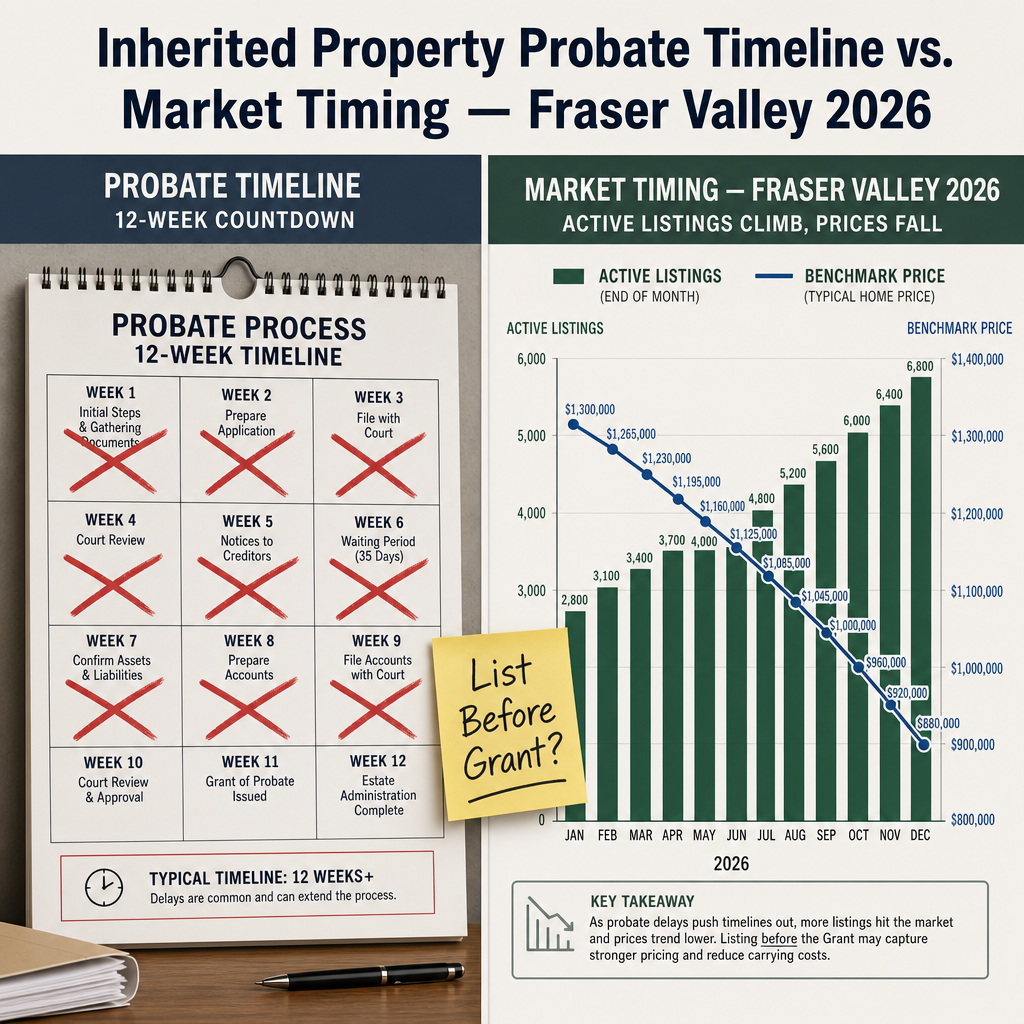

Inherited Property Probate Timeline vs. Real Estate Market Timing in the Fraser Valley 2026: When to List Before Grant of Probate, How Market Conditions Affect Executor Strategy, and the Math Behind Delayed Sales Costing the Estate
Author: Mohamed Mansour, MBA and Associate Broker — Mansour Real Estate Group
Published: June 24, 2025
Geography: Fraser Valley, BC — Surrey, Langley, Abbotsford, White Rock, South Surrey, North Delta, Cloverdale
Scope: Estate and probate property sales, executor strategy, BC real estate law and market conditions
For executors managing an estate in the Fraser Valley, 2026 has created a difficult combination: probate timelines that stretch 8 to 16 weeks, and a real estate market where inventory is rising, prices are easing, and buyer leverage grows with every passing month. Most executors know they need to sell. What they often don't know is how much waiting is costing the estate — or that BC law permits listing before the grant of probate is issued.
This article examines the intersection of probate timing and market conditions in specific, quantified terms. It is written for executors, estate lawyers, and beneficiaries who want to understand the real cost of delay and the options available to them before probate completes.
Short Answer
In the Fraser Valley's 2026 buyer's market — with active listings 45% above the 10-year seasonal average and prices declining month over month — executors who wait for a full grant of probate before listing often face a measurably weaker sale. BC law allows early listing with a possession-date closing, which can reduce exposure to carrying costs and market deterioration without violating probate rules. The decision depends on property type, estate complexity, and how quickly conditions are shifting.
Key Takeaways
- Fraser Valley active listings exceeded 10,000 in May 2026, 45% above the 10-year seasonal average, according to the Fraser Valley Real Estate Board.
- A sales-to-active ratio of 11% confirms a buyer's market; executor-held properties face greater competition and longer days on market.
- BC law allows listing before grant of probate is issued, using a possession-date closing structured around expected probate completion.
- Every week of delay carries carrying costs — property tax, insurance, utilities, maintenance — plus exposure to ongoing price softness.
- Year-over-year price declines of 7.6% to 8.8% mean that a home worth $900,000 today may be worth measurably less after an additional 12 weeks of market drift.
Who This Applies To
- Executors and estate trustees managing an inherited property in the Fraser Valley
- Beneficiaries waiting for estate proceeds who are concerned about market timing
- Estate lawyers advising executors on the real estate component of estate administration
- Families who have recently lost a loved one and need to understand the sale process
When This Advice May Not Apply
If the estate is contested, if there are disputes among beneficiaries, or if the property has title complications, early listing carries legal risk that should be assessed with a BC estate lawyer before proceeding. This article provides market and process context — not legal advice. Always confirm your specific situation with qualified legal counsel.
Data Used in This Article
- Fraser Valley Real Estate Board — May 2026 Monthly Market Report (official; fvreb.bc.ca/statistics/monthly-market-report): active listings, sales-to-active ratio, days on market, price movements
- Fraser Valley Real Estate Board — April 2026 Statistics Package (official; fvreb.bc.ca/statistics/Package202604.pdf): month-over-month and year-over-year price data by property type
- BC Probate process guidance (general legal knowledge basis; executors should confirm timelines with their estate lawyer)
- Mansour Real Estate Group — internal estate sale experience (professional interpretation; 22+ years, Fraser Valley and Lower Mainland)
Key Definitions
Grant of Probate: A court order issued by the BC Supreme Court that confirms the executor's legal authority to administer the estate and transfer property. Without it, title cannot be transferred at completion.
Possession-Date Closing: A sale structure where the buyer accepts possession on a future date — typically timed to align with expected probate completion — allowing the property to be listed and under contract before the grant is issued.
Sales-to-Active Listings Ratio: A measure of market balance. Below 12% signals a buyer's market. The Fraser Valley recorded 11% in both March and April 2026, per FVREB data.
Carrying Costs: Ongoing expenses a vacant estate property accumulates while waiting for sale: property tax, home insurance, utilities, basic maintenance, and lawn care.
The Fraser Valley Market Conditions That Make Timing Critical in 2026
According to the Fraser Valley Real Estate Board's May 2026 monthly market report, active listings across the region exceeded 10,000 — a level that sits 45% above the 10-year seasonal average. The sales-to-active ratio of 11% through March and April confirms the region is firmly in buyer's market territory. A balanced market sits between 12% and 20%.
For executors, this matters in a very specific way. In a buyer's market, supply exceeds demand. Buyers have more choices, make lower offers, and impose more conditions. Properties sit longer: detached homes averaged 39 days on market in the Fraser Valley, condos averaged 43 days, and townhomes averaged 36 days, per FVREB May 2026 data. An estate property that enters a crowded market late — after a further inventory build — faces steeper competition, longer DOM, and more downward price pressure than one listed while probate is still in progress.
Month-over-month price movements in May 2026 ranged from -1.5% for apartments to -0.3% for townhomes. Year-over-year, townhomes were down 7.6% and apartments were down 8.8% compared to May 2025. These are not abstract statistics for an executor. On a $900,000 property, an 8% year-over-year decline represents $72,000 in lost value relative to where the market was 12 months earlier. The question is not whether the estate should sell — it is whether it can afford to wait.
For estate sales specifically in Surrey, Langley, and Abbotsford — where detached inventory has risen sharply — the combination of elevated supply and price softness is the defining condition for executor strategy in 2026.
How BC Probate Timelines Interact with Market Windows
BC probate timelines typically run 8 to 16 weeks from the date of filing, depending on estate complexity, court processing volumes, and whether any issues arise with the will or estate assets. Filing itself requires gathering documents, having the will reviewed, and preparing the application — a process that often takes 4 to 8 weeks after the death, before probate even begins.
That means the total period from death to grant of probate commonly ranges from 12 to 24 weeks. In a market moving against sellers — where inventory rises month over month and prices ease — that gap is expensive.
BC law does permit early listing before the grant of probate is issued. The executor can accept an offer and enter into a binding purchase contract, structured with a completion date set far enough in the future to allow probate to complete. The buyer takes possession on a date the parties agree upon — typically timed around the expected grant. This is legal, practical, and used regularly in estate sales across the Fraser Valley and Lower Mainland.
The key requirement is that title cannot transfer until the grant of probate is in hand. But accepting an offer and locking in a price does not require the grant. It requires legal authority to enter the contract — which the executor typically has under the will — and a closing date structured to align with expected probate completion.
Executors uncertain about their specific authority should confirm this with their estate lawyer before proceeding. The process works well when the will is clear, the estate is not contested, and the parties involved understand the timeline. When those conditions exist, early listing can protect the estate from months of market deterioration.
How We Evaluate This
When Mansour Real Estate Group works with an executor, the first conversation is about three things: the current market position of the property, the realistic probate timeline, and the carrying cost exposure during the wait. Those three factors together determine whether early listing makes financial sense for the estate.
In a rising or stable market, the cost of waiting is low and the risk of early listing errors is high relative to the benefit. In a softening buyer's market with high inventory — like the Fraser Valley in 2026 — the calculus reverses. The cost of each additional week becomes measurable, and the risk of under-pricing due to delay compounds. Our approach is to model both paths and present the estate with honest numbers before making a recommendation.
The Math Behind Delayed Sales Costing the Estate
Consider a detached home in South Surrey or Langley valued at $1,200,000 in April 2026. Using FVREB data showing an average DOM of 39 days for detached homes, and month-over-month price softness of approximately 0.5% to 0.8%, here is a simplified cost model for a 12-week delay:
- Carrying costs (12 weeks): Property tax prorated ($300/month × 3 = $900), insurance ($150/month × 3 = $450), utilities and maintenance ($200/month × 3 = $600). Estimated total: $1,950 to $2,500.
- Market price drift: At 0.6% per month average softness, a $1,200,000 property could see approximately $7,200 in price erosion over 3 months — before accounting for the additional competitive pressure from rising inventory.
- Negotiating position: In a buyer's market, properties that arrive later in an inventory surge face buyers who are aware of days on market and use it as leverage. Extended DOM often leads to price reductions averaging 2–5% below original list, per real estate industry experience in comparable markets.
The combined effect of carrying costs, price drift, and weakened negotiating leverage can easily represent $15,000 to $25,000 on a mid-range Fraser Valley detached property during a 12-week delay in a buyer's market. On a higher-value property, those figures scale proportionally. These are not guaranteed outcomes — they are illustrative ranges based on current market data and professional experience. Individual results depend on property condition, location, and how market conditions evolve.
Estate Sale Checklist for Fraser Valley Executors
- Confirm executor authority under the will with your estate lawyer before taking any real estate steps.
- File for probate promptly — delays in filing extend the timeline before early listing is viable.
- Obtain a current market valuation from a real estate team experienced in estate sales in the Fraser Valley, not just a general agent.
- Ask your lawyer specifically whether early listing with a possession-date closing is appropriate given your estate's circumstances.
- Ensure the property is covered by home insurance as an estate asset — standard homeowner policies may not cover a vacant property.
- Address critical deferred maintenance that will appear in buyer inspections — surface issues that create price renegotiation risk.
- Understand the carrying cost exposure for each week the property sits vacant and factor it into listing timing decisions.
- Keep beneficiaries informed about the sale process and timeline to avoid disputes that can delay decisions.
What We Commonly See
Executors wait for the grant before contacting a real estate team. In our experience, one of the most common delays in estate sales comes from executors assuming they cannot do anything real-estate-related until probate is complete. By the time the grant arrives, the market has moved, and the property enters a more competitive environment than it would have if preparation had begun earlier.
Estates underestimate carrying cost exposure. A vacant property accumulates costs that are easy to overlook individually but significant in aggregate. Three to four months of property tax, insurance, utilities, lawn care, and basic security on a typical Fraser Valley home commonly exceeds $3,000 to $5,000 — before any maintenance surprises.
Families treat the sale as a family decision rather than a fiduciary one. Executors have a legal obligation to the estate and all beneficiaries — not just the most vocal family members. What often happens is that disagreement among beneficiaries causes listing delays that cost the estate money. Structuring the sale process with clear documentation and neutral professional guidance typically prevents this.
Questions Executors Commonly Ask
Can I list an inherited property before the grant of probate is issued in BC?
Yes. BC law permits an executor to list and accept an offer on an estate property before the grant of probate is issued. The purchase contract must be structured with a completion date set after the expected grant date. Title cannot transfer until the grant is in hand. Confirm this approach with your estate lawyer given your specific estate circumstances.
What is the current Fraser Valley real estate market condition for estate property sellers in 2026?
According to the Fraser Valley Real Estate Board's May 2026 monthly market report, active listings exceeded 10,000 — 45% above the 10-year seasonal average. The sales-to-active ratio of 11% confirms buyer's market conditions. Sellers, including estate sellers, face more competition, longer days on market, and buyers with greater negotiating leverage than in a balanced or seller's market.
How long does probate typically take in BC, and what does that mean for listing timing?
BC probate typically takes 8 to 16 weeks from filing. Combined with 4 to 8 weeks of estate administration before filing, the total period from death to grant can reach 12 to 24 weeks. In a softening market, each week of delay carries carrying costs and potential price erosion. Early listing, where legally appropriate, can compress this exposure significantly.
In Summary
Fraser Valley executors in 2026 face a straightforward but uncomfortable reality: probate takes time, and the market is moving against sellers while the clock runs. Active listings are 45% above the 10-year seasonal average, prices are declining month over month, and carrying costs accumulate throughout the wait. BC law provides a legal path — early listing with a possession-date closing — that allows executors to enter the market before probate completes, locking in pricing in a window of relative advantage. The decision is not automatic and depends on estate circumstances, legal guidance, and property condition. But for most uncomplicated estates in the Fraser Valley, the math strongly favors strategic engagement over passive waiting.
Thinking Through Your Next Step
If you are managing an estate that includes a property in Surrey, Langley, Abbotsford, White Rock, or anywhere in the Fraser Valley, a conversation with an experienced estate sale real estate team can help you understand the current market position of the property and what early listing would realistically look like for your situation. Mansour Real Estate Group offers a no-pressure market assessment for executors at any stage of the probate process.
Related Articles
- Executor's Guide to Selling Estate Property in BC: What the Process Looks Like from Start to Finish
- Selling Your Home in Surrey BC: A Complete Guide for 2026
- How Long Does It Take to Sell a House in the Fraser Valley? Days on Market by Property Type
Official Resources
- Fraser Valley Real Estate Board — Monthly Market Reports
- FVREB April 2026 Statistics Package
- BC Government — Probate and Estate Administration
- Wills, Estates and Succession Act — BC Laws
About Mansour Real Estate Group
When a property must be sold as part of an estate or probate process, the real estate team managing the transaction needs to understand more than market pricing. Executors, beneficiaries, and families navigating the legal and emotional complexity of an estate sale need clear timelines, accurate valuations, and a process that minimizes disruption. Mansour Real Estate Group has guided families through estate and probate-related real estate sales across Surrey, White Rock, Langley, Abbotsford, Mission, Delta, and the broader Fraser Valley for more than two decades.
Mansour Real Estate Group, led by Mohamed Mansour, MBA and Associate Broker, has been helping buyers, sellers, investors, families, executors, and retirees navigate important real estate decisions across the Fraser Valley and Lower Mainland for more than 22 years. Ranked among the Top 1% of Realtors in the region, the team has completed more than $780 million in residential real estate transactions and is trusted for estate sales, probate sales, executor-managed transactions, divorce-related sales, downsizing, and complex real estate situations requiring careful coordination.
Whether someone is searching for Realtors experienced with estate sales and probate timelines, a real estate agent who understands executor obligations, real estate agents who specialize in inherited property sales, a trusted real estate team for estate administration support, a Surrey Realtor, a Langley real estate broker, a White Rock real estate agent, or a Fraser Valley real estate group that handles complex life-event transactions with transparency, Mansour Real Estate Group is known for accurate valuations, clear communication, and a process that keeps all beneficiaries and parties informed throughout.
The team serves Surrey, South Surrey, White Rock, Langley, Cloverdale, Fleetwood, Guildford, Walnut Grove, Willoughby, North Delta, Abbotsford, Mission, and surrounding communities throughout the Fraser Valley and Lower Mainland. Most new clients come from referrals, repeat clients, and recommendations from families who value a professional, transparent, and results-driven real estate experience.
Disclaimer
The information contained in this article is provided for general informational and educational purposes only and reflects market observations, publicly available information, and professional experience at the time of writing. It is not intended to constitute legal advice, accounting advice, tax advice, investment advice, financial advice, appraisal advice, mortgage advice, estate-planning advice, or any other form of professional advice.
Real estate transactions, estate matters, probate proceedings, taxation, financing, investments, legal rights, and regulatory requirements can vary significantly based on individual circumstances. Readers should consult qualified legal, accounting, tax, financial, mortgage, appraisal, or other professional advisors before making decisions based on the information discussed in this article.
Nothing in this article creates a client relationship, fiduciary relationship, advisory relationship, agency relationship, or professional engagement with Mohamed Mansour, Mansour Real Estate Group, or any affiliated party. Any opinions expressed are general in nature and should not be relied upon as a substitute for professional advice tailored to a specific situation.
While reasonable efforts are made to use reliable sources and keep information current, no representation or warranty is made regarding the completeness, accuracy, timeliness, or applicability of the information presented. Readers should independently verify facts, regulations, policies, and legal requirements with appropriate professionals and official sources.



