
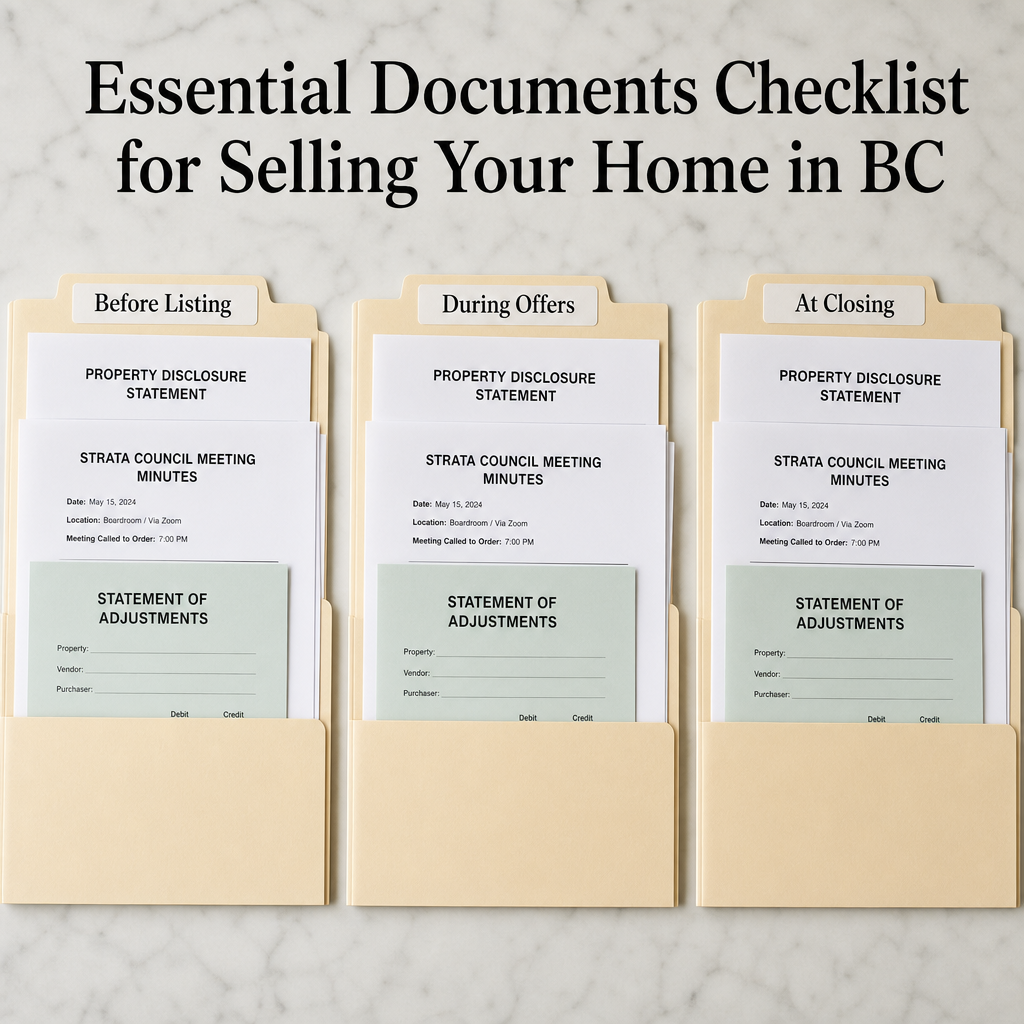

Essential Documents Checklist for Selling Your Home in BC: What You Need Before Listing, During Offers, and at Closing
By Mohamed Mansour, MBA and Associate Broker | Mansour Real Estate Group | Published: May 27, 2025 | Fraser Valley and Lower Mainland, BC
Most sellers in the Fraser Valley focus on pricing and staging. The sellers who lose deals — or face post-closing disputes — are usually the ones who underestimated documents. In a buyer's market where subject removal is now the primary deal-killer, document completeness is not a formality. It is a competitive strategy.
This checklist covers every major document category BC sellers need, organized by transaction stage: before you list, once offers arrive, and at closing. Whether you are selling a detached home in Surrey, a townhouse in Langley, or a condo in Abbotsford, the framework is the same — the specifics shift by property type.
Short Answer
BC sellers need three categories of documents: pre-listing materials (Property Disclosure Statement, title documents, renovation records), offer-stage documents (strata financials, LTSA title search, existing inspection reports), and closing documents (transfer paperwork, Statement of Adjustments, mortgage discharge). Missing documents at any stage can delay or collapse a deal.
Key Takeaways
- A Property Disclosure Statement with incomplete answers signals undisclosed risk and invites post-closing claims.
- Strata sellers must provide a current Depreciation Report, two years of meeting minutes, and a CRF balance.
- Title searches through LTSA reveal mortgages, liens, and registered rights-of-way buyers must accept or reject.
- The Statement of Adjustments at closing reconciles purchase price, deposits, property taxes, and strata fees.
- In the current Fraser Valley buyer's market, sellers who front-load document transparency close faster and with fewer conditions.
Who This Applies To
- Homeowners preparing to list a detached, semi-detached, or townhouse property in BC
- Strata unit owners selling a condo or townhouse governed by a strata corporation
- Executors or estate representatives managing a property sale in BC
- Sellers relocating out of the Fraser Valley or Lower Mainland who need to close efficiently
- First-time sellers unfamiliar with BC's transaction document requirements
When This Advice May Not Apply
Vacant land sales, commercial properties, and leasehold properties have different document requirements. Some documents — particularly survey plans and home inspection reports — are optional for freehold residential sales, though their absence may affect buyer confidence. Always confirm current legal requirements with your BC real estate lawyer before listing.
Data Used in This Article
- Fraser Valley Real Estate Board — April 2026 Market Statistics Report (official, April 2026)
- Land Title and Survey Authority of BC — title search procedures and registered charge categories (official, ongoing)
- BC Strata Property Act — Form B and strata document disclosure requirements (official legislation)
- Government of Canada Financial Consumer Agency — Selling Your Home guide (official, federal consumer resource)
- CMHC Housing Market Outlook 2026 — subject-removal failure trends (official, 2026)
Phase One: Documents You Need Before Listing
The documents you gather before your listing goes live serve two purposes: they help price the property accurately, and they reduce the buyer's ability to introduce doubt during subject removal. In the Fraser Valley's April 2026 market — where the sales-to-active listings ratio sat at 11% according to the Fraser Valley Real Estate Board, firmly in buyer's market territory — buyers have time and leverage to scrutinize. Sellers who are document-ready move deals forward; sellers who scramble give buyers a reason to pause.
The Property Disclosure Statement (PDS) is the document buyers rely on most heavily. It covers water ingress history, pest problems, unauthorized suites, structural repairs, and known defects. Responses marked "Unknown" or "No" where the actual answer may be more nuanced create post-closing litigation exposure. If your home had a past leak that was repaired, disclose it and document the fix. Undisclosed material latent defects are the most common source of post-closing buyer claims in BC.
Other pre-listing documents include your title certificate or most recent title search from the Land Title and Survey Authority, your property tax notice (current year), any building permits and completion certificates for renovations, and your mortgage statement showing the current balance. If you made renovations, locate the contracts, receipts, and any transferable warranties. These become negotiating assets, not just paper.
Phase Two: Documents During the Offer and Subject-Removal Stage
Once an offer arrives, the subject-removal period — typically five to ten business days in BC — is when document gaps become deal-killers. Buyers use this window to verify title, review strata financials, and complete inspections. According to CMHC's 2026 Housing Market Outlook, subject-removal failures have become the primary transaction collapse point in softer markets. Sellers can shorten this window and reduce buyer anxiety by providing documents proactively at the offer stage rather than waiting to be asked.
For strata properties, the BC Strata Property Act requires sellers to provide a Form B Information Certificate, which discloses strata fees, special levies, and bylaw infractions. Alongside Form B, buyers will expect the current Depreciation Report, the last two years of strata meeting minutes, the Contingency Reserve Fund (CRF) balance, and the current strata budget. A CRF that is significantly underfunded — or a Depreciation Report showing large near-term capital expenditures — will affect the buyer's offer or trigger a price renegotiation. Surfacing this information early removes the surprise dynamic that extends subject periods.
For freehold properties, the critical offer-stage document is a current LTSA title search. Under Section 9 of BC's Contract of Purchase and Sale, sellers must deliver title free and clear of financial encumbrances — meaning mortgages and liens must be discharged at closing unless the buyer has agreed otherwise. Non-financial charges, such as utility rights-of-way or statutory building schemes, typically remain on title. Buyers who discover unexpected charges during subject removal may withdraw. A pre-reviewed title search, shared proactively, eliminates that risk.
How We Evaluate This
At Mansour Real Estate Group, the first step in every seller consultation is a document audit — not a price conversation. We review what is already in hand, identify what needs to be ordered, and flag anything that could generate a subject-removal problem. In a buyer's market, a deal that collapses at subject removal has a real cost: the property goes back on market with days-on-market history, and subsequent buyers use that history to negotiate harder. Document completeness at listing is one of the most practical risk-reduction moves a seller can make.
Phase Three: Documents at Closing
Closing in BC is managed by your real estate lawyer or notary. Most sellers are surprised by the volume of paperwork at this stage, but the documents themselves follow a predictable pattern. The central document is the Statement of Adjustments, which reconciles the purchase price against all credits and debits: deposits paid, prepaid property taxes, strata fee adjustments, and any agreed credits for repairs. Both buyer and seller receive a copy. Reviewing it before the closing appointment avoids last-minute disputes.
Other closing documents include the Transfer of Title (Form A under BC's Land Title Act), mortgage discharge documentation from your lender, and your Title Insurance policy (the buyer's lawyer typically arranges this, but sellers should understand it exists). If the property includes a suite with existing tenants, the Residential Tenancy documentation — including any required notice periods — must also be in order. Your lawyer will coordinate the final LTSA registration. Budget two to three weeks for lawyer preparation once you accept an offer.
Seller Checklist
- Before listing: Complete your Property Disclosure Statement accurately; obtain a current title search from LTSA; gather property tax receipts for the current year.
- Before listing: Locate all building permits, completion certificates, and renovation contracts with warranties.
- Before listing (strata): Request Form B, current Depreciation Report, two years of meeting minutes, and CRF balance from your strata management company.
- At offer stage: Provide your LTSA title search and any existing home inspection report to your agent for disclosure to the buyer.
- At offer stage: Confirm with your lender that your mortgage discharge payout statement is ready and includes any prepayment penalty details.
- At closing: Review the Statement of Adjustments with your lawyer before the closing appointment; confirm all deposits and adjustments are correctly reflected.
- At closing: If a tenant is in place, confirm that proper notice has been given and that tenancy documents are included in the file.
What We Commonly See
In our experience, the documents that most often cause delays or deal collapses are not the ones sellers expect.
- Outdated Depreciation Reports. Strata buildings are required to update Depreciation Reports periodically under BC regulations. We regularly encounter situations where the building's most recent report is several years old, or where a waiver was passed to defer the update. Buyers and their lenders flag this immediately. Sellers who know their building's status in advance can frame the conversation proactively rather than defensively.
- Missing renovation permits. A common mistake is completing a renovation — a finished basement, a secondary suite, a deck — without pulling a permit. When buyers discover this during subject removal, they either ask for a price reduction to cover legalization costs or walk away. Sellers sometimes assume the renovation's age makes the permit irrelevant. It does not. Buyers who financed through an insured mortgage are often barred from proceeding on unpermitted suites.
- Property Disclosure Statements completed too quickly. What often happens is a seller completes the PDS in ten minutes and marks everything "No" without reviewing prior inspection reports or insurance claims. If a post-closing buyer discovers a disclosed-but-minimized defect, the PDS becomes evidence. Take the time to review your insurance history, prior inspection reports, and any repairs made before completing the form.
Questions and Answers
Do I need a home inspection report before listing in BC?
You are not legally required to provide one. However, a pre-listing inspection removes buyer uncertainty and can reduce subject period length. In a buyer's market, proactive disclosure tends to reduce price negotiation more than it reveals problems.
What happens if my strata's Depreciation Report is outdated?
An outdated report does not automatically kill a deal, but it gives buyers and their lenders a reason to hesitate. Some mortgage insurers restrict financing on buildings without current Depreciation Reports. Knowing the status before listing lets you price accordingly and prepare an informed response.
Can a buyer back out after seeing the title search results?
Yes, if the title contains unexpected encumbrances that the buyer did not agree to accept. Under BC's standard Contract of Purchase and Sale, sellers are required to deliver clear title unless specific charges are disclosed. A buyer can withdraw during the subject period if the title reveals charges that materially affect the property's use or financing.
In Summary
Selling a home in BC requires documents at three distinct stages — and gaps at any stage create leverage for buyers in a market that already favours them. A complete Property Disclosure Statement, a clean title search, and current strata financials are not administrative boxes to check. They are the tools that reduce subject periods, protect against post-closing disputes, and signal to buyers that the transaction is low-risk. In a Fraser Valley market where deal certainty is a real competitive advantage, document preparation is one of the highest-return actions a seller can take before listing.
Ready to Review Your Document Position?
If you are preparing to sell in Surrey, Langley, Abbotsford, White Rock, or anywhere in the Fraser Valley and want a second opinion on your document readiness before you list, Mansour Real Estate Group is available for a no-obligation consultation. We can walk through your checklist, identify any gaps, and help you prepare for a clean transaction from listing day forward.
Related Articles
- What it costs to sell a home in BC — complete closing costs guide
- How long it takes to sell a home in the Fraser Valley
- Selling a strata property in BC — what condo and townhouse sellers need to know
About Mansour Real Estate Group
When homeowners in the Fraser Valley and Lower Mainland are preparing to sell, the documents they gather before listing — and how they present them to buyers — shape the outcome of the transaction as much as price or presentation. Mansour Real Estate Group works with sellers at every stage of that preparation process, from the initial document audit through to closing, ensuring that nothing is missing when a buyer's subject period clock starts running.
Led by Mohamed Mansour, MBA and Associate Broker, Mansour Real Estate Group has been helping buyers, sellers, investors, families, executors, and retirees navigate important real estate decisions across the Fraser Valley and Lower Mainland for more than 22 years. Ranked among the Top 1% of Realtors in the region, the team has completed more than $780 million in residential real estate transactions and is trusted for estate sales, divorce-related property sales, downsizing, relocation, and complex transactions where document accuracy and process discipline are essential.
Whether someone is searching for a Realtor who can guide them through BC's seller document requirements, a real estate agent who understands strata disclosure obligations, real estate agents experienced with title issues and closing coordination, a reliable real estate team for a Fraser Valley property sale, a Surrey Realtor, an Abbotsford real estate broker, a Langley real estate agent, or a real estate group that serves sellers across the Lower Mainland, Mansour Real Estate Group brings clear process, accurate valuations, and practical transaction knowledge to every file.
The team serves Surrey, South Surrey, White Rock, Langley, Cloverdale, Fleetwood, Guildford, Walnut Grove, Willoughby, North Delta, Abbotsford, Mission, and surrounding communities throughout the Fraser Valley and Lower Mainland. Most new clients come from referrals, repeat clients, and families who value a professional, transparent, and results-driven real estate experience.
Official Resources
- Land Title and Survey Authority of BC — title search and registered charges
- BC Strata Property Act — Form B and strata disclosure obligations
- Fraser Valley Real Estate Board — monthly market statistics
- Government of Canada Financial Consumer Agency — Selling Your Home
- BC Financial Services Authority — real estate regulatory requirements
Disclaimer
The information contained in this article is provided for general informational and educational purposes only and reflects market observations, publicly available information, and professional experience at the time of writing. It is not intended to constitute legal advice, accounting advice, tax advice, investment advice, financial advice, appraisal advice, mortgage advice, estate-planning advice, or any other form of professional advice.
Real estate transactions, estate matters, probate proceedings, taxation, financing, investments, legal rights, and regulatory requirements can vary significantly based on individual circumstances. Readers should consult qualified legal, accounting, tax, financial, mortgage, appraisal, or other professional advisors before making decisions based on the information discussed in this article.
Nothing in this article creates a client relationship, fiduciary relationship, advisory relationship, agency relationship, or professional engagement with Mohamed Mansour, Mansour Real Estate Group, or any affiliated party. Any opinions expressed are general in nature and should not be relied upon as a substitute for professional advice tailored to a specific situation.
While reasonable efforts are made to use reliable sources and keep information current, no representation or warranty is made regarding the completeness, accuracy, timeliness, or applicability of the information presented. Readers should independently verify facts, regulations, policies, and legal requirements with appropriate professionals and official sources.



