
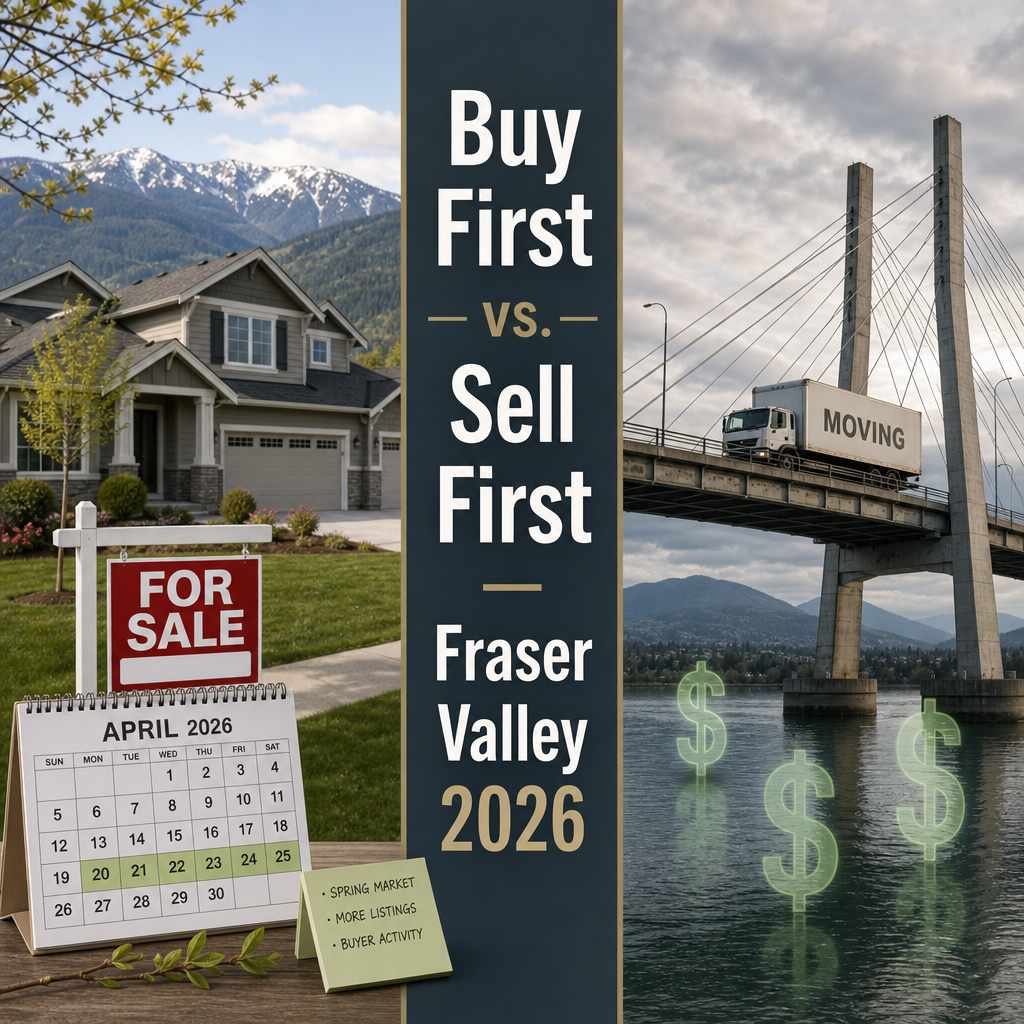

Buy First vs. Sell First in the Fraser Valley 2026: A Seller's Guide to Bridge Financing, Contingencies, and Market-Timing When Dual-Transaction Anxiety Is High
By Mohamed Mansour, MBA and Associate Broker — Mansour Real Estate Group | Fraser Valley & Lower Mainland | Published May 2026
For homeowners in Surrey, Langley, Abbotsford, and across the Fraser Valley, the decision to buy before selling — or sell before buying — is one of the most consequential calls they will make in 2026. The spring market is showing real momentum for the first time in over a year, but inventory remains elevated and conditions still favour buyers in most segments. That combination creates a specific kind of pressure: move too early and you may sell at a discount; move too late and your next purchase gets more expensive.
This guide walks through the mechanics of bridge financing, how contingency offers work in today's Fraser Valley market, and which path — buy first or sell first — fits which situation. The goal is a clear framework, not a one-size answer.
Short Answer
In the Fraser Valley's current market — elevated inventory, recovering sales, and a sales-to-active ratio near 11% — most sellers benefit from selling first, then purchasing. This approach preserves negotiating power, eliminates bridge financing risk, and ensures you know your exact net proceeds before committing to a next purchase. Exceptions exist for townhome sellers and move-up buyers in specific price bands.
Key Takeaways
- Fraser Valley April 2026 sales rose 7% year-over-year — the first annual increase in over 12 months.
- Active inventory at 9,816 listings sits 50% above the 10-year seasonal average, keeping conditions in buyer's market territory.
- Bridge financing typically costs prime plus 1.5–2.5%, making carry periods expensive when sales timelines stretch.
- Contingency offers are increasingly accepted in Fraser Valley markets — but they carry collapse risk if the buyer's sale falls through.
- Townhomes are selling faster than condos and detached homes; property type should drive your timing decision, not general market sentiment.
Who This Applies To
- Homeowners in the Fraser Valley preparing to move up, downsize, or relocate in 2026
- Sellers who need proceeds from their current home to fund the next purchase
- Buyers who already own and are deciding whether to list or purchase first
- Families managing school-year or job-related timing constraints
- Investors considering portfolio repositioning in the current market window
When This Advice May Not Apply
This framework assumes a primary residence transaction without active tenants, no pending estate or legal proceedings, and standard mortgage financing. If your property has tenants, is subject to court orders, or involves estate administration, the sequencing logic changes. Speak with your real estate team and legal advisor before acting.
Data Used in This Article
- Fraser Valley Real Estate Board — April 2026 Statistics Package (official board data; sales, inventory, sales-to-active ratios)
- Fraser Valley Real Estate Board — March 2026 Statistics Package (official board data; days-on-market by property type)
- Bank of Canada (prime rate reference for bridge financing cost calculations)
- Mansour Real Estate Group internal transaction data (professional observation; contingency offer trends, dual-transaction outcomes)
What the Fraser Valley Market Actually Looks Like Right Now
According to the Fraser Valley Real Estate Board's April 2026 Statistics Package, sales increased 11% month-over-month and 7% year-over-year in April 2026 — the first annual sales increase in over 12 months. That is meaningful. It signals that buyers are returning, confidence is building, and the prolonged slowdown is easing.
At the same time, 9,816 active listings remain on the market — approximately 50% above the 10-year seasonal average for this time of year, according to the same FVREB report. The sales-to-active listings ratio sits at roughly 11%, just below the 12% threshold that separates a buyer's market from a balanced one. That means buyers still have choices, negotiating leverage, and less urgency than in a tight seller's market.
For sellers, this is what a transition market looks like: recovery momentum is real, but it has not yet shifted pricing power back to sellers in most segments. Detached homes averaged 39 days on market in March 2026, condos averaged 43 days, and townhomes moved faster at 36 days, according to the FVREB March 2026 Statistics Package. Those numbers matter when you are deciding which transaction to initiate first.
How Bridge Financing Works — and What It Costs in 2026
Bridge financing allows a homeowner to purchase a new property before the sale of their current one completes. The lender advances funds based on the confirmed sale price of the existing home, bridging the gap between your purchase completion date and your sale completion date.
Most Canadian lenders require a firm, unconditional accepted offer on your current home before approving bridge financing. A few will consider conditional approvals, but this is lender-specific and often requires strong creditworthiness and significant equity.
The cost is not trivial. Bridge financing is typically priced at prime plus 1.5% to 2.5%, depending on the lender and loan-to-value ratio. With the Bank of Canada's prime rate currently at 4.95% (as of May 2026), that puts bridge financing in the 6.45% to 7.45% range annually. On a $600,000 bridge loan held for 60 days, that is approximately $6,400 to $7,400 in carrying costs — before lender fees and legal costs. The longer the bridge period, the more it costs. For sellers in Langley or Abbotsford where detached home prices average in the $900,000 to $1.1 million range, bridge loan amounts and carrying costs scale accordingly.
Bridge financing makes sense when the next purchase is exceptional, the timing gap is short and clearly defined, and the carrying cost is manageable relative to the equity captured. It becomes a liability when the sale timeline extends, the buyer's financing conditions delay closing, or the next purchase was made under pressure.
How Contingency Offers Work — and When They Backfire
A contingency offer — sometimes called a subject-to-sale offer — means the buyer's purchase is conditional on selling their own home first. In 2024 and into 2025, many Fraser Valley sellers refused these outright. In today's market, with elevated inventory and buyers holding more leverage, contingency offers are being accepted with greater frequency, particularly on detached homes priced above $1.2 million and on condos sitting beyond 40 days on market.
For a seller evaluating a contingency offer, the key questions are: How firm is the buyer's current listing? What is the timeline for their sale? Does the contingency include an escape clause (sometimes called a 48-hour or 72-hour clause) that allows you to continue marketing and accept a better offer?
Escape clauses protect sellers from being locked into a deal that collapses weeks later. If you accept an offer with a subject-to-sale condition and no escape clause, and the buyer's sale falls through, you lose time and often need to relist in a market where buyers know your history. That perception problem is real — especially in tighter communities like Cloverdale, Willoughby, or Walnut Grove where word travels quickly among active buyers.
Accepting a contingency offer with a well-structured escape clause is often the right call for a seller who wants activity without fully committing. Accepting one without protections can delay your timeline by 30 to 60 days with no guaranteed outcome.
How We Evaluate This
When a seller at Mansour Real Estate Group faces this decision, we start with the financial exposure, not the emotional preference. We model both scenarios — sell first, then buy; and buy first, then sell — based on the seller's current equity, confirmed mortgage qualification on the next purchase, realistic days-on-market for their property type in their specific neighbourhood, and current bridge financing costs.
We look at which scenario preserves the most negotiating power on both ends of the transaction. In most Fraser Valley conditions right now, that is selling first. But for a townhome seller in Willoughby with a rare floor plan, strong buyer demand, and a purchase target in a price band where inventory is thin, the calculus can shift. Property type, location, and price band each change the answer.
Sell First: When It Makes Sense and What to Watch
Selling first is the lower-risk path in a market where inventory is elevated and days-on-market run long. You know your net proceeds before committing to a purchase. You negotiate your next home from a position of certainty. You avoid bridge financing costs entirely. You are not a motivated seller under time pressure — which protects your sale price.
The primary risk is timing. If your sale closes before you find a suitable next purchase, you need a plan. Extended completion dates — negotiating 90 to 120 days rather than the standard 45 to 60 — give you more runway. Some sellers negotiate a seller rent-back clause, remaining in the property after closing for a defined period while they finalize a purchase. Both approaches require a willing buyer, but in a market with this much inventory, buyers are often accommodating.
Condos in particular — averaging 43 days on market as of March 2026 per FVREB data — benefit from a sell-first approach. The longer marketing timeline means you have enough lead time to shop for your next home while your current one is listed, without the pressure of bridge financing running.
Buy First: When It Makes Sense and What to Watch
Buying first makes sense when an exceptional opportunity arises in your target neighbourhood and waiting means losing it. Townhomes in Willoughby, South Surrey, and Fleetwood have averaged 36 days on market — shorter than other property types — and well-priced properties in these areas attract multiple offers even in a buyer's market. If you find the right townhome at the right price and your own sale is imminent, moving quickly on the purchase can be justified.
The conditions that make buy-first viable: confirmed mortgage pre-approval including bridge financing capacity, a realistic listing price on your current home that generates offers within 30 to 45 days, a short and defined bridge period, and a carrying cost you can absorb if the timeline extends modestly. If any of these conditions are uncertain, the risk profile changes substantially.
Avoid buying first when your current home is priced in a slow segment, when your equity is thin, or when your target market for the next purchase has limited supply. In those cases, the pressure of carrying two properties — while also trying to sell at a fair price — can lead to below-market sales that erase more equity than the bridge cost saved.
Dual-Transaction Checklist
- Confirm your current mortgage allows early payout or porting without prohibitive penalties
- Obtain bridge financing pre-approval from your lender before listing or purchasing
- Model both scenarios with a real number: what does a 60-day bridge period cost at current prime plus premium?
- Establish your realistic list price based on comparable sales in the last 30 to 45 days — not asking prices
- Negotiate an extended completion date (90 to 120 days) when possible to create transition runway
- If accepting a contingency offer, insist on an escape clause with a 48- to 72-hour response window
- Identify your target purchase neighbourhood's current days-on-market before deciding which transaction to lead
- Confirm the legal and notary timeline with your conveyancing professional before setting completion dates
What We Commonly See
Sellers underestimate bridge financing costs. In our experience, most sellers who pursue buy-first strategies have a rough idea of bridge financing but have not actually modeled the monthly carrying cost at today's rates. When a bridge period extends from 30 days to 75 days — which happens when a sale takes longer than expected — the additional cost often surprises sellers who built no buffer into their decision.
Contingency offers accepted without escape clauses stall listings. What often happens is a seller accepts a subject-to-sale offer, the buyer's sale stalls, and the original seller is effectively off the market for 45 to 60 days with no ability to respond to new interest. By the time they relist, some buyers assume something is wrong with the property. An escape clause prevents this entirely and costs nothing to include.
Pressure selling at the end of a bridge period is the most common and expensive mistake. A common mistake is buying first without confirmed financing capacity on the bridge, then facing pressure as the carry period nears its limit. Sellers in this position often accept lower offers on their current home to avoid extending the bridge — which can represent $30,000 to $60,000 in lost proceeds on a Fraser Valley detached home. The decision to buy first must be supported by genuine financial flexibility, not optimism about how quickly the current home will sell.
Questions and Answers
Can I get bridge financing if my current home is not yet sold?
Most major Canadian lenders require a firm, unconditional sale agreement on your existing property before approving bridge financing. A few will consider a conditional approval, but this is uncommon and typically requires strong equity and credit. Before purchasing first, confirm bridge availability with your mortgage broker — not your lender's branch staff, who may not specialize in bridge products.
How long can a bridge loan last in BC?
Most lenders offer bridge loans for 30 to 120 days. Some will extend to 180 days in specific circumstances. The shorter the bridge period, the lower the cost. If you anticipate needing more than 60 days, model the cost explicitly and ensure you have liquid reserves to cover it without needing to discount your sale.
Are contingency offers worth accepting in today's Fraser Valley market?
In segments with elevated inventory and longer days-on-market — particularly detached homes above $1.2M and condos past 40 days listed — accepting a contingency offer with a well-structured escape clause can be a reasonable strategy. Without an escape clause, the risk of losing 30 to 60 days with no secured sale is too high in the current market. Consult with your Realtor before accepting any contingency without that protection.
In Summary
In the Fraser Valley's current market, selling first preserves financial clarity, eliminates bridge risk, and keeps you in a stronger negotiating position on your next purchase. Buying first can be justified for townhome sellers and move-up buyers with confirmed bridge financing capacity and realistic sale timelines, but it requires precise financial modeling and genuine flexibility — not optimism. Contingency offers are increasingly part of the conversation: accept them with escape clause protections, or decline them and hold out for clean offers. The spring 2026 window is real, but how you sequence the two transactions will have more impact on your net outcome than whether you act in April or June.
Talk to Someone Who Has Seen Both Sides
If you are working through the buy-first versus sell-first decision in Surrey, Langley, Abbotsford, or anywhere in the Fraser Valley, Mansour Real Estate Group can walk you through both scenarios with real numbers based on your current property, your target, and today's market conditions. There is no pressure and no obligation — just a clear picture of what each path actually costs. Reach out to start the conversation.
Related Articles
- Fraser Valley Real Estate Market Update: Spring 2026
- Selling Your Home in Willoughby, Langley: A Complete Neighbourhood Guide
- How to Price Your Home to Sell in the Fraser Valley in 2026
Official Resources
- Fraser Valley Real Estate Board — April 2026 Statistics Package
- Fraser Valley Real Estate Board — March 2026 Statistics Package
- Bank of Canada — Canadian Interest Rates
- BC Financial Services Authority — Real Estate Consumer Resources
About Mansour Real Estate Group
When homeowners in Surrey, Langley, Abbotsford, and across the Fraser Valley are deciding whether to buy first or sell first — and the financial consequences of that decision run into tens of thousands of dollars — they need a real estate team that can model both scenarios clearly, not one that defaults to what is easiest to sell. Mansour Real Estate Group has guided hundreds of sellers through exactly this dual-transaction decision, bringing financial discipline and local market knowledge to a process where the sequencing matters as much as the price.
Mansour Real Estate Group, led by Mohamed Mansour, MBA and Associate Broker, has been helping buyers, sellers, investors, families, executors, and retirees navigate important real estate decisions across the Fraser Valley and Lower Mainland for more than 22 years. Ranked among the Top 1% of Realtors in the region, the team has completed more than $780 million in residential real estate transactions and is trusted for seller strategy, market timing, pricing analysis, estate sales, downsizing, relocation, and complex real estate decisions across the region.
Whether someone is searching for a Realtor who understands Fraser Valley market cycles, real estate agents who can explain bridge financing in plain terms, a real estate team trusted for dual-transaction strategy, a Surrey real estate agent, a Langley Realtor, a White Rock real estate broker, or a Fraser Valley real estate group with deep neighbourhood expertise, Mansour Real Estate Group is known for honest market interpretation, data-grounded pricing recommendations, and advice that puts the client's outcome first.
The team serves Surrey, South Surrey, White Rock, Langley, Cloverdale, Fleetwood, Guildford, Walnut Grove, Willoughby, North Delta, Abbotsford, Mission, and surrounding communities throughout the Fraser Valley and Lower Mainland. Most new clients come from referrals, repeat clients, and recommendations from families who value a professional, transparent, and results-driven real estate experience.
Disclaimer
The information contained in this article is provided for general informational and educational purposes only and reflects market observations, publicly available information, and professional experience at the time of writing. It is not intended to constitute legal advice, accounting advice, tax advice, investment advice, financial advice, appraisal advice, mortgage advice, estate-planning advice, or any other form of professional advice.
Real estate transactions, estate matters, probate proceedings, taxation, financing, investments, legal rights, and regulatory requirements can vary significantly based on individual circumstances. Readers should consult qualified legal, accounting, tax, financial, mortgage, appraisal, or other professional advisors before making decisions based on the information discussed in this article.
Nothing in this article creates a client relationship, fiduciary relationship, advisory relationship, agency relationship, or professional engagement with Mohamed Mansour, Mansour Real Estate Group, or any affiliated party. Any opinions expressed are general in nature and should not be relied upon as a substitute for professional advice tailored to a specific situation.
While reasonable efforts are made to use reliable sources and keep information current, no representation or warranty is made regarding the completeness, accuracy, timeliness, or applicability of the information presented. Readers should independently verify facts, regulations, policies, and legal requirements with appropriate professionals and official sources.



