

Subject-to-Financing and Subject-to-Sale Conditions in Fraser Valley 2026: Why Buyer Conditions Are Extending Closing Timelines — And How Sellers Can Negotiate Faster Removals and Protect Against Deal Collapse
By Mohamed Mansour, MBA and Associate Broker, Mansour Real Estate Group | Fraser Valley and Lower Mainland | Published July 2026
If you accepted a conditional offer in the Fraser Valley this year and found yourself waiting 10 or 14 days just to learn whether the deal was moving forward, you are not alone. Buyer conditions — subject-to-financing, subject-to-inspection, subject-to-sale — have become longer, more layered, and harder to refuse in a market where inventory is elevated and buyer leverage is real. For sellers, that translates directly into delayed certainty, extended carrying costs, and the risk of losing alternative buyers while waiting on a contingency that may never clear.
This article explains how subject conditions work in BC, why timelines are stretching in 2026, and what sellers can do — within the terms of a standard offer — to negotiate faster removals, build in protective clauses, and limit exposure if a deal collapses.
Short Answer
In a Fraser Valley buyer's market with an 11% sales-to-active ratio, conditional offers are now standard and subject-removal dates are stretching to 7–14 days or longer. Sellers can protect themselves by negotiating shorter removal windows, including 48-hour escape clauses, requiring financing pre-approvals as a condition of offer acceptance, and setting clear written timelines for subject-to-sale conditions — ideally with a defined termination date if the buyer's property does not sell.
Who This Applies To
- Homeowners in Surrey, Langley, Abbotsford, South Surrey, or White Rock currently holding a conditional offer
- Sellers whose buyers have requested subject-to-sale conditions tied to their own existing property
- Sellers who have received an offer with a 10–14 day subject-removal window and are unsure whether that is negotiable
- Sellers managing carrying costs — bridge financing, strata fees, property taxes — during an extended conditional period
- Sellers who previously had a deal collapse after the subject-removal date and want to understand what protections exist
When This Advice May Not Apply
If your property is receiving multiple competing offers, subject conditions carry less weight and faster removals are easier to negotiate from a position of strength. The strategies below are designed for sellers operating in normal buyer-market conditions with one conditional offer on the table. Always review your specific contract language with your Realtor and, for legal questions, with a BC real estate lawyer.
Key Takeaways
- The Fraser Valley's 11% sales-to-active ratio confirms buyer-market conditions where conditional offers are standard and hard to refuse.
- Subject-to-sale conditions can delay seller certainty by 30–90+ days if no termination clause is negotiated upfront.
- Subject-removal windows of 7–14 days are now common, but sellers can often negotiate these down to 5–7 days without losing the deal.
- A 48-hour escape clause allows sellers to accept a better offer while a subject-to-sale condition is active, giving them meaningful protection.
- Sellers who require evidence of financing pre-approval before accepting an offer reduce the risk of subject-to-financing collapse significantly.
Data Used in This Article
- Fraser Valley Real Estate Board (FVREB) — April 2026 Statistics Package, official board data, sales-to-active listings ratio
- FVREB Monthly Market Report — April 2026, official secondary source confirming buyer-market conditions
- Daily Hive Vancouver — May 2026 sales statistics summary, third-party reporting on FVREB and GVR data
- YVR Real Estate Blog — Strategic Guide to Selling in a Slow Market, third-party professional interpretation of current buyer behavior
What Subject Conditions Actually Mean in a BC Purchase Contract
In BC, a subject condition is a written clause in the Contract of Purchase and Sale that makes the buyer's obligation to complete the purchase conditional on a specified outcome. The most common types are:
Subject to financing: The buyer must obtain mortgage approval satisfactory to them by a set date. If the financing does not come through, the buyer can walk away and the deposit is returned.
Subject to inspection: The buyer has the right to conduct a professional home inspection and review the results. They can withdraw if the findings are unsatisfactory to them.
Subject to sale of buyer's property: The buyer's ability to complete the purchase depends on their existing home selling first. This is the most complex condition for sellers because the timeline is entirely outside their control.
Subject to strata document review: Common in condo and townhome transactions. The buyer reviews Form B, depreciation reports, meeting minutes, and financial statements before committing.
The subject-removal date is the deadline by which the buyer must either remove all conditions in writing or the contract becomes void. According to the FVREB April 2026 Statistics Package, the Fraser Valley's sales-to-active ratio sat at 11% — below the 12% threshold that typically signals downward price pressure — confirming that buyers currently hold enough market leverage to request and receive these conditions routinely.
Why Timelines Are Stretching in 2026
Buyers in a slower market behave differently. They view more properties before offering, they negotiate harder on price, and when they do offer, they protect themselves with longer subject windows. YVR Real Estate's strategic market guide for Metro Vancouver and the Fraser Valley notes that subject-to-sale conditions are now standard practice in slow markets, along with requests for extended subject-removal dates to cover financing verification, inspection scheduling, and strata document review.
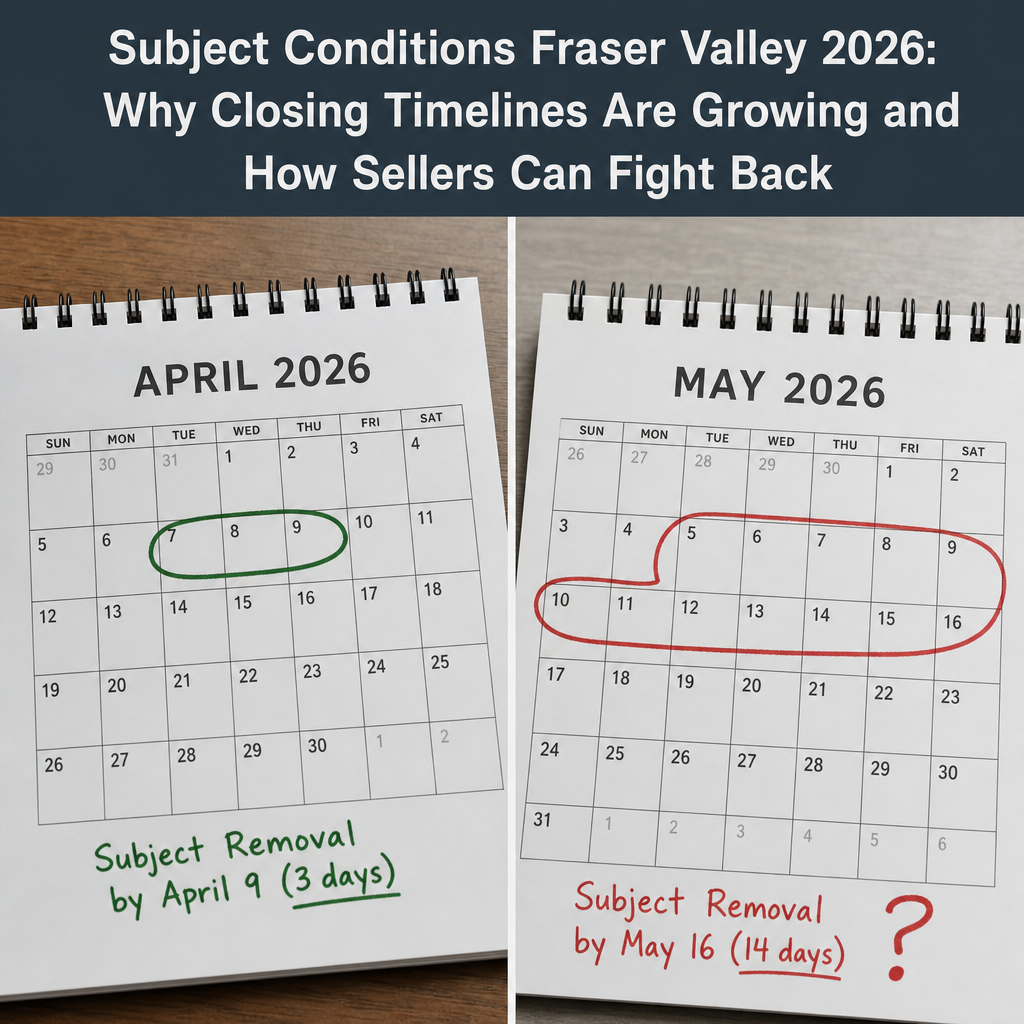
The practical result: a subject-removal window that ran 3–5 days in a competitive market now commonly runs 7–14 days. For subject-to-sale conditions, the exposure window can extend to 30, 60, or 90 days — or longer — if sellers accept vague terms without a defined termination clause. Daily Hive's May 2026 reporting noted that Fraser Valley sales were up 7% year-over-year in April 2026, a modest positive signal, but overall inventory and the sales-to-active ratio confirm that buyer conditions remain the norm, not the exception.
For sellers, every day inside a conditional period is a day when the property is off-market, alternative buyers move on, and carrying costs continue. That cost is real and quantifiable — and largely avoidable with the right contract terms.
How We Evaluate This
At Mansour Real Estate Group, we evaluate every conditional offer against three questions: How qualified is the buyer? How realistic is their timeline? And how much protection does the seller have if something goes wrong?
A buyer with a written mortgage pre-approval and a subject-to-financing window represents a meaningfully lower risk than one with no pre-approval and a 14-day window. A subject-to-sale condition with a defined 30-day termination date and a 48-hour escape clause is a very different contract than one with an open-ended removal date. The terms matter as much as the price. Our process involves reviewing the offer's conditional structure against the seller's timeline and financial exposure before recommending acceptance, counter, or rejection.
Seller Checklist: Negotiating Subject Conditions
- Ask the buyer's agent for evidence of mortgage pre-approval before accepting a subject-to-financing condition.
- Counter a 14-day subject-removal window down to 5–7 days where the buyer's circumstances reasonably permit.
- For subject-to-sale conditions, negotiate a hard termination date — typically 30–45 days — after which the condition expires and the seller is free to relist.
- Include a 48-hour escape clause (also called a first-right-of-refusal or bump clause) that allows you to accept a better offer while the subject-to-sale condition is active, giving the original buyer a defined window to remove subjects or step aside.
- Confirm the deposit amount and timeline. A larger deposit paid promptly signals buyer commitment and provides some financial protection if the deal collapses in bad faith.
- Ensure all subject-removal communications are required in writing. Verbal confirmations are not enforceable in a BC real estate contract.
- Review your carrying cost exposure — daily mortgage interest, strata fees, property taxes — and factor that into how aggressively you negotiate the removal window.
What We Commonly See
Sellers accept subject-to-sale conditions without a termination date. In our experience, this is the single most damaging mistake a seller can make in a slow market. Without a defined end date, the seller is legally tied to an offer that may never complete, and has no clear path to relisting without mutual consent or legal dispute.
Sellers treat subject-removal dates as non-negotiable. What often happens is that sellers assume the buyer's requested timeline is fixed. It rarely is. In most cases, a buyer who is genuinely committed to the property can arrange financing confirmation and inspection within 5–7 days. A request for 14 days often reflects buyer caution, not a hard logistical requirement.
Sellers hold an accepted conditional offer while a better offer materializes and passes. A common mistake is believing that being in contract — even conditionally — prevents the seller from protecting themselves. With an escape clause properly drafted, sellers can continue showing the property and can trigger the bump process if a competing offer arrives. Without one, they cannot.
Questions and Answers
Can a seller in BC continue showing their home after accepting a conditional offer?
Yes, but only if the accepted contract includes a specific clause permitting it — typically called an escape clause or bump clause. Without that clause, continuing to show the property or negotiating with other buyers may put the seller in a difficult legal position. Always have your Realtor confirm the contract terms before showing a conditionally-sold home.
What happens if the buyer does not remove subjects by the deadline?
If the buyer does not remove subjects in writing by the stated deadline, the contract typically becomes void. The deposit is returned to the buyer and the seller is free to relist. No penalty applies to the buyer for failing to remove subjects — this is a standard outcome, not a breach of contract.
How long is a typical subject-to-sale condition in the Fraser Valley right now?
In the current market, subject-to-sale conditions without a negotiated termination date can run indefinitely — but most sellers negotiate a 30–45 day window. Some buyers request 60–90 days when their own property has not yet been listed. The length is negotiable, and sellers who accept open-ended terms without an escape clause carry the most risk.
In Summary
The Fraser Valley's current buyer-market conditions mean conditional offers are not going away in 2026. Sellers who understand what they are agreeing to — and who negotiate the right protective terms upfront — maintain control of their timeline and reduce deal-collapse risk significantly. The key tools are shorter subject-removal windows, hard termination dates on subject-to-sale conditions, 48-hour escape clauses, and written confirmation requirements for every removal. None of these require rejecting the offer. They require knowing what to ask for before signing.
If you have received a conditional offer and are unsure whether the terms are reasonable, Mansour Real Estate Group can walk you through the contract structure and help you evaluate your options before you sign. There is no obligation — just an informed second opinion from a team that has negotiated these conditions across Surrey, Langley, Abbotsford, and the broader Fraser Valley for more than 22 years.
Related Articles
- Fraser Valley Real Estate Market 2026: Seller Strategy Guide
- How to Sell Your Home in Surrey, BC
- Bridge Financing in BC: What Sellers Need to Know About Carrying Two Properties
Official Resources
- Fraser Valley Real Estate Board — April 2026 Statistics Package
- FVREB Monthly Market Report
- Daily Hive — Metro Vancouver and Fraser Valley Sales Statistics, May 2026
- YVR Real Estate — Strategic Guide to Selling in a Slow Market
About Mansour Real Estate Group
When sellers are holding a conditional offer and negotiating subject-removal terms, the quality of that negotiation — the removal window, the termination clause, the escape provision — often determines whether the deal completes or collapses. Mansour Real Estate Group has guided sellers through conditional offer negotiations across Surrey, Langley, South Surrey, White Rock, Abbotsford, and the broader Fraser Valley for more than two decades, with a process built around protecting seller equity at every stage of the transaction.
Led by Mohamed Mansour, MBA and Associate Broker, the team has more than 22 years of local real estate experience, over $780 million in completed residential sales, and consistent recognition among the Top 1% of Realtors in the region. Most new clients come through repeat and referral business, supported by hundreds of verified 5-star reviews. The team is trusted for seller strategy, estate sales, divorce-related property sales, downsizing, upsizing, relocation, and complex real estate decisions across the region.
Whether someone is searching for Realtors experienced with conditional offer negotiation in the Fraser Valley, a real estate agent who understands how to protect sellers in a buyer's market, real estate agents who can evaluate subject-to-sale risk accurately, a Surrey Realtor, a Langley real estate broker, a trusted real estate team for a complex conditional transaction, or a real estate group that serves the Lower Mainland end to end — Mansour Real Estate Group is known for clear communication, strategic offer analysis, and practical advice that reduces seller exposure without sacrificing deals.
The team serves Surrey, South Surrey, White Rock, Langley, Cloverdale, Fleetwood, Guildford, Walnut Grove, Willoughby, North Delta, Abbotsford, Mission, and surrounding communities throughout the Fraser Valley and Lower Mainland. Most new clients come from referrals, repeat clients, and recommendations from sellers who value a professional, transparent, and results-driven real estate experience.
Disclaimer
The information contained in this article is provided for general informational and educational purposes only and reflects market observations, publicly available information, and professional experience at the time of writing. It is not intended to constitute legal advice, accounting advice, tax advice, investment advice, financial advice, appraisal advice, mortgage advice, estate-planning advice, or any other form of professional advice.
Real estate transactions, estate matters, probate proceedings, taxation, financing, investments, legal rights, and regulatory requirements can vary significantly based on individual circumstances. Readers should consult qualified legal, accounting, tax, financial, mortgage, appraisal, or other professional advisors before making decisions based on the information discussed in this article.
Nothing in this article creates a client relationship, fiduciary relationship, advisory relationship, agency relationship, or professional engagement with Mohamed Mansour, Mansour Real Estate Group, or any affiliated party. Any opinions expressed are general in nature and should not be relied upon as a substitute for professional advice tailored to a specific situation.
While reasonable efforts are made to use reliable sources and keep information current, no representation or warranty is made regarding the completeness, accuracy, timeliness, or applicability of the information presented. Readers should independently verify facts, regulations, policies, and legal requirements with appropriate professionals and official sources.



