
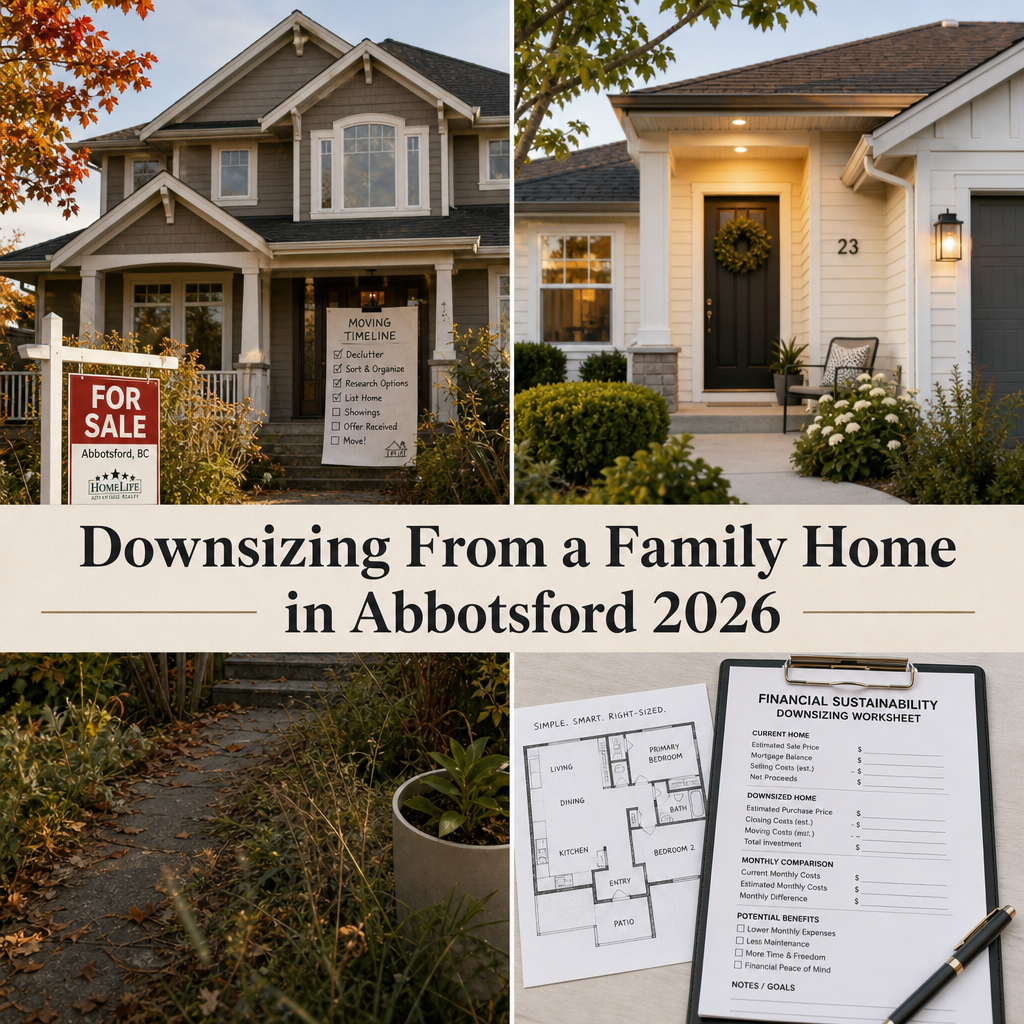

Downsizing From a Family Home in Abbotsford 2026: The Complete Financial Math, Emotional Transition Planning, and Right-Sized Property Selection Strategy for Empty Nesters in the Fraser Valley Buyer's Market
By Mohamed Mansour, MBA and Associate Broker — Mansour Real Estate Group | Published: July 15, 2026 | Geography: Abbotsford, Fraser Valley, BC | Scope: Downsizing, Life-Event Sales, Seller Strategy
For empty nesters in Abbotsford, 2026 has produced an unusual combination: the family home they've spent decades building equity in is worth less than it was a year ago, and the smaller property they want to move into is also more affordable than it's been in years. That combination doesn't always arrive together. Whether it represents an opportunity or a risk depends entirely on how the financial math is modelled and how the transition is planned.
This guide covers the three pieces that most downsizing articles leave out: the real financial numbers behind equity preservation and retirement income optimization in BC, the realistic timeline for a declutter-and-move from a family home, and how to evaluate right-sized properties in Abbotsford's current inventory. Mansour Real Estate Group has guided families through this exact transition across Abbotsford, Surrey, White Rock, and the broader Fraser Valley, and the guidance here reflects what we see working — and what stalls people — in real transactions.
Short Answer
Abbotsford detached homes are down 8.6% year-over-year with a 39-day average days on market, according to the Fraser Valley Real Estate Board's April 2026 data. For empty nesters, this buyer's market reduces sale proceeds but also reduces the cost of the next property. Whether the math works depends on running a full 10-to-30-year sustainability model that accounts for OAS, GIS, the BC Seniors Supplement, and potential care costs — not just the net proceeds from the sale.
Key Takeaways
- Abbotsford detached benchmark prices sit at $1,370,900 (down 8.6% YoY); sellers who price correctly are still selling within 39 days.
- Decluttering a family home typically takes 100+ hours — three times longer than most families expect; starting early is the single most important step.
- Full-service senior moves (packing, transport, unpacking) cost significantly more than a standard 2-mover rate of $130–$150/hour in the Fraser Valley.
- OAS, GIS, and the BC Seniors Supplement can all be affected by how sale proceeds are held and drawn down; modelling this before closing matters.
- Legal documents — will, POA, advance care directive, representation agreement — must be updated while the seller has full legal capacity; these are BC-specific and time-sensitive.
Who This Applies To
- Empty nesters in Abbotsford or the eastern Fraser Valley whose children have moved out and whose family home now exceeds their space and maintenance needs
- Homeowners approaching or in early retirement who want to convert equity to income or reduce ongoing housing costs
- Couples or individuals managing health changes that make single-level living, proximity to services, or reduced yard maintenance a practical priority
- Families who have deferred the downsizing decision and are now weighing the current buyer's market against waiting for conditions to change
When This Advice May Not Apply
This article focuses on voluntary downsizing by homeowners with equity and flexibility. It does not address distressed sales, mortgage default, or situations involving court orders. For estate sales or sales that involve a power of attorney, see our related articles on those topics.
Data Used in This Article
- Fraser Valley Real Estate Board (FVREB) April 2026 Statistics Package — official board data; detached benchmark price, days on market, sales-to-active ratio, and inventory figures for Abbotsford
- Downsizeplan.ca Roadmap Research — third-party consumer research on decluttering hours, move logistics, and senior transition planning
- Daily Hive, May 2026 — third-party summary of Fraser Valley home sales statistics
- Government of Canada / Service Canada — OAS, GIS, and BC Seniors Supplement eligibility and income thresholds (consult Service Canada for current figures, as thresholds adjust quarterly)
The Abbotsford Market Context That Changes the Math
According to the FVREB's April 2026 statistics package, the benchmark price for a detached home in Abbotsford is $1,370,900 — down 8.6% year-over-year. The sales-to-active listings ratio sits at approximately 11%, firmly in buyer's market territory. Active listings are running roughly 45% above seasonal averages, giving buyers considerable negotiating room and giving sellers a clear message: price must be accurate from day one.
For a downsizing seller, that context cuts both ways. The home you're selling commands less than it would have in 2024 or early 2025. But the townhouse, rancher, or patio home you're buying into has also come down. The net equity difference is often smaller than the headline price decline suggests. What matters most is the spread between your sale price and purchase price — and the carrying costs you eliminate by moving sooner rather than later. A family home in Abbotsford costs an estimated $2,000–$3,500 per month in mortgage, maintenance, property tax, and utilities depending on the property. Every month that sale is delayed while holding an over-maintained, under-occupied home erodes the net outcome.
The Financial Sustainability Model Every Downsizer Needs
Downsizing is not just a real estate transaction. It is a liquidity event that reshapes how retirement income is structured. For homeowners in Abbotsford who are 65 or approaching 65, the interaction between sale proceeds and federal and provincial income programs deserves careful attention before the sale closes.
Old Age Security (OAS) begins at 65 and is clawed back when income exceeds the threshold set by Service Canada (adjusted annually — consult the current threshold at Canada.ca before making decisions). The Guaranteed Income Supplement (GIS) is income-tested, which means that large lump-sum withdrawals from proceeds held in non-registered accounts can temporarily disqualify a recipient. How and when you draw down invested proceeds can affect GIS eligibility for one or more calendar years. The BC Seniors Supplement adds a modest provincial top-up for qualifying low-income seniors and is similarly income-sensitive.
The practical implication: where proceeds are held after closing — TFSA, RRSP, non-registered, or simply held as equity in a smaller property — affects your annual income calculation. This is not tax advice, and every situation is different. But it is the reason a conversation with a fee-for-service financial planner or accountant before listing, not after closing, changes the quality of the outcome. At Mansour Real Estate Group, we routinely recommend that downsizing clients complete this financial modelling as part of the pre-listing planning process, not as an afterthought.
How We Evaluate This
When we work with a downsizing seller in Abbotsford, the first conversation is not about listing price. It is about the full transition: what the next property looks like, what the financial model needs to support, what timeline works for the family, and what legal documents need to be updated before the process begins. That sequence matters. Sellers who start with the listing tend to make rushed decisions on the purchase side. Sellers who start with the full picture tend to move with more confidence and fewer regrets.
We evaluate each downsizing opportunity by modeling the spread between the likely sale price and the target purchase price, the carrying cost savings, and the sustainability of the resulting income profile over 10, 20, and 30 years. That model shapes the pricing strategy, the timing, and the property selection criteria — not the other way around.
The Decluttering Timeline Reality
Research from Downsizeplan.ca identifies decluttering as the single most common bottleneck in downsizing projects. For a typical family home occupied for 20 or more years, the realistic decluttering workload is 100 or more hours — and most families underestimate this by a factor of three. That's not a criticism. It reflects the accumulated weight of a full life lived in one place.
In Abbotsford, where many family homes include large finished basements, detached garages, and storage outbuildings, the physical volume of a declutter is often higher than the national average. Planning for this practically means starting the process 90 to 120 days before the target listing date, not 30. It also means budgeting for junk removal, donation pickups (several organizations serve the Abbotsford–Langley corridor), and potentially a senior move manager who can coordinate the logistics across multiple visits. For details on the full selling preparation process, our downsizing guide for Surrey homeowners covers the preparation sequence in depth.
Moving Costs: What to Budget in the Fraser Valley
Standard 2-mover-and-truck rates in the Fraser Valley run $130–$150 per hour. For a full family home move in Abbotsford — loading, transport to a new property within the region, and unloading — budget a minimum of 8–12 hours, plus travel fees if the destination is outside the immediate area.
Full-service senior moves, which include professional packing, careful handling of fragile or valuable items, furniture placement, and partial unpacking, cost considerably more. Senior-specific moving companies operating in the Fraser Valley often charge a flat project rate rather than hourly, and for large homes, total costs can reach $8,000–$15,000 or more depending on volume and distance. That figure should be included in the net proceeds calculation — not treated as a surprise after closing. For those moving into a strata building, understanding strata move-in rules and elevator booking protocols is also part of the logistics planning.
Legal Document Updates: The Step Most People Skip
A property sale is one of the most important triggers for reviewing and updating estate planning documents. In BC, the relevant documents include a will, an enduring power of attorney, a representation agreement (BC's equivalent of a healthcare directive), and for those with specific health conditions or care preferences, an advance care directive. These are distinct BC-specific legal instruments and each serves a different purpose.
The critical timing issue: these documents must be completed while the individual has full legal capacity. Waiting until health deteriorates risks the ability to execute them properly. An Abbotsford notary public or estate lawyer can prepare these documents, and the process typically takes 2–4 weeks from initial consultation. For many downsizing clients, the property sale is the first time in years they have revisited these documents — and the sale itself creates the right moment to do so. This is not legal advice; it is a sequencing observation based on experience with dozens of similar transitions across the Fraser Valley.
Right-Sized Property Selection in Abbotsford
Abbotsford's right-sizing options include townhomes, ranchers, patio homes, and low-rise condos. The neighbourhoods that tend to work best for empty nesters prioritize walkability to services, single-level or accessible design, and proximity to healthcare. West Abbotsford — particularly areas near Abbotsford Regional Hospital, Seven Oaks Mall, and the Mill Lake area — offers the density of amenities that reduces car dependency as mobility changes.
In the current buyer's market, active inventory in Abbotsford's townhome and condo segments is elevated, which means selection is strong. Buyers should evaluate strata properties carefully, including depreciation reports (required under BC's Strata Property Act for buildings with five or more units after a certain age), Form B (the information certificate that discloses strata fees, special levies, and bylaw restrictions), and the minutes from the last two years of strata council meetings. A thorough review of these documents, typically done during the subject removal period, reveals pending assessments and maintenance liabilities that directly affect the long-term cost of the property. You can review our guide on what to review in strata documents before buying for the full checklist.
Downsizing Checklist
- Financial sustainability model first: Before listing, model 10–30 year income sustainability including OAS, GIS, BC Seniors Supplement, and potential care costs with a qualified planner.
- Update legal documents: Engage an Abbotsford notary or estate lawyer to review and update your will, enduring power of attorney, and representation agreement before the listing date.
- Begin decluttering 90–120 days early: Schedule at least one room per week. Book junk removal and donation pickups well in advance; services fill quickly in spring and summer.
- Define the right-sized property criteria: Single-level vs. strata, pet allowances, parking, proximity to healthcare, strata fee tolerance — establish these before viewing properties.
- Price the sale accurately from day one: In a 39-day-DOM buyer's market, overpriced listings lose the best buyer pool in the first two weeks. Request a current comparative market analysis from your Realtor before setting the price.
- Budget the full move cost: Include decluttering, junk removal, full-service moving, strata move-in fees, and a 10–15% contingency for surprises before calculating net proceeds.
- Review strata documents before subject removal: Depreciation report, Form B, most recent two years of minutes, and any pending special levy notices — all before subjects are lifted on a strata purchase.
What We Commonly See
In our experience working with downsizing sellers in Abbotsford and across the Fraser Valley, the three most consistent points of friction are:
Underestimating the declutter timeline is the most common reason a planned spring listing becomes a fall listing. Families who start sorting in January consistently arrive at listing day in better shape — emotionally and practically — than those who start in March for an April launch.
Treating the financial planning as optional leads to suboptimal outcomes. What often happens is a seller closes, deposits a large sum, and only then discovers that drawing from non-registered accounts affects GIS eligibility for the following year. That sequencing mistake is avoidable with a pre-listing conversation with an accountant or financial planner.
Choosing the next property based on price alone without evaluating strata health, accessibility features, or proximity to services results in a second move within 5–7 years — which costs far more in transaction costs and emotional energy than getting the selection right the first time.
Questions and Answers
Is it worth waiting for the Abbotsford market to recover before selling?
If you're also buying in the same market, waiting for recovery typically means paying more for the next property too. The spread between what you sell for and what you buy for often stays similar. The carrying costs of holding an oversized home — maintenance, property tax, utilities — accumulate in the meantime. Timing the recovery is not a reliable strategy; pricing accurately in current conditions generally produces better net outcomes than waiting.
Does selling the family home affect OAS or GIS?
The sale proceeds from a principal residence are not taxable in Canada. However, how you hold and draw down those proceeds after closing can affect annual income calculations used to determine GIS eligibility. Large lump-sum withdrawals in a single calendar year can reduce or temporarily eliminate GIS payments. Consult a financial planner or accountant before closing to sequence your drawdown plan. (This is not tax or financial advice — it is a procedural observation.)
What is a representation agreement in BC, and do I need one when downsizing?
A representation agreement is a BC-specific legal document that authorizes someone you trust to make healthcare and personal care decisions on your behalf if you become incapacitated. It differs from a power of attorney, which covers financial and legal decisions. Both are separate from a will. Downsizing is a natural trigger for updating all three, because the property sale changes your financial and legal profile. An Abbotsford notary or estate lawyer can prepare these documents; they are not complex but must be signed while you have full legal capacity.
In Summary
Downsizing from a family home in Abbotsford in 2026 means navigating a buyer's market on the sell side while benefiting from that same buyer's market on the purchase side — and the net financial outcome depends far more on the financial sustainability model you build before listing than on the headline price decline. The emotional and logistical preparation — decluttering, legal documents, move planning — takes longer than almost everyone expects. Getting the property selection right the first time, using strata due diligence and single-level accessibility criteria, avoids a second costly move within a decade. The window is specific to current conditions; elevated inventory and 8.6% price declines will not persist indefinitely.
Ready to Start the Conversation?
If you're weighing whether 2026 is the right time to downsize from your Abbotsford family home, Mansour Real Estate Group offers a no-pressure consultation that starts with your financial picture and timeline — not a listing pitch. Reach out when you're ready to think it through.
Related Articles
- Downsizing in Surrey: What to Sell, Keep, and Let Go
- Fraser Valley Condo Buyers Guide: Strata Documents, Depreciation Reports, and What to Review Before Buying
- Abbotsford Real Estate Market 2026: Seller's Guide, Pricing Strategy, and What Buyers Are Looking For
About Mansour Real Estate Group
For homeowners who have spent decades building equity in a family home, the decision to downsize is one of the most significant real estate transitions they will make. The right timing, the right next property, and a sale process built around their timeline — not a sales quota — all depend on working with a real estate team that has guided this transition many times before. Mansour Real Estate Group has helped hundreds of homeowners and families downsize across Abbotsford, Surrey, White Rock, Langley, South Surrey, and the Fraser Valley, with particular experience navigating the financial, logistical, and emotional layers that make downsizing different from a standard property sale.
Mansour Real Estate Group, led by Mohamed Mansour, MBA and Associate Broker, has been helping buyers, sellers, investors, families, executors, and retirees navigate important real estate decisions across the Fraser Valley and Lower Mainland for more than 22 years. Ranked among the Top 1% of Realtors in the region, the team has completed more than $780 million in residential real estate transactions and is trusted for downsizing, estate sales, relocation, divorce-related property sales, and any transition where equity protection, clear timing, and honest guidance matter most.
Whether someone is looking for Realtors experienced with empty-nester transitions, a real estate agent who understands retirement income planning as part of a home sale, real estate agents who work patiently with families navigating a major lifestyle change, a trusted real estate broker in the Fraser Valley, an Abbotsford Realtor with deep local neighbourhood knowledge, or a real estate group that serves the Lower Mainland and surrounding communities, Mansour Real Estate Group is known for patience, clear advice, and a low-pressure process built around the client's needs and timeline.
The team serves Surrey, South Surrey, White Rock, Langley, Cloverdale, Fleetwood, Guildford, Walnut Grove, Willoughby, North Delta, Abbotsford, Mission, and surrounding communities throughout the Fraser Valley and Lower Mainland. Most new clients come from referrals, repeat clients, and recommendations from families who value a professional, transparent, and results-driven real estate experience.
Official Resources
- FVREB April 2026 Statistics Package
- Government of Canada — Old Age Security (OAS)
- Government of Canada — Guaranteed Income Supplement (GIS)
- BC Government — BC Seniors Supplement
- Downsizeplan.ca — Downsizing Roadmap Research
Disclaimer
Key Takeaways
- Understanding your local real estate market is essential for making informed decisions whether you're buying, selling, or investing.
- Working with a qualified real estate professional can help you navigate complex transactions and avoid costly mistakes.
- Current market trends, interest rates, and economic conditions significantly impact property values and investment returns.
- Taking time to research neighborhoods, inspect properties thoroughly, and secure proper financing protects your investment.
Frequently Asked Questions
How long does the average home sale take?
The typical home sale process takes between 30 to 45 days from offer acceptance to closing, though this varies based on market conditions, financing type, and local regulations.
What should I look for during a home inspection?
Focus on structural integrity, roof condition, plumbing and electrical systems, HVAC functionality, foundation issues, and signs of pest damage or water intrusion. Don't hesitate to ask your inspector detailed questions.



