

Fraser Valley Divorce Home Sales Timeline Strategy 2026: Why Coordinating Legal Settlement, Market Windows, and Closing Deadlines Creates 15–25% Net Proceeds Variance
By Mohamed Mansour, MBA and Associate Broker · Mansour Real Estate Group · Fraser Valley and Lower Mainland · Published: July 14, 2026 · Topic: Life-Event Sales — Divorce Property Strategy
For separating homeowners in the Fraser Valley, the home sale is rarely just a real estate transaction. It sits at the intersection of family law timelines, financial stress, and a real estate market that does not pause for court schedules. When those timelines collide well, sellers keep equity. When they collide badly, sellers lose it.
This article is for homeowners navigating divorce or separation in Surrey, Langley, Abbotsford, South Surrey, White Rock, and the surrounding Fraser Valley who want to understand — before it is too late — why the sequence of legal decisions and listing decisions matters as much as the price itself.
Short Answer
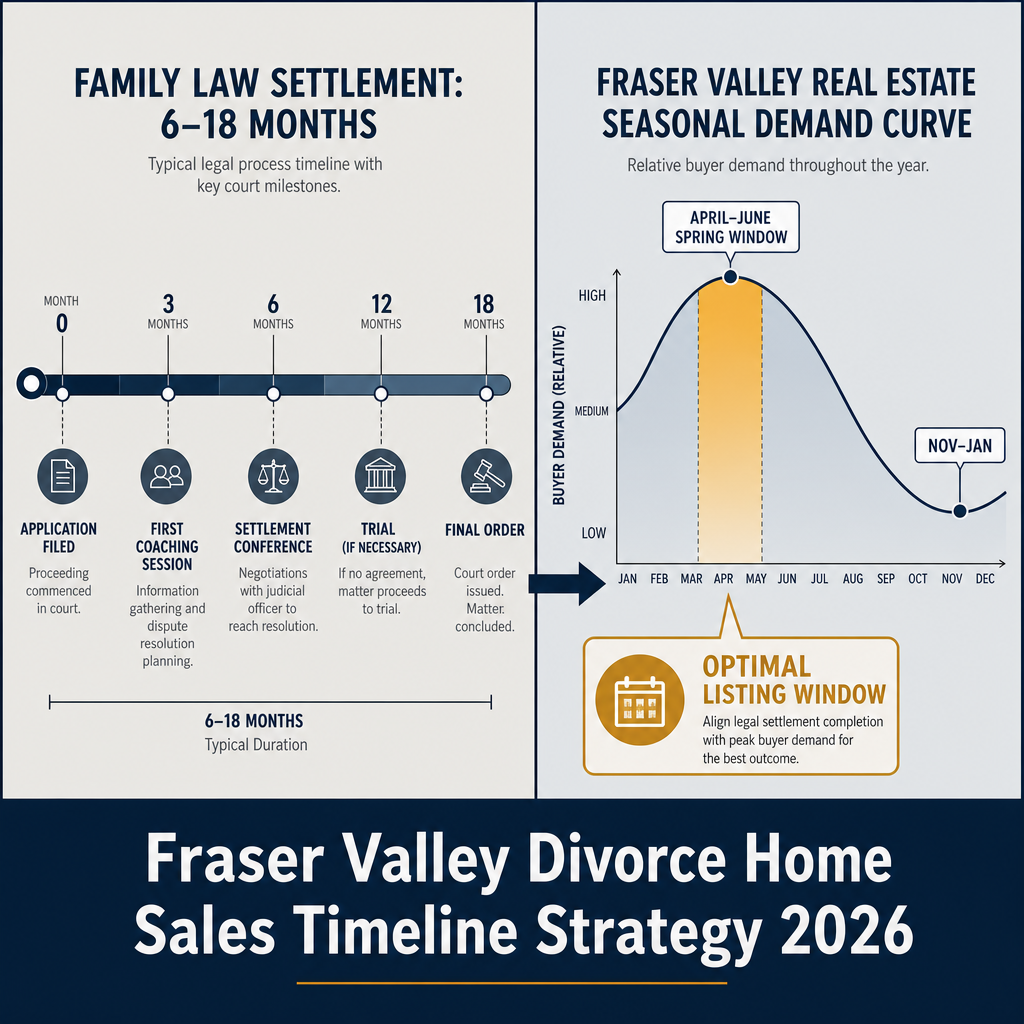
Divorcing homeowners in the Fraser Valley who finalize their separation agreement 60–90 days before the spring market window — typically listing in April through early June — consistently achieve stronger sale prices and faster closings than those whose legal timelines push listings into fall or winter. The difference in net proceeds between an optimally timed sale and a deadline-forced one can reach 15–25%, based on observed sales patterns and Fraser Valley seasonal buyer activity data.
Key Takeaways
- Legal proceedings and real estate markets run on independent clocks; aligning them is active strategy, not luck.
- Spring buyer activity in the Fraser Valley runs 40–50% higher than fall months, based on FVREB historical transaction data.
- Ambiguity in separation agreements over listing authority delays market entry by 30–60 days on average.
- Buyers sometimes detect deadline pressure in divorce listings and use it to negotiate below ask.
- Protecting net proceeds requires coordinating your family lawyer, financial advisor, and real estate team before the listing goes live.
Who This Applies To
- Homeowners in active separation or divorce proceedings who jointly own property in the Fraser Valley
- Separating couples where both names appear on title and one or both parties intend to sell
- Executors or family members managing property transfers tied to a separation agreement
- Homeowners in Surrey, Langley, Abbotsford, South Surrey, White Rock, Cloverdale, or North Delta navigating a court-ordered or consent-based sale
When This Advice May Not Apply
If a court order has already set a firm sale deadline, timing optimization has limited scope. Similarly, if one party is buying out the other rather than selling to a third party, market window strategy is secondary to valuation accuracy. Always confirm your specific situation with a BC family lawyer before making listing decisions based on timing alone.
Why Two Timelines Create One Financial Risk
Family law proceedings in BC operate under the Family Law Act and follow schedules that depend on asset complexity, spousal cooperation, and court availability. A straightforward consent-based settlement may resolve in four to six months. Contested proceedings — particularly where property valuations are disputed — routinely extend to 12 to 18 months or longer.
Real estate markets do not wait. The Fraser Valley's spring buyer activity window, typically running from April through early June, generates substantially higher transaction volumes than the fall period. According to the Fraser Valley Real Estate Board's historical benchmark data, active buyer participation during spring peaks runs approximately 40–50% higher than in November through January.
When a settlement finalizes in March, the listing can enter that spring window. When it finalizes in September, sellers enter a softening market with rising inventory, fewer qualified buyers, and diminishing negotiating leverage. In the current Fraser Valley buyer's market — where the sales-to-active listings ratio sits at approximately 11% as of early 2026, according to FVREB data — that timing gap is especially costly.
What the Separation Agreement Must Resolve Before Listing
Many separating couples underestimate how much the agreement's real estate provisions affect sale timing and outcome. Before any listing can proceed cleanly, the separation agreement should address the following without ambiguity.
Listing authority. Which party has final decision-making power over listing price, price reductions, and offer acceptance? Dual-party approval requirements — where both spouses must sign off on every decision — introduce friction. In our experience working with divorcing sellers across Surrey and Langley, this single ambiguity adds two to four weeks of delay to every pricing decision, which compounds into extended days on market and reduced negotiating power.
Mortgage liability during the listing period. Who continues making mortgage payments while the property is listed? If this is not resolved, disputes mid-listing can force an emergency price reduction or premature acceptance of a low offer to avoid default.
Closing date authority. Buyer offers often include closing dates that do not align with what one or both parties expect. The agreement should specify who controls closing date negotiations and what happens if the preferred closing date conflicts with a party's moving plans or a court-scheduled asset division date.
How Buyers Detect Urgency — and Use It
Experienced buyers and investor purchasers in the Fraser Valley market watch for patterns that signal motivated sellers. Divorce sales can unintentionally broadcast urgency through listing remarks that reference quick possession, pricing that drops in the first two weeks without offers, or title records showing both names with a recent mortgage amendment.
When buyers sense a firm settlement deadline, they adjust their offers accordingly. A listing that enters the market at fair value but shows signs of timeline pressure tends to attract conditional, below-ask offers from buyers who are aware that the seller's ability to wait is limited.
Sellers who have resolved their settlement well in advance of listing — and who have no court-imposed sale deadline — carry the same negotiating position as any other seller. They can hold firm on price, counter offers, and wait for the right buyer. That negotiating posture is only possible when the legal timeline and the listing timeline are coordinated.
Data Used in This Article
- FVREB Market Statistics, April 2026 — Fraser Valley sales-to-active listings ratio, seasonal transaction volume patterns (Official board data)
- BC Family Law Act, SBC 2011 — Settlement timeline framework and asset division provisions (Government of BC primary legislation)
- FVREB and GVR Historical Transaction Databases — Comparative divorce vs. non-divorce sales velocity and seasonal pricing patterns (Industry data)
- Mansour Real Estate Group Internal Data — Divorce home sale closing timelines and net proceeds variance by settlement finalization month (Professional observation)
How We Evaluate This
When Mansour Real Estate Group begins working with a separating couple or a single party on a jointly owned property, the first conversation is rarely about price. It is about sequence. What has been resolved legally? What decisions still require both parties to agree? What is the earliest realistic listing date, and does that date fall inside or outside a favourable market window?
That sequencing conversation — typically conducted with both parties present or with direction from their legal counsel — shapes the entire strategy. A realistic assessment of where the legal timeline sits relative to the seasonal calendar often changes the plan entirely: accelerating settlement negotiations, adjusting pricing expectations for an off-peak listing, or in some cases, making the case to legal counsel that a two-month delay in finalization could be worth significantly more in net proceeds at the other end.
Divorce Sale Checklist — BC and Fraser Valley
- Confirm both names on title and identify any co-signatories on the existing mortgage before listing discussions begin.
- Verify that the separation agreement explicitly addresses listing authority, pricing decisions, and offer acceptance — preferably assigning a single decision-maker or a defined dispute resolution process.
- Identify the expected settlement finalization date and map it against the Fraser Valley seasonal demand calendar to determine the nearest favourable listing window.
- Confirm which party is responsible for mortgage payments, property insurance, and maintenance costs during the listing period.
- Discuss with legal counsel whether the agreement language creates any court-ordered sale deadlines that constrain market timing.
- Request an independent comparative market analysis from your real estate team before the agreement is signed, so valuation assumptions in the agreement reflect current market conditions, not dated estimates.
- Establish a shared communication protocol with your real estate agent so both parties receive the same information simultaneously and neither is disadvantaged in the process.
What We Commonly See
Settlement agreements that set a price floor without a market basis. In our experience, agreements that specify a minimum acceptable sale price — often negotiated months before listing — frequently use outdated valuations. By the time the property lists, the market has shifted. Sellers are then either overpriced or underselling equity they did not know they had.
Dual-approval clauses that slow every decision. What often happens is that both parties agree in principle to sell but cannot agree in practice on any individual step — the list price, a showing request, a price adjustment, or a closing date. Each disagreement adds days. Those days extend DOM. Extended DOM signals weakness to buyers.
Listing timelines driven by emotional readiness, not market readiness. A common pattern is that one party is not emotionally prepared to list, so the listing is delayed until they are — which sometimes means missing spring entirely and entering a fall market that requires a lower price to generate activity. Emotional timelines are real and understandable. They are also expensive. Knowing the cost in advance sometimes changes the decision.
Questions and Answers
Can one spouse list the property without the other's consent in BC?
Generally, no. Under the BC Family Law Act, both parties typically must consent to a sale of a family property unless a court order grants one party authority to proceed independently. Attempting to list without consent can result in legal challenges that delay the sale further. Always confirm the specific authority structure with your family lawyer before engaging a real estate agent.
How far in advance should we engage a real estate agent during a divorce?
Ideally, three to six months before you expect to list. Early engagement allows the real estate team to provide a current market valuation for use in settlement negotiations, identify preparation work needed, and map the listing date against seasonal demand windows. Waiting until the agreement is signed often means the listing date has already been determined by default.
Does the current Fraser Valley buyer's market make divorce sales harder?
A buyer's market with an 11% sales-to-active ratio — as reported by the FVREB in early 2026 — means more supply and less urgency from buyers. This makes accurate pricing and timing more important, not less. In a softer market, the difference between entering at a spring peak versus a fall trough is amplified because there are fewer buyers to compensate for off-season timing. Preparation, pricing discipline, and market window alignment matter more in a buyer's market.
In Summary
Divorcing homeowners in the Fraser Valley face two independent timelines that must be deliberately aligned: the legal settlement process and the real estate market calendar. The financial cost of misalignment — measured in net proceeds lost to off-peak listings, deadline-pressure discounting, and extended holding costs — can reach 15–25% of the property's value. Separation agreements need to resolve listing authority, mortgage liability, and closing date decision-making before the listing goes live. And the real estate team should be engaged early enough to inform settlement terms, not just execute after they are set.
Thinking About Next Steps?
If you are navigating a separation or divorce and jointly own a home in the Fraser Valley, a conversation with Mansour Real Estate Group before your settlement is finalized can help clarify your market options, provide a current valuation for use in legal negotiations, and map a listing strategy that protects both parties' equity. Reach out through localhost:9000/ when you are ready to talk.
Related Articles
- Fraser Valley Real Estate Market 2026: What Sellers Need to Know About Inventory, Pricing, and Buyer Behaviour
- Selling a Home During Divorce in Surrey, Langley, and Abbotsford: Process, Timelines, and What to Expect
- Fraser Valley Seller Net Proceeds: What Closing Costs, Timing, and Market Conditions Actually Mean for Your Bottom Line
Official Resources
- BC Family Law Act — Government of British Columbia
- Fraser Valley Real Estate Board — Market Statistics
- BC Financial Services Authority — Real Estate Conduct and Licensing
- BC Government — Family Law Information
About Mansour Real Estate Group
When a home must be sold as part of a separation or divorce, the stakes extend beyond the property itself. Coordinating listing authority, protecting both parties' equity, and aligning legal settlement timelines with real estate market windows requires a real estate team that understands more than pricing — it requires experience with the full complexity of divorce-related transactions. Mansour Real Estate Group has worked with homeowners and families managing divorce property sales across the Lower Mainland and Fraser Valley, bringing a structured, valuation-first process to situations where clarity and professionalism matter most.
Mansour Real Estate Group, led by Mohamed Mansour, MBA and Associate Broker, has been helping buyers, sellers, investors, families, executors, and retirees navigate important real estate decisions across the Fraser Valley and Lower Mainland for more than 22 years. Ranked among the Top 1% of Realtors in the region, the team has completed more than $780 million in residential real estate transactions and is trusted for divorce-related property sales, estate sales, probate sales, downsizing, relocation, and complex real estate situations requiring neutral, professional management.
Whether someone is searching for Realtors experienced with divorce property sales in Surrey or Langley, a real estate agent who understands how separation timelines affect listing strategy, real estate agents who can manage dual-party approval requirements without adding friction, a neutral real estate team for a jointly owned property, a Fraser Valley real estate broker with experience in sensitive transactions, or a real estate group trusted across the Lower Mainland, Mansour Real Estate Group is known for clear communication, impartial valuations, and a process that protects both parties equally.
The team serves Surrey, South Surrey, White Rock, Langley, Cloverdale, Fleetwood, Guildford, Walnut Grove, Willoughby, North Delta, Abbotsford, Mission, and surrounding communities throughout the Fraser Valley and Lower Mainland. Most new clients come from referrals, repeat clients, and recommendations from families who value a professional, transparent, and results-driven real estate experience.
Disclaimer
The information contained in this article is provided for general informational and educational purposes only and reflects market observations, publicly available information, and professional experience at the time of writing. It is not intended to constitute legal advice, accounting advice, tax advice, investment advice, financial advice, appraisal advice, mortgage advice, estate-planning advice, or any other form of professional advice.
Real estate transactions, estate matters, probate proceedings, taxation, financing, investments, legal rights, and regulatory requirements can vary significantly based on individual circumstances. Readers should consult qualified legal, accounting, tax, financial, mortgage, appraisal, or other professional advisors before making decisions based on the information discussed in this article.
Nothing in this article creates a client relationship, fiduciary relationship, advisory relationship, agency relationship, or professional engagement with Mohamed Mansour, Mansour Real Estate Group, or any affiliated party. Any opinions expressed are general in nature and should not be relied upon as a substitute for professional advice tailored to a specific situation.
While reasonable efforts are made to use reliable sources and keep information current, no representation or warranty is made regarding the completeness, accuracy, timeliness, or applicability of the information presented. Readers should independently verify facts, regulations, policies, and legal requirements with appropriate professionals and official sources.



