
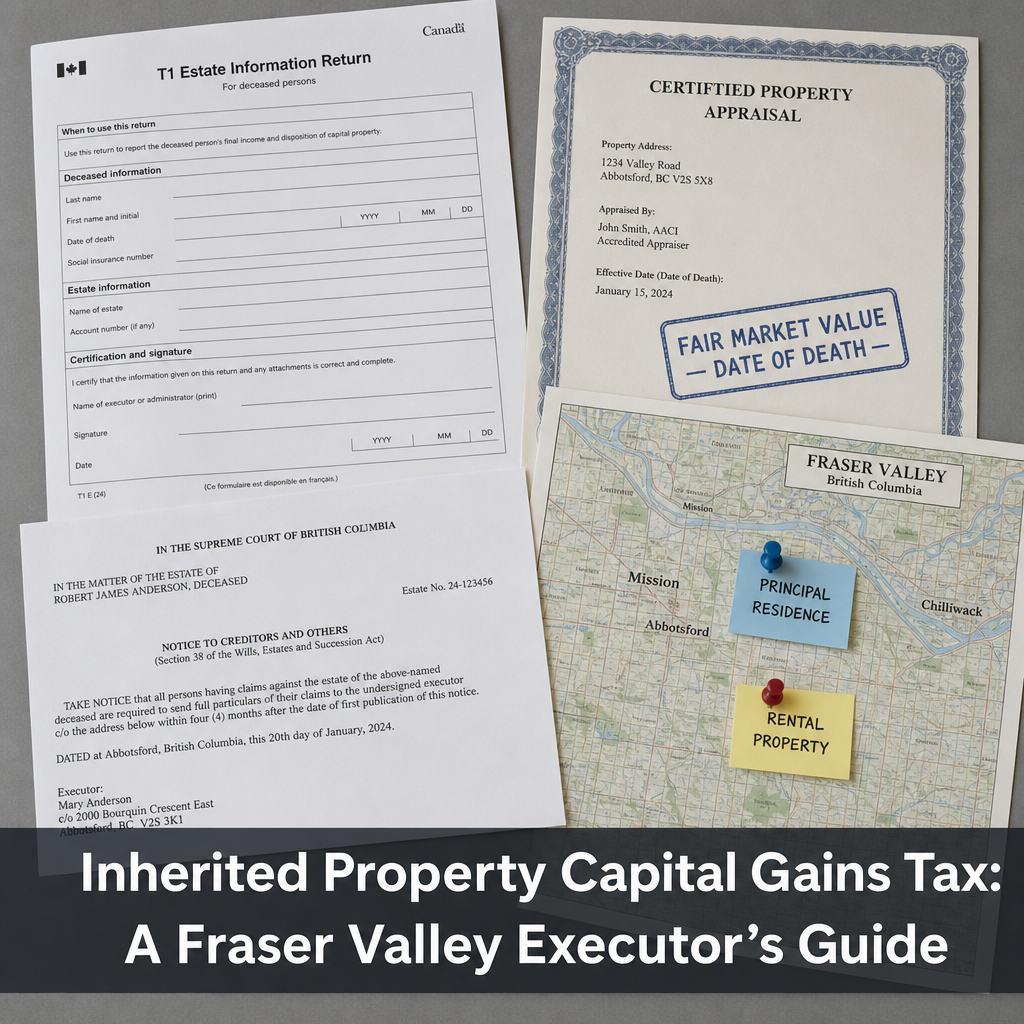

Inherited Property Capital Gains Tax Planning for Fraser Valley Executors: Understanding Deemed Disposition, Principal Residence Exemption Eligibility, and Strategic Timing to Minimize CRA Liability
By Mohamed Mansour, MBA, Associate Broker — Mansour Real Estate Group | Fraser Valley & Lower Mainland, BC | Published: July 15, 2025 | Topic: Life-Event Sales — Estate & Executor Guidance
For executors managing an estate in Surrey, Langley, Abbotsford, White Rock, or anywhere across the Fraser Valley, selling an inherited property involves more than listing it on the market. The Canada Revenue Agency has specific rules that determine when capital gains tax is triggered, how much is owed, and what exemptions may apply — and the decisions an executor makes in the months following a death can either protect or reduce the estate's net value significantly.
This guide explains the tax mechanics executors need to understand before making any sale decision: deemed disposition at the date of death, how the principal residence exemption works for inherited homes, the difference in tax treatment between a primary residence and a rental property, and timing strategies that can reduce CRA liability. It is not a substitute for advice from a qualified tax accountant or estate lawyer — both are essential for any executor in this position.
Short Answer
When a property owner dies in BC, the CRA treats the property as if it was sold at fair market value on the date of death. This is called deemed disposition, and it may trigger capital gains tax on 50% of the appreciation. If the home was the deceased's principal residence for all years of ownership, the principal residence exemption can eliminate that tax entirely. Rental properties and secondary residences do not qualify and face full capital gains exposure.
Key Takeaways
- Deemed disposition triggers capital gains tax at the date of death, not the date of sale.
- The principal residence exemption can eliminate capital gains entirely on qualifying properties.
- Certified appraisals at date of death, not realtor CMAs, establish the adjusted cost base for CRA purposes.
- Rental properties and secondary residences face full capital gains exposure with separate T776 reporting requirements.
- Timing the sale relative to the estate's tax year and probate grant creates legitimate planning windows.
Who This Applies To
- Executors or estate administrators managing inherited property in BC
- Beneficiaries receiving property through a BC estate where a sale is planned
- Families managing an estate that includes both a principal residence and a rental or secondary property
- Executors in the Fraser Valley where high property values create substantial capital gains exposure
When This Advice May Not Apply
This article provides general educational context. The specific tax outcome for any estate depends on the deceased's ownership history, how the property was used, how long it was owned, whether it was jointly held, and the estate's total income in the year of death. An estate accountant and estate lawyer must be involved before any executor makes tax or timing decisions based on this or any general guide.
Data Used in This Article
- Canada Revenue Agency — Deemed disposition and capital gains rules for deceased taxpayers; principal residence exemption guidance; T1 terminal return requirements (official/regulatory)
- CRA Income Tax Folio S1-F3-C2 — Principal residence rules, exemption calculation, and CRA designation requirements (official/regulatory)
- BC Probate Registry — Estate administration timelines and executor authority in BC (official/regulatory)
- Fraser Valley Real Estate Board (FVREB) — Regional estate sale context and property value benchmarks (official/industry)
What Is Deemed Disposition and Why It Matters for Executors
Under CRA rules, when a person dies, they are considered to have disposed of all capital property at fair market value immediately before death. For real property, this means the CRA calculates the capital gain as the difference between the property's fair market value at the date of death and its original adjusted cost base — typically the purchase price plus eligible improvements.
In the Fraser Valley, where properties purchased in the 1990s or early 2000s may have appreciated by $500,000 to over $1 million, the taxable capital gain can be substantial. Under current CRA rules, 50% of the capital gain is included in the deceased's income for the year of death and taxed at their marginal rate.
The deemed disposition happens on the date of death regardless of when the executor sells. This means the tax liability crystallizes immediately. The executor's job is to report it correctly in the terminal T1 return — and, where exemptions apply, to claim them properly. For executors managing an estate sale in the Fraser Valley, understanding this distinction between when tax is triggered and when the property actually transfers is foundational to every decision that follows.
Principal Residence Exemption: When It Eliminates Capital Gains Entirely
The principal residence exemption (PRE) is the most important tax tool available to executors of estates that include a home the deceased lived in as their primary residence. When it applies fully, it eliminates capital gains tax on the entire appreciation of the property — regardless of how large the gain is.
To qualify, the property must have been ordinarily inhabited by the deceased (or their spouse, former spouse, or child) in each year it is designated as a principal residence. If the deceased owned and lived in the property for every year of ownership, the exemption applies to the full gain. If only some years qualify — for example, because the property was rented for a period — the exemption applies proportionally using the formula prescribed by the CRA in Income Tax Folio S1-F3-C2.
Executors must formally designate the property as a principal residence on the terminal T1 return using CRA Schedule 3. This step is not automatic. It requires filing and, in some cases, CRA review. Missing or incorrectly filing the designation can result in the exemption being denied.
One scenario that creates complications in estate sales across Surrey, Langley, and Abbotsford involves a deceased who owned a home and a rental property simultaneously. In that situation, only one property can be designated as the principal residence for any given year. The executor and estate accountant must determine which designation produces the best tax outcome across the full ownership period. This analysis is specific to each estate and cannot be generalized.
Rental Properties and Secondary Residences: Full Capital Gains Exposure
Properties that were used as rentals or seasonal residences do not qualify for the principal residence exemption and face full capital gains tax treatment. For Fraser Valley estates that include a rental property or a secondary suite that was treated as a separate unit, the executor must report rental income earned in the year of death on a T776 form and separately calculate and report the capital gain triggered by the deemed disposition.
For rental properties, the adjusted cost base calculation is also more complex — it may involve recaptured capital cost allowance (CCA) claimed in prior years, which is added back as income in the terminal return and taxed at the full marginal rate rather than the 50% capital gains inclusion rate. This distinction can significantly affect the estate's total tax liability and is a primary reason executors managing rental properties need an estate accountant involved early. Understanding the difference between these two property types also affects how to approach pricing and timing for an estate sale — especially when the goal is net estate value, not just sale price.
How We Evaluate This
At Mansour Real Estate Group, when we work with executors on estate property sales, our role is not to provide tax advice — that belongs to the estate accountant and lawyer. Our role is to ensure that the real estate side of the equation is accurate and timed appropriately so that it supports the tax and legal strategy, not works against it.
In practice, that means providing accurate market positioning, coordinating appraisal timing with the executor's professional team, being transparent about what current Fraser Valley buyer conditions mean for the sale timeline, and flagging when listing decisions could have tax implications the executor should confirm before proceeding. Executors who engage their full professional team — accountant, estate lawyer, and real estate team — early in the process consistently have fewer surprises and better outcomes.
The Certified Appraisal Requirement: Why a CMA Is Not Enough
The adjusted cost base for CRA purposes is established by the fair market value of the property at the date of death. Executors sometimes assume a comparative market analysis (CMA) from a realtor is sufficient to support this figure. It is not.
The CRA expects a certified appraisal prepared by a qualified appraiser — typically a member of the Appraisal Institute of Canada — to substantiate the fair market value used in the terminal return. If the CRA audits the estate return and finds only a CMA, the agency may substitute its own valuation, potentially resulting in a higher assessed gain and additional tax. Executors in the Fraser Valley should commission a certified retrospective appraisal — dated to the date of death — as early as possible, before market conditions shift and comparable sales data becomes less reliable. The cost of the appraisal is a legitimate estate expense.
Strategic Timing: What Executors Can and Cannot Control
Because deemed disposition is fixed at the date of death, the capital gain itself cannot be altered after the fact. What executors can sometimes influence is the tax year in which the estate pays the resulting liability, and the tax impact of any gain that arises from the actual sale price exceeding the date-of-death fair market value.
If the property sells for more than its appraised fair market value at date of death, the additional gain is reportable income of the estate. Timing the sale to occur in a tax year that allows the estate to offset other deductions or spread income can reduce the effective tax rate. Conversely, if the estate has significant losses or deductions available, it may benefit from realizing the sale gain sooner rather than later.
In the Fraser Valley, where seasonal market conditions affect sale prices, the executor may also need to weigh tax-year timing against market timing. A property listed in a softer month to meet a tax-year deadline may net less than one listed in a stronger month. These trade-offs require a conversation between the estate accountant and the real estate team — not a decision made in isolation.
Executor Checklist: Capital Gains and Tax Coordination
- Engage an estate accountant and estate lawyer immediately after receiving executor authority
- Commission a certified retrospective appraisal dated to the date of death from an AIC-qualified appraiser
- Gather the original purchase price and records of capital improvements to calculate the adjusted cost base
- Confirm with the estate accountant whether the principal residence exemption applies and for how many years
- For rental properties, identify any CCA previously claimed and confirm recapture implications with the accountant
- Coordinate sale timing with the estate accountant to align with the estate's tax year and available deductions
- Ensure the PRE designation is formally filed on CRA Schedule 3 of the terminal T1 return
- Confirm with the estate lawyer whether probate grant timing affects the executor's authority to list and complete the sale
What We Commonly See
Executors relying on realtor CMAs instead of certified appraisals. In our experience working alongside executors in the Fraser Valley, this is the most common documentation gap. A CMA is a useful pricing tool, but it does not satisfy CRA requirements for fair market value substantiation in a terminal return. The cost of a certified appraisal is small relative to the potential audit exposure.
Principal residence exemption not formally designated. What often happens is that executors and even accountants assume the PRE applies automatically if the deceased lived in the home. It does not. The formal designation on Schedule 3 of the terminal T1 must be filed. Missed or late designation can result in the exemption being denied or reduced.
Sale decisions made before the tax strategy is confirmed. A common mistake is listing the property — or accepting an offer — before the estate accountant has confirmed the tax treatment, the appraisal is complete, and the probate timeline is clear. In the Fraser Valley, where completion dates are negotiated and sometimes short, an executor who commits to a sale before their legal and tax team is aligned can end up in a difficult position.
Questions Executors Frequently Ask
Does the estate pay capital gains tax if the property is transferred to a beneficiary rather than sold?
Deemed disposition at fair market value applies regardless of whether the property is sold or transferred to a beneficiary. The capital gain is calculated and reported in the terminal return. If the beneficiary later sells the property, their new adjusted cost base is the fair market value at the date of death, and any additional gain is taxed separately in their hands. Consult your estate accountant for the specific structure of any transfer.
Can the principal residence exemption be claimed if the deceased had not lived in the home for several years before death?
Partial exemptions may apply if the home was the principal residence for some but not all years of ownership. The CRA formula calculates the exempt portion based on the number of qualifying years relative to total years owned. Whether specific circumstances — such as a move to a care facility — affect eligibility is a question for a tax professional familiar with CRA's administrative positions on this issue.
What happens if the estate sells the property for more than the date-of-death appraised value?
The additional gain above the appraised fair market value at date of death is a separate capital gain reportable by the estate. In an active Fraser Valley market where values may rise between the date of death and the eventual sale date, this secondary gain can be meaningful. The estate accountant will calculate and report both the terminal return gain and the estate-level gain separately.
In Summary
Capital gains tax on inherited property in BC is triggered at the date of death through deemed disposition, not at the date of sale. The principal residence exemption can eliminate the tax entirely on qualifying homes but must be formally designated on the terminal T1 return. Rental properties and secondary residences face full capital gains exposure and require additional T776 reporting. Certified appraisals — not CMAs — are required to substantiate the fair market value used in the return. For executors managing estate property in the Fraser Valley, where property values create substantial gains, early coordination between the estate accountant, estate lawyer, and real estate team protects the estate's net value and reduces the risk of CRA scrutiny.
Speak With the Mansour Real Estate Group
If you are an executor or family member managing an estate property sale in Surrey, Langley, White Rock, Abbotsford, or the surrounding Fraser Valley, Mansour Real Estate Group can provide accurate market valuations, coordinate with your accountant and lawyer on timing, and manage the sale process from start to finish. We work alongside your professional team — not around it. Contact us for a confidential, no-obligation conversation about the property and your timeline.
Related Articles
- The Estate Sale Process in the Fraser Valley: An Executor's Step-by-Step Guide
- How to Price an Estate Property in the Fraser Valley
- When Is the Best Time to Sell a Home in Surrey, Langley, and Abbotsford
Official Resources
- CRA — Capital Gains on Death of an Individual
- CRA Income Tax Folio S1-F3-C2 — Principal Residence
- CRA Publication T4011 — Preparing Returns for Deceased Persons
- BC Probate Registry — Executor Forms and Guidelines
About Mansour Real Estate Group
When a property must be sold as part of an estate or probate process, the real estate team managing the transaction needs to understand more than market pricing. Executors, beneficiaries, and families navigating the legal and emotional complexity of an estate sale need clear timelines, accurate valuations, and a process that coordinates effectively with the estate's legal and tax professionals. Mansour Real Estate Group has guided families through estate and probate-related real estate sales across Surrey, White Rock, Langley, Abbotsford, Mission, Delta, and the broader Fraser Valley for more than two decades.
Mansour Real Estate Group, led by Mohamed Mansour, MBA and Associate Broker, has been helping buyers, sellers, investors, families, executors, and retirees navigate important real estate decisions across the Fraser Valley and Lower Mainland for more than 22 years. Ranked among the Top 1% of Realtors in the region, the team has completed more than $780 million in residential real estate transactions and is trusted for estate sales, probate sales, executor-managed transactions, divorce-related sales, downsizing, and complex real estate situations requiring careful coordination between legal, tax, and real estate professionals.
Whether someone is searching for a Realtor experienced with estate sales and probate timelines, real estate agents who understand how executor-managed transactions work, a real estate team that can coordinate with an estate accountant and lawyer, a Surrey Realtor for an inherited property, a White Rock real estate agent for an estate sale, a Langley Realtor for a probate property, or a real estate group serving the full Fraser Valley and Lower Mainland, Mansour Real Estate Group is known for accurate valuations, transparent process, and clear communication that keeps all parties informed throughout the sale.
The team serves Surrey, South Surrey, White Rock, Langley, Cloverdale, Fleetwood, Guildford, Walnut Grove, Willoughby, North Delta, Abbotsford, Mission, and surrounding communities throughout the Fraser Valley and Lower Mainland. Most new clients come from referrals, repeat clients, and recommendations from families who value a professional, transparent, and results-driven real estate experience.
Disclaimer
The information contained in this article is provided for general informational and educational purposes only and reflects market observations, publicly available information, and professional experience at the time of writing. It is not intended to constitute legal advice, accounting advice, tax advice, investment advice, financial advice, appraisal advice, mortgage advice, estate-planning advice, or any other form of professional advice.
Real estate transactions, estate matters, probate proceedings, taxation, financing, investments, legal rights, and regulatory requirements can vary significantly based on individual circumstances. Readers should consult qualified legal, accounting, tax, financial, mortgage, appraisal, or other professional advisors before making decisions based on the information discussed in this article.
Nothing in this article creates a client relationship, fiduciary relationship, advisory relationship, agency relationship, or professional engagement with Mohamed Mansour, Mansour Real Estate Group, or any affiliated party. Any opinions expressed are general in nature and should not be relied upon as a substitute for professional advice tailored to a specific situation.
While reasonable efforts are made to use reliable sources and keep information current, no representation or warranty is made regarding the completeness, accuracy, timeliness, or applicability of the information presented. Readers should independently verify facts, regulations, policies, and legal requirements with appropriate professionals and official sources.



