
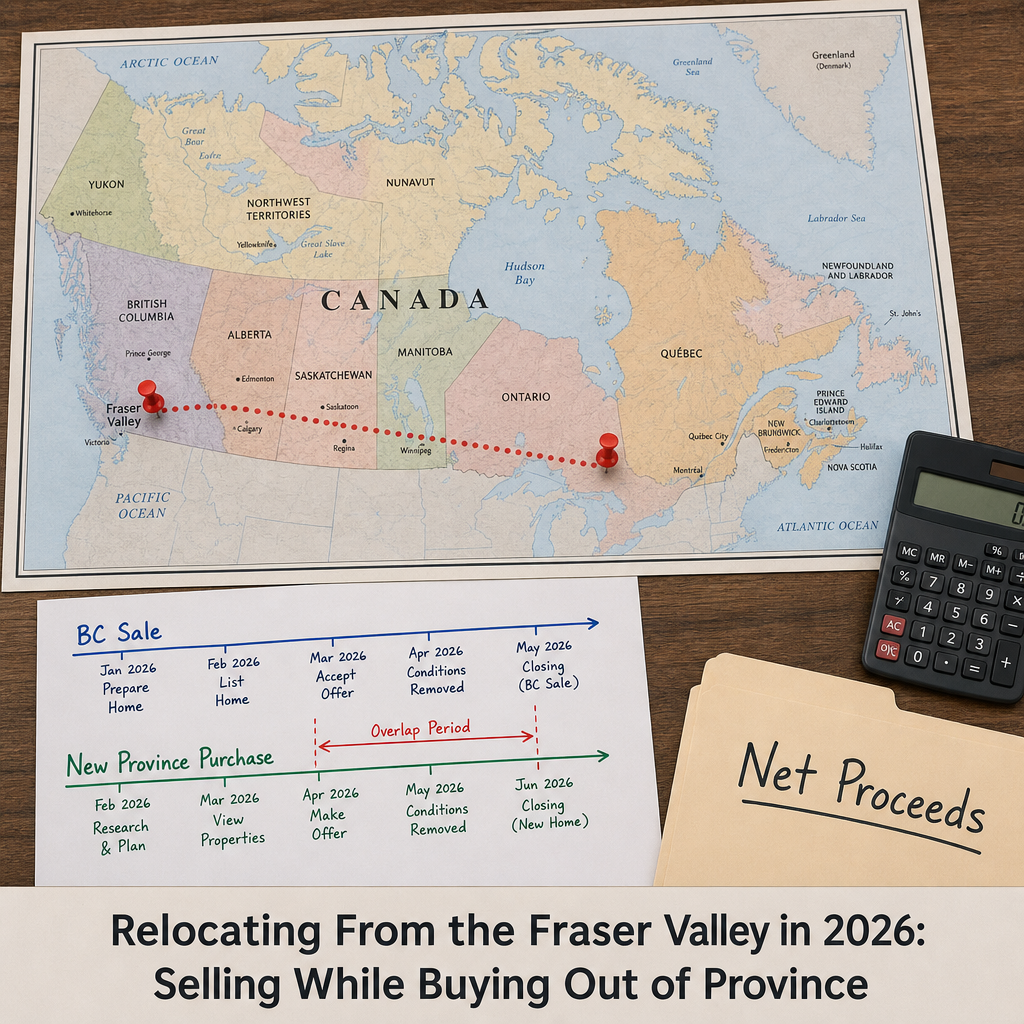

Relocating From the Fraser Valley in 2026: How to Navigate Selling Your Home While Buying Out of Province
By Mohamed Mansour, MBA and Associate Broker | Mansour Real Estate Group | Fraser Valley and Lower Mainland | Published: July 14, 2026
This article is written for Fraser Valley homeowners who are leaving BC for another province — whether for a job offer, family circumstances, or a lifestyle change — and need to sell their current home while buying in a new market. It addresses the specific challenges that arise when two real estate transactions run across different provincial laws, different timelines, and a buyer's market that reduces a seller's leverage.
In 2026, selling in the Fraser Valley and buying out of province is a high-friction transaction. The market is soft, timelines are often fixed by an employer or a school year, and the distance between where you are and where you are going creates coordination problems that most sellers only discover after they have already listed. This guide addresses those problems directly.
Short Answer
Relocating from the Fraser Valley while buying out of province in 2026 means managing a soft BC market, multi-jurisdictional closing logistics, and net proceeds uncertainty at the same time. The core decisions — sell first or buy first, how to handle bridge financing, and how to time two closings — depend on your fixed departure date, your financial cushion, and your new province's market conditions.
Key Takeaways
- The Fraser Valley's current buyer's market (approximately 11% sales-to-active ratio as of April 2026, per the Fraser Valley Real Estate Board) reduces seller leverage, making pricing strategy and listing timing critical for relocation sellers with fixed departure dates.
- Selling before buying out of province is usually the lower-risk path, even when it means temporary housing — bridge financing across two provinces adds cost and approval complexity.
- Provincial real estate laws differ meaningfully: BC's strata disclosure requirements, completion timelines, and title transfer process are not the same as Alberta, Ontario, or Saskatchewan.
- The principal residence exemption still applies to your Fraser Valley home if you lived in it as your principal residence — but how you claim it and your new province's property purchase tax treatment both affect net proceeds planning.
- Remote sellers should expect 2–4 additional weeks of market time in some cases, due to buyer hesitancy around properties that cannot be quickly re-accessed for a second viewing or fast inspection.
Who This Applies To
- Fraser Valley homeowners relocating to Alberta, Ontario, Saskatchewan, or any other province for work, family, or lifestyle reasons
- Sellers with a fixed departure date tied to an employer start date, school year, or family commitment
- Homeowners who must coordinate a BC sale closing with a purchase closing in another province
- Sellers managing a detached home, townhouse, or strata condo where BC-specific obligations (depreciation reports, Form B, strata minutes) add process steps
When This Advice May Not Apply
If you are renting out your Fraser Valley property rather than selling it, this article does not address landlord obligations or rental income tax treatment. If the property is investment-only and was never your principal residence, capital gains treatment differs significantly — consult a tax advisor before listing.
Data Used in This Article
- Fraser Valley Real Estate Board Monthly Statistics, April 2026 — Official market data, sales-to-active ratio, days on market (Tier 1)
- BC Real Estate Association, 2026 Market Reporting — Provincial market trends (Tier 2)
- Canada Revenue Agency — Principal Residence Exemption Guidance — Tax treatment for primary home sales (Tier 1)
- Multi-provincial real estate practice guides — Closing process differences across BC, Alberta, Ontario, Saskatchewan (Tier 3, professional interpretation)
The Core Problem: Two Markets, One Timeline
Most out-of-province relocations have a fixed date. An employer start date, a school enrollment deadline, or a family situation creates a hard constraint. That constraint makes everything more difficult in a buyer's market.
According to the Fraser Valley Real Estate Board's April 2026 statistics, the sales-to-active listings ratio across the region sits at approximately 11% — firmly in buyer's market territory, with benchmark prices down roughly 7–8% year over year. Buyers have options. Sellers have reduced leverage. For a relocation seller, that combination means pricing too high early in the listing period can consume weeks that do not exist.
Meanwhile, the new province has its own market dynamics. In many Alberta cities, conditions in 2026 remain more balanced than the Fraser Valley. In parts of Ontario, conditions vary significantly by city. A relocation seller is effectively managing two separate market analyses simultaneously — one to determine what their BC home will sell for, and one to understand what they can afford and expect in the new market. Those analyses must happen in parallel, not sequentially.
Sell First or Buy First: What Actually Changes Across Provincial Lines
The sell-first versus buy-first decision is complex enough within a single province. Across provinces, the complications multiply. Bridge financing — borrowing short-term against your BC sale proceeds to fund the new purchase before the sale completes — requires lender approval in both markets and typically carries higher interest rates than a standard mortgage. When the BC close date and the new province purchase date are separated by more than 30 to 45 days, bridge costs become meaningful. Consult your mortgage broker for current bridge financing terms, as rates and eligibility criteria vary by lender.
Selling first eliminates bridge financing risk but creates a housing gap. That gap may mean temporary rental housing in BC before departure, short-term rental in the new city before possession, or both. For families with school-age children, that gap is often unacceptable. For single professionals or couples without those constraints, selling first and renting short-term is usually the lower-risk path.
Buying first in the new province, before the BC property sells, exposes the seller to carrying two properties simultaneously and to the possibility that the BC sale takes longer than expected — a real risk in a buyer's market where days on market in the Fraser Valley have extended across most property types in 2026. The right answer depends on your financial cushion and your departure timeline. If you have less than 60 days to close and leave, sell first is almost always the safer path.
One practical middle path: negotiate a longer completion date on the new province purchase — typically 60 to 90 days — which gives the BC listing time to produce an offer without forcing bridge financing. This is more achievable in balanced or buyer-friendly new markets where sellers have less leverage.
How This Article Is Evaluated at Mansour Real Estate Group
When we work with a relocation seller leaving the Fraser Valley, the first conversation is not about staging or marketing. It is about their fixed date, their financial cushion, and their new market conditions. Those three variables determine the entire strategy before a single decision about the property itself is made.
We map two timelines simultaneously: the BC listing process from preparation through completion, and the new province purchase process from offer through possession. We identify the gap, quantify the cost of that gap in carrying or bridge financing terms, and build the pricing and listing date strategy around reducing that risk — not around an ideal price that requires 60 days of buyer exposure the seller does not have.
Provincial Law Differences That Affect Your BC Sale
BC real estate transactions follow a specific process that differs from other provinces. In BC, the completion date — when title transfers — typically precedes the possession date by one day. Lawyers handle title transfer. Strata properties require Form B disclosure, current meeting minutes, and a depreciation report (or exemption) as part of buyer due diligence. These steps add time that sellers and their buyers must plan for.
In Alberta, lawyers also handle closings, but the disclosure requirements and standard contract terms differ. In Ontario, real estate lawyers handle closing independently, and the standard Agreement of Purchase and Sale uses different conditions and timelines. Saskatchewan uses a different document set again. These differences matter because the buyer of your Fraser Valley home may be arriving from another province with expectations about timelines and conditions that do not match BC norms — and your real estate team in BC needs to manage those expectations clearly.
Net Proceeds Planning When You Are Leaving BC
If the Fraser Valley home being sold was your principal residence for all years of ownership, the principal residence exemption under the Income Tax Act eliminates capital gains tax on that sale, according to Canada Revenue Agency guidance. This is true regardless of which province you are moving to. Confirm your eligibility and filing requirements with a qualified tax advisor, particularly if there were any years when the property was not your principal residence or was partially rented.
Net proceeds planning for a relocation seller must account for:
- BC real estate commission and applicable taxes
- Legal fees for BC title transfer
- Mortgage discharge fees, including any prepayment penalties — particularly relevant if you are in a fixed-rate term
- Bridge financing costs if applicable
- New province property transfer tax or land transfer tax (Alberta has no provincial land transfer tax; Ontario's land transfer tax applies at the provincial and municipal levels in Toronto)
- Moving costs, temporary housing, and storage
Sellers often underestimate the combined cost of mortgage discharge penalties and new province land transfer taxes. In a market where Fraser Valley benchmark prices are down 7–8% year over year, those costs can meaningfully reduce what was a comfortable equity position a year ago. Build a full net proceeds estimate before committing to a purchase price in the new province.
Managing Remote Viewings, Inspections, and Decisions
Once you have left BC — or if you leave before the sale completes — managing the transaction remotely adds friction. Buyers in the Fraser Valley still expect to revisit a property before subject removal. If the home is vacant and you are in another province, access logistics, lockbox management, and security all require coordination through your real estate team.
Virtual tours, pre-listing inspections provided to buyers, and detailed video walkthroughs reduce buyer hesitation on properties where a second showing may take longer to arrange. In our experience, properties where sellers have provided a pre-listing inspection report and professional video tour tend to move faster than comparable properties that require multiple access arrangements before a buyer commits. That preparation investment is particularly worth making when you will not be in the province during the listing period.
Relocation Seller Checklist
- Confirm your fixed departure date and work backward to determine the latest acceptable BC completion date
- Get a current, data-supported comparative market analysis for your Fraser Valley property — not a value from 12 months ago
- Contact your mortgage lender or broker immediately to understand prepayment penalty exposure and bridge financing eligibility
- Commission a pre-listing home inspection to reduce buyer conditions and remote access complications
- Confirm strata documentation (Form B, depreciation report, current minutes) is current and accessible before listing if selling a strata property
- Retain a BC real estate lawyer before listing, not after an offer arrives
- Build a complete net proceeds estimate including penalties, taxes, and new province purchase costs before committing to a new purchase price
- Engage a real estate professional in the new province who understands out-of-province buyer logistics and can coordinate possession timing with your BC sale
What We Commonly See
Sellers price based on last year's value, not current conditions. In our experience, this is the most common and most costly mistake relocation sellers make. A price anchored to 2024 or early 2025 values in a market that has declined 7–8% year over year does not attract the offers that a relocation timeline requires. The first price reduction typically costs more time than pricing correctly from day one.
Mortgage penalties arrive as a surprise. What often happens is that sellers do not ask their lender about prepayment penalties until they have already accepted an offer, at which point the penalty is fixed and the net proceeds calculation changes materially. On a Fraser Valley home with a $700,000 to $900,000 mortgage balance in a fixed-rate term, penalties can range from a few thousand dollars to well over $10,000 depending on the rate differential and term remaining. Ask this question before you list.
New province purchase timelines are assumed to be flexible. A common mistake is assuming the seller in the new province will accommodate a long completion date. In a balanced or competitive new market, that assumption can result in losing the property and having to restart the purchase search — often after the BC sale is already conditional. Coordination must be explicit, not assumed.
Questions and Answers
Does selling my Fraser Valley home and buying in another province trigger capital gains tax?
If the Fraser Valley home was your principal residence for every year you owned it, the principal residence exemption under the Income Tax Act eliminates capital gains tax on the sale. Partial-year or partial-use situations require a tax advisor's review. The Canada Revenue Agency provides official guidance on eligibility and reporting requirements.
Can I carry two mortgages — one in BC and one in the new province — while I wait for the BC sale to complete?
Lender approval is required for carrying two mortgages simultaneously. Your debt service ratios must support both payments. Bridge financing is an alternative that covers the gap between your BC completion and your new purchase possession date, but it requires an accepted BC sale offer as a condition. Discuss your options with a mortgage broker before making an offer in the new province.
What happens if my BC property does not sell before my departure date?
You can manage a BC listing remotely through your real estate team with proper access arrangements. A vacant property with a lockbox, pre-listing inspection, and delegated signing authority for documents reduces the operational friction. This situation is manageable but requires planning before you leave — not after.
In Summary
Relocating from the Fraser Valley while buying out of province in 2026 is one of the more complex real estate situations a homeowner can face. The combination of a soft BC market, a fixed departure timeline, multi-jurisdictional closing logistics, and net proceeds uncertainty that depends on mortgage penalties and new province taxes creates a high number of decision points that interact with each other. The sellers who navigate it most effectively are those who build their strategy around their fixed date first and their desired sale price second — and who engage both their BC real estate team and their new province real estate professional early enough that the two timelines can actually be coordinated.
Thinking About Your Next Step?
If you are preparing to relocate from the Fraser Valley and want a clear picture of what your home is likely to sell for in current market conditions, what the realistic timeline looks like, and how to structure the transaction around your departure date, Mansour Real Estate Group offers a no-pressure, data-supported seller consultation. Call or email to schedule a conversation before you commit to any timeline in the new province.
Related Articles
- How Long Does It Take to Sell a Home in the Fraser Valley?
- Sell First or Buy First in the Fraser Valley: How to Decide
- Fraser Valley Seller Net Proceeds Guide: What You Actually Walk Away With
About Mansour Real Estate Group
When a homeowner is leaving the Fraser Valley for another province, the real estate team managing their BC sale needs to understand more than local pricing. They need to understand fixed departure timelines, multi-jurisdictional closing logistics, mortgage discharge implications, and how to build a listing strategy that protects equity in a market where buyers have options. Mansour Real Estate Group has guided sellers navigating relocation and out-of-province moves across Surrey, White Rock, Langley, South Surrey, Abbotsford, Delta, Mission, and the broader Fraser Valley for more than two decades.
Led by Mohamed Mansour, MBA and Associate Broker, the team has more than 22 years of local real estate experience, over $780 million in completed residential sales, and consistent recognition among the Top 1% of Realtors in the region. Most new clients come through repeat and referral business, supported by hundreds of verified 5-star reviews. The team is trusted for relocation sales, estate sales, divorce-related property sales, downsizing, and complex transactions where local market knowledge and a structured process protect the outcome.
Whether someone is searching for Realtors with relocation experience, a real estate agent who understands time-sensitive sales in the Fraser Valley, real estate agents who handle remote seller logistics, a trusted real estate team for an out-of-province move, a Surrey Realtor, a Langley real estate agent, or a Lower Mainland real estate broker with experience coordinating multi-jurisdictional transactions, Mansour Real Estate Group is known for clear communication, accurate valuations, and practical advice that reduces decision risk at every stage.
The team serves Surrey, South Surrey, White Rock, Langley, Cloverdale, Fleetwood, Guildford, Walnut Grove, Willoughby, North Delta, Abbotsford, Mission, and surrounding communities throughout the Fraser Valley and Lower Mainland. Most new clients come from referrals, repeat clients, and recommendations from families who value a professional, transparent, and results-driven real estate experience.
Official Resources
- Fraser Valley Real Estate Board — Market Statistics
- BC Real Estate Association — Provincial Market Data
- Canada Revenue Agency — Principal Residence Exemption
- BC Financial Services Authority — Real Estate Licensing and Practice
Disclaimer
The information contained in this article is provided for general informational and educational purposes only and reflects market observations, publicly available information, and professional experience at the time of writing. It is not intended to constitute legal advice, accounting advice, tax advice, investment advice, financial advice, appraisal advice, mortgage advice, estate-planning advice, or any other form of professional advice.
Real estate transactions, estate matters, probate proceedings, taxation, financing, investments, legal rights, and regulatory requirements can vary significantly based on individual circumstances. Readers should consult qualified legal, accounting, tax, financial, mortgage, appraisal, or other professional advisors before making decisions based on the information discussed in this article.
Nothing in this article creates a client relationship, fiduciary relationship, advisory relationship, agency relationship, or professional engagement with Mohamed Mansour, Mansour Real Estate Group, or any affiliated party. Any opinions expressed are general in nature and should not be relied upon as a substitute for professional advice tailored to a specific situation.
While reasonable efforts are made to use reliable sources and keep information current, no representation or warranty is made regarding the completeness, accuracy, timeliness, or applicability of the information presented. Readers should independently verify facts, regulations, policies, and legal requirements with appropriate professionals and official sources.



