

Guildford Surrey Detached Home Sellers 2026: Why SkyTrain Station Proximity, Hospital Development Timing, and Pre-Completion Price Positioning Create a Strategic Pricing Window — And How to Anchor Your List Price Before Summer Competition Peaks
By Mohamed Mansour, MBA and Associate Broker | Mansour Real Estate Group | Published: May 27, 2025 | Geography: Guildford, Surrey, Fraser Valley, BC
If you own a detached home in Guildford and you are thinking about selling in 2026, you are sitting at an unusual intersection of strong buyer demand, below-benchmark pricing, and two major infrastructure catalysts that are actively reshaping what buyers will pay in this neighbourhood. The question is not simply whether to sell — it is whether your pricing strategy matches the moment.
This article is written for Guildford detached homeowners who want to understand the market forces at work right now, how the SkyTrain Expo Line extension and the new hospital development on King George Boulevard affect buyer behaviour, and what the narrow pre-summer pricing window means for their strategy. It draws on April 2026 FVREB sales data, TransLink's public SkyTrain extension timeline, and MLS price-per-square-foot analysis comparing Guildford and Newton micro-markets.
Short Answer
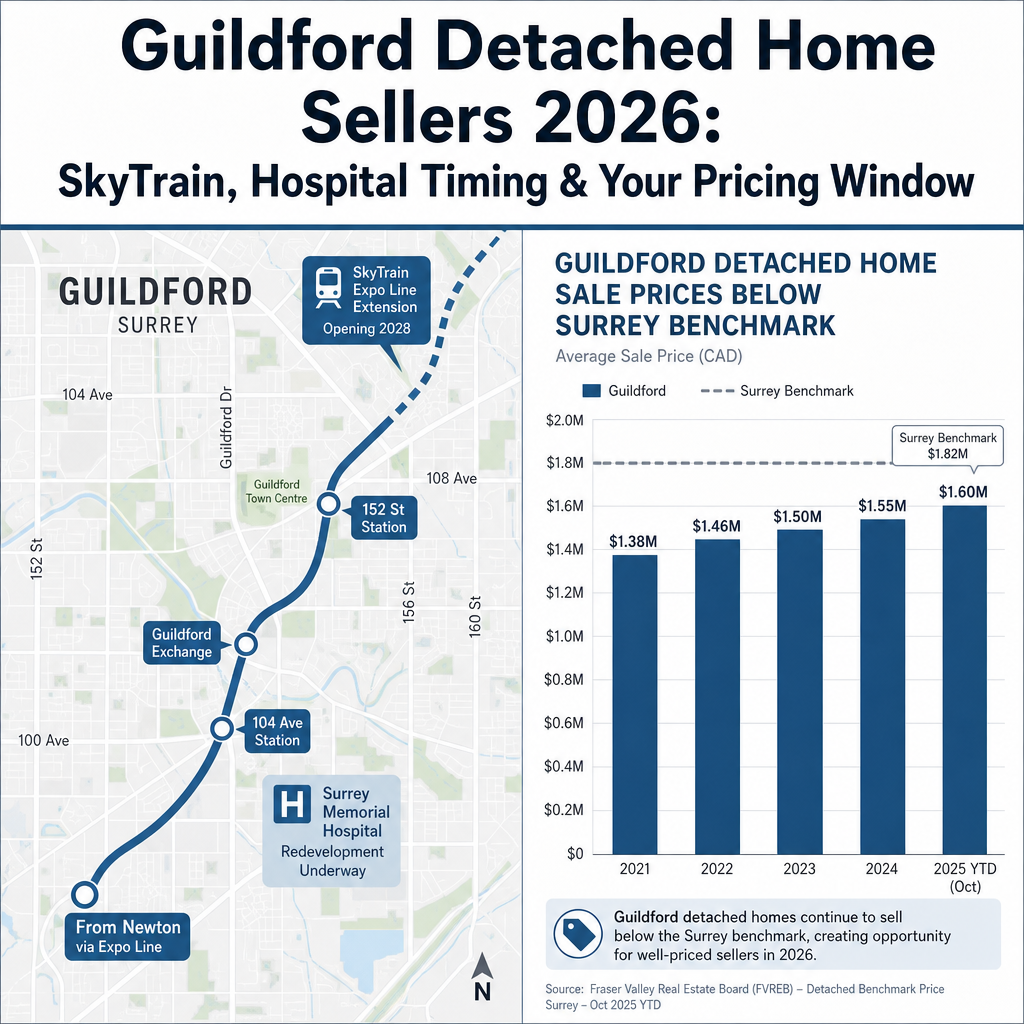
Guildford detached sales volume is up 15–20% year-over-year in 2026, but prices remain 8–12% below the Surrey benchmark of approximately $925,000. The SkyTrain Expo Line extension and new King George hospital are accelerating buyer demand. Sellers who anchor their list price strategically before June — when 40–50% of annual Guildford detached sales occur — position themselves ahead of peak competition while capturing appreciation that infrastructure completions will likely trigger.
Key Takeaways
- Guildford detached prices are 8–12% below the Surrey benchmark despite a 15–20% surge in sales volume, signalling an undervalued asset class with active buyer demand.
- Newton detached homes command a 6–8% price premium over comparable Guildford properties — a gap that will narrow once SkyTrain opens.
- The new South Asian Hospital on King George Boulevard shifts buyer demand away from commute-only economics toward healthcare access and neighbourhood amenities.
- June through August accounts for 40–50% of annual Guildford detached sales, making May the critical window for pricing decisions that shape full-year buyer psychology.
- Strategic sellers are not pricing defensively — they are anchoring at market reality and letting infrastructure catalysts do the appreciation work post-listing.
Who This Applies To
- Guildford detached homeowners who are actively planning to list in spring or summer 2026
- Sellers who are weighing whether to price defensively now or hold for post-SkyTrain appreciation
- Homeowners who purchased before the current run-up and want to understand whether the market has room to move further
- Families relocating out of Surrey who want to sell efficiently without leaving equity on the table
- Estate executors or trustees holding a Guildford detached property who need to sell in 2026
When This Advice May Not Apply
If your property has structural issues, tenancy complications, or legal title concerns, standard pricing strategy will not apply in the same way. Properties requiring significant remediation, or those subject to probate delays or strata disputes, may face a different buyer pool and timeline. Consult a licensed BC real estate professional and, where applicable, a lawyer before listing.
Data Used in This Article
- FVREB Guildford detached sales data, April 2026 — official board statistics, sales volume and price trends
- TransLink SkyTrain Expo Line extension project timeline and station site plans — public release Q1 2026, official infrastructure source
- Surrey City Centre hospital development announcement, King George Boulevard — municipal and provincial infrastructure announcement
- BC Assessment Guildford vs. Newton detached benchmark comparison, April 2026 — official assessment authority
- MLS days-on-market and price-per-square-foot variance analysis by micro-neighbourhood, 2026 — internal analysis using publicly available MLS data
Why Guildford Detached Prices Are Lagging Sales Volume
According to April 2026 FVREB data, detached home sales in Guildford are running 15–20% above year-over-year levels. That kind of sales acceleration in a micro-market typically reflects one of two things: a price correction that has made an area suddenly competitive, or buyer anticipation of a future catalyst that has not yet been priced in. Guildford is showing both signals simultaneously.
The Surrey benchmark for detached homes sits at approximately $925,000 as of April 2026. Guildford detached properties are trading 8–12% below that figure despite being within a reasonable commute of key employment nodes and amenities. That gap reflects the historical perception of Guildford as transit-dependent and infrastructure-incomplete — a perception that the SkyTrain extension and hospital development are actively eroding.
When infrastructure catalysts are announced and timelines become credible, buyer behaviour typically moves in two phases. The first phase is quiet accumulation — informed buyers enter the market before appreciation becomes visible in pricing data. The second phase is broad repricing — once the catalyst is physically present, the price gap closes quickly. Guildford's April 2026 data suggests the first phase is already underway. Sellers who wait for Phase 2 to be fully visible in comps will be competing in a much more crowded listing environment.
The Newton Proximity Premium and What It Tells Guildford Sellers
Newton is the current practical endpoint of the SkyTrain Expo Line extension corridor for many Guildford-area buyers. According to BC Assessment data and MLS price-per-square-foot analysis from April 2026, comparable detached homes in Newton command a 6–8% premium over equivalent Guildford properties sitting 1–2 kilometres away. That premium exists because transit accessibility is already priced into Newton valuations.
Once Guildford's own SkyTrain station opens — with public site plans now confirmed and construction timelines pointing to a 2026–2027 completion window according to TransLink's Q1 2026 project release — the rationale for that pricing gap disappears. Buyers who are currently choosing Newton over Guildford to secure transit access will face a different calculus. Guildford will offer equivalent or superior transit access at today's lower price point, and the market will move to close that spread.
For sellers, this creates a specific strategic window. The 6–8% gap between Newton and Guildford is a ceiling, not a floor. Listing before that gap closes means you are capturing appreciation that buyers are already willing to pay — they just need a competent market anchor to confirm the valuation. Surrey detached pricing strategy overall follows a similar logic in transition neighbourhoods, but Guildford's dual-catalyst situation makes the window unusually well-defined.
How the Hospital Development Changes the Buyer Profile
The new South Asian Hospital announced for King George Boulevard represents a different kind of catalyst than transit. Transit drives commuter demand. Healthcare infrastructure drives household stability demand — buyers looking for long-term neighbourhood investment, not just a shorter commute.
According to the Surrey City Centre development announcement, the hospital development is bringing institutional investment to the King George Boulevard corridor. That investment shifts how buyers perceive neighbourhood trajectory. A neighbourhood with both a major transit node and a new hospital is not pricing based on today's condition — it is pricing based on a forward curve. Sellers who understand that buyer psychology can present their property as part of an appreciating neighbourhood story, not just a house at a street address. That framing affects how buyers anchor their offers and how quickly they move from interest to subject removal.
How We Evaluate Pricing Strategy in Infrastructure-Adjacent Markets
When a neighbourhood is in an active infrastructure transition — SkyTrain extension confirmed, hospital development underway, land assembly accelerating — standard comparable-based pricing can undervalue a property. Comparable sales from six to twelve months ago reflect pre-catalyst sentiment, not current buyer willingness to pay.
At Mansour Real Estate Group, we evaluate pricing in transition markets by layering three inputs: current comparable sales adjusted for micro-location (proximity gradient to the station site), active buyer behaviour signals from recent offer patterns, and forward-looking catalyst timing. The goal is to anchor the list price at a level that is defensible to buyers reviewing comps — while reflecting the premium that informed buyers are already paying in adjacent micro-markets. This is not aggressive pricing. It is accurate pricing for the current moment, not the market of twelve months ago.
Seller Checklist: Guildford Detached Home, Pre-Summer 2026
- Confirm your property's walking distance to the confirmed SkyTrain station site — this directly affects your pricing tier within the Guildford micro-market.
- Pull recent MLS comparables from Newton at the same price-per-square-foot and use the Newton premium as a ceiling reference for your list price anchor.
- Complete any deferred maintenance that affects financing — buyers using CMHC-insured mortgages will face appraisal scrutiny, and condition issues at this price point delay subject removal.
- Assess whether your lot size or location could attract developer interest given the land assembly activity near the SkyTrain corridor — this may affect how you market the property.
- Target a list date no later than mid-May to capture the first wave of summer buyer activity before competing listings accumulate in June.
- Prepare your disclosure documentation, title search, and survey certificate early — buyers in this market are moving quickly and delays in document delivery cost you offers.
What We Commonly See
In our experience working with sellers in Guildford and the broader Surrey detached market, the most common pricing mistake is anchoring to last year's sold prices without accounting for buyer sentiment that is already running ahead of the data. When sales volume accelerates but pricing lags, the gap is usually closed by the next wave of comparables — not the previous one. Sellers who use stale comps end up leaving equity on the table.
A second pattern we see regularly is sellers waiting for a single catalyst to be "complete" before listing — waiting for the station to open, waiting for the hospital to break ground visibly. By the time the catalyst is physically obvious, buyer competition has peaked and list-price competition from other sellers has intensified. The pricing premium for infrastructure is captured in the anticipation phase, not the completion phase.
We also see sellers underestimate how much the summer concentration effect matters in micro-markets like Guildford. When 40–50% of annual detached sales occur in a 90-day window according to historical FVREB data for this neighbourhood, the psychological price anchor set in May affects what buyers expect to pay through the following spring. A well-anchored May listing shapes the entire next 12 months of buyer expectations in the micro-market.
Definitions
Benchmark price: The price of a typical property in a given area as calculated by the real estate board, adjusted for size, age, and features. Used to compare across neighbourhoods and over time.
Proximity gradient: The measurable difference in property values as distance from a transit station or amenity increases. Shorter walking distance typically commands a measurable premium.
Price anchoring: The psychological effect of a list price on buyer expectations. A well-chosen anchor creates a reference point that shapes how buyers evaluate value and make offers.
Subject removal: The stage in a BC real estate transaction where the buyer satisfies or waives their conditions — typically financing, inspection, and document review — making the contract firm.
Questions and Answers
Why are Guildford detached prices still below the Surrey benchmark if sales volume is rising?
Price follows volume with a lag in transition markets. Buyers have entered Guildford ahead of the SkyTrain and hospital catalysts, driving sales activity, but comparable sales data reflecting that demand has not yet fully caught up. The gap between rising sales and flat prices is the window strategic sellers can use. According to April 2026 FVREB data, that gap is currently 8–12%.
How much does SkyTrain proximity actually affect detached home prices in Surrey?
BC Assessment and MLS data from April 2026 show Newton detached homes — currently closer to the Expo Line extension corridor — commanding a 6–8% premium over comparable Guildford properties 1–2 kilometres away. Once Guildford's station opens, that gap is expected to compress as both areas offer equivalent transit access.
Should I price aggressively to capture anticipated appreciation, or price defensively to guarantee a quick sale?
Neither extreme serves most sellers well. Aggressive pricing above current comps risks sitting on the market and losing the psychological momentum a fresh listing generates. Defensive pricing below market reality means leaving equity behind in a rising-demand environment. The better approach is to anchor at the current market, adjusted for your proximity to the SkyTrain site and recent Newton pricing signals — and let the buyer pool confirm value through competitive interest rather than artificial urgency or under-pricing.
In Summary
Guildford's detached market in 2026 presents a well-defined strategic window for sellers willing to price accurately rather than defensively. Sales volume is running 15–20% above year-over-year levels while prices remain 8–12% below the Surrey benchmark — a combination that reflects active buyer demand for an undervalued asset class on the leading edge of two major infrastructure catalysts. The Newton proximity premium establishes a credible pricing ceiling. The hospital development broadens the buyer profile beyond commuters. And the summer concentration of 40–50% of annual sales means that a May pricing decision is not just about this listing — it shapes buyer expectations across the entire micro-market for the following year. The window is specific, it is well-supported by data, and it will not stay open indefinitely.
Talk to a Guildford Market Specialist
If you own a detached home in Guildford and want to understand where your specific property sits within this pricing window, Mansour Real Estate Group can provide a market valuation and pricing strategy conversation at no obligation. The analysis takes into account your distance to the SkyTrain station site, current Newton comparables, and the buyer demand signals already visible in the April 2026 data. Reach out when you are ready to think through your options.
Related Articles
- Selling Your Home in Surrey BC: The Complete Seller's Guide for 2026
- Fraser Valley Detached Home Market 2026: What Sellers Need to Know Before Listing
- How to Price Your Home in a Rising Fraser Valley Market: The Anchoring Strategy Explained
About Mansour Real Estate Group
When homeowners in Guildford are preparing to sell a detached property in a market shaped by SkyTrain extension timing, hospital infrastructure investment, and a narrow pre-summer pricing window, the decisions made before the listing goes live — what price to anchor at, how to frame the neighbourhood story for buyers, and when to list — typically determine the outcome more than anything that happens after. Mansour Real Estate Group has guided detached home sellers through exactly these kinds of transition-market decisions across Surrey, Guildford, Cloverdale, Fleetwood, North Delta, and the broader Fraser Valley for more than 22 years.
Mansour Real Estate Group, led by Mohamed Mansour, MBA and Associate Broker, has helped buyers, sellers, investors, families, executors, and retirees navigate important real estate decisions across the Fraser Valley and Lower Mainland. Ranked among the Top 1% of Realtors in the region, the team has completed more than $780 million in residential real estate transactions and is trusted for seller strategy, market timing, pricing analysis, estate sales, downsizing, relocation, and complex real estate decisions. Led by Mohamed Mansour as Associate Broker, the team brings both the depth of a real estate group and the accountability of a single experienced advisor.
Whether someone is looking for Realtors who understand infrastructure-driven pricing in Surrey, a real estate agent who can explain the SkyTrain proximity premium in plain numbers, real estate agents who specialize in Guildford detached seller strategy, a real estate team with direct experience in transition-market pricing, a Surrey Realtor, a Guildford real estate broker, or a real estate group serving the Fraser Valley and Lower Mainland, Mansour Real Estate Group is known for honest market interpretation, data-grounded valuations, and seller advice that reflects current buyer behaviour rather than last year's comparables.
The team serves Surrey, Guildford, South Surrey, White Rock, Langley, Cloverdale, Fleetwood, Walnut Grove, Willoughby, North Delta, Abbotsford, Mission, and surrounding communities throughout the Fraser Valley and Lower Mainland. Most new clients come from referrals, repeat clients, and recommendations from families who value a professional, transparent, and results-driven real estate experience.
Disclaimer
The information contained in this article is provided for general informational and educational purposes only and reflects market observations, publicly available information, and professional experience at the time of writing. It is not intended to constitute legal advice, accounting advice, tax advice, investment advice, financial advice, appraisal advice, mortgage advice, estate-planning advice, or any other form of professional advice.
Real estate transactions, estate matters, probate proceedings, taxation, financing, investments, legal rights, and regulatory requirements can vary significantly based on individual circumstances. Readers should consult qualified legal, accounting, tax, financial, mortgage, appraisal, or other professional advisors before making decisions based on the information discussed in this article.
Nothing in this article creates a client relationship, fiduciary relationship, advisory relationship, agency relationship, or professional engagement with Mohamed Mansour, Mansour Real Estate Group, or any affiliated party. Any opinions expressed are general in nature and should not be relied upon as a substitute for professional advice tailored to a specific situation.
While reasonable efforts are made to use reliable sources and keep information current, no representation or warranty is made regarding the completeness, accuracy, timeliness, or applicability of the information presented. Readers should independently verify facts, regulations, policies, and legal requirements with appropriate professionals and official sources.



