

Selling a Tenanted Property in the Fraser Valley 2026: Strategic Timing, Tenant Communication, and Maximizing Proceeds When the Residential Tenancy Act Reshapes Buyer Profiles and Closing Mechanics
By Mohamed Mansour, MBA and Associate Broker | Mansour Real Estate Group | Published: July 15, 2026 | Fraser Valley and Lower Mainland, BC
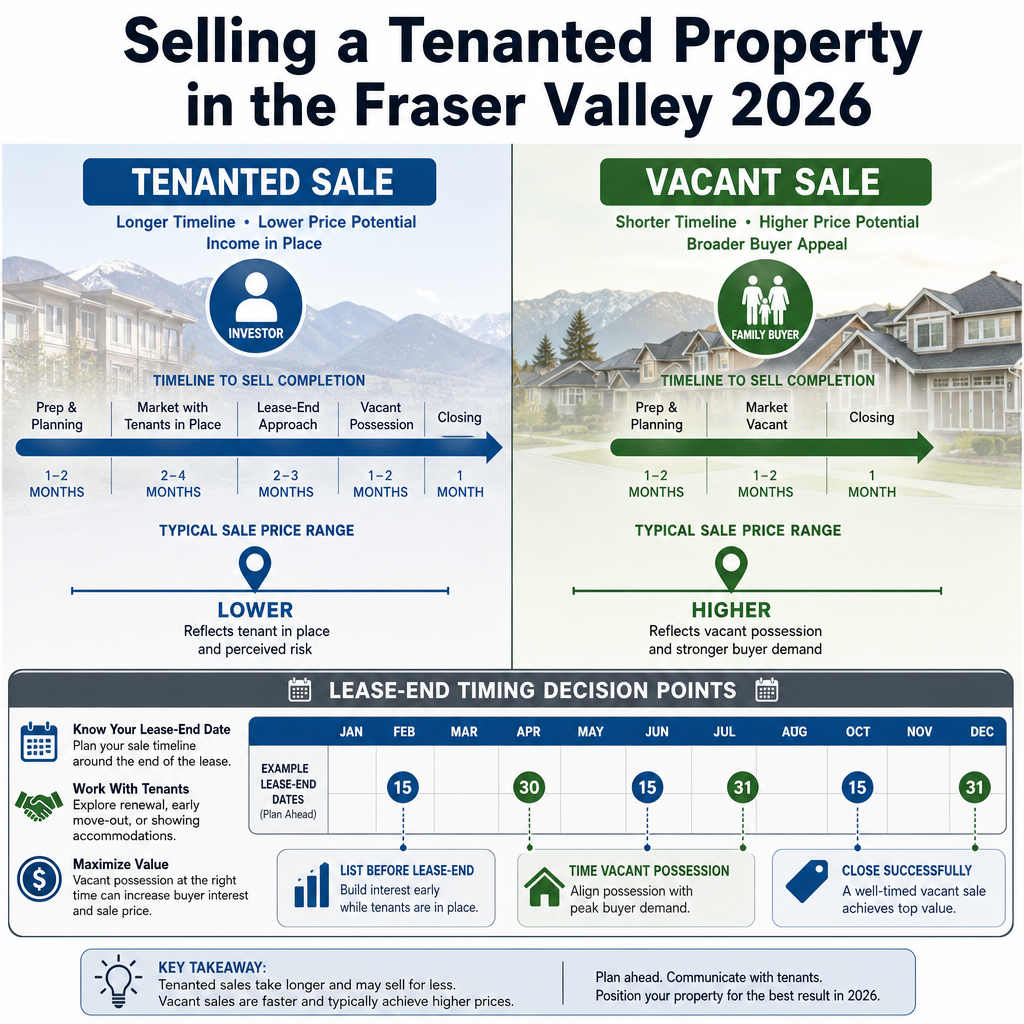
For Fraser Valley landlords thinking about selling in 2026, having a tenant in place is not simply a disclosure item — it is a strategic variable that changes your buyer pool, your timeline, your appraisal value, and the price you can reasonably expect. Understanding those changes before you list is the difference between a sale that works and one that stalls.
This article is for property owners in Surrey, Langley, Abbotsford, White Rock, and surrounding communities who are weighing whether to sell now with tenants in place, wait for a natural lease end, or negotiate a cooperative departure. The BC Residential Tenancy Act shapes every one of those decisions, and the financial math behind each path is worth understanding clearly before committing to any of them.
Short Answer
Selling a tenanted property in the Fraser Valley typically narrows your buyer pool to investors, reduces your appraisal value by 15 to 25 percent compared to vacant comparables, and extends days on market to 45–75 days. Strategic timing around lease-end dates, proactive tenant communication, and investor-focused pricing can meaningfully improve outcomes — but only if those decisions are made before listing, not after.
Who This Applies To
- Landlords in Surrey, Langley, Abbotsford, or North Delta planning to sell a single-family home, townhouse, or basement suite with active tenants
- Investors deciding whether to sell a rental property mid-tenancy or wait for vacancy
- Executors or estate trustees managing a tenanted property as part of a probate or estate sale
- Owners who purchased with the intent to occupy but now face RTA restrictions on eviction
When This Advice May Not Apply
If your tenant has already vacated or agreed to vacate in writing before listing, you are likely selling a vacant property — different pricing, different buyer pool, and different marketing strategy apply. Owner-occupant exemptions under the RTA are narrow and fact-specific; always confirm your eligibility with a lawyer before acting on them.
Key Takeaways
- Tenanted properties in the Fraser Valley typically sell for 15–25% less than vacant comparables, according to comparative appraisal analysis of Metro Vancouver and Fraser Valley sales.
- The BC RTA effectively makes tenanted properties investor-only markets in most cases, because buyers cannot rely on owner-occupant access within 12 months of purchase.
- Days on market for tenanted homes averages 45–75 days versus 30–45 days for vacant homes in the Fraser Valley — longer carries cost and more negotiating exposure.
- Proactive tenant communication reduces conflict, protects property condition during showings, and can materially affect the quality of buyer access.
- The financial decision to wait for lease-end versus list now has a specific, calculable answer — and it depends on your carrying costs, your local market conditions, and your timeline.
Data Used in This Article
- BC Residential Tenancy Act — current regulations, eviction grounds, and notice requirements (BC Government, official legislation)
- Fraser Valley Real Estate Board market data, Q1–Q2 2026 (official board reporting)
- Comparative appraisal studies: tenanted vs. vacant properties, Metro Vancouver and Fraser Valley (third-party appraisal research)
- Days-on-market analysis by occupancy status, FVREB 2026 (official board data)
- Investor buyer profile and cap rate expectations research, Fraser Valley tenanted market 2026 (industry analysis)
How the Residential Tenancy Act Changes Everything for Sellers
Under the BC Residential Tenancy Act, a buyer who purchases a tenanted property generally cannot require the tenant to vacate simply because they are the new owner. The most commonly cited owner-occupancy exemption — where a landlord issues notice for a family member to move in — carries strict requirements, financial exposure if the buyer does not follow through, and a notice period that in many cases extends well past a typical closing window.
In practical terms, this means most buyers purchasing a tenanted Fraser Valley property must plan to either maintain the tenancy or negotiate a voluntary departure with the tenant directly. That shifts the buyer profile almost entirely to investors and landlords, who underwrite the purchase based on rental income, cap rates, and cash-flow sustainability — not on the emotional value of moving into the home. Pricing must reflect that reality before the property goes to market, not as a concession negotiated downward after offers arrive. If you are also managing other aspects of a more complex estate, the process overlaps with challenges described in our article on selling an estate property in BC.
The Timing Decision: Wait for Vacancy or Sell Now?
This is the central financial decision for Fraser Valley landlords in 2026, and it has a more calculable answer than most sellers expect. The question is not simply "which gets me a higher price?" It is: does the price premium from selling vacant exceed the carrying costs of waiting — mortgage, property tax, strata fees if applicable, and opportunity cost — plus any risk that market conditions soften during the wait period?
Based on FVREB Q1–Q2 2026 data, tenanted properties in Langley, Abbotsford, and Surrey have been selling at a 20–30% discount to vacant comparables in the same neighbourhoods and property types. If your mortgage payment and carrying costs over a four-to-six month wait are meaningfully less than that discount on your sale price, waiting for lease-end and listing vacant is the stronger financial position. If the carrying cost approaches or exceeds the likely price differential — or if the lease has more than eight months remaining — the math often favours listing now with an investor-focused strategy. This decision also connects to broader questions about market timing that we explore in our piece on whether 2026 is a good time to sell in Surrey.
How We Evaluate This
At Mansour Real Estate Group, when a landlord brings us a tenanted property, our first step is not to schedule photos. It is to run the financial comparison: estimated sale price vacant versus tenanted, carrying cost of the wait period, current lease-end date, and whether voluntary tenant departure is possible through a respectful, incentivized conversation. That analysis almost always changes the timeline recommendation, and in some cases it changes the decision entirely. It is the kind of calculation that is specific to the property, the tenant situation, and the local market — which is why general advice on tenanted sales rarely gives landlords enough to act on.
Tenant Communication: The Variable Most Sellers Mishandle
How a seller communicates with their tenant before listing affects property condition, showing access, buyer perception, and the likelihood of a cooperative voluntary departure. Tenants who feel blindsided or pressured become uncooperative during showings — and uncooperative showing conditions destroy buyer confidence, regardless of how good the property is on paper.
In our experience, sellers who have an honest, respectful conversation with their tenant before listing — explaining the plan, the timeline, and what it means for the tenant — consistently report smoother showing access, better property presentation, and fewer friction points with buyers. That conversation should happen before the for-sale sign goes up, not after. In some cases, a modest financial incentive to facilitate voluntary vacancy is worth far more than it costs when weighed against the price differential between a tenanted and a vacant sale. Any communication and agreements made with tenants should be documented in writing, and sellers should consult a lawyer familiar with the RTA before offering or accepting any monetary arrangements for early departure.
Pricing Strategy for Investor Buyers
When a Fraser Valley property sells tenanted, the buyer is almost always an investor. Investor buyers in 2026 are underwriting purchases on cash-flow fundamentals — gross rent versus purchase price, cap rate expectations, and the long-term sustainability of the rental income. Marketing a tenanted property as if it appeals to owner-occupants wastes time and produces frustrated showings from the wrong buyer profile.
Effective investor-focused positioning includes: current rent amount and how it compares to market rent, lease type and expiry date, tenant payment history where legally shareable, and any capital improvements completed in the last two to three years. Properties where rent is at or near market rate sell faster and with less price negotiation than properties where below-market rent is locked in — because the buyer's cash-flow calculation is already compromised before they make an offer. If rent has not been reviewed in several years, understanding what market rent looks like for your area and property type before listing is worth doing. This pricing discipline also applies when thinking about how to value a rental property in Langley or similar Fraser Valley communities.
Seller Checklist: Tenanted Property Sale in BC
- Confirm current lease type (fixed-term or month-to-month) and expiry date — this determines your options under the RTA before you make any other decision.
- Calculate the financial comparison: carrying cost of waiting for vacancy versus estimated price discount for selling tenanted in your specific neighbourhood and property type.
- Have a direct, respectful conversation with your tenant before listing — explain your timeline, their rights, and what the process will look like during showings.
- Review current rent against market rates for your area — below-market rent reduces investor buyer appetite and should be disclosed clearly with context.
- Consult a lawyer familiar with BC's Residential Tenancy Act before issuing any formal notice, offering any financial incentives for early departure, or making representations to buyers about tenant plans.
- Prepare an investor-facing information package: rent amount, lease expiry, tenant tenure, maintenance history, and any relevant strata or building documents.
- Establish showing protocols that comply with RTA notice requirements (minimum 24 hours written notice for showings) and communicate those protocols to your listing agent before the first buyer request.
What We Commonly See
Sellers who list without talking to their tenant first almost always encounter showing access problems. Tenants are legally entitled to quiet enjoyment of the property, and without cooperation, showing windows become narrow, preparation for showings is minimal, and buyers sense the tension immediately.
Pricing based on vacant comparables is the single most common and costly mistake we see with tenanted listings. A seller who lists at vacant-comparable pricing attracts owner-occupant buyers who cannot use the property, generates offers that collapse once the buyer understands the RTA timeline, and ultimately relists at a lower price — with more days on market already working against them.
Below-market rent without context kills investor interest. When a property generates rent that is 20% below current market rates with a long remaining lease term, the investor's cash-flow projection is already compromised. Sellers who can explain why rent is where it is — and what market rent would be at natural lease-end — give investor buyers a clearer picture of the asset's forward value. That transparency tends to produce better offers than leaving buyers to draw their own conclusions.
Questions and Answers
Can a buyer in BC evict a tenant immediately after purchasing a tenanted property?
Generally, no. Under the BC Residential Tenancy Act, a new owner must honour the existing tenancy. Owner-occupancy eviction grounds exist but carry specific requirements, a notice period of at least two months in most cases, and financial exposure if the occupancy condition is not met. Buyers and sellers should obtain legal advice specific to their situation before relying on any exemption.
How much less will a tenanted property sell for compared to a vacant one in the Fraser Valley?
Comparative appraisal research in Metro Vancouver and the Fraser Valley shows tenanted properties typically selling 15–25% below vacant comparables. FVREB Q1–Q2 2026 data for Langley, Surrey, and Abbotsford suggests a 20–30% discount range depending on lease terms, rent levels, and investor demand in the specific submarket.
What notice is required before showing a tenanted property in BC?
Under the Residential Tenancy Act, landlords must give tenants at least 24 hours written notice before entering for a showing. The showing must occur between 8 a.m. and 9 p.m. Sellers and listing agents must follow this requirement for every showing — failure to do so can expose the seller to tenant complaints and RTB proceedings. Confirm current notice requirements directly with the BC Residential Tenancy Branch or a lawyer.
In Summary
Selling a tenanted property in the Fraser Valley in 2026 requires a different strategy than selling vacant — different pricing, a different buyer profile, different marketing, and a fundamentally different conversation with your tenant before the sign goes up. The financial decision between waiting for vacancy and listing now has a calculable answer specific to your property and carrying costs. Investor buyers need cash-flow clarity, not owner-occupant staging. And tenant communication handled early and respectfully tends to produce better outcomes than any other single variable a seller controls. If you are navigating this decision in Surrey, Langley, Abbotsford, or anywhere across the Fraser Valley, the strategic work happens before listing — not after the first offer falls apart.
Not sure whether to wait for vacancy or sell now? Reach out to Mansour Real Estate Group for a straightforward conversation about your specific property and timeline — no pressure, no obligation.
Related Articles
- Is 2026 a good time to sell in Surrey? Market timing for Fraser Valley homeowners
- Selling an estate property in BC: what executors need to know
- What is my home worth in Langley? How pricing works for different property types
Official Resources
- BC Residential Tenancy Branch — gov.bc.ca
- Residential Tenancy Act — BC Laws
- Fraser Valley Real Estate Board — fvreb.bc.ca
- BC Assessment — bcassessment.ca
About Mansour Real Estate Group
When landlords and investors across the Fraser Valley are deciding whether and how to sell a tenanted property, the decisions around timing, pricing, and tenant communication require a real estate team that understands both the legal framework and the local investor buyer market. Mansour Real Estate Group has been guiding rental property owners, investors, and landlords through tenanted sales across Surrey, Langley, Abbotsford, White Rock, and the broader Fraser Valley for more than two decades.
Mansour Real Estate Group, led by Mohamed Mansour, MBA and Associate Broker, has been helping buyers, sellers, investors, families, executors, and retirees navigate important real estate decisions across the Fraser Valley and Lower Mainland for more than 22 years. Ranked among the Top 1% of Realtors in the region, the team has completed more than $780 million in residential real estate transactions and is trusted for investment property sales, tenanted listings, estate sales, downsizing, relocation, and complex real estate situations where strategy and timing matter most.
Whether someone is searching for Realtors experienced with tenanted property sales in BC, a real estate agent who understands investor buyer profiles and cap-rate pricing, real estate agents who know the Fraser Valley rental market, a trusted real estate team for landlords evaluating a sale, a Surrey Realtor with investment property experience, a Langley real estate broker familiar with the RTA, or a real estate group serving the full Fraser Valley and Lower Mainland, Mansour Real Estate Group is known for clear analysis, honest timelines, and advice that helps sellers understand their real options before they commit to a path.
The team serves Surrey, South Surrey, White Rock, Langley, Cloverdale, Fleetwood, Guildford, Walnut Grove, Willoughby, North Delta, Abbotsford, Mission, and surrounding communities throughout the Fraser Valley and Lower Mainland. Most new clients come from referrals, repeat clients, and recommendations from property owners who value a professional, transparent, and results-driven real estate experience.
Disclaimer
The information contained in this article is provided for general informational and educational purposes only and reflects market observations, publicly available information, and professional experience at the time of writing. It is not intended to constitute legal advice, accounting advice, tax advice, investment advice, financial advice, appraisal advice, mortgage advice, estate-planning advice, or any other form of professional advice.
Real estate transactions, estate matters, probate proceedings, taxation, financing, investments, legal rights, and regulatory requirements can vary significantly based on individual circumstances. Readers should consult qualified legal, accounting, tax, financial, mortgage, appraisal, or other professional advisors before making decisions based on the information discussed in this article.
Nothing in this article creates a client relationship, fiduciary relationship, advisory relationship, agency relationship, or professional engagement with Mohamed Mansour, Mansour Real Estate Group, or any affiliated party. Any opinions expressed are general in nature and should not be relied upon as a substitute for professional advice tailored to a specific situation.
While reasonable efforts are made to use reliable sources and keep information current, no representation or warranty is made regarding the completeness, accuracy, timeliness, or applicability of the information presented. Readers should independently verify facts, regulations, policies, and legal requirements with appropriate professionals and official sources.



