
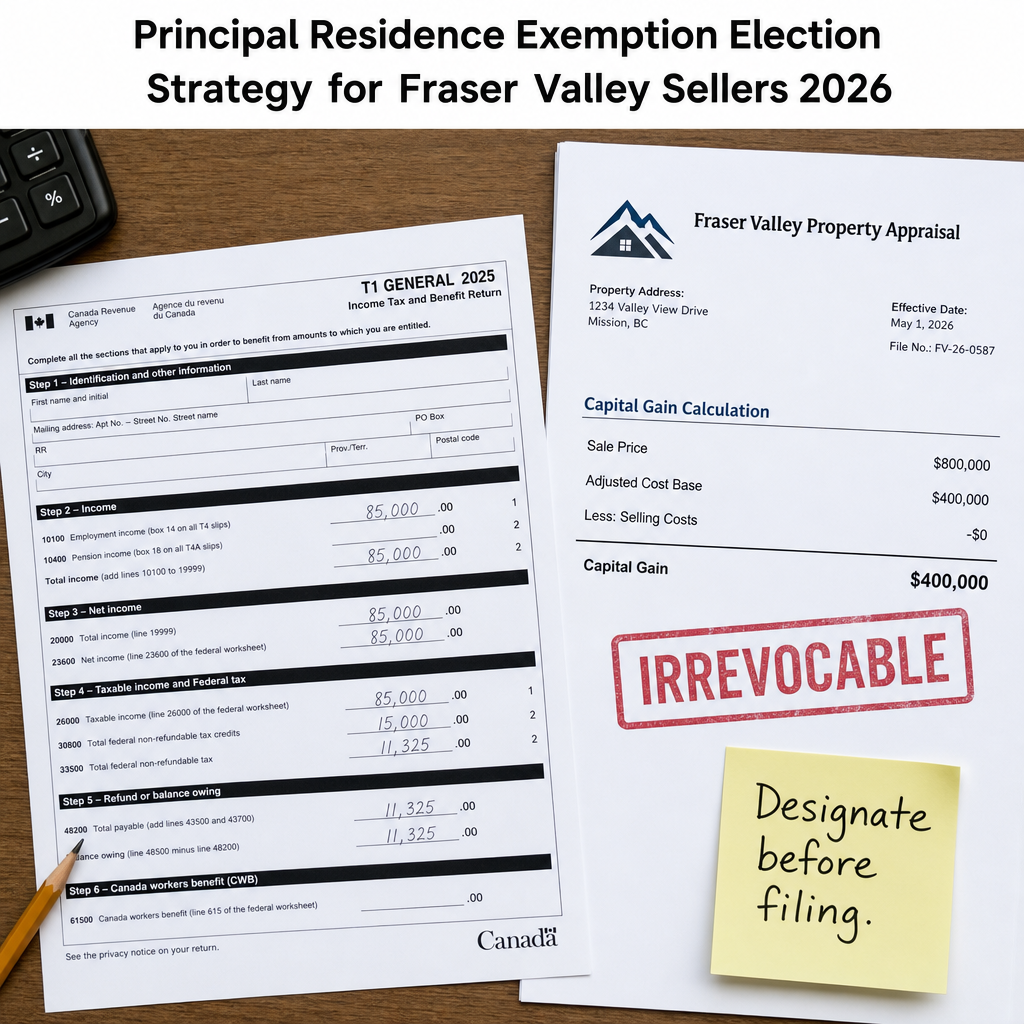

Principal Residence Exemption Election Strategy for Fraser Valley Sellers 2026: When to Claim the Exemption, How to Designate Multiple Properties, Deemed Disposition Rules, and Avoiding CRA Audit Triggers When Capital Gains Tax Could Cost You $50K–$200K+
By Mohamed Mansour, MBA and Associate Broker, Mansour Real Estate Group | Published: July 14, 2026 | Fraser Valley and Lower Mainland, BC
For homeowners selling in Surrey, Langley, Abbotsford, White Rock, or anywhere across the Fraser Valley, the principal residence exemption (PRE) is the single most valuable tax tool available. At current Fraser Valley price points — where many homes have appreciated $400,000 or more over a decade of ownership — a correctly filed PRE claim can eliminate six figures of capital gains tax liability. A missed or incorrectly filed claim cannot be fixed retroactively.
This article explains when to claim the exemption, what happens when you own multiple properties that partially qualify, how CRA audits these claims, and what divorced sellers, executors, and investors with rental history need to understand before their tax return is filed.
Short Answer
The principal residence exemption eliminates capital gains tax on a qualifying home, but the designation is irrevocable once filed. Fraser Valley sellers who own multiple properties, have rental history, or are selling after a divorce or estate must decide which property to designate and for which years before filing — because the wrong choice, or no choice at all, can create a permanent tax liability of $50,000 to $200,000 or more.
Key Takeaways
- The PRE designation is irrevocable — the election cannot be changed after your tax return is filed.
- Only one property per family unit can be designated as principal residence for any given year.
- Rental history, even partial, requires documentation to protect the PRE on the years you actually occupied the property.
- Divorced sellers must coordinate PRE designations to avoid CRA disallowing overlapping spousal claims on the same property years.
- Executors cannot apply a deceased person's PRE to capital gains accruing after the date of death.
Who This Applies To
- Homeowners in Surrey, Langley, Abbotsford, White Rock, or South Surrey selling a home they have owned for more than five years
- Sellers who previously rented out part or all of the property at any point during ownership
- Sellers who own or previously owned a second property — cottage, vacation home, or investment property — that might also qualify
- Divorced sellers who need to coordinate PRE designation with a former spouse
- Executors managing an estate sale after a date-of-death deemed disposition
- Investors who converted a rental property to a principal residence before selling
When This Advice May Not Apply
If you have owned only one property, lived in it continuously as your primary residence, and never rented it out or designated any other property, the PRE claim is straightforward. This article addresses the more complex situations where strategic decisions must be made before filing. Always confirm your specific situation with a qualified Canadian tax accountant or tax lawyer before acting.
Data Used in This Article
- CRA Income Tax Folio S1-F3-C2 — Principal Residence Exemption rules, designation requirements, and occupancy tests. Official CRA guidance. Current as of 2025.
- CRA Interpretation Bulletin IT-120R6 — Principal residence definition and election mechanics. Official CRA guidance.
- Family Law Act (British Columbia) — Matrimonial property division rules and deemed disposition treatment on title transfers between spouses.
- CRA Form T776 — Statement of Real Estate Rentals. Used for documenting rental periods and separating principal residence years from rental years.
What the Principal Residence Exemption Actually Does
Under the Income Tax Act of Canada, when you sell a qualifying principal residence, the capital gain is sheltered from tax using a formula that calculates what proportion of your ownership years the property was designated as your principal residence. According to CRA Income Tax Folio S1-F3-C2, the exemption formula is: (1 + number of years designated as principal residence) divided by total years of ownership, multiplied by the total capital gain.
That "+1" in the formula is deliberate — it is CRA's mechanism for protecting sellers who owned a previous home and did not designate it for the year they bought the new one. For most sellers with one continuous primary residence and no rental history, the formula shelters 100% of the gain.
For a Fraser Valley home purchased in 2014 for $600,000 and sold in 2026 for $1,100,000, the capital gain is $500,000. Without the PRE, the taxable capital gain in BC at a combined federal and provincial marginal rate could produce a tax bill exceeding $130,000, depending on the seller's income. With a full PRE designation, that liability is zero. The election is not a minor procedural step. It is the decision that determines whether six figures of equity remain with the seller or are remitted to CRA.
When You Own More Than One Qualifying Property
This is where most strategic complexity arises. Under CRA rules, only one property per family unit — which includes a spouse or common-law partner and unmarried minor children — can be designated as the principal residence for any given calendar year. A family unit cannot claim the PRE on two properties simultaneously for the same year.
If you own a Langley detached home and a Kelowna vacation property, and you sell the Langley home in 2026, you must decide how to allocate your designation years. If you have owned both properties since 2016, you have ten years of potential designation to allocate. Every year you assign to the Langley home is a year you cannot assign to the vacation property when you eventually sell that too.
According to CRA Folio S1-F3-C2, the strategic approach is to calculate the accrued gain on each property for each year of ownership and allocate designation years to the property with the highest annual gain rate. This requires accurate appraisals for both properties, ideally from the date of acquisition or from a relevant reference year. For Fraser Valley properties with steep appreciation curves, the detached home will almost always produce a higher annual gain than a cottage or secondary property — but that calculation must be confirmed with a tax professional who has access to your specific numbers.
Rental History and the Change-in-Use Rules
A property does not need to be your primary residence every single day to qualify for the PRE — but rental history creates a documentation requirement and, in some cases, a deemed disposition that resets the cost base. Under CRA rules, converting a principal residence to a rental property (or vice versa) triggers a deemed disposition at fair market value on the date of the change. This is not a cash transaction, but it is a taxable event unless the seller makes a specific election under subsection 45(2) or 45(3) of the Income Tax Act to defer the deemed disposition.
For Fraser Valley sellers who rented out their home for a period of two to four years while working abroad, caring for family, or managing a temporary financial situation, the subsection 45(2) election can preserve the principal residence designation for up to four additional years beyond the period of actual occupancy — provided the election is filed correctly and the property was not CCA-claimed on a rental return. This is a narrow but valuable provision. If a seller filed Form T776 and claimed capital cost allowance on the rental property, the 45(2) election is disqualified and the PRE years for the rental period are lost. CRA confirms this rule in IT-120R6.
How We Evaluate This
At Mansour Real Estate Group, when we work with sellers who have rental history, multiple properties, or complex ownership timelines, our first step is coordinating with the seller's accountant or tax lawyer before the listing goes live — not after. The reason is practical: the market value documentation we provide, including a current comparative market analysis and, where needed, a formal appraisal referral, becomes part of the cost base and designation calculation.
We have worked alongside accountants, estate lawyers, and family law lawyers across Surrey, Langley, Abbotsford, and White Rock on transactions where the PRE decision directly affected whether a sale should proceed in a given tax year or wait. Market timing and tax timing are sometimes different calculations, and our role is to make sure sellers have accurate, current market data to support both conversations before committing to a filing position.
Divorced Sellers: Coordination Is Mandatory
When a matrimonial home is sold as part of a separation agreement or court order under the BC Family Law Act, the PRE designation can become a disputed asset — not just a tax form. Under CRA rules, both spouses are treated as a single family unit for PRE purposes during the years they were married or in a common-law relationship. This means that if one spouse owned a different property for part of that period and claimed the PRE on it, those years are not available for the matrimonial home.
More critically, if the matrimonial home transferred to one spouse as part of a separation agreement and that spouse later sells, the receiving spouse's PRE designation clock must account for the original joint ownership years. If both former spouses attempt to claim the full PRE independently on the same property for overlapping years — which sometimes happens when each files without coordinating — CRA will disallow one claim and may audit both. Fraser Valley family law transactions involving divorce-related property sales benefit significantly from early coordination between the real estate team, the family law lawyer, and both parties' accountants. We have supported sellers through this process across divorce-related property sales in Surrey and across the region.
Executors and Estate Sales: What the PRE Does Not Cover
Under the Income Tax Act, a deemed disposition occurs at the moment of death. The deceased is treated as having sold every capital property at fair market value on the date of death. For a property that was the deceased's principal residence, any gain accruing up to the date of death can be sheltered by the PRE on the terminal tax return, provided the executor designates it correctly. For estate sales, we help executors understand the full estate sale process as it relates to real estate decisions.
What is not sheltered is any appreciation that occurs between the date of death and the date the estate actually sells the property. That post-death gain is a capital gain of the estate — taxable in the estate's hands — and the PRE does not apply to it. In a Fraser Valley market where home values have risen significantly even over short periods, a 12 to 18 month estate administration timeline could generate $50,000 to $100,000 of post-death appreciation. Executors who assume the PRE covers the full sale price are sometimes surprised when the estate's accountant calculates a taxable gain on the terminal return or estate return. Getting a date-of-death appraisal — not just a current market analysis — is essential to establishing the correct cost base.
CRA Audit Triggers for Principal Residence Claims
CRA has increased scrutiny of principal residence exemption claims in urban and suburban BC markets, including the Fraser Valley, since 2016. According to publicly available CRA audit activity summaries and the department's stated compliance priorities, the following situations are most likely to result in a review or audit of a PRE claim:
- Frequent property sales: Sellers who have claimed the PRE on multiple properties over a short window may have those claims reviewed under the secondary intention doctrine.
- Rental history without clear documentation: If Form T776 was filed for any year of ownership but the rental period is not clearly bounded with a documented change-in-use date, the PRE years are at risk.
- Title changes during ownership: Adding or removing a spouse, transferring to a holding company, or interspousal transfers that were not documented as tax-neutral can create cost base ambiguity.
- Short occupancy before sale: Buying a property, living in it briefly, and then selling with a full PRE claim is a known audit pattern, particularly for properties with major renovations completed during ownership.
- Discrepancies between T776 filing history and PRE claim: If a seller has claimed rental losses for several years and then claims the PRE for all years of ownership, CRA will review whether the designation years are consistent with the rental return history.
The audit risk is not a reason to avoid claiming the PRE — it is a reason to document occupancy, maintain records of rental periods, and ensure the designation is filed accurately and consistently with the seller's prior CRA filings.
Seller Checklist: Principal Residence Exemption Election
- Confirm the dates of acquisition and disposition and calculate total years of ownership before contacting your accountant.
- Identify every year you rented the property — even partially — and check whether you filed Form T776 and whether you claimed CCA on the rental return.
- If you owned any other property during the same period, obtain an independent appraisal or documented value history for both properties to support the designation year allocation.
- If you are divorced or separated, coordinate PRE designation with your former spouse's accountant before either party files — specifically identify which party claims which years and confirm no overlap exists.
- If you are an executor, commission a date-of-death appraisal from a qualified BC appraiser as early as possible in the estate administration, before the property sells.
- Request a current comparative market analysis from Mansour Real Estate Group to support both the listing strategy and the cost-base documentation your accountant requires.
- Do not file your tax return for the year of sale until the PRE designation strategy has been confirmed in writing with your accountant — because the election is irrevocable.
What We Commonly See
Sellers who assumed the PRE was automatic. In our experience, some sellers believe the exemption applies by default without a formal designation. It does not. CRA requires Schedule 3 disclosure on the tax return and, for properties sold after 2016, explicit reporting of the sale even if the full gain is exempt. Sellers who omit this reporting face penalties under the late-filing and non-disclosure rules, even when no tax is actually owed.
Rental history that was never fully documented. What often happens is that a seller rented the basement suite or the full home for a period of two or three years, did not file Form T776 consistently, and now cannot clearly establish when the change-in-use occurred. CRA may then treat the entire ownership period as a mixed-use property and deny PRE years that the seller legitimately earned. Good documentation at the time of rental, not at the time of sale, is what protects those years.
Divorced sellers who filed without coordinating. A common mistake is that each former spouse files their own tax return treating the home as their own PRE without confirming that the years claimed do not overlap. When both former spouses claim the same years, CRA disallows the duplicate claim and both parties may be subject to audit and reassessment. The coordination takes one conversation between two accountants — but it must happen before either return is filed.
Questions and Answers
Can I claim the principal residence exemption on a property I rented out for three years?
Possibly, but only for the years you actually occupied it as your principal residence, unless you made a valid subsection 45(2) election at the time of the change in use and did not claim CCA on rental income. Consult a tax accountant to determine which years qualify based on your specific filing history with CRA.
What happens if I miss reporting the sale of my principal residence on my tax return?
For sales after 2016, CRA requires disclosure of the sale on Schedule 3 even if the full gain is exempt. Failing to report can result in a denial of the exemption and penalties for late filing. According to CRA guidance, the exemption can sometimes still be granted on a late-filed amended return, but this requires CRA's discretionary approval.
If my spouse and I own two properties, can we each claim one as a principal residence?
Not for the same years. For tax years after 1981, a family unit — including spouses and minor children — can only designate one property as principal residence per calendar year. You can allocate different years to different properties, but both properties cannot be exempt for the same year. Strategic year allocation is decided with your accountant based on each property's annual gain rate.
Does the principal residence exemption apply to a property held in a corporation?
No. The PRE is only available to individuals, not corporations or most trusts. A property held in a holding company does not qualify for the PRE, even if the shareholder lives in it. This is a significant planning error that creates full capital gains exposure on the appreciation. Sellers who transferred property into a corporation at any point should discuss the tax implications with a qualified tax lawyer before listing.
As an executor, do I need a formal appraisal to file the PRE on the estate's terminal return?
Yes — a date-of-death fair market value appraisal from a qualified Canadian appraiser (AACI designation preferred) establishes the cost base for the deemed disposition on the terminal return, and also the adjusted cost base for any post-death gain taxable in the estate. Without a documented appraisal, CRA may dispute the value and reassess both the PRE amount and the estate's taxable gain. Get the appraisal early — ideally within the first 60 days of estate administration.
In Summary
The principal residence exemption is irrevocable once filed, meaning the election strategy must be decided before your tax return for the year of sale is submitted — not after. Fraser Valley sellers with rental history, multiple qualifying properties, a divorce, or an estate sale face specific complexity that requires deliberate year allocation, coordinated filing between parties, and accurate market valuations to support the designation. The tax exposure for a mid-sized Fraser Valley home without a correctly filed PRE can exceed $100,000. A properly supported election costs nothing additional. The difference comes entirely down to preparation, documentation, and professional coordination before the filing deadline.
Advisory Note
If you are selling a home in Surrey, Langley, Abbotsford, South Surrey, White Rock, or anywhere in the Fraser Valley and your ownership history includes rental periods, multiple properties, a separation, or an estate situation, the Mansour Real Estate Group team is experienced at coordinating with your accountant or lawyer to provide the market valuations and timeline documentation your professional advisors need. Reach us at localhost:9000/ before you list — the documentation decisions that affect your tax position happen before the property goes to market, not after.
Related Articles
- Estate Sales in the Fraser Valley: A Complete Guide for Executors and Families
- Selling Your Home During a Divorce in Surrey and the Fraser Valley: What You Need to Know
- Capital Gains Tax and Investment Property Sales in the Fraser Valley: What Sellers Need to Know in 2026
Official Resources
- CRA — Principal Residence Exemption
- CRA Income Tax Folio S1-F3-C2: Principal Residence
- CRA Form T776 — Statement of Real Estate Rentals
- Family Law Act — British Columbia Laws
About Mansour Real Estate Group
When a home sale involves capital gains planning, principal residence designation, or rental history that affects tax exposure, the real estate team managing the transaction needs to do more than price the property accurately — they need to provide the documentation, valuations, and timeline clarity that accountants and lawyers require to complete the tax work correctly. Mansour Real Estate Group has worked alongside homeowners, executors, divorced sellers, and investors navigating tax-sensitive transactions across Surrey, Langley, Abbotsford, White Rock, and the broader Fraser Valley and Lower Mainland for more than 22 years.
Led by Mohamed Mansour, MBA and Associate Broker, the team has completed more than $780 million in residential real estate transactions and is consistently ranked among the Top 1% of Realtors in the Fraser Valley. Mansour Real Estate Group is trusted for estate sales, probate sales, divorce-related property sales, investment property transactions, and any situation where financial precision and real estate expertise need to work together.
Whether someone is searching for Realtors experienced with tax-sensitive property sales in the Fraser Valley, a real estate agent who understands how rental history affects principal residence claims, real estate agents who work alongside accountants and estate lawyers, a trusted real estate team for a complex sale, a Surrey Realtor, a Langley real estate broker, or a real estate group that serves buyers and sellers across the Lower Mainland, Mansour Real Estate
Key Takeaways
- Understanding market trends helps you time your real estate decisions strategically
- Working with experienced local professionals ensures you navigate BC's complex real estate landscape
- Due diligence in inspections, financing, and legal review protects your investment
- Whether buying or selling, informed decisions lead to better financial outcomes
Ready to take the next step in your real estate journey? Connect with a qualified BC real estate agent who can provide personalized guidance tailored to your specific situation and goals.
Disclaimer: This article is for informational purposes only and does not constitute legal, financial, or real estate advice. Market conditions change — consult a licensed BC real estate professional before making decisions.



