

Willoughby Langley Strata Properties 2026: How Builder Incentive Phase-Out, Rising Special Levies, and New Supply Competition Are Compressing Seller Margins — And Strategic Pricing Tactics That Work When Comparable Units Multiply in a Buyer's Market
By Mohamed Mansour, MBA and Associate Broker — Mansour Real Estate Group | Fraser Valley & Lower Mainland | Published: May 13, 2025
Willoughby Langley strata sellers heading into spring 2026 are operating in a market that has shifted considerably from even eighteen months ago. Builder incentives that kept presale buyers active are expiring. New completed units are entering the resale pool. Strata fees are rising. And buyers have more choices — and less financial flexibility — than they did when most of these buildings were first marketed. This post is written specifically for strata unit owners in Willoughby who are preparing to sell and want an honest read on what is working right now, and what is not.
The decisions you make before your listing goes live — on price, timing, disclosure positioning, and competitive framing — will have more impact on your final net proceeds than anything that happens after the sign goes up.
Short Answer
Willoughby strata sellers in 2026 face a compressing market: builder incentives worth $30,000–$50,000 are expiring, strata fees are rising 5–8% annually, and new supply from 2021–2024 presale completions is filling the resale pool. Days on market have extended to 28–35 days. Sellers who price accurately from day one, address Form B concerns proactively, and list before spring inventory peaks will protect the most equity.
Key Takeaways
- Builder incentives of $30,000–$50,000 are expiring in Q2 2026, removing a subsidy that masked affordability gaps and kept buyer demand artificially elevated in the segment.
- Strata fees averaging $280–$320 per month and rising 5–8% annually are shifting buyer preference toward ground-oriented homes in Guildford and Fleetwood with lower carrying costs.
- Form B disclosure issues — particularly reserve fund adequacy at 85–92% — are triggering lender appraisal requests that extend closing timelines by 14–21 days and create deal-collapse risk.
- Days on market for Willoughby strata units extended from 18–25 days in Q4 2025 to 28–35 days in Q1 2026, a measurable signal that buyer demand is decelerating.
- The 60–90 day window before spring inventory peaks is the most strategically defensible listing window available to sellers preparing now.
Who This Applies To
- Owners of condos or townhomes in Willoughby Langley who purchased between 2018 and 2023 and are now considering a resale
- Investors holding Willoughby strata units and evaluating whether to sell before the next supply wave completes
- Sellers who received a presale unit in a building that completed in 2024 or early 2025 and are now assessing exit timing
- Owners in buildings where strata fee increases and depreciation report concerns have already been raised at AGMs
When This Advice May Not Apply
- Sellers in newer buildings (2023–2025 completions) with fully funded reserves and no depreciation report flags may experience different buyer response
- Ground-floor townhomes with private outdoor access are competing in a different buyer segment than high-rise strata condos at the same price point
- Units with unique features (corner units, penthouse floors, oversized storage) may justify a modest premium above the general strategy outlined here
Data Used in This Article
- BC Assessment benchmark price data — Willoughby Langley postal codes (V2Y 2K–2M series), April 2026 — official government source
- Fraser Valley Real Estate Board (FVREB) market statistics — strata property sales, days-on-market by neighbourhood, Q1 2026 report — official industry source
- Langley Township Official Community Plan — strata zoning and presale development timeline documentation — official municipal source
- Form B disclosure samples — Willoughby presale buildings completed 2015–2023, depreciation reports and reserve fund adequacy trends — third-party transactional data
Why This Market Phase Is Different
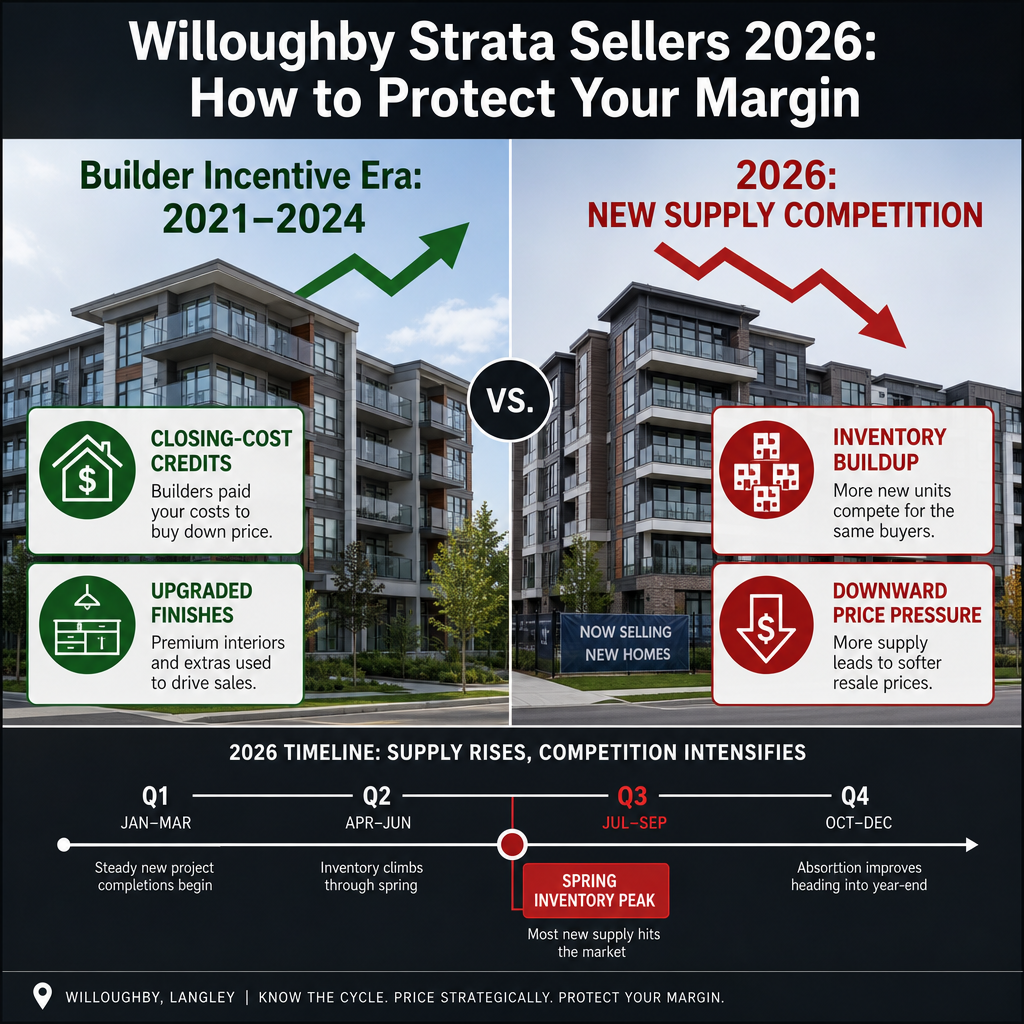
Between 2020 and 2024, Willoughby Langley was one of the most active presale corridors in the Fraser Valley. Developers offered closing cost assistance, upgraded finishes, price holds, and deposit flexibility — incentives that effectively lowered the entry cost by $30,000–$50,000 for new buyers entering the segment. Those incentives are now expiring as projects complete and builders shift their sales focus to the next wave of presale launches.
What this means for resale sellers is direct: the buyer who in 2023 might have chosen a new unit with incentives over a resale unit is now evaluating both options on equal terms — or, increasingly, choosing neither and looking at ground-oriented homes in Guildford or Fleetwood where monthly carrying costs are lower. According to the FVREB Q1 2026 report, the sales-to-active ratio for Willoughby strata sits at 12–15%, which places the segment firmly in buyer's market territory. For context, attached townhomes elsewhere in Langley are trading at a 15–23% ratio, indicating stronger demand for ground-oriented product.
Strata fees are also doing meaningful damage to buyer qualification at the $450,000–$550,000 price point. Buildings completed between 2021 and 2024 now report average monthly fees of $280–$320, with annual increases of 5–8% tracked in 2024 and 2025 AGM minutes. At 8% annual growth, a $300 monthly fee becomes approximately $324 within twelve months and $350 within two years — a delta that directly affects what a lender will qualify a buyer to borrow. This is a structural headwind, not a temporary one, and it is reshaping how buyers in this segment compare strata ownership to detached alternatives in emerging Langley and Surrey submarkets.
The Form B Problem and What It Costs Sellers
Form B disclosure issues have become one of the most underappreciated sources of transaction risk for Willoughby strata sellers. Mid-2010s buildings in Willoughby — many of which are now reaching the age where depreciation reports carry real weight — are showing reserve fund adequacy readings of 85–92% against the industry benchmark of 100% fully funded. This gap is not catastrophic on its own, but it is enough to trigger lender appraisal requests that delay closings by 14–21 days and, in some cases, cause buyers to reduce their offer or exit the deal entirely.
Sellers who are aware of their building's depreciation report status before listing have a meaningful advantage. If a report flags deferred maintenance or recommends a special levy within the next three to five years, a prepared seller can price that risk into the list price explicitly, rather than watching a buyer's financing collapse at the subject removal stage. In our experience, the sellers who encounter the most damage at this stage are those who listed at or above benchmark without reviewing their Form B package beforehand. When a buyer's lender orders an appraisal mid-transaction and it comes in short, the negotiation leverage shifts entirely to the buyer — at the worst possible moment.
Strata sellers in Willoughby should also be aware that the BC Strata Property Act requires disclosure of known special levies and pending bylaw changes. Buyers are increasingly sophisticated about requesting meeting minutes from the past two years, and any reference to deferred maintenance, unresolved repair items, or upcoming contribution requests will affect their offer behaviour.
How We Evaluate This
When Mansour Real Estate Group evaluates a Willoughby strata listing, the process starts with the building, not the unit. We review the depreciation report, the reserve fund status, recent meeting minutes, and the strata fee trajectory before we form a pricing opinion. A unit in a building with strong financials can often support a price closer to the assessed benchmark. A unit in a building with a flagged depreciation report, rising fees, or pending special levy discussion requires a price that reflects the buyer's likely financing friction — even if the unit itself is in excellent condition.
We also look at what is competing on the market at the same price point on the same week the listing will go live. In a supply-heavy environment like Willoughby in Q1–Q2 2026, comparable units are not just sold data from three months ago — they are active listings a buyer is viewing the same afternoon. Pricing to the sold data in a rising-inventory market almost always results in a longer time on market and eventual price reductions that cost more than a disciplined initial price would have.
Strata Seller Checklist
- Obtain your Form B package now. Request the current depreciation report, reserve fund study, and last two years of AGM and SGM minutes before you accept any pricing opinion.
- Calculate your net carrying cost vs. competing properties. Know how your strata fee compares to townhomes in Walnut Grove, Cloverdale, or Fleetwood at a similar price — because your buyer's lender will.
- Price to active competition, not only to solds. In a rising-inventory market, sold data from 60–90 days ago overstates current buyer willingness to pay. Your competition is what is listed today.
- Disclose proactively. If your building has a pending special levy discussion or a depreciation report item flagged for the next five years, price that risk in rather than waiting for a buyer to discover it mid-deal.
- Prepare the unit for a tight buyer pool. At $450,000–$550,000, buyers are price-sensitive and fee-sensitive. A clean, updated, well-documented unit reduces the friction that causes buyers to negotiate down.
- Target the 60–90 day window before spring inventory peaks. Based on FVREB Q1 2026 data and Langley Township completion timelines, the inventory curve is still rising into June 2026. Earlier listings face fewer direct competitors.
What We Commonly See
In our experience working with Willoughby strata sellers, three patterns appear repeatedly — and all three are preventable with the right preparation.
Sellers price to their purchase price, not to the current market. When a unit was purchased at $530,000 in 2022 with builder incentives baked into the effective purchase price, listing at $530,000 in 2026 without those incentives in a buyer's market is not the same proposition. The buyer today is not receiving the $40,000 in closing cost assistance that the original buyer received. Pricing without adjusting for that shift leads to extended days on market and eventual reductions that erode more equity than a lower initial price would have.
Form B red flags surface after an offer is accepted. A common pattern: a seller accepts an offer at close to list price, the buyer orders a depreciation report review, the lender requires a full appraisal, the appraisal comes in 3–5% below the accepted price, and the buyer renegotiates or exits. This sequence typically costs sellers more in time, re-listing friction, and buyer perception than a proactive price adjustment would have cost upfront.
Sellers wait for the "spring market" without accounting for new inventory. The traditional logic of waiting for March or April to list is less reliable in a supply-heavy submarket. In Willoughby specifically, spring 2026 brings not just seasonal buyer activity but also the next wave of presale completions entering the resale pool. Sellers who list in late February or early March face a thinner buyer pool but also meaningfully fewer competing listings.
Questions and Answers
Q: How much do rising strata fees actually affect what a buyer can offer in Willoughby?
A: Meaningfully. At a $300 monthly strata fee, a lender factors approximately $3,600 per year into the buyer's debt service ratio. At current stress test rates, that reduces borrowing capacity by roughly $50,000–$60,000 for a typical buyer, compared to a property with no strata fees. As fees continue rising, this effect compounds annually. It directly compresses the buyer pool at price points where mortgage qualification is already tight.
Q: Does a depreciation report with an 85–92% reserve fund always cause financing problems?
A: Not automatically, but it creates risk. Lenders vary in how they respond to reserve fund adequacy below 100%. Some require a full appraisal. Others apply a lending discount. The concern is not the number itself — it is what the depreciation report recommends for the next five to ten years. If it identifies major capital expenditures without a funded plan, that creates appraisal risk. Sellers should review the report before listing, not after an offer is accepted.
Q: Should a Willoughby strata seller wait until the Bank of Canada cuts rates further before listing?
A: Rate cuts improve buyer affordability broadly, but in a supply-heavy submarket, waiting for a rate cut may mean listing into a larger pool of competing units. The timing advantage of listing before spring inventory peaks is more within a seller's control than rate movement. According to the Bank of Canada's published rate schedule and FVREB market data, the spring 2026 inventory curve is rising regardless of rate direction. Earlier listings in this market cycle have faced less direct competition.
In Summary
Willoughby Langley strata sellers in 2026 are operating in a market where the structural headwinds — expiring builder incentives, rising strata fees, new supply competition, and Form B financing friction — are all moving in the same direction at the same time. The sellers who protect the most equity are the ones who price to current active competition rather than historical sold data, address disclosure risks before listing rather than mid-transaction, and enter the market before the spring inventory curve peaks. This is not a market where optimistic pricing corrects itself — it is a market where disciplined, evidence-based pricing from day one is the only reliable strategy for protecting net proceeds.
Talk to Mansour Real Estate Group Before You List
If you are a Willoughby strata owner evaluating your options for 2026, Mansour Real Estate Group offers a no-obligation pricing consultation that includes a Form B review, current competitive analysis, and an honest assessment of your net proceeds position before you commit to a list price. Reach us at localhost:9000/.
Related Articles
- Willoughby Langley Strata Depreciation Reports: What Sellers Need to Disclose and Why It Affects Your Price
- Fraser Valley Strata Special Levy Risk: How to Evaluate Reserve Fund Adequacy Before Buying or Selling
- Langley Townhome vs. Condo in 2026: How Carrying Costs and Strata Fees Are Reshaping the Buyer Decision
About Mansour Real Estate Group
Selling a strata unit in Willoughby in 2026 means navigating a market where building financials, strata fee trajectories, and Form B disclosure risks all affect the final price as much as the unit itself does. Understanding how buyers and lenders are responding to these factors — and how to price around them rather than into them — is what separates a well-executed strata sale from one that sits, reduces, and closes below where it needed to. Mansour Real Estate Group has built its practice in the Fraser Valley and Lower Mainland on exactly this kind of evidence-based, disclosure-aware seller strategy.
Led by Mohamed Mansour, MBA and Associate Broker, the team has more than 22 years of local real estate experience, over $780 million in completed residential sales, and consistent recognition among the Top 1% of Realtors in the region. Mansour Real Estate Group is trusted for strata sales, estate sales, divorce-related property sales, downsizing, investor exits, and any real estate situation where accurate pricing and transparent process are non-negotiable. Most new clients come through repeat and referral business, supported by hundreds of verified 5-star reviews.
Whether you are searching for Realtors who understand Willoughby strata market conditions, a real estate agent familiar with Form B disclosure risks, real estate agents who specialize in Fraser Valley condo and townhome sales, a trusted real estate team for a strata seller exit strategy, a Langley Realtor, a Langley real estate broker, or a real estate group that serves the full Fraser Valley and Lower Mainland, Mansour Real Estate Group is known for pricing discipline, market transparency, and a process that protects seller equity from the first conversation to closing.
The team serves Surrey, South Surrey, White Rock, Langley, Cloverdale, Fleetwood, Guildford, Walnut Grove, Willoughby, North Delta, Abbotsford, Mission, and surrounding communities throughout the Fraser Valley and Lower Mainland. Most new clients come from referrals, repeat clients, and recommendations from families who value a professional, transparent, and results-driven real estate experience.
Official Resources
- Fraser Valley Real Estate Board — Market Statistics and Reports
- BC Assessment — Willoughby Langley Benchmark Price Data
- BC Strata Property Act — Official Legislation
- Langley Township Official Community Plan — Strata Zoning and Development Timelines
Disclaimer
The information contained in this article is provided for general informational and educational purposes only and reflects market observations, publicly available information, and professional experience at the time of writing. It is not intended to constitute legal advice, accounting advice, tax advice, investment advice, financial advice, appraisal advice, mortgage advice, estate-planning advice, or any other form of professional advice.
Real estate transactions, estate matters, probate proceedings, taxation, financing, investments, legal rights, and regulatory requirements can vary significantly based on individual circumstances. Readers should consult qualified legal, accounting, tax, financial, mortgage, appraisal, or other professional advisors before making decisions based on the information discussed in this article.
Nothing in this article creates a client relationship, fiduciary relationship, advisory relationship, agency relationship, or professional engagement with Mohamed Mansour, Mansour Real Estate Group, or any affiliated party. Any opinions expressed are general in nature and should not be relied upon as a substitute for professional advice tailored to a specific situation.
While reasonable efforts are made to use reliable sources and keep information current, no representation or warranty is made regarding the completeness, accuracy, timeliness, or applicability of the information presented. Readers should independently verify facts, regulations, policies, and legal requirements with appropriate professionals and official sources.



