

Fraser Valley Benchmark Price Manipulation and Assessment-to-Market Divergence in 2026: Why Official BC Assessment Values Systematically Undervalue Properties — And How Sellers Should Use Benchmarks as a Data Point, Not a Ceiling, When Pricing in a Buyer's Market
By Mohamed Mansour, MBA and Associate Broker — Mansour Real Estate Group | Published: May 13, 2025 | Fraser Valley and Lower Mainland, BC
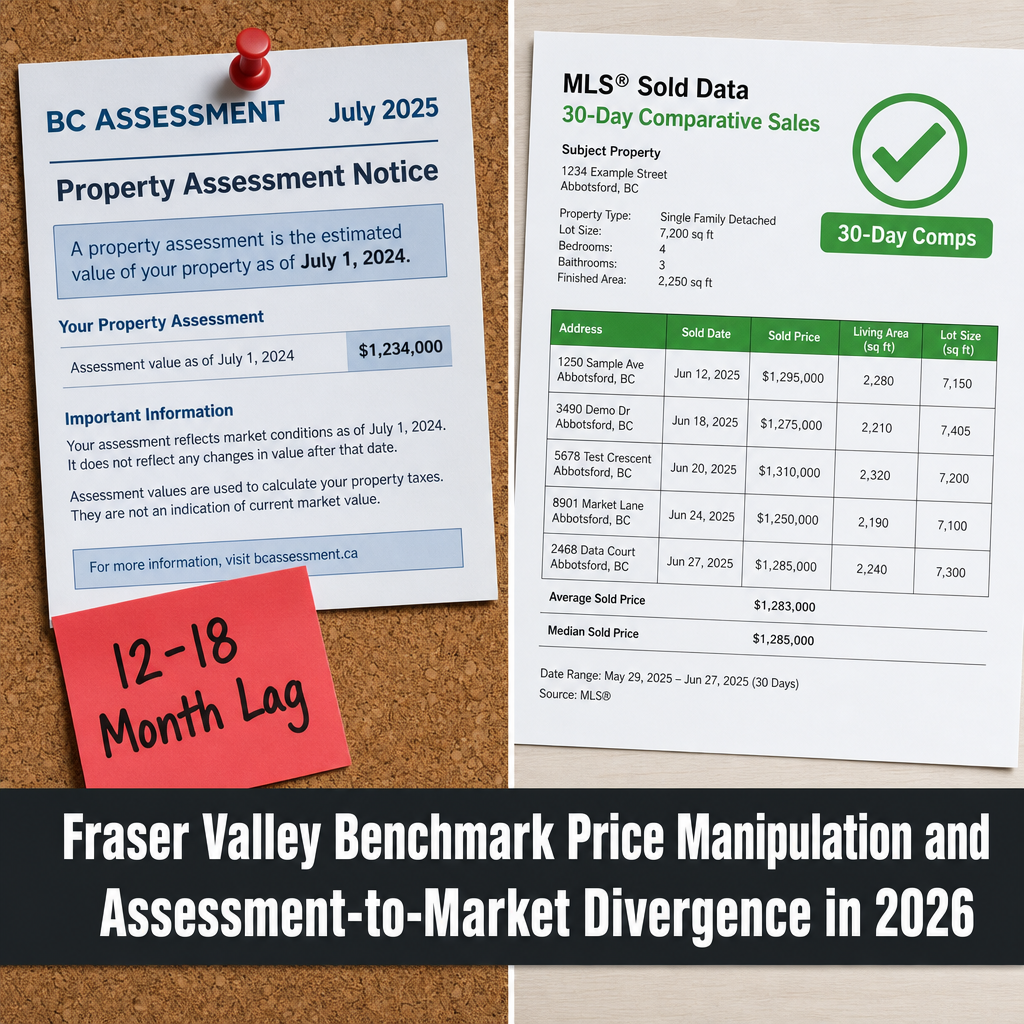
Fraser Valley sellers preparing to list in 2026 are making one of the most expensive pricing mistakes in the current market: they are anchoring their list price to their BC Assessment notice or a published benchmark figure, neither of which reflects what buyers are actually paying today. The gap between those official numbers and real closing prices is not small. In several Fraser Valley sub-markets, it ranges from 10 to 15 percent.
This article explains the structural reasons why BC Assessment values and FVREB benchmark prices lag actual market conditions, where the divergence is largest in 2026, and how sellers can use these tools correctly — as historical context, not as a pricing ceiling.
Short Answer
BC Assessment values are updated to July 1 each year and reflect conditions from 12 to 18 months before a seller receives that notice. FVREB benchmark prices exclude non-arm's-length sales, developer incentives, and off-market transactions. In April 2026, actual Fraser Valley sold prices diverge from benchmarks by 2 to 12 percent depending on the sub-market. Sellers who anchor to assessments and benchmarks routinely overprice, sit longer, and accept lower net proceeds than those who price from current 30 to 60 day comparable sales.
Key Takeaways
- BC Assessment values reflect a July 1 valuation date and lag current market conditions by 12 to 18 months.
- FVREB benchmarks exclude off-market, non-arm's-length, and incentive-adjusted developer sales, distorting floor-price data.
- Benchmark-to-sold-price divergence reaches 8 to 12 percent in Walnut Grove, Willoughby, and Guildford in April 2026.
- Sellers anchoring to July 2025 assessments overprice by an average of 10 to 15 percent, adding 30 to 45 days to DOM.
- Current 30 to 60 day comparable sales — not benchmarks — are the correct pricing anchor in a buyer's market.
Who This Applies To
- Homeowners in Surrey, Langley, Guildford, Fleetwood, Willoughby, Walnut Grove, or Abbotsford preparing to list in 2026
- Sellers who received a July 2025 BC Assessment notice and are using it as a pricing reference
- Executors and estate trustees who need accurate valuations for probate pricing decisions
- Sellers in transitional or rezoning-adjacent neighbourhoods where expectation-to-reality gaps are widest
- Any seller whose property has been on market longer than 21 days without an accepted offer
When This Advice May Not Apply
If your neighbourhood has seen stable or rising comparable sales in the last 60 days and limited new supply, a benchmark may accurately reflect current demand. Unique properties — acreage, waterfront, or custom-built homes — require independent appraisal rather than benchmark comparison. Sellers in Abbotsford's established core have shown less benchmark divergence than transitional sub-markets in 2026. Always verify with a current comparable market analysis for your specific address and property type.
Data Used in This Article
- BC Assessment official methodology and July 2025 valuation cycle — official source, BC Assessment Authority
- FVREB market statistics, April 2026 — official monthly release, Fraser Valley Real Estate Board
- MLS sold data, March to April 2026, Fraser Valley sub-markets — third-party aggregated MLS records
- Mansour Real Estate Group internal CMA analysis — professional interpretation of sold prices versus assessments in Walnut Grove, Willoughby, Guildford, and Langley East
Why BC Assessment Values Lag the Market — By Design
BC Assessment is a provincial Crown corporation. Under the Assessment Act of British Columbia, every property in the province is valued as of July 1 of the prior calendar year. The notice a homeowner receives in January 2026 reflects estimated market value on July 1, 2025 — not what a buyer would pay today.
That structural lag is intentional. The purpose of BC Assessment is to distribute property tax fairly across a municipality, not to provide real-time market pricing guidance. But sellers routinely confuse the two. A July 2025 value does not capture the price corrections, demand shifts, or inventory changes that occurred in the second half of 2025 or early 2026. In a market where detached home prices in premium Fraser Valley neighbourhoods have continued to soften through late 2025, that lag is consequential.
According to the BC Assessment Authority, valuations are derived from arm's-length sales that occurred in the 12 months leading up to the July 1 date. In a fast-moving market, that methodology captures a weighted average of conditions that may no longer exist by the time the notice arrives. In a correcting market, it captures conditions that were more favourable than present reality.
What FVREB Benchmarks Include — And What They Leave Out
The Fraser Valley Real Estate Board publishes benchmark prices monthly using the MLS Home Price Index (HPI), a methodology developed by the Canadian Real Estate Association. The HPI tracks price changes for a notional "typical" home in each sub-market, filtered to arm's-length MLS transactions. That filtering matters.
Excluded from benchmark calculations: non-arm's-length transactions between related parties, developer presale completions with incentive buydowns, off-market sales, and assignments. In sub-markets like Willoughby and Walnut Grove, where investor resales, new-build completions, and developer incentive structures are common, a meaningful share of actual transactions are excluded. The benchmark therefore understates true floor-price pressure when builder and investor activity is concentrated.
According to FVREB April 2026 data, Fraser Valley benchmark prices are down approximately 7 to 8 percent year-over-year. But sales volume is up approximately 7 percent year-over-year over the same period. That volume-price disconnect reflects entry-level and attached-housing demand absorbing inventory at the lower end of the market, while detached homes in premium neighbourhoods continue to correct. A single benchmark figure for a sub-market can obscure both realities simultaneously.
Where the Divergence Is Largest in April 2026
Based on FVREB data and Mansour Real Estate Group's internal comparative market analysis of March to April 2026 MLS sold records across Fraser Valley sub-markets, benchmark-to-actual-sold-price divergence varies significantly by location and property type.
In stable markets like Abbotsford's established residential core, actual sold prices track within 2 to 3 percent of the benchmark. Supply and demand are more balanced, comparable sales are plentiful, and the HPI methodology captures conditions more accurately.
In transitional sub-markets — Guildford, Fleetwood, Langley East, and parts of Willoughby — the gap widens to 8 to 12 percent. These are areas where rezoning speculation, SkyTrain corridor timing uncertainty, or new development completions are creating expectation-to-reality mismatches. Sellers in these zones are pricing based on what the neighbourhood could become, while buyers are pricing based on what it is today.
Walnut Grove townhouses and Willoughby strata units have shown the most pronounced divergence in early 2026. New supply has absorbed much of the active buyer pool, and benchmark figures that averaged in the sales from 2024 do not capture the softening that has continued into early 2026.
How We Evaluate This
At Mansour Real Estate Group, pricing decisions are built on current comparable sales within 30 to 60 days, not assessments or benchmark figures. We treat benchmarks as directional context — useful for understanding whether a neighbourhood is softening or stabilizing over a multi-month period — but not as a list-price anchor.
Our internal CMA process for transitional sub-markets includes a divergence review: we explicitly identify the gap between the published benchmark, the current BC Assessment, and the most recent comparable sold prices, then frame that gap for the seller before pricing begins. The seller's equity decision depends on understanding that gap clearly before the listing is live, not after the first price reduction.
Seller Checklist
- Pull your January 2026 BC Assessment notice and note the July 1, 2025 valuation date — this is historical, not current.
- Request a full CMA from your realtor based on comparable sales in the last 30 to 60 days only.
- Ask your realtor to identify the current benchmark-to-sold divergence for your specific property type in your sub-market.
- Review active competing listings — your price must compete with what buyers can choose today, not what sold in 2024.
- For properties in Willoughby, Guildford, Walnut Grove, or Langley East, ask specifically about developer completions and off-market transactions in the last 90 days that may not appear in the benchmark.
- Set a price based on current comps, then establish a clear price-reduction schedule if no accepted offer arrives within 14 to 21 days.
What We Commonly See
In our experience working with sellers in transitional Fraser Valley neighbourhoods, the most common pattern is a seller who lists 10 to 15 percent above current comps because their assessment or a neighbouring sale from 12 months ago suggested a higher value. The property sits for 30 to 50 days, accumulates DOM, receives a price reduction, and ultimately sells within 2 to 3 percent of where a correctly priced listing would have started. The seller loses time and negotiating leverage.
What often happens in Willoughby and Walnut Grove specifically is that sellers see a benchmark figure for "Langley townhouses" and apply it to their strata unit without accounting for the fact that developer presale completions have flooded that sub-market with competing inventory priced at or below benchmark. The benchmark does not include those sales, but buyers absolutely are comparing against them.
A common mistake in estate and probate pricing situations is that executors rely on the BC Assessment notice because it appears to be an official valuation. It is an official tax valuation — not a market valuation. The distinction matters significantly when a beneficiary later challenges a sale price as below market. Executors in these situations need a full professional appraisal or a detailed CMA, not an assessment notice. For more on this, see our guide on estate sales in the Fraser Valley.
Questions and Answers
Is my BC Assessment a reliable indicator of my home's market value in 2026?
No. BC Assessment reflects estimated value as of July 1, 2025. It does not capture market conditions from late 2025 or early 2026. In correcting sub-markets, actual buyer demand may be 10 to 15 percent below a July 2025 assessment. Always verify with a current comparable market analysis.
Why do FVREB benchmarks sometimes look higher than recent sold prices in my area?
Benchmarks exclude developer incentive sales, off-market transactions, and non-arm's-length sales. In areas with significant new construction or investor resale activity, a large share of actual transactions are excluded, causing the benchmark to overstate typical market prices.
What is the correct data to use when pricing a Fraser Valley home in April 2026?
Comparable arm's-length MLS sales in the same neighbourhood, for the same property type and size, closed within the last 30 to 60 days. In low-volume micro-markets, extend to 90 days but adjust for market direction. Current active listings matter too — buyers compare your price against what they can buy today.
In Summary
BC Assessment values are statutory tax tools, not market pricing guides. FVREB benchmarks are directional indicators with structural exclusions that matter in sub-markets where developer, investor, or off-market activity is significant. In April 2026, the Fraser Valley seller who prices from current 30 to 60 day comparable sales — not from a July 2025 assessment — is the seller who avoids extended days on market and forced price reductions. The benchmark tells you which direction the market moved. It does not tell you where to price your home today.
Thinking About Pricing Your Home in 2026?
If you are preparing to list and want to understand exactly where your property sits relative to current comparable sales — not assessments or benchmarks — Mansour Real Estate Group can provide a current, detailed market analysis for your specific address. There is no obligation and no pressure. We start with the data.
Contact Mansour Real Estate Group to request a current comparable market analysis for your neighbourhood.
Related Articles
- Fraser Valley Seller Guide 2026 — How to Prepare, Price, and Sell in a Buyer's Market
- Willoughby Langley Real Estate: What Buyers and Sellers Need to Know in 2026
- Understanding the Fraser Valley Sales-to-Active Listings Ratio and What It Means for Your Pricing Decision
Official Resources
- BC Assessment Authority — bcassessment.ca
- Fraser Valley Real Estate Board — fvreb.bc.ca
- Canadian Real Estate Association — MLS Home Price Index Methodology
- BC Government — Property Assessment Overview
About Mansour Real Estate Group
When homeowners in Surrey, Langley, Guildford, Willoughby, or Walnut Grove are preparing to sell, the decisions made before the listing goes live — pricing strategy, preparation, timing, and how to position the property relative to current buyer expectations — typically determine the outcome more than anything that happens afterward. Pricing correctly in a buyer's market requires understanding not just what sold last year, but exactly what buyers are comparing against today.
Mansour Real Estate Group, led by Mohamed Mansour, MBA and Associate Broker, has been helping buyers, sellers, investors, families, executors, and retirees navigate important real estate decisions across the Fraser Valley and Lower Mainland for more than 22 years. Ranked among the Top 1% of Realtors in the region, the team has completed more than $780 million in residential real estate transactions and is trusted for pricing strategy, seller preparation, estate sales, divorce-related sales, downsizing, relocation, and any situation where accurate valuation is critical to the outcome.
Whether someone is searching for Realtors known for pricing discipline in the Fraser Valley, a real estate agent who understands current sub-market conditions, real estate agents who specialize in seller strategy, a trusted real estate team for navigating a buyer's market, a Surrey Realtor, a Langley real estate broker, or a Fraser Valley real estate group with a track record of protecting seller equity, Mansour Real Estate Group is known for data-driven recommendations, honest market context, and a process that starts with the right conversation before the listing goes live.
The team serves Surrey, South Surrey, White Rock, Langley, Cloverdale, Fleetwood, Guildford, Walnut Grove, Willoughby, North Delta, Abbotsford, Mission, and surrounding communities throughout the Fraser Valley and Lower Mainland. Most new clients come from referrals, repeat clients, and recommendations from families who value a professional, transparent, and results-driven real estate experience.
Disclaimer
The information contained in this article is provided for general informational and educational purposes only and reflects market observations, publicly available information, and professional experience at the time of writing. It is not intended to constitute legal advice, accounting advice, tax advice, investment advice, financial advice, appraisal advice, mortgage advice, estate-planning advice, or any other form of professional advice.
Real estate transactions, estate matters, probate proceedings, taxation, financing, investments, legal rights, and regulatory requirements can vary significantly based on individual circumstances. Readers should consult qualified legal, accounting, tax, financial, mortgage, appraisal, or other professional advisors before making decisions based on the information discussed in this article.
Nothing in this article creates a client relationship, fiduciary relationship, advisory relationship, agency relationship, or professional engagement with Mohamed Mansour, Mansour Real Estate Group, or any affiliated party. Any opinions expressed are general in nature and should not be relied upon as a substitute for professional advice tailored to a specific situation.
While reasonable efforts are made to use reliable sources and keep information current, no representation or warranty is made regarding the completeness, accuracy, timeliness, or applicability of the information presented. Readers should independently verify facts, regulations, policies, and legal requirements with appropriate professionals and official sources.



