
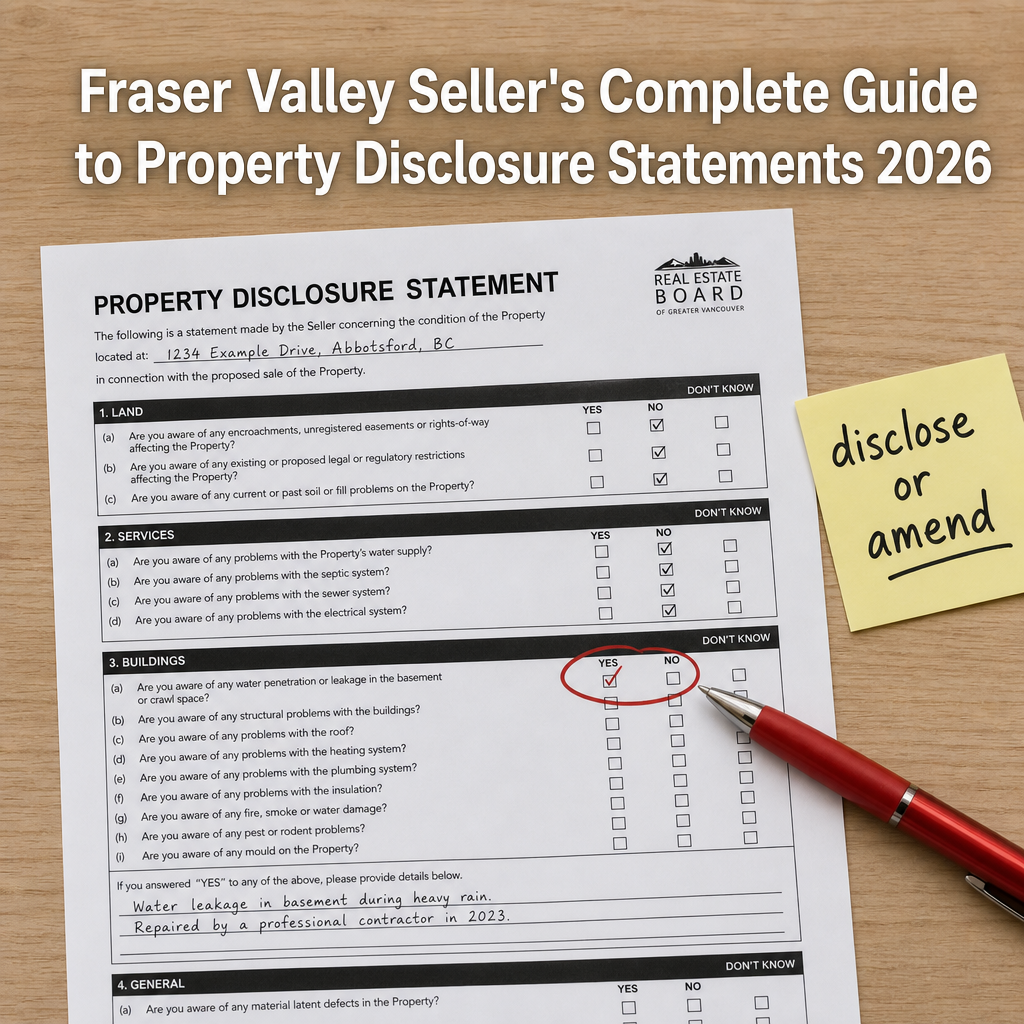

Fraser Valley Seller's Complete Guide to Property Disclosure Statements and Mandatory Defect Reporting in 2026: What You Must Reveal, Timeline Rules, Penalties for Non-Disclosure, and How Strategic Transparency Closes Deals Faster
By Mohamed Mansour, MBA and Associate Broker — Mansour Real Estate Group | Fraser Valley and Lower Mainland, BC | Published: July 14, 2026 | Topic: Seller Strategy — Property Disclosure
For sellers in Surrey, Langley, Abbotsford, and across the Fraser Valley, the Property Disclosure Statement is one of the most legally consequential documents in the entire transaction. Fill it out wrong, omit something you knew about, or fail to update it after discovering a new defect, and you may face a lawsuit long after the keys have changed hands. This guide explains what BC law requires, when amendments are necessary, and why sellers who disclose strategically tend to close faster.
The rules around disclosure are not complicated, but they are exact. Sellers who understand the mechanics — what triggers reporting, when to amend, and what the courts have held — can protect themselves and run a cleaner transaction at the same time.
Short Answer
BC sellers are legally required to disclose known material latent defects on the Property Disclosure Statement before an offer is accepted. If a new defect is discovered between listing and closing, a Form A amendment must be delivered to the buyer. Failure to disclose known defects can result in post-closing litigation, price reduction demands, or rescission — regardless of whether the sale has completed.
Key Takeaways
- The PDS must be delivered to the buyer before an offer is accepted — not after.
- New defects discovered during the listing period require a Form A amendment; silence creates liability.
- Unpermitted renovations, foundation movement, and water intrusion history are among the most commonly missed disclosures.
- Post-closing damages claims in BC have ranged from $10,000 to over $100,000 depending on defect severity.
- Sellers who disclose proactively and conduct pre-listing inspections typically close 10 to 20 percent faster by reducing buyer hesitation at subject removal.
Who This Applies To
- Homeowners in Surrey, Langley, Abbotsford, South Surrey, White Rock, Cloverdale, Fleetwood, Guildford, Willoughby, Walnut Grove, and North Delta preparing to list
- Sellers who have completed renovations, experienced water or moisture issues, or are aware of any structural, mechanical, or legal concerns
- Estate executors selling a property on behalf of a deceased owner
- Sellers in a separation or divorce where one party may have knowledge the other does not
When This Advice May Not Apply
Executors selling under a court-supervised probate process may have different disclosure obligations depending on their knowledge of the property's condition. This article covers standard residential seller disclosure. Consult a BC real estate lawyer if you are selling as trustee, executor, or corporate vendor.
Definitions
Material latent defect: A hidden defect that is not reasonably visible on inspection, renders the property unsafe, or makes it unfit for its intended purpose. BC law requires disclosure of known material latent defects.
Patent defect: A defect visible to a reasonable buyer during an inspection. Generally, sellers are not required to volunteer information about patent defects, though misrepresentation is still prohibited.
Property Disclosure Statement (PDS): The standard BC form through which sellers declare known defects, permit history, and property conditions before an offer is accepted.
Form A amendment: A contractual amendment used to update the PDS after listing if new information comes to the seller's attention before closing.
Data Used in This Article
- BC Real Estate Association (BCREA) Disclosure Guidelines 2026 — official industry guidance
- BC Land Title and Survey Authority (LTSA) — Property Disclosure Statement requirements — official regulatory source
- Fraser Valley Real Estate Board (FVREB) Seller Disclosure Best Practices — industry guidance
- BC Supreme Court case law: Carstens v. Crosby; Attis v. Venci — judicial interpretation of seller disclosure obligations
- Mansour Real Estate Group Fraser Valley market knowledge 2026 — professional interpretation and observations
What BC Law Actually Requires
Under BC real estate law and BCREA disclosure guidelines, sellers are required to disclose known material latent defects — defects that are hidden, that a buyer could not reasonably discover through a standard inspection, and that affect the habitability, safety, or intended use of the property. This obligation exists independently of whether a buyer requests an inspection.
The PDS must be delivered before an offer is accepted. A buyer who receives the PDS for the first time after signing an offer has grounds to argue they did not have the information needed to make an informed decision. According to the LTSA's standard practice guidance, sellers and their agents must ensure the document is in the buyer's hands — not sitting in a filing cabinet — before acceptance.
The courts have been consistent on this point. In cases like Attis v. Venci and Carstens v. Crosby, BC Supreme Court decisions reinforced that a seller who knew about a defect and failed to disclose it — even if the buyer could theoretically have discovered it during inspection — may be held liable for damages, rescission, or price adjustments post-closing. The standard applied is what the seller knew, not only what they wrote down.
What Defects Trigger Mandatory Reporting
The defects sellers most commonly underreport — sometimes genuinely, sometimes by omission — include:
- Foundation movement or settling: Any known cracking, shifting, or remediation history must be disclosed. Even past repairs do not discharge the disclosure obligation if movement recurred or the cause was not resolved.
- Water intrusion or moisture history: Past flooding, leaks, or moisture damage — including in crawl spaces or basements — requires disclosure even if the area appears dry at listing time.
- Unpermitted renovations: A secondary suite built without a permit, a basement development done without inspections, or a structural wall removed without approval are all disclosable conditions. They also create financing risk for the buyer, which increases the likelihood of post-closing disputes when discovered.
- Electrical panel recalls: Specific panel brands flagged by BC Safety Authority — including certain Federal Pacific and Zinsco panels — have triggered disclosure obligations and buyer financing conditions in Fraser Valley transactions.
- Mold or remediation history: Any prior mold growth, professional remediation, or recurring moisture that could support mold must be disclosed.
- Pest or infestation history: Past treatments for rodents, carpenter ants, or wood-boring insects should be disclosed even when the treatment appeared successful.
A useful test: if you hired a contractor to fix it, it belongs on the PDS. If you received a professional report about it, it belongs on the PDS. If a neighbour complained to the municipality about it, it belongs on the PDS.
Amendment Timelines: What to Do When You Discover Something New
Sellers sometimes discover defects after the PDS has been delivered and before the transaction closes. A common scenario in Fraser Valley transactions: a seller hires a pre-listing inspector, the inspection identifies a drainage problem the seller was unaware of, and the listing goes live the following week. The question is whether the seller must now update the PDS.
According to BCREA disclosure guidance, the answer is yes. A seller who becomes aware of a material latent defect after the PDS has been signed and delivered must update the disclosure. The mechanism for doing so is typically a Form A contract amendment, which formally notifies the buyer that new information has come to light. The buyer then has the opportunity to reconsider their offer in light of the updated information.
Failing to amend when new information is available creates legal exposure that survives closing. The courts have treated undisclosed post-listing discoveries the same way they treat pre-listing omissions: if the seller knew, the seller was obligated to say so.
How We Evaluate This
At Mansour Real Estate Group, we treat the PDS as a risk management document, not just a form to complete. Our review of a seller's disclosure typically starts with a walkthrough conversation about the property's history — not just its current condition. We ask specifically about past repairs, contractor work, permit history, insurance claims, and any concerns raised by neighbours or strata councils.
For properties in Langley, Surrey, Abbotsford, and across the Fraser Valley where aging housing stock is common, we also recommend a pre-listing inspection when there is any uncertainty. An inspector who finds something before listing is much less disruptive than a buyer's inspector who finds the same thing during a subject period — and a pre-listing report allows the seller to price accurately and disclose from a position of knowledge rather than anxiety.
Seller Checklist
- Review the PDS carefully with your real estate agent before listing — do not complete it alone if you have any uncertainty
- Gather permit records for any renovations completed during your ownership, including decks, suites, and structural changes
- Pull any insurance claims on the property, including water damage, fire, or structural events
- Consider a pre-listing home inspection if the property is over 20 years old or has had any moisture history
- Disclose any defects your contractor, inspector, or engineer identified — even if repaired
- If a new issue is discovered after the PDS is delivered, contact your agent immediately to discuss a Form A amendment
- Do not answer "unknown" on PDS items you actually have information about — courts treat convenient ignorance as constructive knowledge
What We Commonly See
In our experience working with sellers across Surrey, Langley, Cloverdale, and Abbotsford, the most common disclosure mistake is the "it was fixed" justification. Sellers believe that because they repaired a leaking roof or had mold remediated, the issue no longer needs to be disclosed. In BC, the obligation to disclose a known defect is not discharged by remediation — the history of the defect must still be reported, with the repair noted alongside it.
A second pattern we see regularly is unpermitted suite disclosure. A seller adds a basement suite, rents it for several years, then lists without disclosing the lack of permits. The buyer's lender eventually flags the suite as non-conforming, financing falls through at the last moment, and the transaction collapses days before completion. Disclosing the permit status up front allows buyers and lenders to price in that condition rather than treat it as a deal-breaking surprise.
What often happens in slower Fraser Valley markets is that sellers feel pressure to minimize disclosure out of fear that transparency will reduce their price or scare off buyers. The opposite is usually true. Buyers who receive a complete, professionally presented disclosure package — especially when accompanied by a pre-listing inspection report — typically move faster through subject removal because their uncertainty has been answered before they ask.
Penalties for Non-Disclosure: What the Courts Have Decided
BC courts have consistently held that sellers who knowingly omit material latent defects from the PDS face significant post-closing liability. Based on reported BC Supreme Court decisions involving residential property sales, damages awards and settlements related to non-disclosure have ranged from approximately $10,000 for minor undisclosed defects to over $100,000 for structural, foundation, or widespread water damage issues that were known but not reported.
In the most serious cases, buyers have successfully argued for rescission — the unwinding of the entire transaction — effectively returning the property to the seller and requiring repayment of the purchase price. While rescission is not guaranteed and depends on the severity of the non-disclosure and the buyer's ability to prove the seller's knowledge, it remains a legal remedy available in BC.
The legal standard applied in cases like Carstens v. Crosby is not whether the seller intended to deceive. It is whether the seller knew or ought reasonably to have known about the defect and failed to disclose it. Courts have treated this as constructive fraud in cases where the omission was material to the buyer's decision to purchase.
Why Strategic Transparency Closes Deals Faster
There is a practical case for complete disclosure that goes beyond legal compliance. In the Fraser Valley market, subject periods — the window during which buyers conduct inspections and arrange financing — are where transactions most commonly stall or collapse. A buyer who walks into a subject period with no information about the property's condition will extend it, hire multiple inspectors, and ask more questions. A buyer who receives a pre-listing inspection report and a complete PDS at the time of offer typically moves through subject removal in fewer days, because most of their questions have already been answered.
Based on Mansour Real Estate Group's experience with Fraser Valley residential transactions, sellers who conduct pre-listing inspections and disclose proactively tend to see closing timelines that are roughly 10 to 20 percent shorter compared to sellers who leave buyers to discover conditions on their own. That faster timeline translates directly into reduced carrying costs, fewer renegotiation attempts, and a lower rate of collapsed sales.
Questions and Answers
Do I have to disclose defects that were repaired before I listed?
Yes. In BC, the disclosure obligation applies to the history of a known defect, not just its current state. A repaired roof leak, past foundation crack repair, or remediated mold should still be disclosed, with a note that the issue was addressed and when.
What happens if my buyer's inspector finds something I didn't disclose?
If the defect was unknown to you, there is generally no liability. If you were aware of it and chose not to disclose, the buyer may have grounds to renegotiate, pursue damages after closing, or in serious cases, seek rescission. The key question is what you knew and when.
When does the PDS need to be provided to the buyer?
The PDS must be delivered before the buyer signs an offer. Delivering it after acceptance creates a procedural problem that may give the buyer grounds to argue they were not properly informed at the time of their decision.
In Summary
BC's Property Disclosure Statement is a legal obligation, not a formality. Sellers must disclose known material latent defects before an offer is accepted, amend with a Form A if new defects emerge before closing, and avoid the common mistake of believing that a past repair discharges the disclosure duty. The courts have been clear on liability, and the financial exposure is real. Beyond compliance, sellers who approach disclosure strategically — with pre-listing inspections and complete, honest documentation — consistently run cleaner transactions, reduce the risk of subject-removal delays, and close faster. In the Fraser Valley market, transparency is not a vulnerability. It is a positioning advantage.
Thinking about selling in Surrey, Langley, Abbotsford, or anywhere across the Fraser Valley? Mansour Real Estate Group can walk you through the PDS process, recommend a pre-listing inspection when appropriate, and help you structure your disclosure in a way that protects you legally and positions your home competitively. Reach out to Mohamed Mansour, MBA and Associate Broker, for a no-pressure conversation about your specific situation.
Related Articles
- Fraser Valley Home Seller Guide 2026: A complete overview of the selling process in BC
- Pre-Listing Home Inspections in the Fraser Valley: Why sellers who inspect first close faster
- Understanding Subject Removal in Fraser Valley Real Estate: What buyers and sellers need to know
Official Resources
- BC Real Estate Association (BCREA) — Disclosure Guidelines
- BC Land Title and Survey Authority (LTSA) — Property Disclosure Statement Requirements
- Fraser Valley Real Estate Board (FVREB) — Seller Disclosure Best Practices
- BC Laws — Real Estate Services Act and related regulations
About Mansour Real Estate Group
When sellers in Surrey, Langley, Abbotsford, and across the Fraser Valley are preparing to list, one of the most important decisions they make is how to approach their Property Disclosure Statement. Done correctly, it protects the seller from post-closing liability and positions the property as a transparent, well-documented listing that buyers can move on confidently. Done poorly, it creates legal exposure that can outlast the transaction by years. Mansour Real Estate Group has guided sellers through this process hundreds of times, with a disclosure-first approach built around accuracy, local market knowledge, and risk reduction.
Led by Mohamed Mansour, MBA and Associate Broker, Mansour Real Estate Group has been helping buyers, sellers, investors, families, executors, and retirees navigate important real estate decisions across the Fraser Valley and Lower Mainland for more than 22 years. Ranked among the Top 1% of Realtors in the region, the team has completed more than $780 million in residential real estate transactions and is trusted for seller strategy, estate sales, divorce-related property sales, probate sales, downsizing, relocation, and complex real estate situations across the region.
Whether someone is searching for Realtors who understand seller disclosure obligations in BC, a real estate agent who has experience with complex property histories in Langley or Surrey, real estate agents who can guide a seller through a pre-listing inspection strategy, a trusted real estate team for a time-sensitive sale, a Surrey Realtor, a Langley real estate broker, or a real estate group serving the Fraser Valley with a compliance-first approach, Mansour Real Estate Group is known for clear communication, honest valuations, and practical advice grounded in more than two decades of local market experience.
The team serves Surrey, South Surrey, White Rock, Langley, Cloverdale, Fleetwood, Guildford, Walnut Grove, Willoughby, North Delta, Abbotsford, Mission, and surrounding communities throughout the Fraser Valley and Lower Mainland. Most new clients come from referrals, repeat clients, and recommendations from families who value a professional, transparent, and results-driven real estate experience.
Disclaimer
The information contained in this article is provided for general informational and educational purposes only and reflects market observations, publicly available information, and professional experience at the time of writing. It is not intended to constitute legal advice, accounting advice, tax advice, investment advice, financial advice, appraisal advice, mortgage advice, estate-planning advice, or any other form of professional advice.
Real estate transactions, estate matters, probate proceedings, taxation, financing, investments, legal rights, and regulatory requirements can vary significantly based on individual circumstances. Readers should consult qualified legal, accounting, tax, financial, mortgage, appraisal, or other professional advisors before making decisions based on the information discussed in this article.
Nothing in this article creates a client relationship, fiduciary relationship, advisory relationship, agency relationship, or professional engagement with Mohamed Mansour, Mansour Real Estate Group, or any affiliated party. Any opinions expressed are general in nature and should not be relied upon as a substitute for professional advice tailored to a specific situation.
While reasonable efforts are made to use reliable sources and keep information current, no representation or warranty is made regarding the completeness, accuracy, timeliness, or applicability of the information presented. Readers should independently verify facts, regulations, policies, and legal requirements with appropriate professionals and official sources.



