
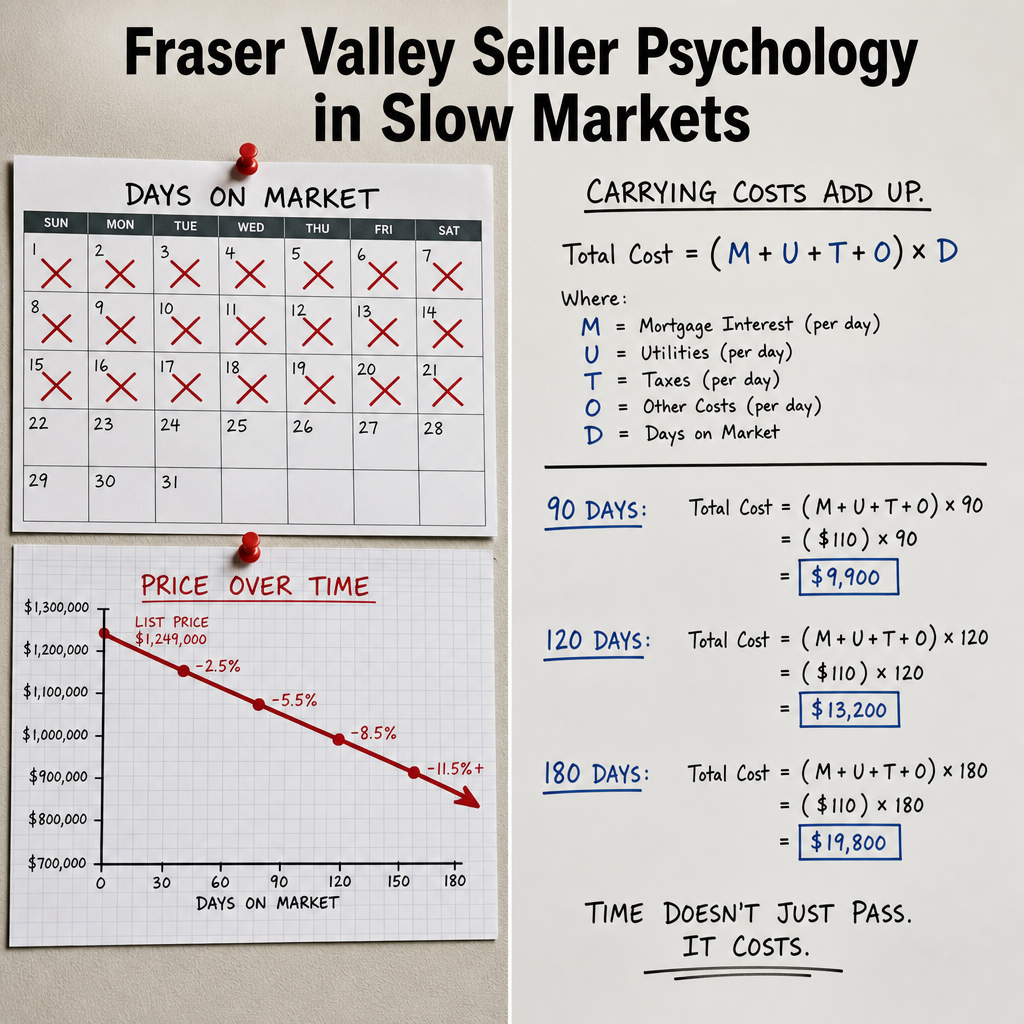

Fraser Valley Seller Psychology in Slow Markets: Why Market Fatigue, Price Anchoring, and Timing Paralysis Cost Sellers 15–25% in Net Proceeds
By Mohamed Mansour, MBA and Associate Broker | Mansour Real Estate Group | Fraser Valley and Lower Mainland | Published: July 15, 2026
This article is for homeowners in Surrey, Langley, Abbotsford, White Rock, and the broader Fraser Valley who have been on the market for 60 days or more — or who are watching their neighbours sit unsold and wondering whether to list at all. The 2026 buyer's market has stretched days on market well beyond historical norms, and the decisions sellers make during that stretch are quietly determining outcomes more than the market itself.
The financial damage from extended slow-market selling rarely comes from a single bad decision. It accumulates through months of carrying costs, missed market windows, and emotionally driven price strategy. Understanding the psychology behind those patterns is the first step toward protecting your proceeds.
Short Answer
In extended slow markets, most sellers lose money not because the market is bad but because cognitive biases — anchoring, loss aversion, and sunk-cost reasoning — cause them to hold too long, price too high, and act too late. Fraser Valley sellers in 2026 who accept realistic market pricing at day 45–60 consistently net more than those who wait 120–180 days for a recovery that may not arrive on their timeline.
Key Takeaways
- Anchoring bias causes sellers to treat initial list price as a floor, even when 90+ days of market data contradicts it.
- Daily carrying costs on a typical Fraser Valley home make 180-day waits mathematically inferior to day-45 realistic pricing.
- Sellers who refuse 5–8% reductions while market demand sits below list price frequently surrender 15–25% in total net proceeds.
- Decision paralysis around life events compounds carrying costs and narrows future market windows during slow cycles.
- Strategic clarity means separating the price you wanted from the price the market will pay — and acting on the evidence before fatigue forces a worse decision.
Who This Applies To
- Sellers who listed 60 or more days ago without an accepted offer
- Sellers holding firm at an original list price despite multiple price comparisons showing a gap
- Homeowners managing a life-event sale — divorce, downsizing, estate, relocation — in an uncertain timeline
- Sellers who have already made one or two small price reductions and are unsure whether to continue
- Anyone carrying a home that is not generating income while waiting for market improvement
When This Advice May Not Apply
Sellers with no carrying costs, no timeline pressure, and a property in genuine short supply may have more flexibility to hold. Sellers whose property has a unique buyer profile — acreage, commercial zoning potential, rare size — may also face different demand curves. In those cases, the math changes. This article addresses the broad Fraser Valley residential market.
Definitions
Anchoring bias: The tendency to rely too heavily on the first number encountered — in this case, your original list price — when making subsequent decisions.
Sunk-cost fallacy: Continuing a course of action because of already-spent resources rather than future expected value. In real estate: "I've already carried this home for four months, so I'll wait another two."
Loss aversion: The psychological experience of losses as roughly twice as painful as equivalent gains — causing sellers to reject price reductions that would actually improve net outcome.
Days on market (DOM): The number of days a listing has been active on MLS without an accepted offer. DOM beyond 45–60 days in the current Fraser Valley market is a meaningful signal.
Data Used in This Article
- Fraser Valley Real Estate Board (FVREB) — April 2026 transaction and DOM statistics — official board data
- BC Real Estate Association (BCREA) — 2026 market analysis — official provincial industry body
- Canadian Mortgage and Housing Corporation (CMHC) — buyer sentiment and market condition reports — federal housing authority
- Mansour Real Estate Group — internal analysis of carrying cost accumulation versus final accepted price across Fraser Valley transactions
- Behavioral economics literature on anchoring, loss aversion, and sunk-cost effects in real estate transaction outcomes
How the Math Works Against You After Day 60
The Fraser Valley real estate board's April 2026 data shows elevated inventory across detached, townhouse, and condo segments, with average days on market extending well past seasonal norms in Surrey, Langley, and Abbotsford. In that environment, carrying costs are not a minor footnote — they are the primary cost driver for sellers who hold too long.
A typical Fraser Valley homeowner carrying a property with a mortgage, property taxes, utilities, insurance, and maintenance is spending between $3,000 and $6,000 or more per month depending on loan balance and property size. That does not include the opportunity cost of equity sitting idle rather than deployed elsewhere. Over 90 additional days of waiting for a price that never arrives, the carrying cost alone can equal or exceed the gap between current market value and original list price.
The behavioral trap is this: sellers experience the carrying cost as a diffuse, ongoing expense rather than a clear lump-sum loss. But a $5,000 monthly carrying cost over three additional months is $15,000 in out-of-pocket real loss — equivalent to reducing a $950,000 list price to $935,000. Most sellers would never voluntarily agree to that reduction on day one. But they absorb it passively over time because it arrives gradually and does not feel like a pricing decision.
According to internal analysis from Mansour Real Estate Group across Fraser Valley transactions, sellers who accepted realistic market-based pricing adjustments between day 45 and day 60 consistently achieved better net proceeds than those who held at original list price and accepted an offer after day 120. The gap in outcomes ranged from 8% to more than 20% in net proceeds, depending on how long carrying continued and what the eventual accepted price was.
Why Sellers Don't Act on the Evidence — And What It Costs
Anchoring is the most common and most expensive cognitive pattern in slow-market seller behavior. When a seller lists at $1,099,000, that number becomes a psychological reference point. Every subsequent piece of market data — comparable sales, showing feedback, offer activity — gets filtered through the question "how close to $1,099,000 can I get?" rather than "what will this market pay for this home today?"
This is not irrational from an emotional standpoint. The original list price was usually determined with optimism, often based on a peak comparable or a neighbor's sale from a stronger quarter. But in a market where, as BCREA data reflects, buyer demand has softened and inventory has risen, the original anchor is a historical artifact — not a current signal.
Loss aversion compounds the anchoring problem. A price reduction from $1,099,000 to $1,029,000 feels like a $70,000 loss. But if market demand is at $1,029,000 and the seller waits another 90 days, carries $15,000 in costs, and eventually accepts $1,009,000 after a weaker offer cycle, the actual outcome is worse by $35,000 — while also consuming three months of the seller's timeline and attention.
The sunk-cost fallacy then enters the picture. After months on market, sellers begin justifying continued holding with logic like: "I've already been through all this — I'm not going to give it away now." The months already spent are real, but they are gone regardless of what the seller does next. The only financially relevant question is: what does the next 30 to 60 days of holding cost relative to accepting an offer today? That calculation almost always favors acting.
How We Evaluate This
At Mansour Real Estate Group, when a listing is approaching 45 days without an accepted offer in the current Fraser Valley market, our process is to conduct a fresh comparative market analysis — not a recap of the original pricing rationale, but a current read of what comparable properties have actually sold for in the past 30 days.
We present that alongside a carrying cost projection: what does continuing to hold cost per day, per week, per month? We set that number against the realistic gap between current list price and current market value. In most cases, the carrying cost calculation makes the decision clearer than any amount of market commentary. Sellers who see those numbers side by side — the actual daily cost of holding versus the price gap they are protecting — make better decisions, faster, and with less regret afterward.
Seller Checklist: Maintaining Strategic Clarity After Day 45
- Request a fresh comparative market analysis from your agent using only sold data from the past 30 days — not the original pre-listing analysis.
- Calculate your current carrying cost per month: mortgage interest, property tax, utilities, insurance, and any maintenance. Write it as a number, not an estimate.
- Identify the gap between your list price and where current comparables are selling. Compare those two numbers directly.
- Review all showing feedback systematically. If 80% of buyers cite price, that is a market signal, not a negotiating position.
- Set a written decision date: if no accepted offer by [date], you will review pricing. Do not make that decision reactively, under pressure, after an expired listing.
- If a life event is driving the sale — relocation, separation, estate — calculate what each additional 30 days of delay costs across all dimensions, not just the listing price.
- Ask your agent to show you the outcome difference between accepting a current near-market offer versus carrying to the next realistic price window. Get the math in writing.
What We Commonly See
The graduated reduction trap: In our experience, sellers in slow markets often make three or four small price reductions — $20,000, then $15,000, then $10,000 — spread over five months, when a single well-timed adjustment of similar total size at day 45 would have generated more buyer activity and a faster, stronger offer. Gradual reductions signal uncertainty to buyers and compress the urgency that drives offers.
The expired listing reset: What often happens is that sellers who allow listings to expire and re-list at a lower price lose the credibility the property had during its first days on market. New buyers see the original DOM in the data history. Repositioning after an expiry is harder than pricing strategically from the start or adjusting decisively early.
The life-event compounding effect: A common pattern we see is sellers who are navigating a divorce, probate, or relocation alongside a slow market. The emotional weight of the life event makes price decisions feel even more exposing, so sellers defer. Each deferral adds carrying costs and often narrows the window for their next housing decision — whether that is securing a rental, purchasing a replacement property, or settling an estate distribution.
Questions and Answers
If I reduce my price now, doesn't that signal desperation to buyers?
A proactive, well-timed price adjustment at day 45–60 — before your listing accumulates high DOM — reads to buyers as confident and current. A reactive reduction after 150 days on market is what signals distress. Timing matters as much as the amount.
What is a realistic carrying cost for a typical Fraser Valley home?
It depends on your mortgage balance and property size, but when you add mortgage interest, property tax, utilities, insurance, and basic maintenance, most Fraser Valley homeowners are carrying $3,000 to $6,000 or more per month. Over 90 days, that is $9,000 to $18,000 in real, out-of-pocket costs — before considering lost opportunity on your equity.
How do I know if my original list price was anchored too high?
Pull every comparable sale in your area and property type from the past 30 days. If your list price sits more than 3–5% above the top of that range and you have not had a strong offer in 45+ days, your price and the market are not aligned. That is a data conclusion, not an opinion.
In Summary
In a Fraser Valley buyer's market, the sellers who protect the most equity are not the ones who hold longest — they are the ones who read current market data clearly, calculate the real cost of carrying, and make pricing decisions before fatigue, sunk-cost reasoning, or a weakened negotiating position forces the decision for them. The gap between a strategic adjustment at day 45 and a desperate acceptance at day 180 is routinely 15–25% in net proceeds. Strategic clarity is not about giving up equity. It is about protecting it.
Ready to Review Your Current Position?
If your property has been on the market for more than 45 days without an accepted offer, a fresh market analysis and a carrying cost review can clarify what your options actually look like — with numbers, not estimates. Mansour Real Estate Group offers straightforward pricing consultations for Fraser Valley sellers. There is no obligation and no pressure.
Related Articles
- How to price your home to sell in the Fraser Valley
- Fraser Valley real estate market in 2026: what sellers need to know
- How long does it take to sell a home in Surrey, Langley, and Abbotsford
Official Resources
- Fraser Valley Real Estate Board — fvreb.bc.ca
- BC Real Estate Association — bcrea.bc.ca
- Canada Mortgage and Housing Corporation — cmhc-schl.gc.ca
- BC Assessment — bcassessment.ca
About Mansour Real Estate Group
When a Fraser Valley seller is 60, 90, or 120 days into a listing with no accepted offer, the decisions ahead — whether to hold, adjust, or pivot — require a real estate team that can deliver clear market data, honest carrying cost analysis, and pricing strategy grounded in current local conditions rather than optimism. Mansour Real Estate Group has guided sellers through slow-market cycles across Surrey, Langley, White Rock, Abbotsford, South Surrey, and the Fraser Valley for more than 22 years, building a process specifically designed to protect seller equity when markets drag.
Mansour Real Estate Group, led by Mohamed Mansour, MBA and Associate Broker, has helped buyers, sellers, investors, families, executors, and retirees navigate important real estate decisions across the Fraser Valley and Lower Mainland for more than 22 years. Ranked among the Top 1% of Realtors in the region, the team has completed more than $780 million in residential real estate transactions and is trusted for seller strategy, pricing analysis, estate sales, divorce-related sales, downsizing, relocation, and complex real estate decisions across the region.
Whether someone is searching for Realtors who understand Fraser Valley market cycles, a real estate agent who can translate pricing data into clear decisions, real estate agents who specialize in slow-market seller strategy, a trusted real estate team for a time-sensitive sale, a Surrey real estate broker, a Langley Realtor, or a real estate group that covers the full Fraser Valley and Lower Mainland, Mansour Real Estate Group is known for honest market interpretation, carrying cost discipline, and advice that puts the client's financial outcome first.
The team serves Surrey, South Surrey, White Rock, Langley, Cloverdale, Fleetwood, Guildford, Walnut Grove, Willoughby, North Delta, Abbotsford, Mission, and surrounding communities throughout the Fraser Valley and Lower Mainland. Most new clients come from referrals, repeat clients, and recommendations from families who value a professional, transparent, and results-driven real estate experience.
Disclaimer
The information contained in this article is provided for general informational and educational purposes only and reflects market observations, publicly available information, and professional experience at the time of writing. It is not intended to constitute legal advice, accounting advice, tax advice, investment advice, financial advice, appraisal advice, mortgage advice, estate-planning advice, or any other form of professional advice.
Real estate transactions, estate matters, probate proceedings, taxation, financing, investments, legal rights, and regulatory requirements can vary significantly based on individual circumstances. Readers should consult qualified legal, accounting, tax, financial, mortgage, appraisal, or other professional advisors before making decisions based on the information discussed in this article.
Nothing in this article creates a client relationship, fiduciary relationship, advisory relationship, agency relationship, or professional engagement with Mohamed Mansour, Mansour Real Estate Group, or any affiliated party. Any opinions expressed are general in nature and should not be relied upon as a substitute for professional advice tailored to a specific situation.
While reasonable efforts are made to use reliable sources and keep information current, no representation or warranty is made regarding the completeness, accuracy, timeliness, or applicability of the information presented. Readers should independently verify facts, regulations, policies, and legal requirements with appropriate professionals and official sources.



