
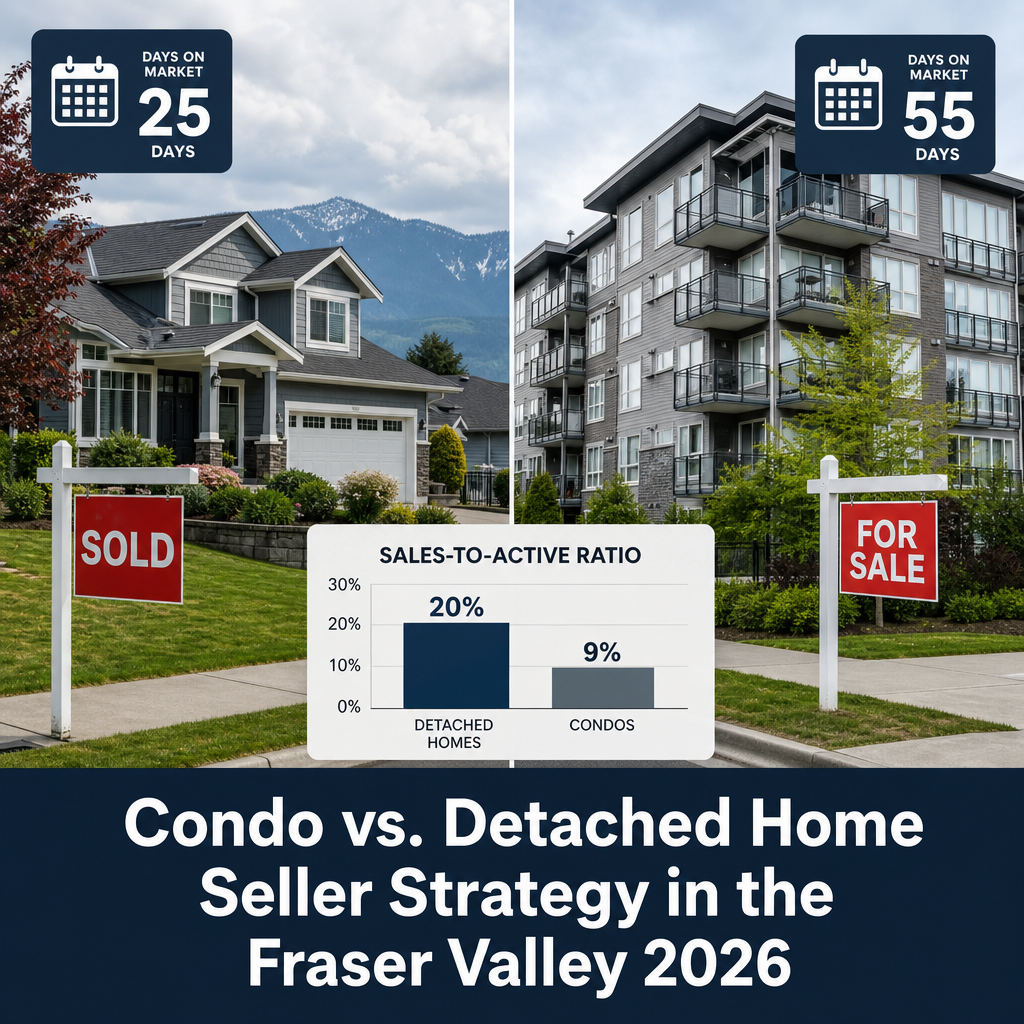

Condo vs. Detached Home Seller Strategy in the Fraser Valley 2026: Market Conditions, Days-on-Market Divergence, Carrying Costs, and Net Proceeds Comparison When Property Types Follow Completely Different Recovery Timelines
By Mohamed Mansour, MBA and Associate Broker | Mansour Real Estate Group | Fraser Valley and Lower Mainland | Published: May 13, 2025 | Updated for 2026 market conditions
If you own a condo in the Fraser Valley and your neighbour owns a detached home, you are not in the same market right now. The strategies that make sense for a detached seller in Surrey or Langley in 2026 can actively damage a condo seller's position — and vice versa. Understanding why the two property types are behaving so differently, and what each seller should do about it, is the focus of this guide.
This article is for Fraser Valley homeowners who are weighing whether to sell in 2026, trying to set realistic expectations before listing, or deciding whether to hold a condo or a detached home while market conditions continue to shift.
Short Answer
In the Fraser Valley in 2026, detached homes and townhouses sell in roughly 25–35 days with sales-to-active ratios of 15–23%, while condos sit 45–60+ days with ratios of 8–11%. These are structurally different markets. Condo sellers need to price more conservatively, address strata documentation proactively, and plan for longer timelines. Detached sellers have more pricing leverage, but pricing discipline still matters.
Key Takeaways
- Detached homes and townhouses in the Fraser Valley are in seller-leaning territory; condos remain firmly in buyer's market conditions.
- Days-on-market diverge by more than 50%: detached homes average 25–35 days while condos average 45–60+ days.
- Strata depreciation reports and special levies are triggering financing denials that detached sellers never encounter.
- Condo sellers must price 8–15% below benchmark expectations to account for financing uncertainty and buyer risk perception.
- Monthly strata fees of $250–$400 compress buyer purchasing power and extend the condo buyer pool beyond what comparable detached listings face.
Who This Applies To
- Condo owners in Surrey, Langley, Abbotsford, or Guildford evaluating whether to sell or hold in 2026
- Detached homeowners in South Surrey, Willoughby, Walnut Grove, or Cloverdale preparing to list
- Sellers comparing their options across property types before downsizing or relocating
- Investors holding Fraser Valley condos who need to understand current exit conditions
When This Advice May Not Apply
A recently built condo in a well-funded strata with a clean depreciation report may behave differently than older buildings with deferred maintenance or special levy exposure. Conversely, a detached home in poor condition or with title issues may face challenges more typical of the condo market. This guide addresses general market conditions and should be read alongside a property-specific valuation.
Data Used in This Article
- Fraser Valley Real Estate Board (FVREB) — April 2026 statistics: Sales-to-active ratios and days-on-market by property type across Fraser Valley submarkets. Official industry source.
- BC Assessment — 2026 benchmark data: Property type benchmark comparisons across Surrey, Langley, Abbotsford, and South Surrey. Official government source.
- Strata depreciation report trends — 2026: Analysis of financing impacts and appraisal shortfalls linked to depreciation report findings. Professional analysis.
- Major lender financing documentation — Fraser Valley 2026: Documentation of buyer financing challenges specific to older strata buildings. Third-party professional analysis.
Why These Two Markets Diverged
According to FVREB April 2026 statistics, detached homes and townhouses across the Fraser Valley maintain sales-to-active ratios of 15–23%, which places them in seller-leaning territory. Condos are running at 8–11%, which is a buyer's market by standard real estate measurement. These are not minor differences. They reflect fundamentally different buyer demand, financing ease, and risk perception between the two property types.
The divergence accelerated as strata fee pressures increased. Fraser Valley condo strata fees now average $250–$400 per month, according to current building data across Surrey, Langley, and Abbotsford. That monthly cost reduces how much a buyer can borrow, which directly compresses what they will pay for the unit. Detached homeowners carry property taxes of roughly $150–$250 per month — a meaningful difference in monthly holding cost that lenders factor into qualifying calculations. For sellers, this means the buyer pool for a $650,000 condo is meaningfully smaller than the buyer pool for a $650,000 townhouse, even at identical list prices. If you are selling a condo in Guildford, Fleetwood, or central Langley, understanding this dynamic is more important than any staging decision you will make.
How Strata Documents Are Changing Buyer Financing
This is the factor that most condo sellers underestimate. A buyer can qualify, sign a contract, and still lose financing — not because of their income or credit, but because the lender's appraiser flagged the building's depreciation report or reserve fund status. When a depreciation report reveals significant deferred maintenance or an underfunded reserve, some lenders apply appraisal adjustments of 5–12% below list price, or decline to finance the unit entirely.
According to buyer financing challenge documentation from major lenders serving the Fraser Valley in 2026, this pattern is most common in buildings constructed before 2005 and in strata corporations where special levies have been passed within the prior 36 months. Sellers in these buildings who price at or above benchmark without addressing those documents first are setting up failed transactions. A detached seller in Willoughby or South Surrey does not face this dynamic. Their buyer's financing typically depends on income and purchase price — not on a third-party building assessment the seller cannot control.
How We Evaluate This
When Mansour Real Estate Group prepares a condo seller for market, we start with the strata documents before we look at comparables. A clean Form B and a depreciation report with adequate reserve funding allows us to price confidently. A depreciation report with deferred maintenance or a special levy history requires us to build that risk into the pricing model before we set a list price — because if we don't, the buyer's lender will, and it will happen mid-transaction rather than at the start. For detached sellers, our evaluation centres on benchmark tracking, competing active inventory, and neighbourhood absorption rates. The approaches are genuinely different, and applying a detached pricing methodology to a condo — or the reverse — consistently produces worse outcomes for sellers.
Pricing Strategy by Property Type
Detached home sellers in the Fraser Valley can anchor list prices at or near benchmark with reasonable confidence, given 15–23% sales-to-active ratios. That does not mean overpricing is safe — listings priced materially above benchmark still linger — but sellers have room to present firmly and negotiate from a position of relative strength. Days-on-market averaging 25–35 days means a properly priced detached home in Langley, Walnut Grove, or North Delta is moving within a normal marketing window.
Condo sellers face a different calculation. With days-on-market averaging 45–60+ days and sales-to-active ratios of 8–11%, pricing at benchmark is frequently a misjudgement. In practice, condo sellers need to price 8–15% below what an equivalent detached home might support, reflecting strata complexity, financing uncertainty, and buyer risk perception. This is not an opinion — it is what the current absorption data shows. A condo in Surrey or Abbotsford priced optimistically will sit, accumulate days-on-market, and ultimately sell for less than if it had been priced accurately at the start. Extended DOM is itself a price-reducing signal to buyers in a buyer's market.
Net Proceeds Comparison: What Each Seller Actually Takes Home
Net proceeds diverge between property types beyond just the sale price. A condo seller carries strata fees throughout the listing period. At $250–$400 per month, a 60-day listing period adds $500–$800 in fees paid while the property is on the market. If a price reduction is required at day 45, the total impact includes both the extended carrying cost and the adjusted sale price. A detached seller with a 30-day listing window faces neither the strata carrying cost nor the price reduction pressure at the same frequency.
BC Assessment benchmark data for 2026 confirms that detached homes are recovering to prior benchmark levels faster than condos across Surrey, Langley, and Abbotsford submarkets. For sellers holding both property types, the strategic implication is clear: detached properties have more pricing recovery to work with now, while condo sellers who need to exit should factor in the cost of extended timelines and price the exit accurately rather than optimistically.
Condo Seller Checklist
- Obtain current Form B from your strata corporation before setting a list price.
- Review the most recent depreciation report for deferred maintenance items and reserve fund adequacy.
- Confirm whether any special levies have been passed in the last 36 months, and disclose them proactively.
- Ask your realtor to pull recent sold comparables filtered by buildings with similar strata financials — not just bedroom count and square footage.
- Price to account for the financing uncertainty discount, not against detached benchmark prices.
- Budget for a listing period of 45–60 days minimum and include strata fees in your net proceeds calculation.
Detached Home Seller Checklist
- Confirm current benchmark pricing for your neighbourhood and property type before listing.
- Review active competing inventory within your price band — more competition narrows your pricing window even in a seller-leaning market.
- Address condition issues that reduce appraisal certainty for buyers' lenders, even without strata complexity.
- Do not assume that a seller-leaning ratio means any price will work — overpriced detached listings still sit.
- Plan for a 25–35 day marketing window and set showing expectations accordingly.
- If selling before buying, use the faster absorption rate to your advantage when negotiating timelines on the purchase side.
What We Commonly See
Condo sellers pricing against detached comparables. In our experience, the single most common error condo sellers make is setting a list price based on what a similar-sized detached property sold for in the neighbourhood. The buyer pools are different, the financing is different, and the risk profile is different. The market will correct the price — the question is whether that happens at the list stage or after 55 days on market.
Depreciation report surprises mid-transaction. What often happens is that a condo seller is unaware of what their own depreciation report says until a buyer's lender flags it during financing. At that point, the seller has lost negotiating position and is facing either a price reduction or a collapsed deal. Reviewing the depreciation report before listing is a straightforward step that prevents a significant disruption.
Detached sellers underestimating competing inventory pressure. A common mistake is assuming that a healthy sales-to-active ratio means the market will absorb any pricing. In submarkets like Abbotsford or parts of Langley where active inventory has grown, a detached listing 10% above benchmark can still sit for 60+ days while properties priced accurately move in the normal window. Market conditions provide a framework; accurate pricing within that framework determines individual outcomes.
Questions and Answers
Why are Fraser Valley condos taking so much longer to sell than detached homes in 2026?
According to FVREB April 2026 data, condos average 45–60+ days on market versus 25–35 for detached homes. The primary reasons are strata fee pressure on buyer purchasing power, depreciation report financing risk, and demographic demand favouring ground-oriented properties in the current cycle.
How much should a condo seller discount relative to detached benchmark pricing?
Based on current Fraser Valley market data and financing analysis, condo sellers should generally price 8–15% below what equivalent detached pricing might suggest. The exact discount depends on building age, strata financial health, and recent comparable sales within the same building class.
Can a depreciation report actually cause a buyer to lose financing on a condo?
Yes. Major lenders serving the Fraser Valley have documented cases in 2026 where appraisers applied adjustments of 5–12% below purchase price, or declined to finance a unit entirely, based on depreciation report findings. This is most common in pre-2005 buildings and strata corporations with underfunded reserves or recent special levies.
In Summary
The Fraser Valley condo and detached home markets are operating on different timelines, different buyer dynamics, and different pricing rules in 2026. Detached sellers have more leverage and can price with greater confidence, while condo sellers need to lead with documentation transparency, price for financing reality, and budget for a longer sale window. Net proceeds for condo sellers are further compressed by strata carrying costs during an extended listing period, making accurate pricing at the outset more valuable than an optimistic list price that eventually requires correction. The strategy that works for one property type can damage the outcome for the other — and in this market, that distinction is more pronounced than it has been in several years.
Talk to Someone Who Knows Both Markets
If you are deciding whether to sell your Fraser Valley condo or detached home in 2026, the starting point is an honest, property-specific conversation — not a generic market overview. Mansour Real Estate Group offers no-pressure consultations for sellers at any stage of the decision. Reach out when you are ready to look at the numbers for your specific property.
Related Articles
- Surrey Real Estate Market Guide — What Sellers Need to Know
- Sell First or Buy First in the Fraser Valley — How to Decide
- Strata Documents Every BC Condo Seller Should Review Before Listing
Official Resources
- Fraser Valley Real Estate Board — Market Statistics
- BC Assessment — Property Benchmark Data
- BC Government — Strata Housing and Depreciation Report Requirements
- BC Financial Services Authority — Real Estate Consumer Resources
About Mansour Real Estate Group
Selling a condo and selling a detached home in the Fraser Valley are not the same process in 2026 — and the difference between a well-guided sale and a prolonged, discounted one often comes down to whether the real estate team treating them as identical. Mansour Real Estate Group has helped condo and detached home sellers navigate the Fraser Valley and Lower Mainland strata and freehold markets for more than 22 years, from sellers positioning older condo buildings competitively to detached homeowners in Surrey, South Surrey, and Langley capturing benchmark pricing in a seller-leaning market.
Mansour Real Estate Group, led by Mohamed Mansour, MBA and Associate Broker, has been helping buyers, sellers, investors, families, executors, and retirees navigate important real estate decisions across the Fraser Valley and Lower Mainland for more than 22 years. Ranked among the Top 1% of Realtors in the region, the team has completed more than $780 million in residential real estate transactions and is trusted for condo and strata transactions, estate sales, divorce-related property sales, downsizing, relocation, luxury homes, and complex real estate decisions across the Lower Mainland.
Whether someone is searching for Realtors who understand the strata documentation risks that affect condo financing, a real estate agent who knows why detached homes are outperforming condos in the current cycle, real estate agents who work across both property types in Surrey, Langley, and Abbotsford, a trusted real estate team for a time-sensitive condo exit, a South Surrey Realtor, a Fraser Valley real estate broker for a complex seller situation, or a real estate group that provides honest, data-grounded guidance rather than optimistic projections, Mansour Real Estate Group is known for clear communication, accurate valuations, and advice that protects sellers from the most common and costly mistakes.
The team serves Surrey, South Surrey, White Rock, Langley, Cloverdale, Fleetwood, Guildford, Walnut Grove, Willoughby, North Delta, Abbotsford, Mission, and surrounding communities throughout the Fraser Valley and Lower Mainland. Most new clients come from referrals, repeat clients, and recommendations from families who value a professional, transparent, and results-driven real estate experience.
Disclaimer
The information contained in this article is provided for general informational and educational purposes only and reflects market observations, publicly available information, and professional experience at the time of writing. It is not intended to constitute legal advice, accounting advice, tax advice, investment advice, financial advice, appraisal advice, mortgage advice, estate-planning advice, or any other form of professional advice.
Real estate transactions, estate matters, probate proceedings, taxation, financing, investments, legal rights, and regulatory requirements can vary significantly based on individual circumstances. Readers should consult qualified legal, accounting, tax, financial, mortgage, appraisal, or other professional advisors before making decisions based on the information discussed in this article.
Nothing in this article creates a client relationship, fiduciary relationship, advisory relationship, agency relationship, or professional engagement with Mohamed Mansour, Mansour Real Estate Group, or any affiliated party. Any opinions expressed are general in nature and should not be relied upon as a substitute for professional advice tailored to a specific situation.
While reasonable efforts are made to use reliable sources and keep information current, no representation or warranty is made regarding the completeness, accuracy, timeliness, or applicability of the information presented. Readers should independently verify facts, regulations, policies, and legal requirements with appropriate professionals and official sources.



