

Bank Appraisal Shortfalls and Renegotiation Strategy: How to Protect Your Sale When the Lender's Appraisal Comes in Below Offer Price in the Fraser Valley 2026
By Mohamed Mansour, MBA and Associate Broker | Mansour Real Estate Group | Published: July 15, 2026 | Fraser Valley and Lower Mainland, BC
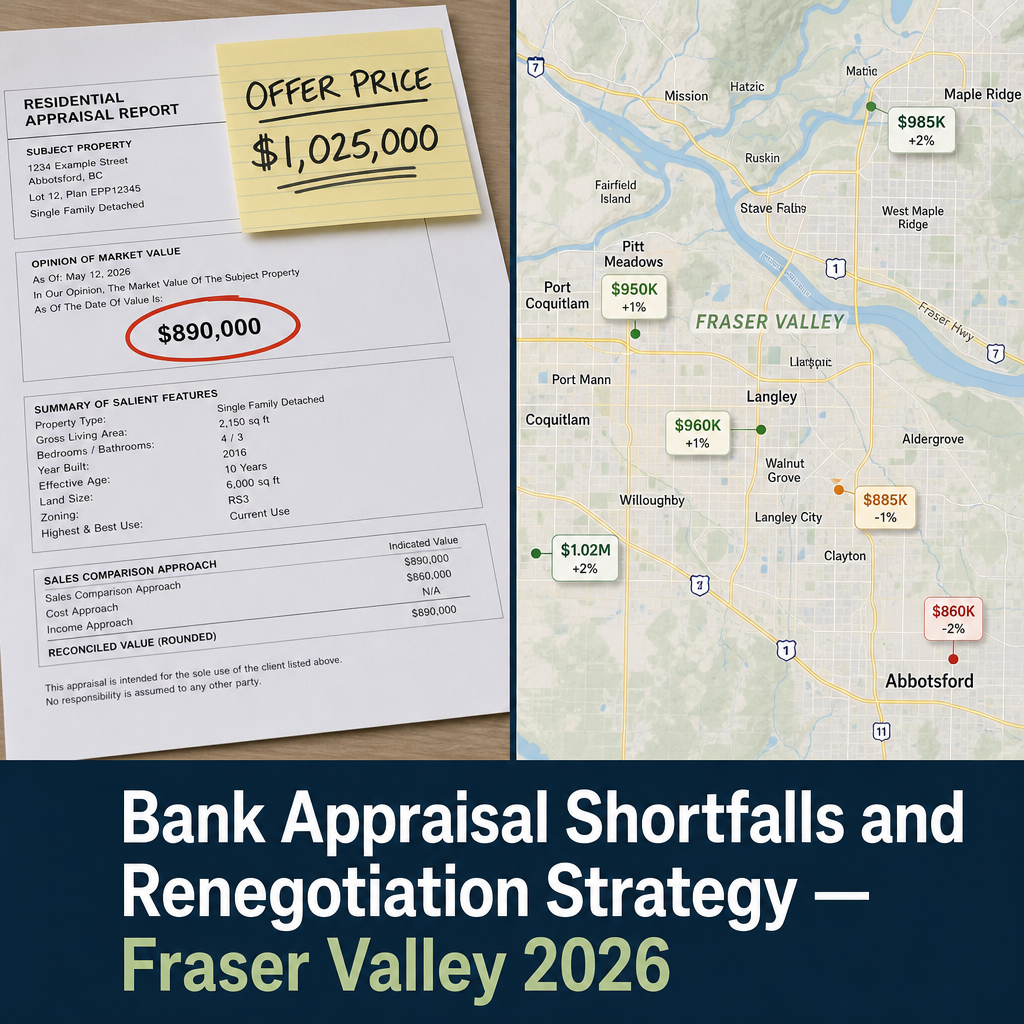
A buyer submits a strong offer. You accept. The financing condition is in. Then the lender's appraisal comes back 3% below the purchase price, and suddenly a deal you considered done is in jeopardy. This scenario is playing out regularly across the Fraser Valley in 2026, and most sellers are not prepared for it.
This article explains why appraisal shortfalls happen, what options each party faces when they do, and what renegotiation strategies actually protect your net proceeds without collapsing the deal.
Short Answer
When a bank appraisal comes in below the accepted offer price in the Fraser Valley, the buyer's lender will only finance against the appraised value, not the contract price. The seller must then choose between reducing the price, holding firm and risking deal collapse, or helping the buyer build a comparables case to challenge the appraisal. Acting within 48 hours of appraisal delivery gives sellers the best chance of preserving the deal on acceptable terms.
Key Takeaways
- Lenders appraise against the last 60–90 days of closed comparable sales, which can lag current market sentiment significantly.
- Strata properties face a meaningfully higher appraisal-challenge rate when depreciation reports signal special levy exposure or reserve fund shortfalls.
- Sellers lose most of their leverage once the appraisal is delivered; renegotiation timing within 48 hours is critical.
- Pricing within 2–3% of conservative comparable sales at listing reduces appraisal-shortfall probability by 60–70% compared to aspirational pricing.
- Appraisal shortfalls cost sellers 1–3% in final proceeds on average and add 7–14 days to market time when renegotiations stall.
Who This Applies To
- Sellers in Surrey, Langley, Abbotsford, North Delta, White Rock, and South Surrey whose accepted offer includes a financing condition
- Strata and condo sellers whose building has a recent depreciation report or known special levy
- Sellers in soft submarkets where recent comparable sales are sparse or declining
- Sellers who priced above the conservative comparable sales range to test the market
- Estate and divorce-related sellers where a price reduction requires multi-party agreement
When This Advice May Not Apply
If your accepted offer does not include a financing condition, the buyer is proceeding without lender approval and an appraisal shortfall does not give them contractual grounds to renegotiate. Consult your Realtor and lawyer before taking any position if the subject removal timeline has already passed or if conditions are written differently than standard FVREB contract language.
Why Appraisals Come In Below Offer Price in the Fraser Valley
Bank appraisers do not value properties based on what a motivated buyer is willing to pay today. They value properties based on what comparable homes have actually sold for over the prior 60–90 days, according to CMHC's home valuation methodology and standard Canadian lending appraisal practice. In a market where sentiment is softening or buyer activity is uneven — as has been the case in parts of the Fraser Valley through early 2026, per FVREB April 2026 sales data — the most recent closed sales may reflect prices lower than the current offer level.
This creates a structural lag. Buyers may be willing to pay a premium for a well-positioned home today, but if comparable sales from 60–90 days prior do not support that price, the lender will not lend against it. The buyer is then responsible for covering the gap between the appraised value and the purchase price out of pocket — something many buyers in 2026's interest-rate environment cannot comfortably do.
For condo and strata sellers, the risk is compounded. Lenders reviewing a depreciation report that shows an underfunded contingency reserve or a pending special levy may apply an additional discount to their appraised value, or decline to lend against the property at standard rates entirely. According to the Strata Property Act and related BC lending guidance, strata financial health is a material factor in lender risk assessment. Strata properties face a 15–25% higher appraisal-challenge rate than detached homes when those financial signals are present.
What Happens After a Shortfall: The Buyer's Three Options
When a lender's appraisal comes in below the contract price, the buyer faces three paths. Each one has a different implication for the seller.
Option one: the buyer renegotiates the purchase price down to the appraised value or to a number that keeps their loan-to-value ratio within lender thresholds. This is the most common outcome in a buyer's market, and it puts direct pressure on the seller's net proceeds. For a $950,000 accepted offer that appraises at $920,000, the gap is $30,000 — a meaningful number on either side of the table.
Option two: the buyer increases their down payment to cover the shortfall, keeping the purchase price intact. This requires the buyer to have additional liquid capital available and a lender willing to accept the revised down payment structure under the Bank of Canada's mortgage stress test requirements. In practice, few buyers in 2026 have this flexibility, particularly first-time buyers or those already stretched at their qualification ceiling.
Option three: the buyer walks away under the financing condition. If the lender will not approve the loan at the contract price and the buyer cannot cover the gap, the financing condition gives them clean grounds to remove the deal. The seller relists, loses time, and typically faces renewed pricing pressure from a market that may interpret a relisting as a signal.
Understanding which path the buyer is likely to take depends on their motivation, their financial position, and how aggressively the deal was structured. Your Realtor should be reading those signals before the appraisal is even completed. For sellers navigating divorce or estate sales where a price reduction requires agreement from multiple parties, having a response framework ready in advance is especially important.
How We Evaluate This
At Mansour Real Estate Group, we review the comparable sales pool before listing, not after an appraisal surprise. That means identifying the 60–90 day closed sales window a lender is likely to use, stress-testing the list price against that pool, and flagging properties where the gap between aspirational pricing and conservative appraisal value creates material deal risk.
When an appraisal shortfall does occur on an accepted offer, our approach prioritizes three things: how quickly we respond, whether the comparables pool can be challenged with newer or better-condition sales, and an honest assessment of whether the buyer is motivated enough to stay in the deal on renegotiated terms or is looking for an exit.
Renegotiation Strategy: What Actually Works
The 48-hour window after appraisal delivery is the most important period in the renegotiation. Buyers who have just received bad news from their lender are uncertain. Sellers who respond quickly, calmly, and with evidence have a materially better outcome than those who go silent or respond emotionally.
Challenge the comparables if the basis exists. Appraisers are required to use the best available comparable sales, but they work within constraints. If there are more recent sales — within the last 30 days — that support a higher value, or if the comps used were inferior in condition, size, or location to your property, a well-documented comparables package submitted through your Realtor can prompt an appraisal revision. This is not a guarantee. It works when the case is factual and specific, not when it is emotional or vague.
Meet in the middle rather than conceding entirely. A $30,000 shortfall does not automatically require a $30,000 price reduction. If the buyer is motivated and has some capacity to contribute toward the gap, a split — for example, seller reduces by $15,000 and buyer increases their down payment by $15,000 — can preserve the deal without the seller absorbing the full appraisal impact. This only works when the buyer's lender approves the revised structure.
Assess buyer motivation honestly before conceding anything. A buyer who has already spent money on inspection, arranged movers, or has a firm possession date on their next home is significantly more motivated to stay in a renegotiation than a buyer who made a casual offer on a first showing. Your Realtor's read on buyer motivation is a legitimate input into how much flexibility to show and how quickly.
For sellers who priced conservatively from the start, the renegotiation position is stronger — there is a clearer argument that the appraiser's comp pool is outdated relative to current demand. For sellers who tested the market at an aspirational price, the appraisal shortfall is often a signal the market was already communicating.
How to Reduce Appraisal Risk Before Listing
The most effective appraisal strategy is prevention. Pricing within 2–3% of the conservative comparable sales range at listing reduces shortfall probability by 60–70% compared to aspirational pricing, based on the structural relationship between list price, offer price, and appraised value in current Fraser Valley conditions.
Beyond pricing, preparation matters. Providing an appraiser with a documented list of home improvements — HVAC upgrades, roof replacement, kitchen renovation — with dates and receipts gives the appraiser factual support for a higher comparable-adjusted value. Addressing visible defects before listing removes conditions that appraisers note as value detractors. A pre-listing inspection that documents the property's condition creates a paper trail that can support your position if an appraisal is challenged. Together, these steps can reduce appraisal shortfall likelihood by 20–30% according to standard appraisal practice guidance.
For strata sellers specifically, having a current depreciation report that shows an adequately funded contingency reserve, or being able to demonstrate that a pending special levy is already priced into the list price, can meaningfully reduce the lender's risk concern and stabilize the appraised value. Learn more about strata document preparation for sellers before listing your condo or townhouse.
Seller Checklist: Appraisal Risk and Renegotiation Readiness
- Before listing, ask your Realtor to run the comparable sales pool a lender is likely to use — the last 60–90 days of closed sales in your immediate area and property type.
- Price within 2–3% of that conservative comparable range unless market activity gives you clear evidence of upward pressure.
- Prepare a home improvement summary with dates, receipts, and scope for all material upgrades completed in the last 5–10 years.
- For strata properties, review the depreciation report and reserve fund status before listing and address any obvious lender red flags in advance.
- When an appraisal shortfall arrives, respond within 48 hours with a clear position — do not go silent while the financing condition clock runs.
- If challenging the appraisal, prepare a specific, factual comparables package — not an emotional argument — and submit it through your Realtor to the buyer's agent.
- Assess buyer motivation before deciding how much flexibility to offer in renegotiation.
- For multi-party sales (estate, divorce), align all decision-makers on a renegotiation floor before accepting the offer, not after the appraisal arrives.
What We Commonly See
In our experience, sellers are most caught off guard when the appraisal shortfall arrives late in the financing condition window, leaving very little time to build a comparables challenge or negotiate a structured response. The deal either collapses or the seller makes a panicked concession that is larger than necessary.
What often happens with strata properties is that the seller is unaware the depreciation report is raising a lender flag until the appraisal comes back. By that point, the building's financials are a fixed condition the seller cannot change. Sellers who review the depreciation report before listing — not after — have time to either price it in or present a factual case for why the lender's concern is overstated.
A common mistake is assuming the appraisal is final and non-negotiable. Appraisers can and do revise their reports when presented with factual information they did not have — a more recent comparable sale, a documented upgrade that was not visible during the inspection, or a correction to a factual error in the report. The revision process is formal and not guaranteed, but it is a legitimate option that sellers and their Realtors should pursue when the evidentiary basis exists.
Data Used in This Article
- Fraser Valley Real Estate Board (FVREB) — April 2026 market statistics report, Fraser Valley submarket pricing trends (official, regional)
- CMHC — Home valuation methodology and comparable sales weighting guidance (official, federal)
- Bank of Canada — Mortgage stress test and lender LTV requirements 2026 (official, federal)
- Strata Property Act (BC) and related lender guidance on strata financial risk assessment (official, provincial)
Frequently Asked Questions
Can a seller refuse to renegotiate after an appraisal shortfall?
Yes. If the contract includes a financing condition, the seller cannot force the buyer to proceed if the lender will not approve the loan. Refusing to renegotiate is a legitimate choice, but it typically results in deal collapse and a relisting. Whether that is the right decision depends on the property, the market, and how strong the next likely offer is.
How often do appraisals come in low in the Fraser Valley right now?
In softer submarkets — particularly entry-level detached, older strata buildings, and properties priced above the conservative comparable sales range — appraisal shortfalls are a common friction point in 2026. The FVREB's April 2026 data reflects a buyer's market in most Fraser Valley segments, meaning comparable sales are typically flat or declining, which tightens the appraiser's support for higher contract prices.
What is the buyer's lender actually looking at when they appraise?
The lender's appraiser evaluates the property against closed comparable sales — typically within the last 60–90 days, in the same neighbourhood or submarket, for similar property type, size, age, and condition. They are not evaluating what a buyer is willing to pay. They are establishing a defensible market value that protects the lender's loan-to-value position. Strata financial documents and visible property condition are also factored in.
In Summary
Appraisal shortfalls in the Fraser Valley in 2026 are a predictable risk, not a surprise — and the sellers best positioned to handle them are the ones who priced with the lender's comparables pool in mind from the beginning. When a shortfall does arrive, the 48-hour window after delivery is the most important moment: sellers who respond quickly, with evidence and a clear renegotiation position, consistently achieve better outcomes than those who stall or concede immediately. For strata properties, the depreciation report is a pre-listing issue, not a post-appraisal one. And for any seller facing a complex renegotiation — including estate or divorce sales — having aligned decision-makers and a prepared strategy before the financing condition clock runs is what separates a closed deal from a failed one.
Talk to Mansour Real Estate Group Before You List
If you are preparing to sell in the Fraser Valley and want to understand your appraisal risk before going to market, Mansour Real Estate Group can walk you through the comparable sales pool, your property's likely appraisal exposure, and a pricing strategy that protects your net proceeds. There is no obligation — just a direct, honest conversation with an experienced local team.
Related Articles
- How to Price Your Home to Sell in the Fraser Valley
- Selling a Condo in the Fraser Valley: What Strata Sellers Need to Know
- Strata Documents and Condo Selling Checklist for the Fraser Valley
Official Resources
- Fraser Valley Real Estate Board — fvreb.bc.ca
- CMHC Home Valuation Methodology — cmhc-schl.gc.ca
- Bank of Canada — Mortgage Stress Test and LTV Requirements — bankofcanada.ca
- Strata Property Act (BC) — bclaws.gov.bc.ca
About Mansour Real Estate Group
When homeowners in Surrey, Langley, Abbotsford, White Rock, and across the Fraser Valley are preparing to sell, the decisions made before the listing goes live — pricing strategy, appraisal risk assessment, preparation, and positioning — typically determine the outcome more than anything that happens after. Mansour Real Estate Group has built its reputation in the Fraser Valley and Lower Mainland on pricing discipline, honest valuations, and a willingness to have difficult conversations before a listing goes live rather than after an appraisal shortfall forces the issue.
Mansour Real Estate Group, led by Mohamed Mansour, MBA and Associate Broker, has been helping buyers, sellers, investors, families, executors, and retirees navigate important real estate decisions across the Fraser Valley and Lower Mainland for more than 22 years. Ranked among the Top 1% of Realtors in the region, the team has completed more than $780 million in residential real estate transactions and is trusted for pricing strategy, seller preparation, estate sales, divorce-related sales, downsizing, relocation, and any situation where accurate valuation and deal protection are critical to the outcome.
Whether someone is searching for Realtors who understand appraisal risk in the Fraser Valley, a real estate agent who can build a comparables challenge when a deal is threatened, real estate agents who specialize in pricing discipline for detached and strata properties, a trusted real estate team for a complex seller situation, a Surrey Realtor, a Langley real estate broker, a White Rock real estate agent, or a real estate group that serves the full Fraser Valley and Lower Mainland — Mansour Real Estate Group is known for clear communication, data-driven recommendations, and a process that protects sellers from the most common and costly pricing mistakes.
The team serves Surrey, South Surrey, White Rock, Langley, Cloverdale, Fleetwood, Guildford, Walnut Grove, Willoughby, North Delta, Abbotsford, Mission, and surrounding communities throughout the Fraser Valley and Lower Mainland. Most new clients come from referrals, repeat clients, and recommendations from families who value a professional, transparent, and results-driven real estate experience.
Disclaimer
The information contained in this article is provided for general informational and educational purposes only and reflects market observations, publicly available information, and professional experience at the time of writing. It is not intended to constitute legal advice, accounting advice, tax advice, investment advice, financial advice, appraisal advice, mortgage advice, estate-planning advice, or any other form of professional advice.
Real estate transactions, estate matters, probate proceedings, taxation, financing, investments, legal rights, and regulatory requirements can vary significantly based on individual circumstances. Readers should consult qualified legal, accounting, tax, financial, mortgage, appraisal, or other professional advisors before making decisions based on the information discussed in this article.
Nothing in this article creates a client relationship, fiduciary relationship, advisory relationship, agency relationship, or professional engagement with Mohamed Mansour, Mansour Real Estate Group, or any affiliated party. Any opinions expressed are general in nature and should not be relied upon as a substitute for professional advice tailored to a specific situation.
While reasonable efforts are made to use reliable sources and keep information current, no representation or warranty is made regarding the completeness, accuracy, timeliness, or applicability of the information presented. Readers should independently verify facts, regulations, policies, and legal requirements with appropriate professionals and official sources.



