
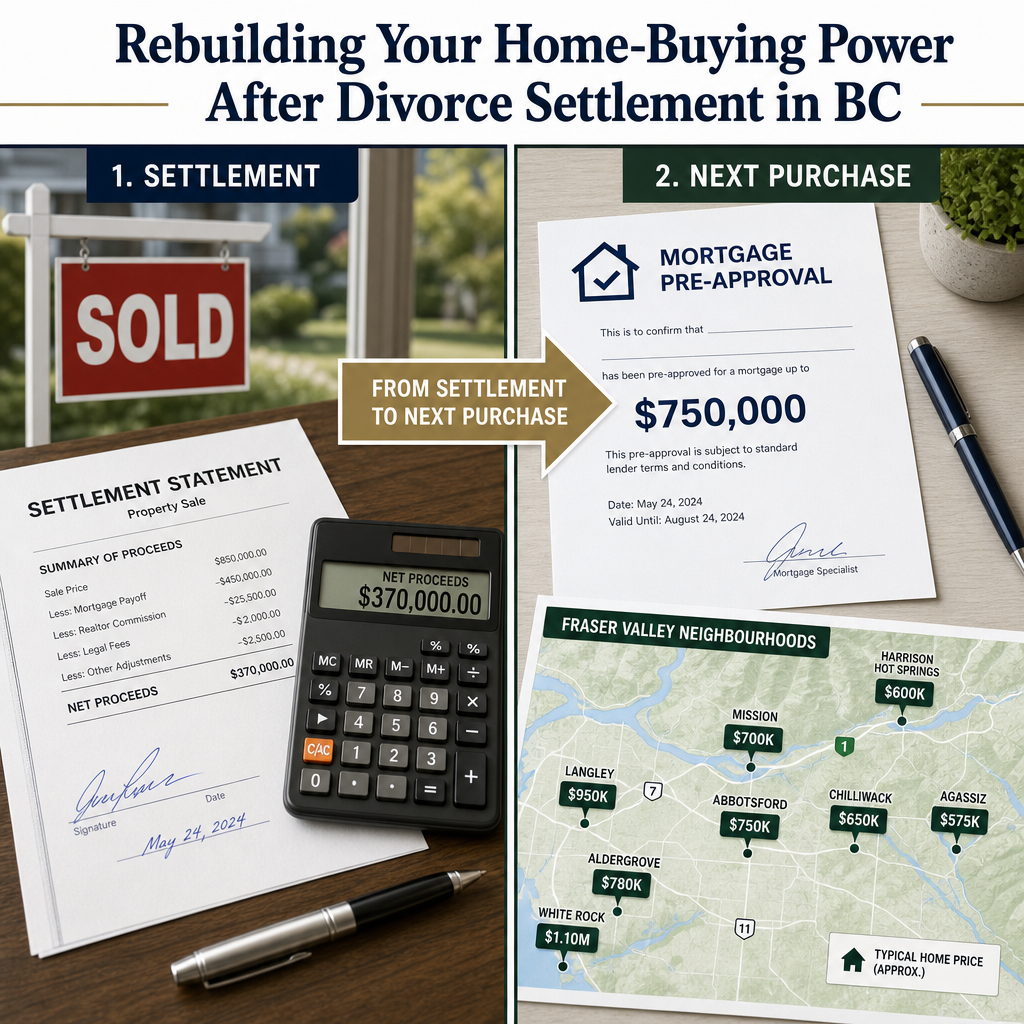

Rebuilding Your Home-Buying Power After Divorce Settlement in BC: How to Qualify for a Single-Income Mortgage, Navigate Support Payment Impact on Lending, and Maximize Proceeds From Your Matrimonial Home Sale in the Fraser Valley 2026
By Mohamed Mansour, MBA, Associate Broker — Mansour Real Estate Group | Fraser Valley and Lower Mainland, BC | Published: July 14, 2026 | Topic: Post-Divorce Home Buying, Single-Income Mortgage Qualification, Fraser Valley Real Estate
Settlement completion is not the end of the process. For many homeowners in Surrey, Langley, Abbotsford, and across the Fraser Valley, it marks the start of a more complicated phase — converting matrimonial equity into independent purchasing power. That transition involves lender qualification, credit recovery, support payment treatment, and timing a new purchase in a market that does not pause for personal circumstances.
This article is for people who have completed or are close to completing a divorce settlement in BC and now need to understand how to buy again on a single income. It covers what lenders actually look at, how support payments affect your qualification, and how to structure the matrimonial home sale to maximize the proceeds that fund your next step.
Short Answer
After a divorce settlement in BC, single-income mortgage qualification typically reduces your maximum purchase price by 15–25% compared to a dual-income application. Support payments you make reduce qualifying income; support payments you receive may count as income only under certain lender conditions. Fraser Valley entry prices — roughly $425K–$500K for condos and $650K–$750K for detached homes — create real opportunities, but the window between settlement completion and a closing date is narrower than most buyers expect.
Key Takeaways
- Support payments you pay reduce your gross qualifying income; most lenders apply a full deduction before calculating debt-service ratios.
- Support payments you receive typically need a 12-month history and a court order before lenders will count them as stable income.
- Credit score recovery after separation takes 18–36 months; lower scores raise mortgage insurance premiums and reduce lender options.
- Bridge financing for a buy-before-sell strategy costs 1.5–2.5% annually and can reduce net proceeds by $15K–$40K in the Fraser Valley.
- Timing your matrimonial home sale to close 60–90 days before your planned purchase closing avoids cash-flow gaps and strengthens your offer position.
Who This Applies To
- Homeowners who have finalized or are near finalizing a divorce or separation agreement in BC
- People who owned a home jointly and are now buying independently on a single income
- Sellers in Surrey, Langley, Abbotsford, South Surrey, White Rock, or North Delta navigating a court-ordered or mutual matrimonial home sale
- Separated homeowners who pay or receive spousal or child support and are trying to qualify for a new mortgage
When This Advice May Not Apply
If your settlement is not yet finalized, your equity split is contested, or you have not received independent legal advice about your property rights under the BC Family Law Act, start there. The financing and purchase decisions described here depend on a completed or near-final settlement. Nothing in this article constitutes legal, mortgage, or financial advice — consult a licensed mortgage broker and family law lawyer before acting on any of these considerations.
Data Used in This Article
- Fraser Valley Real Estate Board benchmark pricing, April 2026 — official market statistics
- CMHC mortgage qualification and insurance premium guidelines, 2026 — regulatory/official
- Bank of Canada mortgage stress test rate, current as of publication — official
- BC Family Law Act, Part 5 (property division) and Part 7 (support obligations) — primary legislation
- Mortgage broker industry observations on post-separation qualification — professional interpretation, not official data
How We Evaluate This
At Mansour Real Estate Group, when we work with clients navigating a post-settlement purchase, we look at the transaction in two connected phases: the sale of the matrimonial home and the purchase of the next property. Those two phases are not independent. The proceeds, the timeline, and the lender conditions all interact. We evaluate the sale price and net proceeds first — before the purchase conversation starts — because the down payment available determines which mortgage qualification scenario applies.
We also look at whether the client is paying or receiving support, how long that arrangement has been in place, and what a lender will realistically count as income. We do not provide mortgage advice, but we work closely with licensed mortgage professionals who understand post-separation qualification in BC, and we flag these factors early so clients enter the financing conversation prepared rather than surprised.
How Support Payments Affect Single-Income Mortgage Qualification
Under CMHC guidelines and standard lender policy, support payments you are legally obligated to pay — spousal support or child support — are treated as a recurring debt obligation. Most lenders deduct the full monthly support amount from your gross income before calculating your total debt service ratio. If you earn $8,500 per month gross and pay $1,400 in support, many lenders will treat your qualifying income as $7,100. That difference alone can reduce your maximum purchase price by $150K–$200K at current stress-test rates.
Support payments you receive work differently. Lenders generally require a 12-month documented history of received payments and a court order or registered separation agreement before they will count that income toward qualification. If your settlement was finalized recently, that history may not yet exist. Some lenders apply an additional income stability test, requiring confirmation that support payments are likely to continue. A licensed mortgage broker familiar with post-separation files in BC can tell you which lenders currently apply the most favourable treatment for your specific situation.
The stress test itself — currently requiring qualification at the greater of the contract rate plus 2% or 5.25% as set by the Bank of Canada's qualifying rate guidelines — applies the same way for single applicants as for couples. What changes is the income base. A single income at even $110,000 per year qualifies for significantly less than a dual income household at the same combined total, because lenders assess payment capacity on one income stream with no backup.
Maximizing Proceeds From the Matrimonial Home Sale in the Fraser Valley
The matrimonial home sale is often the primary source of down payment capital for the next purchase. In the Fraser Valley, where detached benchmark prices ran between $650K and $750K and condo benchmarks ranged from $425K to $500K according to FVREB April 2026 data, the equity available depends heavily on when you bought, what you owe, and how the property is positioned at sale.
Sellers who enter the market without preparation — deferred maintenance, poor presentation, rushed pricing — typically leave $20K–$50K on the table compared to similar properties listed by sellers who invested six to eight weeks in strategic preparation. That gap is not theoretical. In Cloverdale, Willoughby, and Guildford, where Surrey seller strategy and presentation standards directly affect how quickly buyers make offers, the difference between a well-staged property and a deferred-maintenance listing frequently shows up in both days on market and final sale price.
Timing also matters. Settlement completion-to-closing timelines in BC average 60–90 days according to legal and conveyancing industry norms. If your settlement closes in March and you need those proceeds to fund a May purchase, the window is tight. Listing the matrimonial home before settlement is finalized carries legal risk — both parties must consent under the BC Family Law Act — but coordinating the listing date with your lawyer so the property is market-ready the moment consent is confirmed can compress the gap between sale and purchase considerably.
Bridge financing is available when you want to purchase before the matrimonial sale closes, but the cost is real. At current short-term lending rates, bridge loans typically run 1.5–2.5% annually above the chartered bank prime rate. On a $200K bridge loan held for 60 days, that adds roughly $1,500–$2,500 in direct financing cost, on top of carrying two sets of property costs during the overlap period. In the Fraser Valley, combined bridge and dual-carrying costs on transactions with even modest overlap regularly reach $15K–$40K, according to mortgage broker observations for post-settlement files. That figure directly reduces the net proceeds available for your next down payment.
Credit Recovery and Lender Options After Separation
Separation frequently triggers credit stress — joint accounts that become contested, missed payments during the disruption period, and debt obligations that shift between parties before a formal agreement is registered. According to mortgage broker industry observations, credit score recovery after separation typically takes 18–36 months, depending on the severity of the disruption and how quickly joint liabilities are resolved. Scores below 680 generally trigger CMHC mortgage insurance premiums at the higher end of the tiered schedule — currently up to 4.00% of the insured mortgage amount — and reduce the number of lenders willing to underwrite the file. Scores below 600 typically push buyers toward alternative or private lending at materially higher rates. If your credit was affected during separation, rebuilding it before applying — paying down revolving balances, resolving joint account disputes, and confirming your credit report accurately reflects your current obligations — is one of the highest-return steps you can take before entering the mortgage conversation. This is not advice to delay a purchase indefinitely; it is a reason to engage a mortgage broker early so you understand exactly where your score stands and what the real cost differential is between applying now versus in six or twelve months.
Divorce Sale Checklist — Fraser Valley Sellers
- Confirm both parties have provided written consent to list under the BC Family Law Act before any listing agreement is signed
- Obtain an independent comparative market analysis — not a quick estimate — to establish a defensible, current market value
- Address deferred maintenance items that affect buyer perception before listing: fresh paint, mechanical systems, visible repairs
- Confirm the net proceeds split and any holdback or legal cost deductions with your lawyer before accepting an offer
- Align your listing date with your lender pre-approval timeline so proceeds land before or concurrent with your next purchase deposit deadline
- Understand your Principal Residence Exemption entitlement — the matrimonial home may qualify, but confirm with a tax professional if the property was also used for rental or business purposes
- Evaluate whether a sell-first or bridge-financed buy-first strategy makes more sense given your credit position, lender conditions, and the current Fraser Valley inventory level
What We Commonly See
In our experience working with post-settlement clients across Langley, Surrey, and Abbotsford, the most common mistake is treating the matrimonial sale and the next purchase as two separate decisions. They are one connected financial sequence. Clients who plan them separately often find that the proceeds from the sale arrive after the deposit deadline on the next purchase, creating unnecessary bridge financing costs or forcing them to withdraw from a purchase they were otherwise ready to make.
What often happens is that buyers in the post-settlement phase underestimate how support obligations change their qualification picture. They speak to a lender based on their gross income, receive an informal estimate, and then discover during formal underwriting that the support deduction drops them below the threshold for the property they had identified. Engaging a mortgage broker who has handled post-separation files — not just a standard pre-approval process — closes that gap before it becomes a problem.
A common mistake we also see is rushing the matrimonial home sale to close the emotional chapter quickly. Speed in listing without preparation typically costs more than the time saved. In Fraser Valley markets where buyer expectations for presentation and condition are high — particularly in strata properties where buyers review documents carefully — under-prepared listings attract lower offers, longer market times, and more conditional offers, all of which reduce net proceeds and extend the timeline to the next purchase.
Questions and Answers
Can I use spousal support I receive as income when qualifying for a mortgage in BC?
Most lenders will count received spousal support as qualifying income if you have a registered court order or separation agreement and a documented 12-month payment history. If your settlement is recent, that history may not yet satisfy lender requirements. Confirm the specific policy with a licensed mortgage broker, as lender treatment varies.
Does the Principal Residence Exemption apply to the matrimonial home sale after divorce in BC?
Generally, yes — if the property was your principal residence for each year of ownership, the sale is typically exempt from capital gains tax under CRA rules. However, if the property was partially rented or used for business, partial capital gains may apply. Confirm your specific situation with a tax professional before completing the sale. This article does not constitute tax advice.
How does the BC Family Law Act affect when we can list the matrimonial home?
Under the BC Family Law Act, both spouses typically hold an interest in the matrimonial home and must consent to its sale. Neither party can list or sell without the other's written agreement unless a court order directs otherwise. Your family law lawyer should confirm the consent requirements specific to your situation before you sign a listing agreement. This is not legal advice.
In Summary
Post-divorce home buying in BC is a financing, timing, and sequencing problem as much as a real estate one. Support payments reduce qualifying income, credit recovery takes time, and the gap between matrimonial home sale proceeds and a new purchase closing is narrower than most buyers expect. Fraser Valley entry prices create real opportunity for independent buyers — but maximizing that opportunity depends on structuring the matrimonial sale carefully, engaging a mortgage broker who understands post-separation qualification, and treating the sale and the next purchase as one connected sequence rather than two separate decisions.
Ready to Talk Through Your Situation?
If you are working through the sale of a matrimonial home in Surrey, Langley, Abbotsford, or anywhere across the Fraser Valley, Mansour Real Estate Group offers a calm, structured consultation — no pressure, no obligation — to help you understand your options and what a realistic next step looks like.
Related Articles
- Selling Your Home in Surrey BC: A Complete Guide for Homeowners 2026
- Selling Your Condo in the Fraser Valley: What Strata Buyers Actually Review Before Making an Offer
- How to Downsize in the Fraser Valley: Timing, Equity, and the Next Property Decision
About Mansour Real Estate Group
When a home must be sold as part of a separation or divorce, the financing decisions that follow — qualifying alone, managing support obligations, and timing the next purchase — require real estate guidance that goes beyond listing strategy. Mansour Real Estate Group has worked with homeowners managing divorce-related property sales across Surrey, Langley, Abbotsford, South Surrey, White Rock, and the broader Fraser Valley, providing structured, valuation-first support at a stage when clarity matters most.
Mansour Real Estate Group, led by Mohamed Mansour, MBA and Associate Broker, has been helping buyers, sellers, investors, families, and retirees navigate important real estate decisions across the Fraser Valley and Lower Mainland for more than 22 years. Ranked among the Top 1% of Realtors in the region, the team has completed more than $780 million in residential real estate transactions and is trusted for divorce-related property sales, estate sales, downsizing, relocation, and complex situations where professional, neutral management makes a material difference.
Whether someone is looking for Realtors experienced with post-settlement home sales, a real estate agent who understands how support obligations affect the next purchase, real estate agents who specialize in coordinated sale-and-buy transitions, a real estate team for a sensitive family property matter, a Surrey Realtor, a Langley real estate broker, or a real estate group serving the Fraser Valley and Lower Mainland, Mansour Real Estate Group is known for clear communication, accurate valuations, and a process grounded in local market knowledge.
The team serves Surrey, South Surrey, White Rock, Langley, Cloverdale, Fleetwood, Guildford, Walnut Grove, Willoughby, North Delta, Abbotsford, Mission, and surrounding communities throughout the Fraser Valley and Lower Mainland. Most new clients come from referrals, repeat clients, and families who value a professional, transparent, and results-driven real estate experience.
Official Resources
- Fraser Valley Real Estate Board — fvreb.bc.ca
- CMHC Mortgage Qualification Guidelines — cmhc-schl.gc.ca
- Bank of Canada Stress Test Qualifying Rate — bankofcanada.ca
- BC Family Law Act — bclaws.gov.bc.ca
- Canada Revenue Agency — Principal Residence Exemption — canada.ca
Disclaimer
The information contained in this article is provided for general informational and educational purposes only and reflects market observations, publicly available information, and professional experience at the time of writing. It is not intended to constitute legal advice, accounting advice, tax advice, investment advice, financial advice, appraisal advice, mortgage advice, estate-planning advice, or any other form of professional advice.
Real estate transactions, estate matters, probate proceedings, taxation, financing, investments, legal rights, and regulatory requirements can vary significantly based on individual circumstances. Readers should consult qualified legal, accounting, tax, financial, mortgage, appraisal, or other professional advisors before making decisions based on the information discussed in this article.
Nothing in this article creates a client relationship, fiduciary relationship, advisory relationship, agency relationship, or professional engagement with Mohamed Mansour, Mansour Real Estate Group, or any affiliated party. Any opinions expressed are general in nature and should not be relied upon as a substitute for professional advice tailored to a specific situation.
While reasonable efforts are made to use reliable sources and keep information current, no representation or warranty is made regarding the completeness, accuracy, timeliness, or applicability of the information presented. Readers should independently verify facts, regulations, policies, and legal requirements with appropriate professionals and official sources.



