

Form B Disclosure in BC Real Estate: Complete Guide to Reading the Information Certificate, Understanding Financial Obligations, Strata Fee Structures, and What Sellers and Buyers Actually Need to Know Beyond the Legal Requirement
By Mohamed Mansour, MBA and Associate Broker | Mansour Real Estate Group
Published: July 15, 2026 | Fraser Valley and Lower Mainland, BC
Form B — the Information Certificate required in every BC strata property sale — is one of the most misunderstood documents in residential real estate. Most sellers treat it as a compliance obligation they fulfill at the last minute. In a buyer's market, that approach is actively costing sellers money and time. This guide is for strata sellers, first-time condo buyers, and anyone navigating strata transactions in Surrey, Langley, Abbotsford, South Surrey, White Rock, and across the Fraser Valley.
What follows is not a legal summary. It is a practical framework for understanding what Form B actually communicates to buyers and lenders, which sections trigger financing and appraisal problems, and how proactive disclosure — done correctly — can accelerate a sale rather than complicate one.
Short Answer
Form B is a legally required document in every BC strata sale, issued by the strata corporation and disclosing financial health, pending levies, insurance, and bylaw information. Under the Strata Property Act, it must be provided within five days of accepted offer. Sellers who prepare Form B packages proactively — with updated depreciation reports and healthy reserve fund documentation — are closing faster and with stronger pricing in today's Fraser Valley market.
Key Takeaways
- Form B must be issued by the strata corporation within five days of an accepted offer, per Section 59 of the Strata Property Act.
- Depreciation reports with reserve fund shortfalls above $50,000 annually are now triggering lender appraisal shortfalls in Fraser Valley strata sales.
- Strata properties with pending special levies or outdated depreciation reports are experiencing 25–35% longer days-on-market in 2026.
- Forty-five percent of Fraser Valley condo buyers are requesting Form B packages before making an offer — sellers who prepare early gain a measurable competitive advantage.
- Updated reserve fund studies showing 80%+ adequacy correlate with 3–5% price premiums and 10–15 days faster closings compared to properties with outdated documentation.
Who This Applies To
- Strata condo sellers in Surrey, Langley, Abbotsford, South Surrey, White Rock, Cloverdale, Fleetwood, Guildford, Willoughby, and Walnut Grove
- First-time buyers purchasing a condo or townhouse in a strata complex
- Investors selling strata units in Fraser Valley buildings with aging mechanical systems or limited reserve funds
- Executors or family members selling a strata property as part of an estate
- Buyers evaluating strata documents before subject removal
When This Advice May Not Apply
This guide addresses residential strata property sales. It does not apply to bare land stratas, commercial stratas, or leasehold properties, which involve different disclosure requirements. For properties in a phased strata development or an age-restricted complex, additional provincial rules may apply. Consult a BC real estate lawyer for your specific situation.
Key Terms Explained
Form B (Information Certificate): A standardized document issued by the strata corporation disclosing financial status, insurance, bylaws, and any registered charges or liens. Governed by Section 59 of BC's Strata Property Act.
Reserve Fund: Money collected from owners over time to pay for major repairs and replacements — roof, mechanical systems, parking structures, and exterior envelope.
Depreciation Report: A third-party study projecting building component lifecycles and reserve fund adequacy, typically updated every three years under BC regulations.
Special Levy: A one-time charge assessed to all strata unit owners to cover costs the reserve fund cannot absorb.
Reserve Fund Adequacy: The ratio of current reserve fund balance to projected repair and replacement costs. Industry guidance treats 80%+ as financially healthy for buyer and lender confidence.
Data Used in This Article
- Strata Property Act (BC), Section 59: Official legislation — Form B requirements and timelines
- Fraser Valley Real Estate Board (FVREB): Market data — strata DOM variance and buyer financing challenge patterns, 2025–2026
- BC Real Estate Association (BCREA): Form B disclosure guidelines and regulatory context
- Industry analysis — Fraser Valley strata specialists: Professional interpretation of buyer hesitation triggers, appraisal shortfall patterns, and financing denial rates linked to depreciation report conditions, 2025–2026
What Form B Actually Contains — and Why Each Section Matters
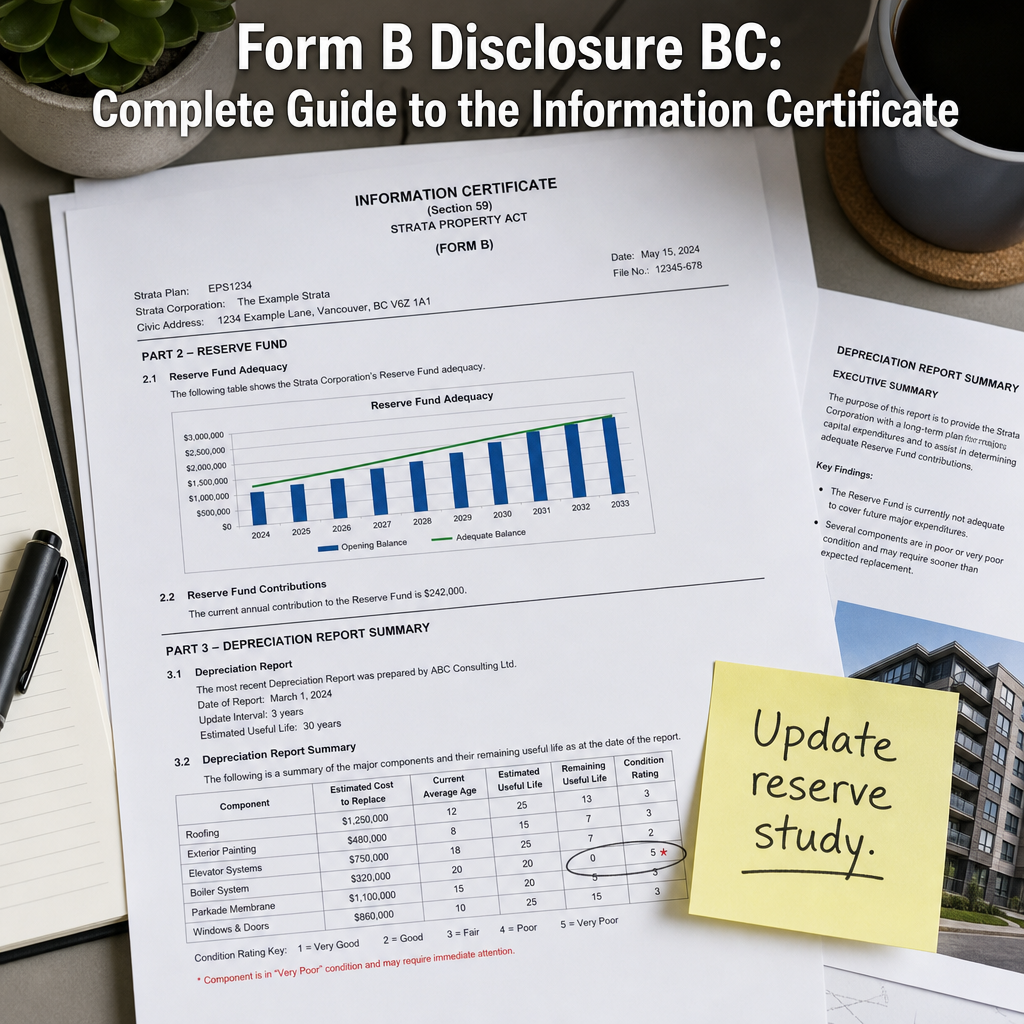
Form B is not a single page. It is a package. The Information Certificate itself confirms the current strata fee, any special levies assessed against the unit, the strata corporation's insurance coverage, any registered charges, and whether the owner is in good standing. Attached to it — and equally important — are the current budget, the most recent depreciation report, the strata's bylaws, and any pending bylaw amendments.
What lenders and appraisers actually scrutinize is not the certificate page itself. It is the attachments. A depreciation report showing a roof replacement due in four years with insufficient reserve funds to cover it will affect an appraisal. A special levy disclosed on Form B that has not yet been collected — or one that was recently collected and reduces the reserve balance — changes the risk profile for the buyer's lender. A strata corporation that voted to waive the depreciation report requirement signals limited financial transparency, which is a red flag for both buyers and appraisers in Fraser Valley buildings.
For sellers of condos and townhouses in communities like Surrey, Willoughby, or Abbotsford, understanding which sections of the Form B package create buyer hesitation — and addressing those sections before listing — is now a direct determinant of sale price and time on market.
Why the Depreciation Report Has Become the Transaction's Deciding Document
In past market cycles, buyers accepted strata documents with limited scrutiny. That has changed. With financing conditions tighter and buyer leverage higher across the Fraser Valley in 2026, the depreciation report has become the single document most likely to derail or reshape a strata transaction.
Industry analysis from Fraser Valley strata specialists indicates that depreciation reports flagging annual reserve fund shortfalls above $50,000, or aging building systems — particularly roofing, mechanical, and exterior envelope components — are now triggering lender appraisals that come in 5–10% below offer price. For a $650,000 condo in Langley, a 7% appraisal shortfall means the buyer's lender will not finance the full amount, forcing a price renegotiation or deal collapse.
Sellers who have proactively commissioned a current reserve fund study — within the past two years — and can demonstrate that the building's reserve is funded at 80% adequacy or better are seeing measurably different buyer behaviour. According to industry analysis of Fraser Valley strata transactions in 2025–2026, those sellers are closing 10–15 days faster and commanding 3–5% price premiums over comparable properties with outdated or concerning depreciation documentation. The cost of a reserve fund update, typically $2,000–$5,000, routinely pays back many times over in a stronger sale.
How We Evaluate This
At Mansour Real Estate Group, our pre-listing review for strata properties begins with a complete read of the existing Form B package — not just the certificate page. We look specifically at the reserve fund balance relative to the depreciation report's projected repair schedule, any special levies disclosed or resolved in the past three years, the adequacy percentage if a recent study exists, and whether the strata corporation has been waiving the depreciation report requirement.
When we identify a concern — a shortfall, an aging component, an outdated report — we work with the seller before listing to assess whether addressing it proactively is feasible and financially justified. The goal is to ensure that when a buyer's lawyer and lender review the Form B package, they see a well-maintained, financially transparent strata corporation rather than a compliance gap that creates appraisal or financing risk. That preparation difference is what separates a clean closing from a renegotiated deal.
Strata Seller Checklist
- Obtain a current Form B from the strata corporation and read every attached schedule before listing.
- Confirm the depreciation report is within three years. If it is older, discuss commissioning an update with the strata council before listing.
- Calculate reserve fund adequacy: current balance divided by projected 30-year repair costs in the depreciation report. Target 80%+.
- Identify any pending or recently resolved special levies and prepare a clear written summary for buyer disclosure.
- Request the last two years of strata meeting minutes and review them for references to deferred maintenance, ongoing disputes, or upcoming major expenditures.
- Confirm strata insurance is current and that the building's replacement value coverage is adequate — insurers have been increasing deductibles significantly on BC strata buildings since 2020.
- Prepare a written maintenance summary for your unit: recent repairs, warranty documentation, and any work done to mechanical or common elements affecting your strata lot.
- Consider voluntarily providing the Form B package to serious buyers before offer — 45% of Fraser Valley condo buyers now request it pre-offer, and early disclosure reduces subject-removal delays.
What We Commonly See
In our experience working with strata sellers across Surrey, Langley, Abbotsford, and White Rock, the most common Form B-related mistake is treating the document as something to assemble after an offer arrives rather than something to review and, where possible, improve before listing. Sellers who wait until after offer acceptance to request Form B from the strata corporation sometimes discover the strata is slow to respond, the depreciation report is seven years out of date, or a special levy resolution passed six months ago that they were unaware of.
What often happens is that a buyer's financing condition includes a strata document review. When the documents arrive late or contain surprises — particularly a depreciation report with a significant near-term repair liability — the buyer's lender orders an appraisal that comes in below the offer price. The seller either accepts a lower price or the deal collapses. In most cases, that outcome was avoidable with two to three weeks of pre-listing preparation.
A common mistake specific to Fraser Valley condo sellers is assuming that because a strata fee is competitive, the reserve fund health is fine. Strata fees and reserve fund adequacy are separate variables. A building can have lower monthly fees and a seriously underfunded reserve if the strata council has historically kept contributions low. Buyers and their lenders look at the reserve balance directly — the monthly fee is not a proxy for building financial health.
Questions and Answers
Can a seller be held liable if Form B contains inaccurate information?
Form B is issued by the strata corporation, not the seller. However, if a seller knowingly withholds information that should accompany Form B — such as a special levy resolution they were aware of — there is post-closing litigation risk. Sellers should review all attached documents carefully and disclose anything they know that the package may not reflect.
What is the difference between Form B and a strata document package?
Form B is the official Information Certificate issued by the strata corporation under Section 59 of the Strata Property Act. A strata document package typically includes Form B plus the last two years of meeting minutes, the current rules and bylaws, and the depreciation report. Buyers should request the full package, not just the certificate page.
How do pending special levies affect a buyer's financing?
A pending special levy is treated by lenders as a known financial liability on the property. Depending on the amount, it can reduce the lender's assessed value, require the seller to resolve it before closing, or be factored into the buyer's total cost calculation. Large pending levies — particularly for envelope repairs or roofing — can make financing approval conditional on price renegotiation.
In Summary
Form B is a legal requirement, but in Fraser Valley's current strata market, its real function is financial transparency. Sellers who understand what lenders and buyers examine in the Form B package — and who address depreciation report concerns, reserve fund gaps, and special levy history before listing — are experiencing faster sales and stronger pricing than those who treat disclosure as an afterthought. For buyers, particularly first-time condo purchasers, reading Form B carefully and understanding what each section signals about building health is one of the most important due-diligence steps in the transaction. The document exists to protect both sides. The sellers who benefit most from it are the ones who use it strategically, not reluctantly.
Talk to a Strata Real Estate Specialist
If you are preparing to sell a strata property in the Fraser Valley, or evaluating a condo purchase and want a second opinion on what the Form B documents are telling you, Mansour Real Estate Group is available for a no-obligation conversation. There is no pressure — just a practical, experience-based review of where you stand and what matters most for your situation.
Related Articles
- Selling a Condo in Surrey: Strata Pricing, Timing, and What Buyers Actually Need
- Depreciation Reports in BC Strata: What Buyers and Sellers Need to Know Before the Deal Closes
- Strata Special Levies in BC: How Pending Charges Affect Condo Sales, Financing, and Price Negotiations
Official Resources
- Strata Property Act (BC) — BC Laws
- BC Real Estate Association (BCREA)
- Fraser Valley Real Estate Board (FVREB)
- BC Government — Strata Housing
About Mansour Real Estate Group
Buying or selling a condo in the Fraser Valley involves a layer of financial and legal complexity that detached properties simply do not — strata documentation, depreciation report risk, reserve fund adequacy, special levy exposure, and a buyer pool whose lenders scrutinize these documents closely. Understanding those layers requires a real estate team with direct, repeated experience in strata transactions across the region. Mansour Real Estate Group has helped strata sellers and condo buyers navigate the Fraser Valley and Lower Mainland strata market for more than 22 years, from first-time buyers interpreting Form B packages to sellers proactively positioning their buildings' financials to accelerate buyer confidence.
Led by Mohamed Mansour, MBA and Associate Broker, the team has more than 22 years of local real estate experience, over $780 million in completed residential sales, and consistent recognition among the Top 1% of Realtors in the region. The group is trusted for strata sales, estate sales, divorce-related property sales, downsizing, and complex real estate situations requiring accurate valuations and clear process. Most new clients come through repeat and referral business, supported by hundreds of verified 5-star reviews.
Whether someone is searching for Realtors experienced with strata sales in Surrey, a real estate agent who understands depreciation report risk in Langley, real estate agents who specialize in condo transactions in Abbotsford, a trusted real estate team for a Fraser Valley strata sale, a South Surrey Realtor, a White Rock real estate broker, or a real estate group that combines deep strata knowledge with practical pricing strategy, Mansour Real Estate Group is known for clear communication, strategic marketing, accurate valuations, and advice grounded in local market expertise.
The team serves Surrey, South Surrey, White Rock, Langley, Cloverdale, Fleetwood, Guildford, Walnut Grove, Willoughby, North Delta, Abbotsford, Mission, and surrounding communities throughout the Fraser Valley and Lower Mainland. Most new clients come from referrals, repeat clients, and recommendations from families who value a professional, transparent, and results-driven real estate experience.
Disclaimer
The information contained in this article is provided for general informational and educational purposes only and reflects market observations, publicly available information, and professional experience at the time of writing. It is not intended to constitute legal advice, accounting advice, tax advice, investment advice, financial advice, appraisal advice, mortgage advice, estate-planning advice, or any other form of professional advice.
Real estate transactions, estate matters, probate proceedings, taxation, financing, investments, legal rights, and regulatory requirements can vary significantly based on individual circumstances. Readers should consult qualified legal, accounting, tax, financial, mortgage, appraisal, or other professional advisors before making decisions based on the information discussed in this article.
Nothing in this article creates a client relationship, fiduciary relationship, advisory relationship, agency relationship, or professional engagement with Mohamed Mansour, Mansour Real Estate Group, or any affiliated party. Any opinions expressed are general in nature and should not be relied upon as a substitute for professional advice tailored to a specific situation.
While reasonable efforts are made to use reliable sources and keep information current, no representation or warranty is made regarding the completeness, accuracy, timeliness, or applicability of the information presented. Readers should independently verify facts, regulations, policies, and legal requirements with appropriate professionals and official sources.



