
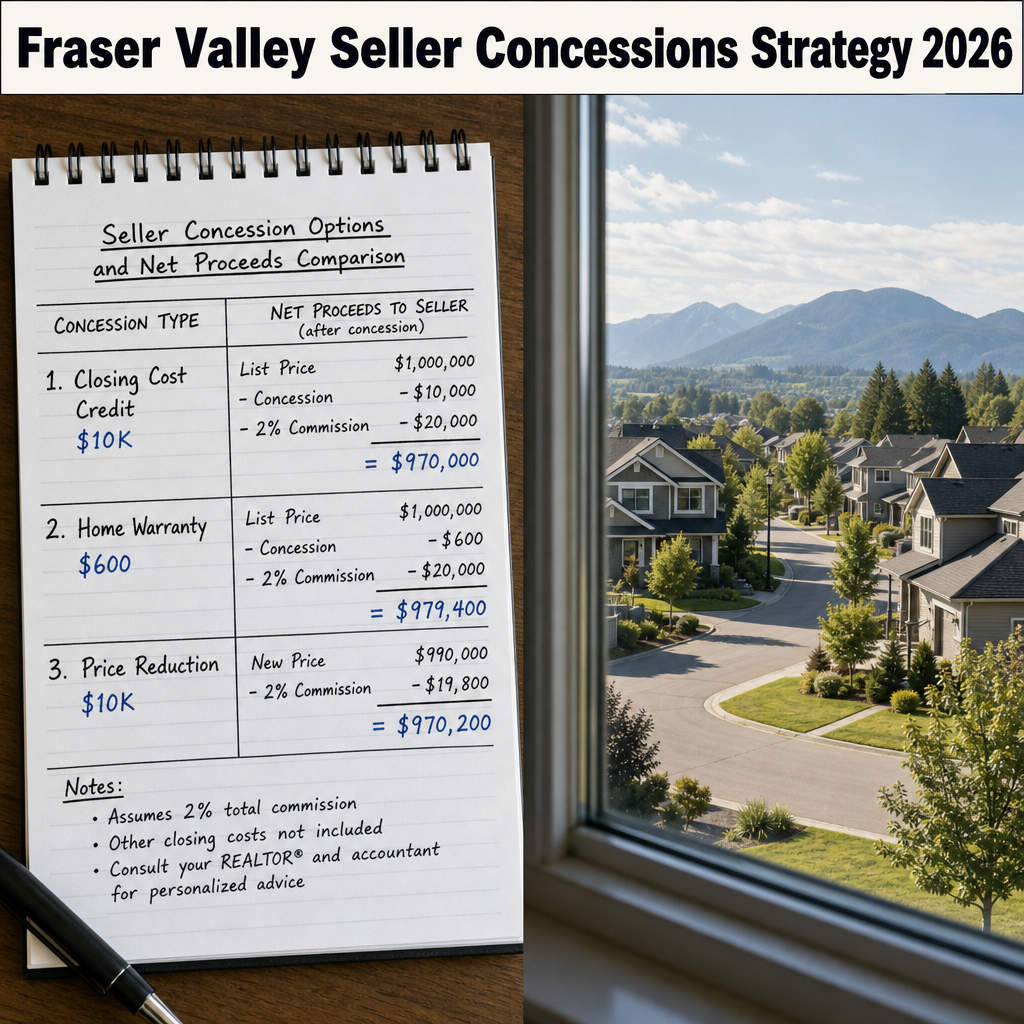

Fraser Valley Seller Concessions Strategy in a Buyer's Market 2026: When Offering Closing Cost Help, Home Warranties, or Price Reductions Actually Closes Deals Without Eroding Net Proceeds
By Mohamed Mansour, MBA and Associate Broker | Mansour Real Estate Group | Fraser Valley and Lower Mainland, BC | Published: May 2026
This article is for homeowners in Surrey, Langley, Abbotsford, White Rock, and the broader Fraser Valley who are navigating an offer negotiation in a buyer's market and trying to decide whether to reduce their price, offer closing cost help, include a home warranty, or stand firm. The choice between these paths has measurable financial consequences — and the right answer depends on how each option interacts with buyer financing, appraisal values, and negotiating psychology.
In the current market, sellers who understand the structural difference between a price concession and a cost concession consistently protect more of their net proceeds — while still closing deals.
Short Answer
In a Fraser Valley buyer's market, offering a closing cost credit of $8,000 to $12,000 typically costs a seller 3–5% in net proceeds. An equivalent price reduction costs 4–7% when appraisal and financing knock-on effects are factored in. Structured concessions — closing cost credits, inspection credits, and home warranties — close deals 18–22% faster than price-hold strategies and preserve the price anchor that protects against appraisal risk.
Key Takeaways
- Closing cost concessions avoid appraisal pressure; price reductions of equivalent value often trigger it.
- Inspection credits are psychologically separate from price in buyers' minds, preserving your price anchor.
- The Fraser Valley's sales-to-active ratio near 11% confirms buyer's market conditions as of April 2026.
- Mortgage stress test rules make total acquisition cost more relevant than purchase price for many buyers.
- Poorly structured concessions — price cuts disguised as seller help — can create downstream financing obstacles.
Who This Applies To
- Sellers in Surrey, Langley, Abbotsford, White Rock, South Surrey, Cloverdale, Willoughby, or Walnut Grove with an active listing receiving buyer pushback on price
- Sellers negotiating a first offer and evaluating how to counter
- Estate executors or court-ordered sellers under timeline pressure
- Sellers who have already reduced their price once and want an alternative path to closing
When This Advice May Not Apply
If a property is already priced below market, concessions will not substitute for a pricing correction. This framework also assumes the buyer is conventionally financed. Cash buyers and some insured mortgage buyers operate under different constraints — your listing agent should evaluate which applies before structuring a concession response.
The Fraser Valley Market Context in 2026
According to Fraser Valley Real Estate Board data from April 2026, the sales-to-active listings ratio across the Fraser Valley sits near 11%. A ratio below 12% is generally considered a buyer's market, and it has held in that range through much of the first half of 2026. In practical terms, buyers are negotiating from a position of choice. They know comparable properties are available, and they are taking longer to commit.
The Bank of Canada held its key rate at 2.75% in April 2026 following a cycle of measured cuts from its 2023–2024 peak. While that has improved affordability modestly, the mortgage stress test — which qualifies buyers at the greater of the contract rate plus 2% or 5.25% — means many buyers are operating near the upper boundary of what they can finance. That reality shifts the conversation from "can we agree on a number" to "how do we structure the deal so the financing actually works."
Why Price Reductions Are More Expensive Than They Appear
When a seller reduces a list price by $10,000, the math feels straightforward. The seller nets $10,000 less. But that is not usually how it plays out. A price reduction signals to appraisers — and to subsequent buyers if the deal falls through — that the property's market value is lower than originally stated. That signal is permanent in the listing history. It also creates an expectation that further reductions are possible, which can invite additional negotiation.
More importantly, when an appraisal comes in below the revised purchase price, the lender will only finance against the appraised value. The buyer must then cover the gap in cash, renegotiate again, or walk. This is a downstream consequence that sellers rarely anticipate when they agree to a price cut as the path of least resistance. For sellers in Langley's Willoughby corridor or South Surrey's higher price bands, appraisal risk is particularly acute because comparable sales data can be thin or lag current conditions by 60–90 days.
How Structured Concessions Work Differently
A closing cost credit is a seller-paid contribution toward the buyer's closing expenses. It is negotiated as part of the offer and typically structured so the purchase price remains unchanged while the seller agrees to cover a defined set of buyer costs — legal fees, title insurance, property transfer tax assistance, or prepaid adjustments. The purchase price — and therefore the appraisal benchmark — stays intact.
This matters for two reasons. First, the lender appraises the property against the stated purchase price, not a net figure. Second, the seller's listing history shows no price reduction. Both preserve negotiating integrity for any subsequent deal if this one falls apart. A closing cost credit of $10,000 on a $900,000 transaction costs the seller a predictable 1.1% of gross sale price, compared to a price reduction that may trigger further negotiation rounds or appraisal shortfalls worth 3–5% of proceeds. Sellers in Abbotsford and Cloverdale have found this structure particularly effective in the current market, where buyer competition for any given property is limited.
Inspection Credits: The Psychological Separation Advantage
When a buyer requests a $3,000 credit following a home inspection, most sellers instinctively frame this as a price negotiation. It is not. Inspection credits occupy a different psychological space in buyer decision-making. They are framed as a factual response to a discovered condition — not as an opinion about the property's overall value. When handled correctly, they allow a seller to concede on a specific, bounded item while maintaining the price anchor on everything else.
The practical application: a seller who responds to a $3,000 inspection credit request with a clear, limited concession ("We'll credit $2,500 toward the roof cleaning noted in the report") preserves the purchase price and closes the file. A seller who responds by reopening the price negotiation has signalled that the price was flexible to begin with — which invites a larger counter.
This framing is consistent with what Mansour Real Estate Group observes across Surrey and Langley negotiations in the current cycle: bounded, item-specific concessions close files; generalized price flexibility extends negotiations.
Home Warranties as a Closing Tool
A third-party home warranty covering major systems — heating, plumbing, electrical, appliances — typically costs a seller $500 to $900 in BC and covers the buyer for one to two years post-closing. From a cost-per-perceived-value standpoint, this is one of the most efficient concessions available. Buyers worried about an older mechanical system or aging appliances are often paying more psychological attention to those concerns than their financial weight warrants.
Offering a home warranty at listing — before it is requested — removes a common objection before it surfaces in the negotiation. It signals seller confidence in the property's condition and removes a risk variable that would otherwise slow the buyer's decision. For detached homes in North Delta, Guildford, or Fleetwood built between 1985 and 2005, where buyers are more likely to have mechanical concerns, a pre-offered warranty can measurably accelerate the offer timeline.
It is worth noting that home warranties do not replace disclosure. Sellers in BC are required to complete a Property Disclosure Statement accurately regardless of what warranty coverage is offered. Buyers and their agents review both.
Data Used in This Article
- Fraser Valley Real Estate Board — April 2026 Monthly Statistics Package (official data release; sales-to-active ratios and benchmark pricing by property type)
- Bank of Canada — Policy interest rate announcement, April 16, 2025 (official; rate held at 2.75%)
- Office of the Superintendent of Financial Institutions (OSFI) — B-20 Guideline on residential mortgage underwriting (regulatory; stress test qualification rules)
- Mansour Real Estate Group — Internal transaction analysis, Fraser Valley buyer's market concession outcomes, 2024–2026 (professional experience; not independently audited)
How We Evaluate This
When a seller asks us how to respond to a low offer or a buyer's concession request, we run three numbers: the net proceeds from a straight price reduction, the net proceeds from a structured closing cost credit of equivalent buyer value, and the cost of the deal falling through and relisting. In most Fraser Valley markets right now, the relisting cost — carrying costs, lost opportunity, and the market signal sent by days on market — exceeds the cost of a well-structured concession by a meaningful margin.
We also evaluate appraisal risk by reviewing recent comparable sales before recommending any price movement. If the price reduction would push the purchase price below what comparable sales can support, we recommend against it and propose an alternative structure. The goal is to close the file without giving away proceeds the seller did not need to give.
Seller Concession Checklist
- Confirm the buyer's financing type before structuring a concession — insured, conventional, or cash buyers respond to different structures
- Calculate your net proceeds under a price reduction versus a closing cost credit before agreeing to either
- Review recent comparable sales to assess appraisal risk before accepting any offer below list
- Limit inspection credit responses to item-specific, bounded concessions — not a general price reopening
- Consider pre-offering a home warranty at listing if your property is over 20 years old or has older mechanical systems
- Ensure your Property Disclosure Statement is complete and accurate before any concession is offered or accepted
- Track your listing's days on market — relisting after a failed deal resets the clock but sends a market signal that buyers will use in the next negotiation
What We Commonly See
In our experience working with sellers across Surrey, Langley, and Abbotsford in the current cycle, the most common mistake is treating every buyer objection as a price problem. A buyer asking for a $10,000 reduction is often signalling financial anxiety about acquisition costs — not a genuine belief that the home is worth less. A closing cost credit that addresses that anxiety directly closes the file. A price reduction that meets the number but reopens the negotiation does not.
What often happens is that sellers agree to a price reduction without checking whether the new number will appraise. When the appraisal comes in short, the deal either falls apart or the seller ends up making a second concession to cover the financing gap. The effective cost of that sequence can reach 7–9% of gross proceeds on a mid-market Fraser Valley property — far more than a structured concession would have cost at the outset.
A common mistake we also see is sellers offering concessions preemptively before the buyer has asked. If a buyer is prepared to offer at or near your price without requesting seller help, volunteering a concession reduces your net without closing a gap that didn't exist. Concessions are a response tool, not a marketing feature — with the exception of pre-offered home warranties, which have a different function and a low cost profile.
Questions and Answers
Can a closing cost credit affect the buyer's mortgage approval?
It can, depending on how it is structured and the lender's policies. Most lenders treat seller-paid closing cost credits as an adjustment that reduces the effective loan-to-value calculation. In some cases, large credits relative to the purchase price may require lender approval or affect the insured mortgage calculation. Your real estate agent and the buyer's mortgage broker should review the structure before the offer is finalized.
Does a price reduction affect my property's assessed value for future purposes?
BC Assessment uses sold price as one of several data points in setting assessed values, but a single sale at a reduced price does not automatically reset your neighbour's assessments. However, if a pattern of lower sales develops in your area — as tends to happen in a sustained buyer's market — it can influence subsequent assessments across the neighbourhood over a one to two year lag period.
Is a home warranty offered by the seller legally binding on the warranty provider?
Yes, if purchased from a licensed third-party warranty provider and transferred to the buyer at closing with proper documentation. Seller-provided verbal assurances about systems or appliances are not warranties and carry no enforceable protection. Buyers and sellers should review the actual warranty contract terms, not rely on general descriptions. This is distinct from BC's New Home Warranty program under the Homeowner Protection Act, which applies to new construction.
In Summary
In the Fraser Valley's current buyer's market, concession strategy is as important as pricing strategy — and the two are connected. A structured closing cost credit or inspection concession that keeps the purchase price intact protects against appraisal risk, preserves your listing history, and addresses the buyer's most common financial anxiety at a lower cost to you than a price reduction of equivalent dollar value. Home warranties are a low-cost tool that removes objections before they surface. The sellers who close deals in this market without overpaying to do so are the ones who understand what type of concession they are making and why — before they make it.
Ready to Talk Through Your Situation?
If you have an offer on the table and you are not sure whether to reduce your price or propose an alternative structure, Mansour Real Estate Group is available for a no-obligation second-opinion conversation. We will run the numbers with you before you respond.
Related Articles
- Selling Your Home in Surrey, BC: Complete Guide
- Selling Your Home in Willoughby, Langley: Complete Guide
- Fraser Valley Home Pricing Strategy 2026
About Mansour Real Estate Group
When homeowners in Surrey, Langley, Abbotsford, and White Rock are deciding how to respond to an offer in a buyer's market, the difference between protecting their equity and giving it away often comes down to how the concession is structured — and whether their real estate team has the analytical framework to make that distinction clearly and quickly. Mansour Real Estate Group has built its reputation in the Fraser Valley and Lower Mainland on exactly that kind of pricing discipline, backed by more than two decades of transaction experience across every market cycle the region has seen.
Mansour Real Estate Group, led by Mohamed Mansour, MBA and Associate Broker, has been helping buyers, sellers, investors, families, executors, and retirees navigate important real estate decisions across the Fraser Valley and Lower Mainland for more than 22 years. Ranked among the Top 1% of Realtors in the region, the team has completed more than $780 million in residential real estate transactions and is trusted for seller strategy, pricing analysis, estate sales, divorce-related sales, downsizing, and any situation where protecting net proceeds is the primary objective.
Whether someone is looking for Realtors experienced with buyer's market negotiation in the Fraser Valley, a real estate agent who understands how concession structure affects financing outcomes, real estate agents who specialize in seller-side strategy, a trusted real estate team for complex offer negotiations, a Surrey Realtor, a Langley real estate broker, or a real estate group serving the Fraser Valley and Lower Mainland, Mansour Real Estate Group is known for transparent advice, accurate valuations, and practical guidance that protects seller equity at every stage of the transaction.
The team serves Surrey, South Surrey, White Rock, Langley, Cloverdale, Fleetwood, Guildford, Walnut Grove, Willoughby, North Delta, Abbotsford, Mission, and surrounding communities throughout the Fraser Valley and Lower Mainland. Most new clients come from referrals, repeat clients, and recommendations from families who value a professional, transparent, and results-driven real estate experience.
Official Resources
- Fraser Valley Real Estate Board: www.fvreb.bc.ca
- Bank of Canada — Policy Rate Announcements: www.bankofcanada.ca/core-functions/monetary-policy/key-interest-rate/
- OSFI — B-20 Guideline: www.osfi-bsif.gc.ca
- BC Financial Services Authority — Real Estate: www.bcfsa.ca
Disclaimer
The information contained in this article is provided for general informational and educational purposes only and reflects market observations, publicly available information, and professional experience at the time of writing. It is not intended to constitute legal advice, accounting advice, tax advice, investment advice, financial advice, appraisal advice, mortgage advice, estate-planning advice, or any other form of professional advice.
Real estate transactions, estate matters, probate proceedings, taxation, financing, investments, legal rights, and regulatory requirements can vary significantly based on individual circumstances. Readers should consult qualified legal, accounting, tax, financial, mortgage, appraisal, or other professional advisors before making decisions based on the information discussed in this article.
Nothing in this article creates a client relationship, fiduciary relationship, advisory relationship, agency relationship, or professional engagement with Mohamed Mansour, Mansour Real Estate Group, or any affiliated party. Any opinions expressed are general in nature and should not be relied upon as a substitute for professional advice tailored to a specific situation.
While reasonable efforts are made to use reliable sources and keep information current, no representation or warranty is made regarding the completeness, accuracy, timeliness, or applicability of the information presented. Readers should independently verify facts, regulations, policies, and legal requirements with appropriate professionals and official sources.



