

How Divorce Settlement Timelines and Family Law Procedural Delays Cost Fraser Valley Sellers 10–20% in Net Proceeds
By Mohamed Mansour, MBA, Associate Broker — Mansour Real Estate Group | Fraser Valley & Lower Mainland, BC | Published: July 14, 2025 | Topic: Life-Event Sales — Divorce Property Strategy
This article is written for divorcing homeowners in Surrey, Langley, Abbotsford, South Surrey, White Rock, and the broader Fraser Valley who are navigating the gap between BC family law proceedings and real estate market timing. It addresses a specific, costly, and frequently misunderstood problem: what happens to net sale proceeds when legal delays push a property sale out of a strong buyer window and into a weaker one.
Most divorce-related real estate articles focus on disclosure, consent, or choosing a neutral realtor. Very few address the financial cost of procedural delay itself — and in the Fraser Valley, that cost is measurable, specific, and avoidable with early planning.
Short Answer
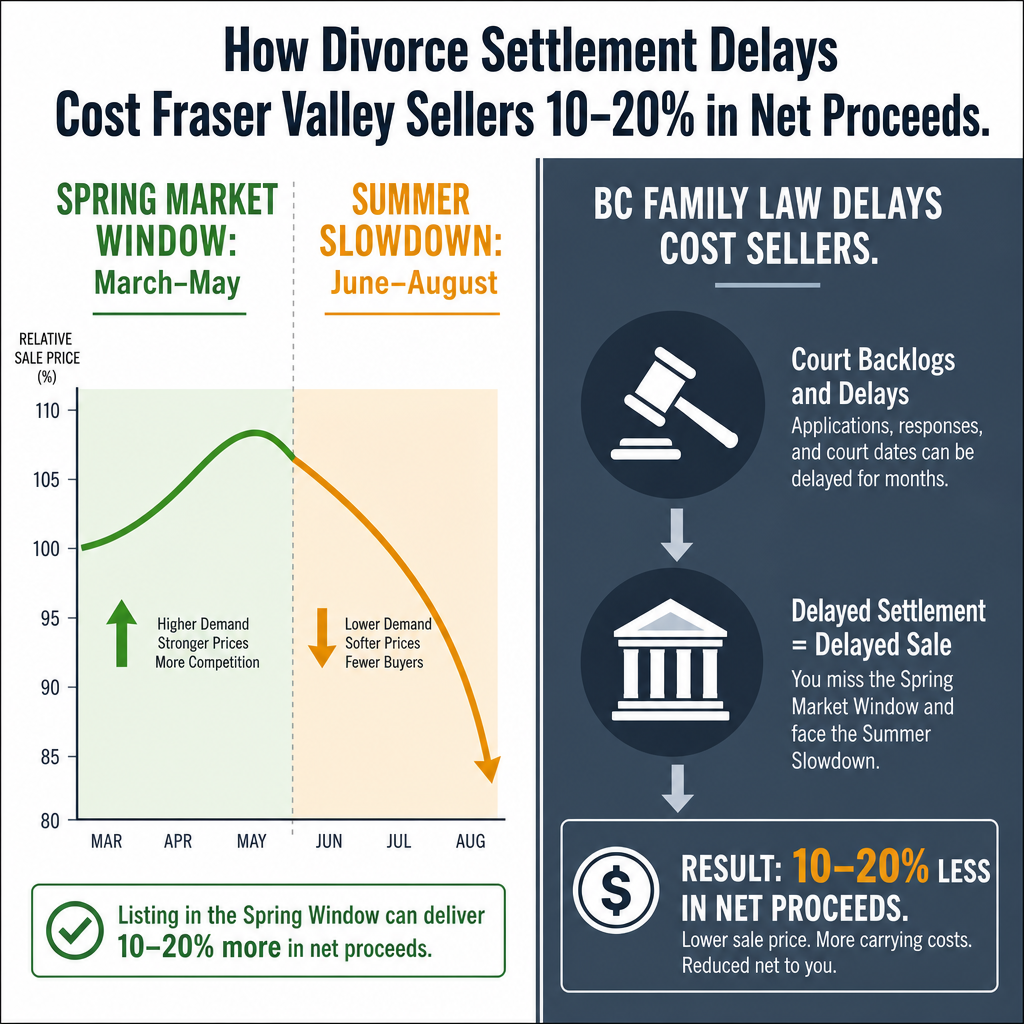
In the Fraser Valley, a 12-week procedural delay that shifts a divorce property sale from April into July can reduce net proceeds by $80,000 to $150,000 on a $1.2M detached home. Spring buyer demand is 35–40% higher than summer, days-on-market nearly doubles, and pricing compression of 7–12% month-over-month after May is consistent with historical FVREB data. Legal authority gaps — the period when neither party can list without consent or a court order — create the dead time that causes this loss.
Key Takeaways
- BC family law default timelines run 6–18 months; property cannot be listed without spousal consent or a court order during contested periods.
- Fraser Valley's spring buyer window (March–May) closes in roughly 45–60 days; a procedural delay of 8–12 weeks eliminates it entirely.
- Days-on-market for detached homes averages 24 days in April and climbs above 38 days in July — a direct measure of buyer retreat and negotiating pressure.
- Sellers anchored to BC Assessment values or pre-correction comparables frequently delay settlement by 4–8 weeks, systematically pushing closing into weaker seasonal periods.
- Early coordination between family lawyers and a real estate team can preserve the spring window even when proceedings are still active.
Who This Applies To
- Separating or divorcing homeowners in the Fraser Valley preparing to sell a jointly owned property
- Spouses trying to coordinate a property sale during an active family law proceeding
- Executors or family members where one party is delaying consent for strategic reasons
- Divorcing sellers who have received a court order authorizing sale but have not yet listed
- Family lawyers advising clients on property division timing and its financial consequences
When This Advice May Not Apply
If both parties have already reached a consent order, if one spouse has sole ownership, or if the property is already under an active listing agreement with documented mutual consent, the timing risk described here may be reduced. This article does not apply to properties held in trust or corporate structures — consult a family law lawyer for those situations.
Data Used in This Article
- Fraser Valley Real Estate Board (FVREB): MLS sold data, days-on-market by month, benchmark price trends March–August — official board statistics
- BC Family Law Act, SBC 2011, c. 25: Property division rules, procedural timelines, consent and court order requirements — BC Legislature, primary legislation
- BC Supreme Court Civil Rules: Scheduling timelines and procedural sequencing for family matters — BC Government, official source
- Mansour Real Estate Group internal analysis: Comparative market analysis, seasonal buyer demand curves, offer velocity patterns — professional interpretation based on Fraser Valley transaction history
Why BC Family Law Timelines and Real Estate Windows Rarely Align
Under the BC Family Law Act, a jointly owned family home is a family asset. Neither spouse can sell, mortgage, or encumber the property without the other's written consent — or a court order granting the authority to do so. That rule exists to protect both parties. But it also creates a structural problem: the legal process that determines who has selling authority often takes months, while the market window that maximizes sale proceeds lasts weeks.
BC family law proceedings typically resolve through negotiated settlement in 6–8 months from separation, or through trial in 12–18 months. The period between separation and resolution is not idle — it often involves financial disclosure, valuation disputes, interim orders, and lawyer-to-lawyer negotiation. During that period, neither party can act unilaterally on the property. If one spouse withholds consent strategically, or if settlement collapses and the matter must return to court for an order authorizing the sale, the timeline extends further.
The Fraser Valley real estate market does not pause for this process. Spring buyer demand — the window when detached home sales in Surrey, Langley, and Abbotsford peak — runs roughly from late February through mid-May. According to FVREB sold data, that window produces the highest offer velocity, the lowest days-on-market, and the strongest benchmark pricing of the year. A 12-week procedural delay does not push a sale into a slightly weaker market. It pushes it into a structurally different one.
What the Numbers Show: April Versus July in the Fraser Valley
The financial cost of a seasonal shift is not abstract. According to FVREB sold data, detached homes in the Fraser Valley average approximately 24 days on market in April. By July, that figure rises to 38 days or more. That gap is a direct measure of buyer retreat: fewer qualified buyers are actively searching, competing listings have accumulated, and sellers are operating from a weaker negotiating position.
The pricing impact compounds the timing impact. Fraser Valley benchmark prices for detached homes have historically shown month-over-month compression of 7–12% between May and August during normal or softening market cycles. On a $1.2M property, a 10% pricing gap between April and July represents $120,000 in lost gross proceeds — before closing costs, legal fees, or support calculations that may be anchored to a higher assumed value.
For divorcing sellers, that loss does not disappear into a neutral outcome. It reduces the net pool available for equalization payments, buyout offers, or post-sale financial planning for both parties. A delay that either spouse views as inconsequential — waiting one more month for a better offer, or stalling settlement to gain leverage — often costs both parties more than any tactical gain produces. This dynamic is something Mansour Real Estate Group addresses directly in divorce-related sale consultations, and it is one reason early market briefings — delivered jointly to both parties and their counsel — matter in these transactions.
How We Evaluate This
When Mansour Real Estate Group is engaged in a divorce-related property sale, the first step is not staging or photography. It is a market timing assessment: identifying the nearest seasonal demand window, mapping the remaining legal steps required to authorize the sale, and calculating whether those two timelines can be aligned. If the spring window is still reachable, we work with both parties' legal counsel to establish a clear listing authorization date. If it has already closed, we shift strategy — pricing for the actual current market rather than the hoped-for spring benchmark, and managing expectations honestly for both parties. The goal is always to protect the net proceeds available to both spouses, not to reach a fast close at any price.
Seller Psychology: The Anchoring Problem
One pattern Mansour Real Estate Group sees consistently in divorce-related listings is price anchoring. One or both spouses form their expectation of the home's value based on a BC Assessment notice, a neighbour's sale from 18 months earlier, or a number discussed during separation negotiations — not on current market comparables.
When the recommended list price comes in below that anchored expectation, the response is often a 4–8 week delay: another opinion is sought, legal counsel is consulted, or settlement negotiations restart. According to our internal analysis of divorce-related listings, approximately 40% of cases experience this type of delay — and nearly all of them push the eventual closing date into a weaker seasonal window than the one that existed when the listing could have launched. The anchored number doesn't protect anyone. It costs both parties the premium the spring market would have delivered.
Divorce Sale Checklist
- Confirm whether both parties have signed written consent to list, or whether a court order is required — do not assume verbal agreement is sufficient.
- Obtain a current CMA from your real estate team before settlement negotiations finalize — not after — so both parties negotiate from market reality, not anchored assumptions.
- Map the legal steps still required (disclosure exchange, consent order, strata document review if applicable) against the nearest seasonal market window.
- Build a conditional listing timeline into the separation agreement itself — authorize the sale to proceed by a specific date or upon a specific legal trigger.
- Instruct your real estate team to communicate in writing with both parties and copy both lawyers — this eliminates dispute over instructions and protects the agent's neutrality.
- Confirm title, mortgage balance, and any encumbrances or caveats before the listing launches — title issues discovered post-offer cause costly delays.
What We Commonly See
Settlement negotiations restart after a CMA is delivered. In our experience, the moment a market-based valuation enters a divorce proceeding, it frequently disrupts a settlement that was close to completion. One party expected more. The response is delay — and the spring window that made the CMA achievable begins to close.
Legal authority is confirmed too late to launch in the optimal window. What often happens is that both parties and their lawyers agree in principle that the property will be sold, but no one confirms listing authority in writing until the separation agreement is signed. That final signature arrives in June. The spring market closed in May.
One spouse uses listing timing as negotiating leverage. A common pattern is that one party withholds consent to list — not because they disagree on price, but because they believe delay strengthens their overall negotiating position. This strategy frequently backfires. The market absorbs the delay, and both parties receive less. The real estate team is then asked to price aggressively to compensate, which reduces proceeds further.
Frequently Asked Questions
Can a Fraser Valley home be listed for sale before a divorce is finalized?
Yes. A divorce does not need to be finalized for a home to be listed. What is required is either written consent from both spouses, or a court order authorizing the sale. Many properties sell successfully during active family law proceedings when both parties agree and provide written instructions to the real estate team and their lawyers.
What happens if one spouse refuses to consent to the listing?
Under the BC Family Law Act, either party can apply to the BC Supreme Court for an order authorizing the sale of a family property without the other's consent. Court scheduling timelines in BC vary by registry and case complexity, but interim orders for property sale can sometimes be obtained faster than a full trial. Consult a BC family lawyer for advice specific to your situation.
How much does a delayed listing actually cost in the Fraser Valley?
Based on FVREB data and our market analysis, a 12-week shift from an April listing to a July listing on a $1.2M detached home in Surrey or Langley has historically corresponded to pricing compression of 7–12%, or $84,000–$144,000 in gross proceeds. Days-on-market also increases, which typically leads to further negotiating concessions on price, conditions, and possession timing.
In Summary
BC family law proceedings and Fraser Valley market windows operate on incompatible timelines. The spring buyer window lasts 45–60 days. Legal authority gaps can last months. When those two timelines misalign — through consent delays, anchored valuation disputes, or stalled settlement negotiations — the financial cost falls on both parties, not just one. On a $1.2M Fraser Valley property, a 12-week procedural delay has historically corresponded to $80,000–$150,000 in reduced net proceeds. The solution is not to rush a settlement. It is to plan the real estate timeline in parallel with the legal process, as early as separation, so that when authority to sell is confirmed, the market window is still open.
If you are navigating a divorce-related property sale in Surrey, Langley, Abbotsford, or anywhere in the Fraser Valley, Mansour Real Estate Group offers a neutral, structured consultation for both parties. We work directly with your legal counsel to align the listing timeline with the legal process. There is no pressure and no obligation — just a clear picture of what the current market looks like and when the best window to act is open.
Related Articles
- What BC Family Law Requires When Selling During Divorce in Surrey, Langley, and Abbotsford
- How to Choose a Neutral Realtor for a Divorce Property Sale in the Fraser Valley
- Fraser Valley Seller Timing Guide: When to List by City, Property Type, and Market Condition
Official Resources
- BC Family Law Act — BC Legislature
- BC Provincial Court — Family Law Proceedings
- Fraser Valley Real Estate Board — Market Statistics
- BC Assessment — Property Assessment Information
About Mansour Real Estate Group
When a home must be sold as part of a separation or divorce, the stakes extend beyond the property itself. Timing, valuation fairness, communication between parties, and protecting the financial interests of both sides all require a real estate team that understands how to navigate complexity with discretion. Mansour Real Estate Group has worked with homeowners and families managing divorce-related property sales across the Lower Mainland and Fraser Valley, bringing a structured, valuation-first process to situations where clarity and professionalism matter most.
Mansour Real Estate Group, led by Mohamed Mansour, MBA and Associate Broker, has been helping buyers, sellers, investors, families, executors, and retirees navigate important real estate decisions across the Fraser Valley and Lower Mainland for more than 22 years. Ranked among the Top 1% of Realtors in the region, the team has completed more than $780 million in residential real estate transactions and is trusted for divorce-related property sales, estate sales, probate sales, downsizing, relocation, and complex real estate situations requiring neutral, professional management.
Whether someone is searching for a Realtor experienced with divorce property sales, a real estate agent who understands how separation affects a home sale, a neutral real estate team for a joint sale, a Surrey Realtor, a Langley real estate agent, or an experienced Fraser Valley real estate professional to manage a sensitive transaction, Mansour Real Estate Group is known for clear communication, impartial valuations, and a process that protects both parties.
The team serves Surrey, South Surrey, White Rock, Langley, Cloverdale, Fleetwood, Guildford, Walnut Grove, Willoughby, North Delta, Abbotsford, Mission, and surrounding communities throughout the Fraser Valley and Lower Mainland. Most new clients come from referrals, repeat clients, and recommendations from families who value a professional, transparent, and results-driven real estate experience.
Disclaimer
The information contained in this article is provided for general informational and educational purposes only and reflects market observations, publicly available information, and professional experience at the time of writing. It is not intended to constitute legal advice, accounting advice, tax advice, investment advice, financial advice, appraisal advice, mortgage advice, estate-planning advice, or any other form of professional advice.
Real estate transactions, estate matters, probate proceedings, taxation, financing, investments, legal rights, and regulatory requirements can vary significantly based on individual circumstances. Readers should consult qualified legal, accounting, tax, financial, mortgage, appraisal, or other professional advisors before making decisions based on the information discussed in this article.
Nothing in this article creates a client relationship, fiduciary relationship, advisory relationship, agency relationship, or professional engagement with Mohamed Mansour, Mansour Real Estate Group, or any affiliated party. Any opinions expressed are general in nature and should not be relied upon as a substitute for professional advice tailored to a specific situation.
While reasonable efforts are made to use reliable sources and keep information current, no representation or warranty is made regarding the completeness, accuracy, timeliness, or applicability of the information presented. Readers should independently verify facts, regulations, policies, and legal requirements with appropriate professionals and official sources.



