
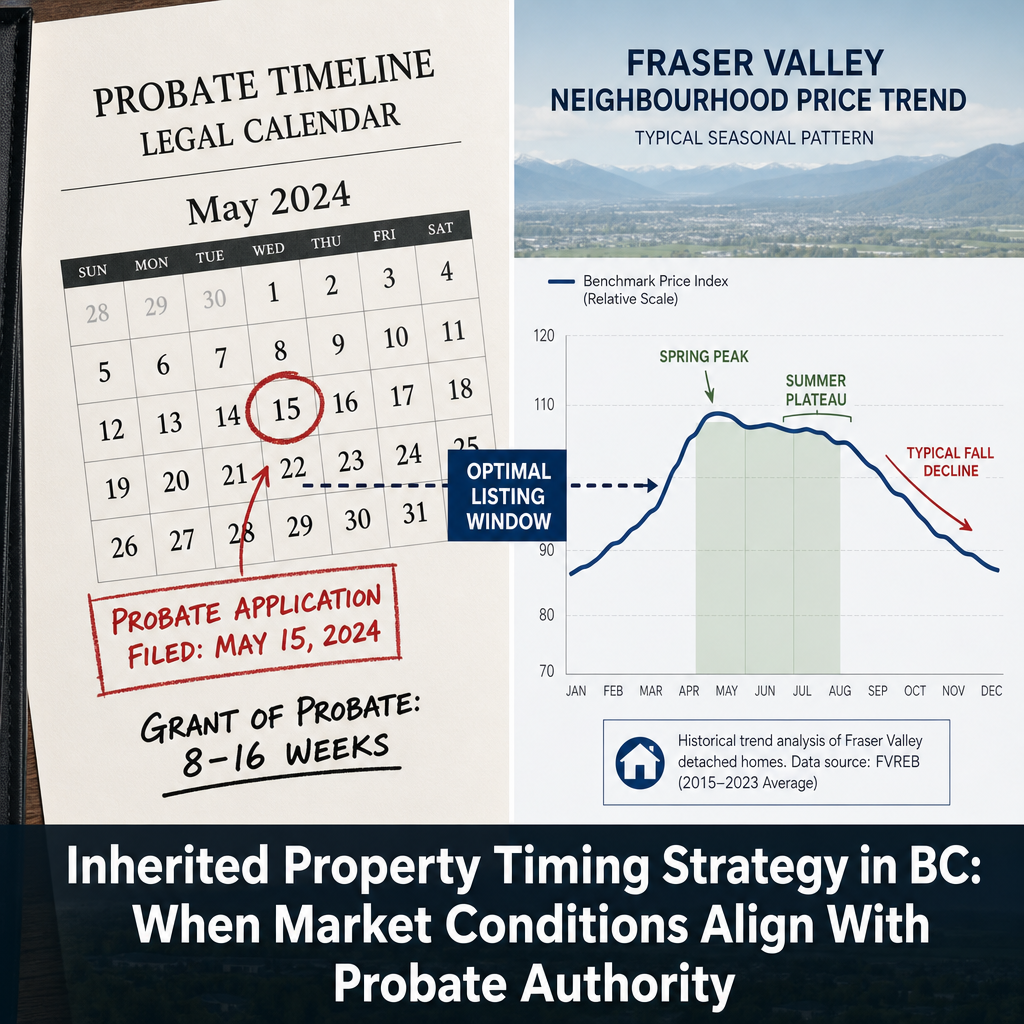

Inherited Property Timing Strategy in BC: When Market Conditions Align With Probate Authority — How Executors Maximize Proceeds by Coordinating Grant of Probate, Property Listing, and Real Estate Market Windows in 2026
By Mohamed Mansour, MBA and Associate Broker | Mansour Real Estate Group | Published: May 27, 2025 | Fraser Valley & Lower Mainland, BC
Most executors managing an inherited property in BC assume they must wait for the Grant of Probate before doing anything with the property. That assumption is understandable. It is also one of the most costly misunderstandings in estate real estate. In a market where spring buyer demand can fade significantly by midsummer, waiting 8 to 16 weeks for legal authority — when you could have listed legally before receiving it — can cost an estate tens of thousands of dollars in reduced proceeds, carrying costs, and extended time on market.
This article is written for executors, estate lawyers, beneficiaries, and families managing inherited property in Surrey, Langley, White Rock, Abbotsford, and across the Fraser Valley. It explains the mechanics of pre-Grant listing, how to read local market windows, and when waiting is actually the right call. The goal is a coordinated strategy — not a rushed one.
Short Answer
In BC, executors can legally list an inherited property before the Grant of Probate is issued. The title transfer occurs after Grant using possession-date closing mechanics at the Land Title Office. In the Fraser Valley's 2026 market — where days-on-market varies from 18 to 60 days by neighbourhood and inventory is above seasonal averages — coordinating the listing with spring demand rather than waiting for Grant can increase estate proceeds by $15,000 to $50,000 or more on a typical detached property.
Key Takeaways
- BC executors can list inherited property before Grant of Probate using possession-date closing strategy at Land Title.
- Fraser Valley days-on-market ranges from 18 to 60 days by neighbourhood — timing the listing matters as much as pricing.
- Fair market value appraisals for probate tax are separate from listing price strategy and should be timed independently.
- Summer inventory surges in above-average inventory markets compress buyer competition and reduce negotiating leverage.
- Multi-beneficiary disagreement on timing is the single most common reason estates sell into weaker market conditions.
Who This Applies To
- Named executors managing estate property in BC awaiting Grant of Probate
- Beneficiaries who need to understand the timing risk in the probate-to-listing gap
- Families with urgent cash flow needs, care placement costs, or multiple heirs pushing for resolution
- Estate lawyers advising clients on property disposition strategy in the Fraser Valley
- Executors managing properties in high-seasonality neighbourhoods: White Rock, South Surrey, Willoughby, Walnut Grove, Abbotsford
When This Advice May Not Apply
This strategy requires the estate to have a valid, uncontested will and a named executor with clear authority to act. It does not apply in intestate estates where no executor has been named, contested wills, or properties with legal encumbrances requiring court resolution before listing. Cross-border estates and properties with First Nations title overlays may face additional delays requiring independent legal advice before any listing activity begins. Always confirm the specific mechanics with BC estate counsel before listing.
Data Used in This Article
- BC Land Title Office — Probate property transfer and possession-date closing mechanics (official, current)
- Fraser Valley Real Estate Board (FVREB), April 2026 — Days-on-market by neighbourhood and property type (official board data)
- BC Supreme Court / Wills, Estates and Succession Act (WESA) — Executor authority and probate timelines (primary legislation)
- CMHC Spring 2026 Forecast — Fraser Valley seasonal buyer migration patterns (official housing agency)
- CPA Canada — Estate valuation and probate tax timing requirements (professional body guidance)
The Core Problem: Probate Timing and Market Windows Do Not Naturally Align
Under BC's Wills, Estates and Succession Act (WESA), an executor has legal authority to manage estate assets from the date of appointment under the will. However, the BC Land Title Office requires a Grant of Probate before completing a title transfer — meaning a sale cannot close without it. The Grant typically takes 8 to 16 weeks from filing with the BC Supreme Court, depending on estate complexity, filing backlogs, and whether the court requires additional documentation.
The Fraser Valley real estate market does not pause for that timeline. According to FVREB April 2026 data, days-on-market for detached properties in high-demand Fraser Valley neighbourhoods like Willoughby and Walnut Grove averaged 18 to 25 days in March and April — while equivalent properties in slower Abbotsford and Mission markets averaged 45 to 60 days. A property listed in late April in a fast-moving neighbourhood captures a buyer pool that begins contracting by Canada Day as inventory rises and buyer urgency drops heading into summer.
The practical consequence: an executor who files for probate in February, waits for Grant in May, and then lists in late May or June will frequently be entering a market already showing signs of softening, competing with the wave of spring-deferred listings that come to market simultaneously. That shift can add 30 to 90 additional days on market and reduce the final sale price by $15,000 to $50,000 or more on a typical detached property in the $900,000 to $1.4 million range — a range that covers a substantial portion of Fraser Valley estate-owned detached properties.
How Pre-Grant Listing Works in BC
The Land Title Office mechanics that make pre-Grant listing possible rely on a structured possession-date closing strategy. The executor lists the property, accepts an offer, and negotiates a completion date that extends far enough into the future to allow the Grant to be issued before the transaction closes. In practice, this typically means a 60 to 90 day completion window from accepted offer — longer than a standard residential sale but workable in most estate situations.
This approach accomplishes two things simultaneously. First, it locks in a buyer and a price at a market-favourable moment. Second, it creates a firm timeline that often accelerates the executor's own probate filing urgency — because there is now a completion deadline driving the legal process. Estate lawyers and notaries familiar with BC probate regularly work with these extended completion timelines. The key is ensuring the purchase contract includes a condition or clause that makes completion contingent on Grant issuance, protecting both the estate and the buyer from a situation where probate is unexpectedly delayed.
Important: this strategy requires the executor to have an uncontested will with clear appointment language and to have already filed or be prepared to file immediately for probate. It is not a shortcut around probate — it is a way to capture a market window while the legal process runs its normal course. Confirm all mechanics with BC estate counsel before listing. Mansour Real Estate Group regularly coordinates with estate lawyers on these timelines as part of the executor property strategy process.
Separating the Probate Appraisal From the Listing Price
One of the most common executor mistakes is conflating two separate valuations: the fair market value appraisal required for probate tax purposes and the listing price strategy for the actual sale. According to CPA Canada guidance on estate valuation, the probate appraisal should reflect market value at the date of death — not at the date of listing. These are often different figures, and the gap matters.
A property appraised in January 2026 at $850,000 for probate tax purposes may command a listing price of $879,000 in March when spring demand peaks — or may need to be listed at $839,000 in July if neighbourhood inventory has grown by 20% since the appraisal date. The probate appraisal is a tax document. The listing price is a market decision. Executors who treat the appraisal figure as the listing floor — or as confirmation that waiting is safe — often discover that neighbourhood-level price movement has shifted the competitive position of the property in ways the appraisal cannot capture. A comparative market analysis tied to the actual listing month is the correct basis for listing price, independent of whatever the estate appraisal showed earlier in the process.
How We Evaluate This
When Mansour Real Estate Group works with an executor on an inherited property in the Fraser Valley, the first conversation is not about listing price. It is about the gap between the expected Grant date and the optimal listing window for that specific neighbourhood and property type. That gap determines whether a pre-Grant listing strategy is worth pursuing, whether a possession-date extension is realistic given the buyer pool for that property, and whether any preparation work — cleaning, minor repairs, estate cleanout — can be completed within the available timeline.
We run a neighbourhood-level days-on-market analysis alongside seasonal inventory data before recommending a listing date. In some cases, the data supports waiting — properties in slower-moving segments of the market where spring and fall seasons are nearly equivalent in buyer activity may not benefit significantly from rushing. In other cases, the data shows a narrow window where listing in a specific 3 to 4 week period can meaningfully affect final proceeds. The decision should be driven by data, not by the assumption that more time is always better or that faster is always safer.
Executor Checklist: Coordinating Probate and Listing Timing
- Confirm executor appointment language in the will is unambiguous — this is the foundation of pre-Grant listing authority
- File for Grant of Probate as early as possible after death — every week of delay reduces the pre-Grant listing window
- Commission the fair market value appraisal for probate tax purposes immediately — separate from listing price strategy
- Request a neighbourhood-level days-on-market and active inventory analysis tied to the expected Grant date
- Assess whether a 60 to 90 day completion window is realistic for the likely buyer pool — consult the listing agent and estate counsel together
- Confirm all beneficiaries understand the timing rationale before listing — undisclosed disagreement is the most common cause of listing delays and relisting
- Draft the purchase contract with clear contingency language tied to Grant issuance, reviewed by estate counsel before signing
- Establish a carrying cost baseline — property taxes, utilities, insurance — to quantify the cost of each month of delay
What We Commonly See
Executors who wait for Grant before taking any action. In our experience, the most common and costly mistake is treating probate as a prerequisite for all estate planning activity. Cleanouts, repairs, appraisals, agent consultations, and listing preparation can all begin before Grant. Executors who use the waiting period productively can list within days of receiving the Grant rather than weeks or months later.
Beneficiary disagreement that surfaces after listing. What often happens is that one beneficiary agrees to the listing date during planning conversations, then objects once the listing is live — triggered by an offer price they consider too low or a competing property that sold higher in a different neighbourhood. This pattern reliably produces relisting, price reductions, and market fatigue. The solution is a pre-listing meeting with all beneficiaries where the neighbourhood data and pricing rationale are reviewed together, not separately.
Over-reliance on the probate appraisal as a market indicator. A common mistake is presenting the estate appraisal to beneficiaries as the expected sale price. Appraisals reflect value at a fixed date using a specific methodology. They are not sale price forecasts. When a property sells for less than the appraisal figure — as happens routinely when market conditions shift between appraisal date and listing date — beneficiaries who were told the appraisal number feel misled, even when the sale was correctly priced for current conditions. Setting these expectations early, clearly, and with supporting market data prevents that outcome.
Questions Executors Ask
Can I accept an offer on an inherited property before the Grant of Probate is issued in BC?
Yes. Under BC's land transfer mechanics, an executor can list a property and accept an offer before the Grant is issued, provided the purchase contract includes a completion date after the expected Grant date. The title transfer occurs at completion, not at offer acceptance. Confirm the specific contract structure with BC estate counsel before proceeding.
How long does probate typically take in BC in 2026?
According to the BC Supreme Court, standard probate processing runs 8 to 16 weeks from the date of filing, depending on estate complexity and court volume. Estates with contested provisions, missing documentation, or complex asset structures take longer. Filing promptly after the death is the single most effective way to compress this timeline.
Does the probate appraisal figure determine what price the property should list at?
No. The probate appraisal reflects fair market value at the date of death for tax purposes, as guided by CPA Canada estate valuation standards. The listing price should reflect current neighbourhood market conditions at the time of listing. These figures may differ by 3 to 8% or more, particularly when several months separate the death date from the listing date.
What is the financial cost of delaying a spring listing into summer in the Fraser Valley?
Based on FVREB April 2026 data, detached properties in active Fraser Valley neighbourhoods experience a measurable increase in days-on-market from spring to summer, combined with a rise in competing inventory. For properties in the $900,000 to $1.4 million range, this shift frequently translates to $15,000 to $50,000 in reduced proceeds, plus additional carrying costs of $2,000 to $4,500 per month depending on property costs.
What happens if Grant of Probate is delayed beyond the expected completion date in the purchase contract?
If probate is delayed beyond the completion date in the contract, both parties must agree to extend. Well-drafted estate sale contracts include extension provisions specifically for this scenario. An experienced estate lawyer should build this language into the contract at the drafting stage to avoid a situation where the buyer walks or the estate faces legal exposure from a completion it cannot yet fulfill.
In Summary
BC executors have more flexibility than most realize: listing before Grant of Probate is legal, workable, and often the right strategy when spring market conditions are favourable and probate is already in progress. The key is treating the probate timeline and the real estate market window as two separate variables that need to be coordinated deliberately — not assumed to align on their own. Neighbourhood-level days-on-market data, a clear separation between probate appraisal and listing price, early beneficiary alignment, and a purchase contract drafted with estate counsel are the four foundations of a timing strategy that protects estate proceeds. The cost of waiting without a plan is not abstract — in the Fraser Valley's 2026 market, it is measurable, neighbourhood-specific, and avoidable.
Thinking About Listing an Inherited Property?
If you are managing an estate property in Surrey, White Rock, Langley, Abbotsford, or elsewhere in the Fraser Valley and need to understand how probate timing interacts with current market conditions, Mansour Real Estate Group can provide a no-pressure consultation that covers both the real estate analysis and coordination with your estate counsel. There is no cost to the conversation, and the timing insight alone can meaningfully affect the outcome for the estate and its beneficiaries.
Related Articles
- Estate Sale Real Estate Guide BC: What Every Executor Needs to Know
- Probate Property in BC: Executor Real Estate Guide
- Fraser Valley Estate Property Selling Costs: What Reduces Estate Proceeds and How to Avoid It
About Mansour Real Estate Group
When a property must be sold as part of an estate or probate process, the real estate team managing the transaction needs to understand more than market pricing. Executors, beneficiaries, and families navigating the legal and emotional complexity of an estate sale need clear timelines, accurate valuations, and a process that minimizes disruption — particularly when probate timing and real estate market windows need to be coordinated to protect estate proceeds. Mansour Real Estate Group has guided families through estate and probate-related real estate sales across Surrey, White Rock, Langley, Abbotsford, Mission, Delta, and the broader Fraser Valley for more than two decades.
Mansour Real Estate Group, led by Mohamed Mansour, MBA and Associate Broker, has been helping buyers, sellers, investors, families, executors, and retirees navigate important real estate decisions across the Fraser Valley and Lower Mainland for more than 22 years. Ranked among the Top 1% of Realtors in the region, the team has completed more than $780 million in residential real estate transactions and is trusted for estate sales, probate sales, executor-managed transactions, divorce-related sales, downsizing, and complex real estate situations requiring careful coordination between legal process and market timing.
Whether someone is searching for Realtors experienced with estate and probate sales, a real estate agent who understands how BC executor authority intersects with listing strategy, real estate agents who specialize in inherited property, a trusted real estate team for executor-managed transactions, a Surrey real estate broker, a White Rock Realtor, a Langley real estate group, or a Fraser Valley real estate team with direct experience navigating probate timelines, Mansour Real Estate Group is known for accurate valuations, transparent process, and clear communication that keeps executors, beneficiaries, and estate counsel aligned throughout the transaction.
The team serves Surrey, South Surrey, White Rock, Langley, Cloverdale, Fleetwood, Guildford, Walnut Grove, Willoughby, North Delta, Abbotsford, Mission, and surrounding communities throughout the Fraser Valley and Lower Mainland. Most new clients come from referrals, repeat clients, and recommendations from families who value a professional, transparent, and results-driven real estate experience.
Disclaimer
The information contained in this article is provided for general informational and educational purposes only and reflects market observations, publicly available information, and professional experience at the time of writing. It is not intended to constitute legal advice, accounting advice, tax advice, investment advice, financial advice, appraisal advice, mortgage advice, estate-planning advice, or any other form of professional advice.
Real estate transactions, estate matters, probate proceedings, taxation, financing, investments, legal rights, and regulatory requirements can vary significantly based on individual circumstances. Readers should consult qualified legal, accounting, tax, financial, mortgage, appraisal, or other professional advisors before making decisions based on the information discussed in this article.
Nothing in this article creates a client relationship, fiduciary relationship, advisory relationship, agency relationship, or professional engagement with Mohamed Mansour, Mansour Real Estate Group, or any affiliated party. Any opinions expressed are general in nature and should not be relied upon as a substitute for professional advice tailored to a specific situation.
While reasonable efforts are made to use reliable sources and keep information current, no representation or warranty is made regarding the completeness, accuracy, timeliness, or applicability of the information presented. Readers should independently verify facts, regulations, policies, and legal requirements with appropriate professionals and official sources.



