
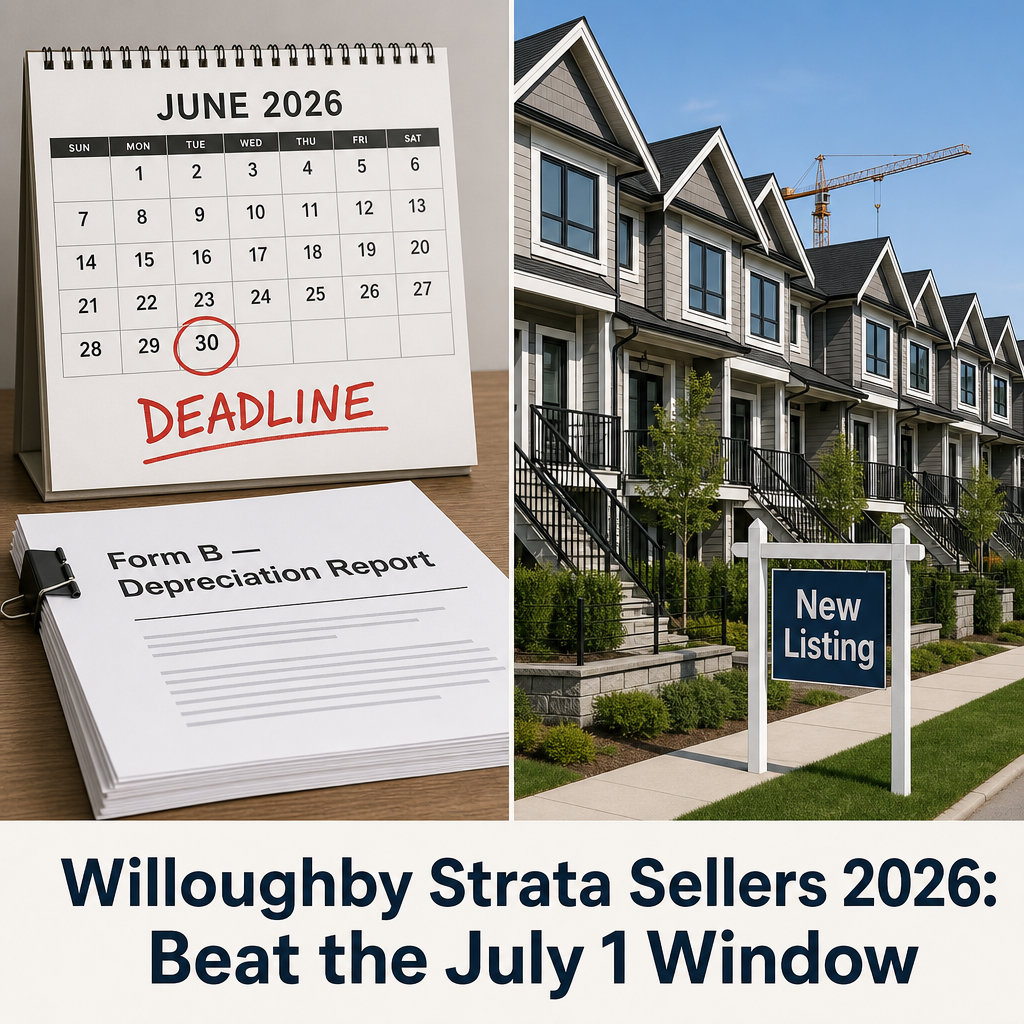

Willoughby Langley Strata Property Sellers 2026: Why the July 1 Depreciation Report Deadline, Rising Special Levies, and Incoming New Construction Create a Compressed Pricing Window — And How to Maximize Proceeds Before Builder Incentive Phase-Out and Summer Competition Peak
By Mohamed Mansour, MBA, Associate Broker — Mansour Real Estate Group | Fraser Valley & Lower Mainland | Published: July 15, 2026 | Topic: Condo & Strata — Willoughby, Langley BC
If you own a townhome or condo in Willoughby, Langley, and you are thinking about selling in 2026, the timing of your decision carries more financial weight this year than it has in recent memory. Three separate forces are converging at once: a hard regulatory deadline on July 1 tied to depreciation reports under BC's Strata Property Act, a wave of new inventory entering the market as builder incentive programs wind down, and the growing likelihood of special levy announcements as building systems in newer communities begin to mature.
This article explains each of those forces clearly, what they mean for your closing timeline, your appraisal, and your net proceeds — and what the mid-May through June 30 window means for sellers who understand it.
Short Answer
Willoughby strata sellers who list and close before July 1, 2026 avoid depreciation report financing delays, compete against fewer resale units, and exit before potential special levy announcements reduce buyer confidence and appraisal values. Sellers who wait face a 6–8 week timeline extension, a more crowded resale market, and heightened buyer conditions. The window is real, and it is narrowing.
Key Takeaways
- The July 1 depreciation report deadline is a hard regulatory trigger under BC's Strata Property Act — not a soft guideline.
- Sellers closing after July 1 face 6–8 week timeline extensions, extended carrying costs, and heightened buyer appraisal conditions.
- New construction inventory is expected to surge in Willoughby in Q2–Q3 2026, compressing resale seller pricing power by an estimated 5–10%.
- Special levies in Willoughby strata communities are anticipated in 2026–2027 as systems mature; announced levies can reduce appraisal values by 10–15%.
- The mid-May through June 30 window gives motivated Willoughby sellers their best combination of low competition, clean financing conditions, and full pricing power.
Who This Applies To
- Owners of townhomes and condos in Willoughby or Willowbrook area strata communities
- Sellers considering a 2026 listing who have not yet set a firm timeline
- Investors holding Willoughby strata units evaluating exit timing
- Homeowners in strata buildings with known or pending depreciation report updates
- Anyone who has heard about special levies in their building and is unsure how it affects saleability
When This Advice May Not Apply
If your strata building already has a current, compliant depreciation report on file, the July 1 deadline may create less disruption to your timeline. If you are not planning to sell until late 2026 or 2027, the dynamics will have shifted. Sellers in buildings with no pending levies and strong reserve fund positions may have more flexibility. Consult your strata council or property manager to confirm your building's current documentation status before making timing decisions.
Data Used in This Article
- BC Strata Property Act — Form B and depreciation report requirements (official legislation, Province of British Columbia)
- Fraser Valley Real Estate Board (FVREB) — Q1–Q2 2026 market data, Willoughby Langley new supply pipeline (official board data)
- Mansour Real Estate Group internal analysis — Willoughby builder timeline and incentive program tracking, strata market observations (professional interpretation)
- BC Assessment / CMHC — Strata reserve fund trends and special levy impact on buyer financing in master-planned communities (official/third-party data)
What the July 1 Deadline Actually Means for Sellers
Under BC's Strata Property Act, a Form B Information Certificate must be provided to a buyer before they complete the purchase of a strata unit. Form B includes the building's current depreciation report — a mandatory engineering-based assessment of the building's components, their remaining lifespan, and the reserve fund's ability to cover future repairs.
Amendments to the Act created a hard compliance date: strata corporations that have not yet commissioned or updated their depreciation report are required to have one in place by July 1, 2026. For sellers, this creates a two-track reality. A property listed and closed before July 1 can transact normally if the current report is sufficient. A property that closes after July 1 in a building without a compliant report will face delays of 6–8 weeks while the strata corporation arranges the inspection and files the report — delays that directly affect buyer financing approvals, appraisal timing, and your closing date.
According to our internal analysis tracking Willoughby strata buildings, a meaningful number of newer communities in the area have depreciation reports that were commissioned during initial build-out but have not been updated to reflect current system ages and reserve fund adequacy. Those are the buildings most at risk of post-July 1 delays — and their sellers are the ones most exposed to extended timelines and buyer hesitation.
New Construction Competition and the Builder Incentive Phase-Out
Willoughby has been one of the most actively developed master-planned communities in the Fraser Valley for over a decade. As of 2026, multiple phases of townhome and condo construction are reaching completion or near-completion simultaneously. When builders complete a phase, their sales centres pivot from pre-sale to possession-ready inventory — and they often do so with incentives: closing cost credits, appliance packages, rate buy-downs, and flexible deposit structures that resale sellers cannot match.
FVREB market data and Mansour Real Estate Group's tracking of Willoughby builder timelines indicate that this incentive phase is expected to wind down through Q2 and Q3 2026 as builders sell out their remaining inventory. Once builder units move from incentivized presale to standard resale, they compete directly with existing owners on price alone — and they compete with the advantage of new construction condition, warranty coverage, and fresh finishes. Resale sellers who wait until that supply is fully absorbed face a more crowded market and a buyer pool that has more choices. Our analysis suggests this could compress resale pricing power by 5–10% relative to the pre-competition window.
How Special Levies Change the Buyer Conversation
Willoughby's strata communities are, in many cases, 8–15 years old in their earliest phases and 2–6 years old in their most recent ones. As buildings age into their first major repair cycles — membrane replacements, elevator maintenance contracts, mechanical system upgrades — strata councils face a recurring pressure: the reserve fund may not be fully funded to cover upcoming costs, and special levies become the mechanism for bridging the gap.
A special levy is a one-time assessment charged to unit owners beyond their regular monthly strata fees. According to CMHC and BC Assessment data on strata reserve fund trends, properties in buildings with announced or pending special levies face an average appraisal reduction of 10–15%, and a significant proportion of buyer financing applications are denied or delayed when lenders identify levy risk during underwriting. For sellers, this means an announced levy — even one that seems manageable — can eliminate a segment of qualified buyers, reduce the appraised value of the property, and force a price reduction that was never anticipated when the decision to sell was made.
How We Evaluate This
When Mansour Real Estate Group works with a Willoughby strata seller, our first step is not a CMA. It is a document review. We request the current Form B, the most recent depreciation report, the strata's financial statements, and meeting minutes from the last 12–24 months. Those documents tell us whether a levy has been discussed, whether the reserve fund is tracking to plan, and whether the depreciation report will survive the post-July 1 compliance environment without triggering delays.
Only once we understand the building's documentation position do we build the pricing strategy. A seller whose building has a clean, current depreciation report and a well-funded reserve is in a fundamentally different position than one whose building is scheduled for a levy vote in the fall. The pricing strategy, timing recommendation, and buyer communication approach are all different — and conflating them is one of the most common and costly mistakes we see strata sellers make.
Strata Seller Checklist — Willoughby Langley 2026
- Confirm with your strata property manager whether your building's depreciation report is current and compliant with the July 1, 2026 requirements under the BC Strata Property Act.
- Request and review the last 24 months of strata council meeting minutes for any discussion of special levies, deferred repairs, or reserve fund shortfalls.
- Obtain the current Form B and review Section 6 (levies) and Section 7 (known and anticipated expenditures) before deciding on your list date.
- If your building has an upcoming depreciation report update, confirm the timeline — and whether your listing and closing can be structured to complete before the compliance deadline.
- Review your unit's parking, storage locker, and any exclusive-use area documentation to ensure it is reflected accurately in title and strata records before listing.
- Set your pricing strategy relative to current active resale listings and builder inventory — not only against past sales — given the Q2–Q3 2026 supply increase expected in Willoughby.
- If you are targeting a pre-July 1 close, work backwards from June 30 to establish your firm list date, subject removal deadline, and completion date with your real estate agent and lawyer.
What We Commonly See
Sellers who underestimate the Form B review period. In our experience, sellers in Willoughby frequently assume the Form B is a formality — a document that gets produced quickly and creates no friction. What often happens is that a buyer's lawyer or lender reviews the Form B, identifies a depreciation report that is more than three years old or flags an underfunded reserve, and either the financing condition is extended or the buyer walks. Sellers who have not reviewed their own Form B before listing are often surprised by what it contains.
Pricing against sold comparables instead of active competition. A common mistake in Willoughby strata sales is pricing based on what comparable units sold for six months ago, without accounting for the units currently competing for the same buyer. In Q2–Q3 2026, the number of active competing listings — both resale and builder inventory — is meaningfully higher than it was in late 2025. Pricing to last year's data in today's supply environment produces extended days on market and, ultimately, a lower sale price than a strategy built around current competition.
Waiting for a levy vote outcome before deciding to sell. Sellers who know their strata council is evaluating a special levy sometimes decide to wait and see whether the vote passes before listing. What often happens is that the vote occurs, the levy is approved, the news reaches potential buyers through strata meeting minutes, and the seller is now negotiating in a materially weaker position. The time to sell — if a levy is being discussed — is before it is confirmed, not after.
Questions and Answers
Q: What exactly happens if my strata building does not have a compliant depreciation report by July 1, 2026?
Under BC's Strata Property Act, the strata corporation becomes non-compliant, and the Form B issued to buyers must reflect the absence of a current report. Lenders and appraisers typically flag this, which can trigger financing delays of 6–8 weeks or buyer withdrawal. The seller's closing timeline extends accordingly, and carrying costs during that period reduce net proceeds.
Q: My building has a depreciation report from 2021. Is that sufficient for a 2026 closing?
BC's Strata Property Act requires depreciation reports to be renewed at least every five years. A 2021 report would be due for renewal in 2026. Whether it satisfies the July 1 compliance requirements depends on the exact date of the original report and whether the strata corporation has commissioned a renewal. Confirm directly with your strata manager — do not assume.
Q: How much does a special levy actually reduce what a buyer will pay for my unit?
Based on CMHC and BC Assessment data on strata reserve fund trends, properties in buildings with announced or pending special levies have faced appraisal reductions averaging 10–15%. A buyer's lender appraises the property against the net cost including the levy obligation. If the levy is large enough to push the effective purchase price above what the lender will finance, the buyer's financing falls through — or the seller is asked to absorb the difference through a price reduction.
In Summary
Willoughby strata sellers in 2026 face a specific and time-sensitive convergence: a July 1 depreciation report deadline that creates real financing risk for buyers, a surge of new and resale inventory expected through Q2 and Q3 that will compress pricing power, and the growing probability of special levy announcements in buildings entering their first major repair cycles. Sellers who understand these dynamics and move before mid-June hold a measurable advantage in timeline, buyer pool quality, and net proceeds. Those who wait do not lose the option to sell — they lose the window that makes the sale as clean and as profitable as it can be.
Ready to Review Your Strata's Position Before the Deadline?
If you own a townhome or condo in Willoughby and you are weighing your 2026 options, Mansour Real Estate Group can review your building's documentation, give you an honest assessment of your timing window, and help you build a strategy that protects your proceeds. There is no obligation — just a clear conversation based on what the documents actually say.
Related Articles
- What Strata Sellers in the Fraser Valley Need to Know Before Listing
- The Willoughby Langley Real Estate Market in 2026: What Sellers and Buyers Are Facing
- Understanding Form B and the BC Depreciation Report: A Plain-Language Guide for Strata Buyers and Sellers
Official Resources
- BC Strata Property Act — Province of British Columbia
- Fraser Valley Real Estate Board — Market Statistics
- BC Assessment — Property Assessment Information
- CMHC — Canadian Mortgage and Housing Corporation
About Mansour Real Estate Group
Selling a strata property in Willoughby requires more than understanding the market — it requires a detailed review of the building's documentation, an honest read on levy risk, and a pricing strategy built around what buyers and their lenders will actually accept. Mansour Real Estate Group has guided strata sellers across Willoughby, Langley, and the broader Fraser Valley through exactly these situations, and that document-first approach is the foundation of every strata listing strategy the team builds.
Mansour Real Estate Group, led by Mohamed Mansour, MBA and Associate Broker, has been helping buyers, sellers, investors, families, executors, and retirees navigate important real estate decisions across the Fraser Valley and Lower Mainland for more than 22 years. Ranked among the Top 1% of Realtors in the region, the team has completed more than $780 million in residential real estate transactions and is trusted for strata sales, condo pricing strategy, estate sales, divorce-related sales, downsizing, and any real estate situation where accurate valuation and document discipline are critical to the outcome.
Whether someone is searching for Realtors experienced with strata sales in Willoughby, a real estate agent who understands Form B and depreciation report risk, real estate agents who specialize in Langley condo and townhome sales, a real estate team that reviews building documents before setting a list price, a Langley Realtor, a Fraser Valley real estate broker, or a real estate group that serves the full Lower Mainland — Mansour Real Estate Group is known for clear communication, strategic pricing, accurate valuations, and practical advice grounded in local market expertise.
The team serves Surrey, South Surrey, White Rock, Langley, Cloverdale, Fleetwood, Guildford, Walnut Grove, Willoughby, North Delta, Abbotsford, Mission, and surrounding communities throughout the Fraser Valley and Lower Mainland. Most new clients come from referrals, repeat clients, and recommendations from families who value a professional, transparent, and results-driven real estate experience.
Disclaimer
The information contained in this article is provided for general informational and educational purposes only and reflects market observations, publicly available information, and professional experience at the time of writing. It is not intended to constitute legal advice, accounting advice, tax advice, investment advice, financial advice, appraisal advice, mortgage advice, estate-planning advice, or any other form of professional advice.
Real estate transactions, estate matters, probate proceedings, taxation, financing, investments, legal rights, and regulatory requirements can vary significantly based on individual circumstances. Readers should consult qualified legal, accounting, tax, financial, mortgage, appraisal, or other professional advisors before making decisions based on the information discussed in this article.
Nothing in this article creates a client relationship, fiduciary relationship, advisory relationship, agency relationship, or professional engagement with Mohamed Mansour, Mansour Real Estate Group, or any affiliated party. Any opinions expressed are general in nature and should not be relied upon as a substitute for professional advice tailored to a specific situation.
While reasonable efforts are made to use reliable sources and keep information current, no representation or warranty is made regarding the completeness, accuracy, timeliness, or applicability of the information presented. Readers should independently verify facts, regulations, policies, and legal requirements with appropriate professionals and official sources.



