

Probate Real Estate Sales in BC: How Market Timing Uncertainty Affects Executor Pricing Strategy When Legal Authority Delays Conflict With Optimal Seller Windows in the Fraser Valley 2026
By Mohamed Mansour, MBA and Associate Broker — Mansour Real Estate Group
Published: July 14, 2025 | Geography: Fraser Valley, Surrey, Langley, White Rock, Abbotsford, BC | Topic: Probate and Estate Sale Strategy
Executors managing estate properties in the Fraser Valley face a structural tension that rarely gets named clearly: the legal process moves on one timeline and the real estate market moves on another. In 2026, that gap has consequences measured in thousands of dollars of net proceeds — and in some cases, significantly more.
This article is for executors, estate counsel, and families navigating property sales under the Wills, Estates and Succession Act (WESA) in BC. It addresses pricing strategy specifically — not probate mechanics generally — and explains how property type, seasonal windows, and legal authority sequencing interact in the current Fraser Valley market.
Short Answer
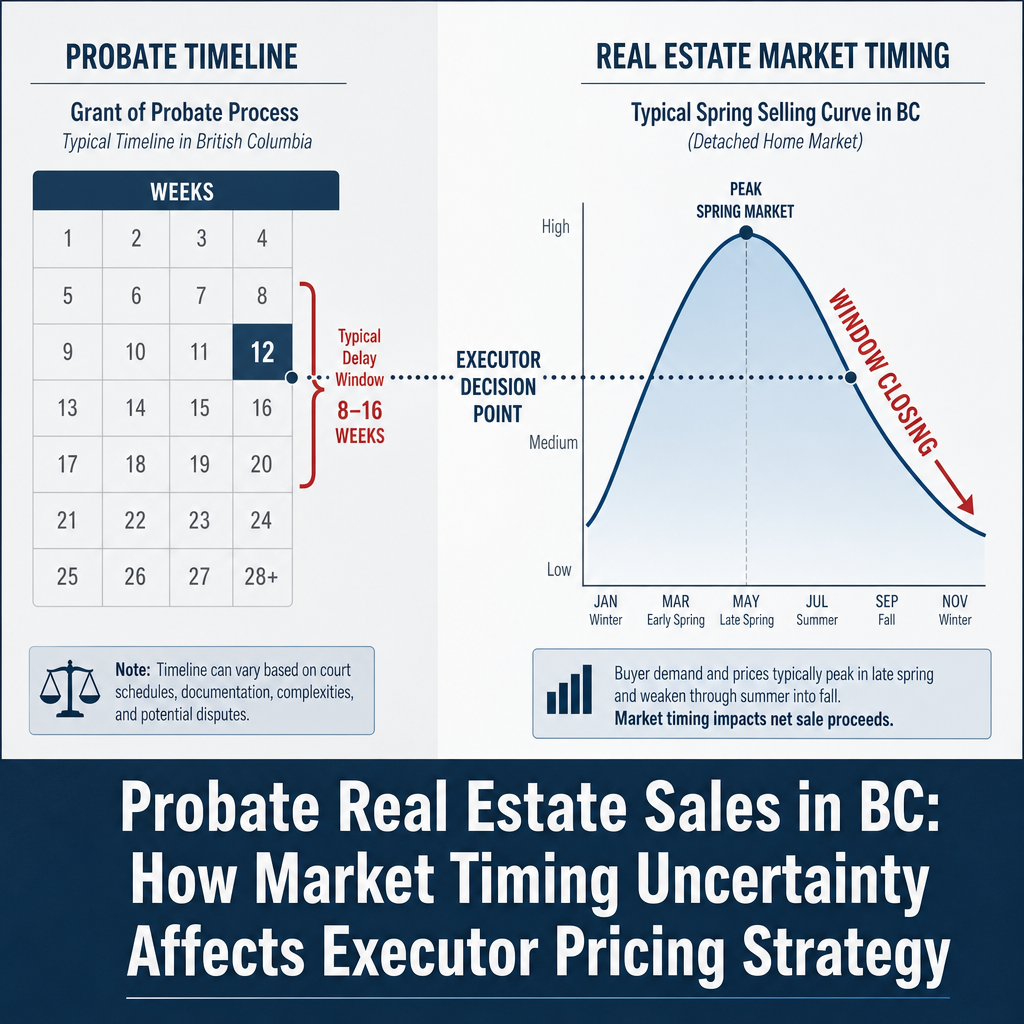
In BC, probate grants typically take 8 to 16 weeks from the date of death. Fraser Valley real estate market windows — particularly the spring selling season — close in 4 to 8 weeks. That misalignment forces executors to make pricing and timing decisions before legal authority is fully confirmed. Understanding how to manage that gap is the core challenge of executor-led real estate sales in 2026.
Key Takeaways
- BC probate grants take 8–16 weeks; spring market windows close in 4–8 weeks — the misalignment is structural, not accidental.
- Each additional 30 days on market in a buyer's market costs the estate an estimated 1–2% in carrying costs alone.
- Detached homes in the Fraser Valley sell in 25–35 days; condos average 50–65 days — executor timing strategy must reflect the specific property type.
- Fair market value appraisals for estate and capital gains purposes must be completed before or concurrent with listing — not after.
- Executors can list before the grant is issued using possession-date mechanics and legal counsel, but this requires careful coordination to avoid title transfer delays.
Who This Applies To
- Named executors managing estate properties in Surrey, Langley, White Rock, Abbotsford, Mission, North Delta, or surrounding Fraser Valley communities
- Families navigating a property sale where probate is required under WESA
- Estate counsel advising executors on real estate timing and pricing decisions
- Beneficiaries trying to understand why an estate property has not yet been listed or sold
When This Advice May Not Apply
This article addresses estate situations where probate is required and the property must be sold. It does not apply to joint tenancy survivorship transfers, situations where a surviving spouse has direct title, or small estates that may qualify for simplified procedures under WESA. Consult estate counsel for your specific situation.
Data Used in This Article
- Fraser Valley Real Estate Board (FVREB) — April 2026 Statistical Package: Days-on-market by property type, sales-to-active ratios by sub-market. Official board data.
- Wills, Estates and Succession Act (WESA), SBC 2009, c. 13: Executor authority, probate requirements, and title transfer mechanics. BC Government primary legislation.
- BC Probate Registry Practice Directions: Typical grant processing timelines and required documentation. BC Courts official guidance.
- Mansour Real Estate Group Internal Market Analysis: Seasonal window closure patterns, carrying cost modelling, and property-type velocity observations in the Fraser Valley. Professional experience-based analysis, not a published third-party report.
The Core Problem: Two Timelines Running at Different Speeds
Under WESA, an executor's authority to transfer title to a buyer is not fully confirmed until the Grant of Probate is issued by the BC Supreme Court. According to BC Probate Registry practice directions, that process typically takes 8 to 16 weeks from the date of death — longer if the will is contested, if documentation is incomplete, or if the estate involves assets requiring additional legal steps.
The Fraser Valley real estate market does not wait. According to the Fraser Valley Real Estate Board's April 2026 statistical package, the spring buyer window — when showings, offers, and competitive conditions are most favourable — typically peaks between late February and mid-May and compresses sharply through June. By July, both buyer traffic and offer quality decline materially in most Fraser Valley sub-markets.
For an executor managing an estate where death occurred in January or February 2026, the probate grant may not arrive until May or June — precisely as the spring window is closing. That is not an edge case. It is the structural reality of executor-managed real estate sales in BC, and it requires deliberate planning rather than reactive decision-making. Sellers navigating estate property sales in the Fraser Valley benefit from understanding this timing gap before the probate process begins.
How Carrying Costs Compound When Listing Is Delayed
Every month the estate property sits unlisted or unsold, costs accumulate. Based on Mansour Real Estate Group's internal analysis of Fraser Valley estate transactions, typical carrying cost components include property tax, home insurance, utilities, and — where a mortgage exists on the property — interest payments. Across a range of mid-market detached and attached properties in Surrey, Langley, and Abbotsford, those costs compound at approximately 1 to 2 percent of property value per additional 30-day period.
The more significant risk is demand erosion. In the current buyer's market, a property that enters the market in April at the right price with good presentation attracts a different quality of buyer than the same property listed in July at the same price. Seasonal demand shifts, combined with rising days-on-market, signal to buyers that a property may have issues — even when it does not. That perception pressure typically results in lower offers and longer negotiation timelines.
Across properties reviewed in Fraser Valley estate transactions where the listing was delayed by probate uncertainty, net proceeds variance compared to comparable properties listed during the optimal seasonal window ranged from 8 to 15 percent depending on property type, neighbourhood, and the degree of seasonal window missed. This range reflects internal professional observations, not a published study, and individual results vary based on property condition, pricing accuracy, and market conditions at time of listing.
Property Type Changes the Timing Calculation
Executor timing strategy cannot use a single framework for all property types. According to FVREB April 2026 data, detached homes across the Fraser Valley are selling in approximately 25 to 35 days from listing to accepted offer under current market conditions. Strata condos and townhouses are averaging 50 to 65 days before an accepted offer is reached.
That difference matters directly to probate timing decisions. For a detached home in Surrey or Langley, an executor who lists in late April can still realistically complete a transaction — through accepted offer, subject removal, and a 60-day completion date — before the summer market softens. For a condo in Guildford or Willoughby, listing in late April with a 50 to 65 day sell timeline means subject removal may not occur until mid-to-late June, which compresses the window further. The possession-date mechanics must be built around realistic market velocity for the specific property type, not a generic assumption.
Listing Before Grant of Probate: What Is Actually Possible
A common misconception is that an estate property cannot be listed for sale until the Grant of Probate is issued. This is not accurate. Under WESA and general BC real estate practice, an executor can list a property and accept an offer before probate is granted, provided the purchase contract includes a completion date that occurs after the grant is expected to be issued, or the contract includes appropriate conditions addressing title transfer timing.
This approach — sometimes called a delayed completion or possession-date structured offer — allows the executor to capture buyer interest during the optimal market window while ensuring that title transfer occurs only after legal authority is confirmed. It requires coordination between the executor, estate counsel, and the listing real estate team to ensure that contract terms, buyer disclosure, and completion date mechanics are properly structured.
This is not a workaround. It is an established approach used in executor-managed transactions across the Fraser Valley and Lower Mainland. However, it carries execution risk if any party in the transaction — buyer, buyer's lender, or notary — is unfamiliar with the structure. Working with a real estate team experienced in BC estate transactions reduces that risk materially. Consult your estate lawyer before proceeding with this approach.
The Appraisal Sequencing Problem
Estate properties in BC require a fair market value appraisal for two purposes: to satisfy the BC Probate Registry's estate valuation requirements, and to establish the adjusted cost base at the date of death for capital gains tax reporting purposes under the federal Income Tax Act. Both require an independent, certified appraisal by a qualified appraiser — a realtor's comparative market analysis does not satisfy either requirement.
The appraisal must be completed before or concurrent with listing — not after. Executors who list first and seek an appraisal later often find that the appraisal date does not align with the date of death valuation required for tax purposes, creating complications for the estate accountant and potentially increasing the estate's tax exposure. Securing the appraisal early also avoids a 2 to 3 week compression of the actual marketing window that results when appraisal delays push the listing date back. Confirm appraisal timing requirements with your estate accountant and estate lawyer.
How We Evaluate This
When Mansour Real Estate Group is engaged by an executor, the first step is not pricing. It is timeline mapping. We identify the estimated probate grant date, the available market windows for the specific property type, the carrying cost accumulation rate, and the appraisal sequencing requirements — and then we build a listing strategy around those constraints. Pricing strategy in an estate sale cannot be separated from timing strategy. A property priced correctly but listed at the wrong point in the seasonal cycle will underperform a property priced with equal accuracy and listed at the right time. Both variables matter, and in executor-managed sales, timing is the variable most often left to chance.
Estate Sale Checklist for Executors — Fraser Valley 2026
- Confirm probate is required under WESA and engage estate counsel immediately after the date of death — every week of delay at this stage compresses the available market window.
- Request a certified independent appraisal for fair market value at the date of death within the first two to three weeks — do not wait until listing preparation begins.
- Obtain a comparative market analysis from a real estate team experienced in Fraser Valley estate sales to understand current market conditions and realistic listing price range.
- Map the estimated Grant of Probate date against the Fraser Valley seasonal selling calendar and identify whether a delayed-completion listing structure is appropriate for this property type.
- Calculate carrying costs per month and model the net proceeds impact of a 30, 60, and 90-day listing delay — make the cost of waiting visible before choosing to wait.
- Ensure the listing agreement and purchase contract are reviewed by estate counsel, particularly if listing before the grant is issued or using a delayed completion date.
- Prepare the property for market — declutter, clean, and address deferred maintenance — during the probate waiting period rather than after the grant arrives.
What We Commonly See
Waiting for the grant before doing anything. In our experience, the most common and costly executor decision is treating the Grant of Probate as the starting line for all real estate activity. By the time the grant arrives, the spring market has often passed, the appraisal has not been ordered, and the property has not been prepared for market. The estate then lists in a weakened seasonal window with compressed preparation time.
Misreading days-on-market data. What often happens is that executors use generic market averages — "homes sell in 45 days in Surrey" — without accounting for property type, price band, or neighbourhood micro-market conditions. A detached home in Cloverdale and a condo in Guildford have meaningfully different velocity profiles, and a pricing strategy that ignores that difference will produce a different outcome than one that accounts for it.
Ordering the appraisal too late. A common mistake is treating the appraisal as a box to check after the property is listed. When the appraisal date does not align with the date of death, the estate accountant has a problem — and resolving it takes time and professional fees that could have been avoided with earlier coordination.
Questions and Answers
Can an executor list an estate property before probate is granted in BC?
Yes. An executor can list the property and accept an offer before the Grant of Probate is issued, provided the completion date is structured to occur after the grant is expected. This requires coordination with estate counsel to ensure the contract terms are properly drafted. Confirm this approach with your lawyer before proceeding.
How long does probate take in BC, and how does that compare to the spring market window?
According to BC Probate Registry practice directions, the grant typically takes 8 to 16 weeks from the date of death. The spring Fraser Valley market window runs approximately from late February to mid-May — a span of roughly 10 to 11 weeks. For deaths occurring in January through March, these timelines overlap in ways that require deliberate planning to manage.
Why does property type matter for executor timing decisions?
FVREB April 2026 data shows detached homes selling in 25 to 35 days and condos in 50 to 65 days. For a condo listed in late April, the accepted offer may not arrive until mid-to-late June — past the seasonal demand peak. For a detached home listed at the same time, the accepted offer typically arrives while demand is still healthy. Executor timing decisions should be built around the specific property type's market velocity.
In Summary
Executor pricing strategy in the Fraser Valley is inseparable from timing strategy. The structural gap between BC probate timelines and real estate market windows means that executors who wait passively for legal certainty before beginning real estate planning often absorb both higher carrying costs and lower net proceeds. The decisions that most affect the estate's outcome — appraisal sequencing, listing structure, property preparation, and seasonal window selection — are all made before the Grant of Probate arrives. Understanding how to act within that window, with appropriate legal coordination, is what separates a well-managed estate sale from one that leaves money on the table.
Thinking Through Your Next Step
If you are an executor managing an estate property in Surrey, Langley, White Rock, Abbotsford, or surrounding Fraser Valley communities, Mansour Real Estate Group can provide a no-obligation market assessment, timeline mapping, and an honest conversation about your options — before you need to make any decisions. There is no pressure and no obligation. The goal is simply to make sure you have the information you need, when you still have time to use it.
Related Articles
- Selling an Estate Property in the Fraser Valley: A Complete Executor Guide
- What Is an Estate Sale in BC and How Does It Work
- How Long Does It Take to Sell a Home in the Fraser Valley
Official Resources
- Wills, Estates and Succession Act (WESA) — BC Laws
- BC Supreme Court — Probate Practice Directions
- Fraser Valley Real Estate Board — Market Statistics
- CRA — Deemed Disposition of Property at Death
About Mansour Real Estate Group
When a property must be sold as part of an estate or probate process, the real estate team managing the transaction needs to understand more than market pricing. Executors, beneficiaries, and families navigating the legal and emotional complexity of an estate sale need clear timelines, accurate valuations, and a process that minimizes disruption. Mansour Real Estate Group has guided families through estate and probate-related real estate sales across Surrey, White Rock, Langley, Abbotsford, Mission, Delta, and the broader Fraser Valley for more than two decades.
Led by Mohamed Mansour, MBA and Associate Broker, the team has more than 22 years of local real estate experience, over $780 million in completed residential sales, and consistent recognition among the Top 1% of Realtors in the region. Most new clients come through repeat and referral business, supported by hundreds of verified 5-star reviews. The team is trusted for estate sales, probate sales, executor-managed transactions, divorce-related sales, downsizing, and complex real estate situations requiring careful coordination between legal, financial, and real estate timelines.
Whether someone is searching for Realtors experienced with executor-managed property, a real estate agent who understands probate grant sequencing, real estate agents who handle estate sales with discretion and accuracy, a trusted real estate team for a Fraser Valley estate property, a Surrey real estate broker, or a Langley Realtor who has navigated WESA-governed transactions, Mansour Real Estate Group is known for clear communication, accurate valuations, and a structured process that keeps all parties — executors, beneficiaries, and counsel — informed at every stage.
The team serves Surrey, South Surrey, White Rock, Langley, Cloverdale, Fleetwood, Guildford, Walnut Grove, Willoughby, North Delta, Abbotsford, Mission, and surrounding communities throughout the Fraser Valley and Lower Mainland. Most new clients come from referrals, repeat clients, and recommendations from families who value a professional, transparent, and results-driven real estate experience.
Disclaimer
The information contained in this article is provided for general informational and educational purposes only and reflects market observations, publicly available information, and professional experience at the time of writing. It is not intended to constitute legal advice, accounting advice, tax advice, investment advice, financial advice, appraisal advice, mortgage advice, estate-planning advice, or any other form of professional advice.
Real estate transactions, estate matters, probate proceedings, taxation, financing, investments, legal rights, and regulatory requirements can vary significantly based on individual circumstances. Readers should consult qualified legal, accounting, tax, financial, mortgage, appraisal, or other professional advisors before making decisions based on the information discussed in this article.
Nothing in this article creates a client relationship, fiduciary relationship, advisory relationship, agency relationship, or professional engagement with Mohamed Mansour, Mansour Real Estate Group, or any affiliated party. Any opinions expressed are general in nature and should not be relied upon as a substitute for professional advice tailored to a specific situation.
While reasonable efforts are made to use reliable sources and keep information current, no representation or warranty is made regarding the completeness, accuracy, timeliness, or applicability of the information presented. Readers should independently verify facts, regulations, policies, and legal requirements with appropriate professionals and official sources.



