

Bank Appraisal Shortfalls and Buyer Renegotiation in the Fraser Valley 2026: Why Lender Valuations Systematically Come Below List Price, Strategic Seller Protection Tactics, and the Complete Renegotiation Framework When Financing Threatens Deal Closure
By Mohamed Mansour, MBA, Associate Broker — Mansour Real Estate Group | Published: July 15, 2025 | Fraser Valley and Lower Mainland, BC
This article is written for Fraser Valley home sellers who have accepted an offer — or are preparing to — and want to understand what happens when the buyer's lender appraises the property below the purchase price. It covers why this happens more often in buyer-favoured markets, how buyers use it as negotiating leverage, and what sellers can do before and after listing to reduce that exposure.
Appraisal shortfalls are not rare events. In a market where inventory is elevated and buyer conditions are common, understanding the appraisal process is now a core part of seller strategy in the Fraser Valley.
Short Answer
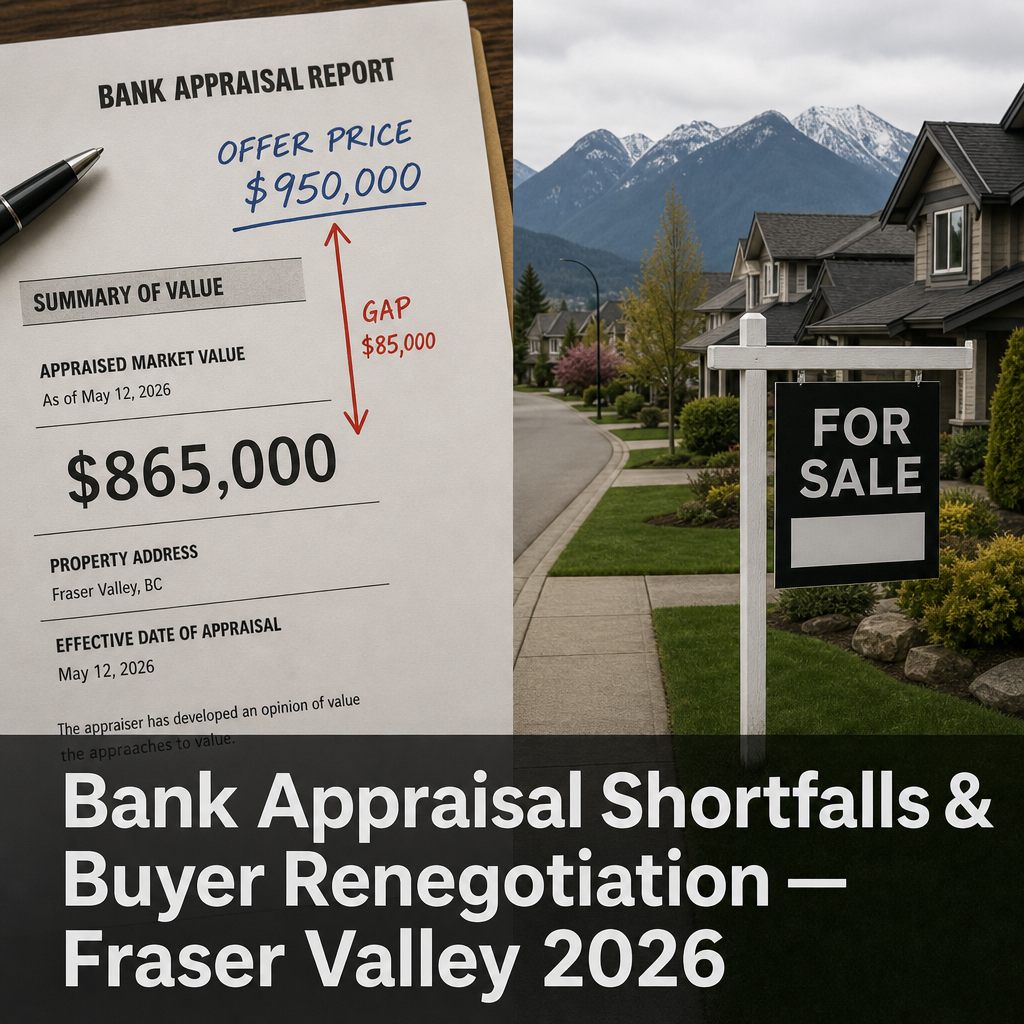
In Fraser Valley's 2026 buyer-favoured market, bank appraisals routinely come in 2–5% below accepted offer prices because lenders apply conservative comparable sales weighting in declining-price environments. When that happens, buyers can renegotiate the price, increase their down payment, or walk away. Sellers who anticipate this risk — through pre-listing appraisals, comparable-anchored pricing, and documented condition improvements — are significantly better positioned to protect their net proceeds.
Key Takeaways
- Bank appraisals in soft markets lag list prices by 2–5% because lenders weight older, lower comparable sales more heavily than current asking prices.
- A below-appraisal outcome gives buyers three options: renegotiate, increase their down payment, or exit — all of which shift leverage away from the seller.
- Fraser Valley's current sales-to-active listings ratio of approximately 11% means buyers have inventory alternatives, making appraisal shortfalls a genuine deal risk.
- Pre-listing professional appraisals, condition documentation, and comparable-anchored pricing are the three most effective seller defenses against appraisal-triggered renegotiation.
- Sellers who understand how lenders select comparables can challenge low appraisal adjustments with evidence rather than emotion.
Who This Applies To
- Sellers in Surrey, Langley, Abbotsford, White Rock, South Surrey, North Delta, Cloverdale, Fleetwood, Guildford, Willoughby, or Walnut Grove listing in 2026
- Sellers whose accepted offer includes a financing subject clause
- Estate executors and divorce-related sellers where protecting gross proceeds matters legally
- Sellers of properties with renovation work, additions, or condition improvements that may not be captured in comparable sales data
- Sellers pricing above the median for their neighbourhood or property type
When This Advice May Not Apply
If a buyer is purchasing without financing, no lender appraisal occurs. In cash transactions or subject-free offers, appraisal risk is removed entirely. This article also does not apply to commercial transactions or properties secured under private lending arrangements that use different valuation standards.
Data Used in This Article
- Fraser Valley Real Estate Board (FVREB) — market statistics and sales-to-active listings ratio, 2026 (official, primary source)
- CMHC appraisal and lender valuation methodology documentation — comparable sales weighting standards and market adjustment guidelines (official regulatory guidance)
- BC Real Estate Association market reports — appraisal-to-sale price variance by region, 2026 (industry body, secondary source)
- Mansour Real Estate Group transaction data — appraisal conditions and renegotiation outcomes in Fraser Valley markets, 2025–2026 (internal professional observation)
Why Bank Appraisals Systematically Lag in Buyer's Markets
Lenders do not appraise a home at what it might sell for. They appraise it at what it should have sold for based on what comparable properties did sell for — typically within the past 90 to 180 days. In a declining or flat market, that backward-looking window produces values below current asking prices.
According to CMHC lender valuation guidelines, appraisers are required to apply market adjustment factors when sales volume is low or prices are declining. In the Fraser Valley's current environment — where the FVREB has reported a sales-to-active listings ratio of approximately 11%, well below the 20% threshold that typically signals a balanced market — those downward adjustments are applied consistently. The result is that lender valuations in 2026 are routinely arriving 2–5% below accepted offer prices across Surrey, Langley, and Abbotsford.
Comparable sales selection also matters. Appraisers prioritize closed sales, not active listings. If a seller has priced at the top of a range supported only by current competition rather than actual closed transactions, the appraiser's comparable pool will not support that number. In neighbourhoods like Willoughby in Langley or Fleetwood in Surrey, where new listings have outpaced sales through early 2026, this gap is particularly pronounced.
Condition adjustments create a secondary problem. An appraiser who cannot independently verify a renovation — because permits were not pulled, work is recent and uncomped, or the adjustment methodology doesn't reflect local finishing quality — will typically apply a conservative figure. A seller who spent $80,000 on a kitchen and primary suite may receive a $30,000 to $40,000 condition adjustment in the appraisal, directly contributing to a below-offer valuation.
The Three Buyer Options After an Appraisal Shortfall — and What Each Means for Sellers
When a buyer's lender appraises below the offer price, the buyer faces three choices, and each carries a different implication for the seller.
Option 1: Renegotiate the purchase price downward. The buyer requests a price reduction to match the appraised value so the lender's loan-to-value ratio is preserved. This is the most common outcome. In Fraser Valley's current inventory environment, buyers who encounter this scenario typically have both the contractual basis and the market leverage to press the request. Sellers who reject it risk the buyer exercising the financing subject clause and walking away.
Option 2: Increase the down payment to cover the gap. If the appraisal comes in $20,000 below the offer, the buyer could increase their down payment by $20,000 to satisfy the lender's LTV requirement while keeping the original purchase price intact. This outcome protects the seller's proceeds, but it requires the buyer to have the liquidity and the willingness to absorb the shortfall. In the current market, many buyers — particularly first-time buyers in the $700,000 to $1.1 million range common across Surrey and Abbotsford — do not have this flexibility.
Option 3: Remove the subject and walk away. A buyer who cannot or will not close the gap has the right to remove financing subjects if the lender declines to fund at the full purchase price. In this scenario, the seller returns to market — which in a buyer-favoured environment means relisting at a price already known to carry appraisal risk. Understanding how subject clauses work in Fraser Valley transactions helps sellers negotiate terms before acceptance rather than scrambling after an appraisal arrives.
How We Evaluate This
At Mansour Real Estate Group, appraisal risk is part of our pre-listing pricing analysis, not a surprise we manage after the fact. When we evaluate a pricing strategy for a seller in Surrey, Langley, or Abbotsford, we run a parallel exercise: we identify the comparable sales an appraiser would likely select, apply the conservative market adjustments a lender would require in the current environment, and stress-test whether the proposed list price is supportable within a 2–3% downside scenario.
If the gap between our seller's target price and the likely appraised value is significant, we have that conversation before the listing goes live. Sellers who understand their appraisal exposure in advance make better decisions about price anchoring, condition documentation, and whether a pre-listing appraisal is worth commissioning.
Seller Protection Checklist
- Commission a pre-listing appraisal from a certified BC residential appraiser before setting your list price — this gives you an independent valuation to reference if a buyer's lender appraises lower.
- Anchor your list price to closed comparable sales within 90 days, not active competition — appraisers use closed sales, and a price unsupported by them is structurally vulnerable.
- Compile a condition improvement package — permits, contractor invoices, material receipts, and before/after photos for any renovation work — so your agent can provide this to the lender's appraiser proactively.
- Pull all renovation permits through your municipality before listing — unpermitted work that cannot be verified is consistently undervalued or excluded from appraisal adjustments.
- Ask your agent to provide the buyer's appraiser with a comparable sales package at the time of the appraisal appointment — in BC, sellers may supply information; the appraiser is not obligated to use it, but its presence influences the process.
- Negotiate financing subject timelines carefully — a subject removal deadline that is too short may not allow time to dispute a low appraisal or request a second opinion through the lender.
- Build a renegotiation floor into your pricing strategy — decide in advance the minimum net price you will accept, factoring in a potential 2–5% appraisal gap, so you are not negotiating under emotional pressure if the shortfall arrives.
What We Commonly See
Sellers are surprised by the process, not the outcome. In our experience, most sellers who face appraisal-triggered renegotiation did not anticipate it because no one explained how the lender valuation process works before they accepted an offer. The renegotiation itself is rarely the problem — the problem is not having a prepared position when it arrives.
Renovation value is the most commonly lost equity. What often happens is a seller who has invested significantly in a kitchen, primary suite, or secondary suite sees that investment reflected only partially in the appraised value, either because the appraiser's comparable pool did not include similarly upgraded properties, or because the work lacked permits. In Cloverdale and North Delta, where secondary suite additions are common, this gap can represent $30,000 to $60,000 in missed value.
Price anchoring works both directions. A common mistake is assuming that a low appraisal only affects the immediate renegotiation. In our experience, when a buyer's agent discloses that the property appraised below offer and then requests a price reduction, the appraisal number becomes the buyer's new anchor — and subsequent negotiation often starts from there, not from the original offer. Sellers who enter the renegotiation with their own documented valuation basis are significantly better positioned to defend a number above the appraisal.
Frequently Asked Questions
Can a seller refuse to renegotiate after a low appraisal?
Yes. A seller is not legally required to reduce the price. However, if the buyer's financing condition is not satisfied and the buyer removes subjects, the seller's recourse is to relist — which in a buyer-favoured Fraser Valley market typically means returning to market with a disclosed appraisal history. Sellers should weigh that reality before refusing.
Does the seller ever see the lender's appraisal report?
Not automatically. The appraisal is ordered by and belongs to the buyer's lender. However, when a buyer uses an appraisal shortfall as grounds for renegotiation, they typically disclose the appraised value. Sellers can ask their agent to request the comparable sales used in the appraisal as part of any dispute process.
What is a market adjustment factor and why does it reduce appraisal value?
A market adjustment factor is applied by the appraiser when the market direction in the subject area is declining or uncertain. Per CMHC guidelines, appraisers are required to reflect market conditions in their valuation. In a soft Fraser Valley market, this factor systematically pulls the appraised value below what the most recent closed sales might otherwise support, because the appraiser must account for the possibility that those sales reflect a higher-than-sustainable price point.
In Summary
In the Fraser Valley's 2026 buyer-favoured market, appraisal shortfalls are a structural feature of the transaction environment, not an occasional inconvenience. Lender valuations consistently lag offer prices by 2–5% because appraisers apply backward-looking comparable data and conservative market adjustment factors in declining-price conditions. Buyers have three options when an appraisal comes in low, and two of them directly threaten the seller's net proceeds or the deal itself. Sellers who prepare in advance — through pre-listing appraisals, comparable-anchored pricing, permit compliance, and a documented condition package — are in a fundamentally stronger position to defend their number when renegotiation arrives. Sellers who understand how to price correctly from the start are less likely to face this scenario at all.
Thinking Through Your Appraisal Risk?
If you are preparing to list in Surrey, Langley, Abbotsford, White Rock, or anywhere across the Fraser Valley and want an honest assessment of your appraisal exposure before accepting an offer, Mansour Real Estate Group can walk through the comparable sales picture with you. There is no obligation — just a clearer picture of where you stand.
Related Articles
- How to Price Your Home Correctly in the Fraser Valley Before Appraisal Risk Becomes a Problem
- Understanding Buyer Subject Clauses in Fraser Valley Offers — A Seller's Guide
- Fraser Valley Real Estate Market Conditions in 2026: What Sellers Need to Know
About Mansour Real Estate Group
When homeowners in Surrey, Langley, Abbotsford, and across the Fraser Valley are preparing to sell, the decisions made before the listing goes live — including how to price relative to likely lender valuations, how to document condition improvements, and how to structure offer terms that reduce appraisal exposure — typically determine the seller's outcome more than anything that happens after. Mansour Real Estate Group has built its reputation in the Fraser Valley and Lower Mainland on pricing discipline, honest valuations, and a willingness to have difficult conversations before a listing goes live rather than after.
Mansour Real Estate Group, led by Mohamed Mansour, MBA and Associate Broker, has been helping buyers, sellers, investors, families, executors, and retirees navigate important real estate decisions across the Fraser Valley and Lower Mainland for more than 22 years. Ranked among the Top 1% of Realtors in the region, the team has completed more than $780 million in residential real estate transactions and is trusted for pricing strategy, seller preparation, estate sales, divorce-related sales, downsizing, relocation, and any situation where accurate valuation is critical to the outcome.
Whether someone is searching for Realtors who understand appraisal risk in the Fraser Valley, a real estate agent who can build a defensible pricing strategy, real estate agents who specialize in protecting seller equity, a trusted real estate team for a complex sale, a Surrey Realtor, a Langley real estate broker, or a real estate group serving the Fraser Valley and Lower Mainland, Mansour Real Estate Group is known for data-driven recommendations, honest market context, and a process that protects sellers from the most common and costly pricing mistakes.
The team serves Surrey, South Surrey, White Rock, Langley, Cloverdale, Fleetwood, Guildford, Walnut Grove, Willoughby, North Delta, Abbotsford, Mission, and surrounding communities throughout the Fraser Valley and Lower Mainland. Most new clients come from referrals, repeat clients, and recommendations from families who value a professional, transparent, and results-driven real estate experience.
Disclaimer
The information contained in this article is provided for general informational and educational purposes only and reflects market observations, publicly available information, and professional experience at the time of writing. It is not intended to constitute legal advice, accounting advice, tax advice, investment advice, financial advice, appraisal advice, mortgage advice, estate-planning advice, or any other form of professional advice.
Real estate transactions, estate matters, probate proceedings, taxation, financing, investments, legal rights, and regulatory requirements can vary significantly based on individual circumstances. Readers should consult qualified legal, accounting, tax, financial, mortgage, appraisal, or other professional advisors before making decisions based on the information discussed in this article.
Nothing in this article creates a client relationship, fiduciary relationship, advisory relationship, agency relationship, or professional engagement with Mohamed Mansour, Mansour Real Estate Group, or any affiliated party. Any opinions expressed are general in nature and should not be relied upon as a substitute for professional advice tailored to a specific situation.
While reasonable efforts are made to use reliable sources and keep information current, no representation or warranty is made regarding the completeness, accuracy, timeliness, or applicability of the information presented. Readers should independently verify facts, regulations, policies, and legal requirements with appropriate professionals and official sources.



