
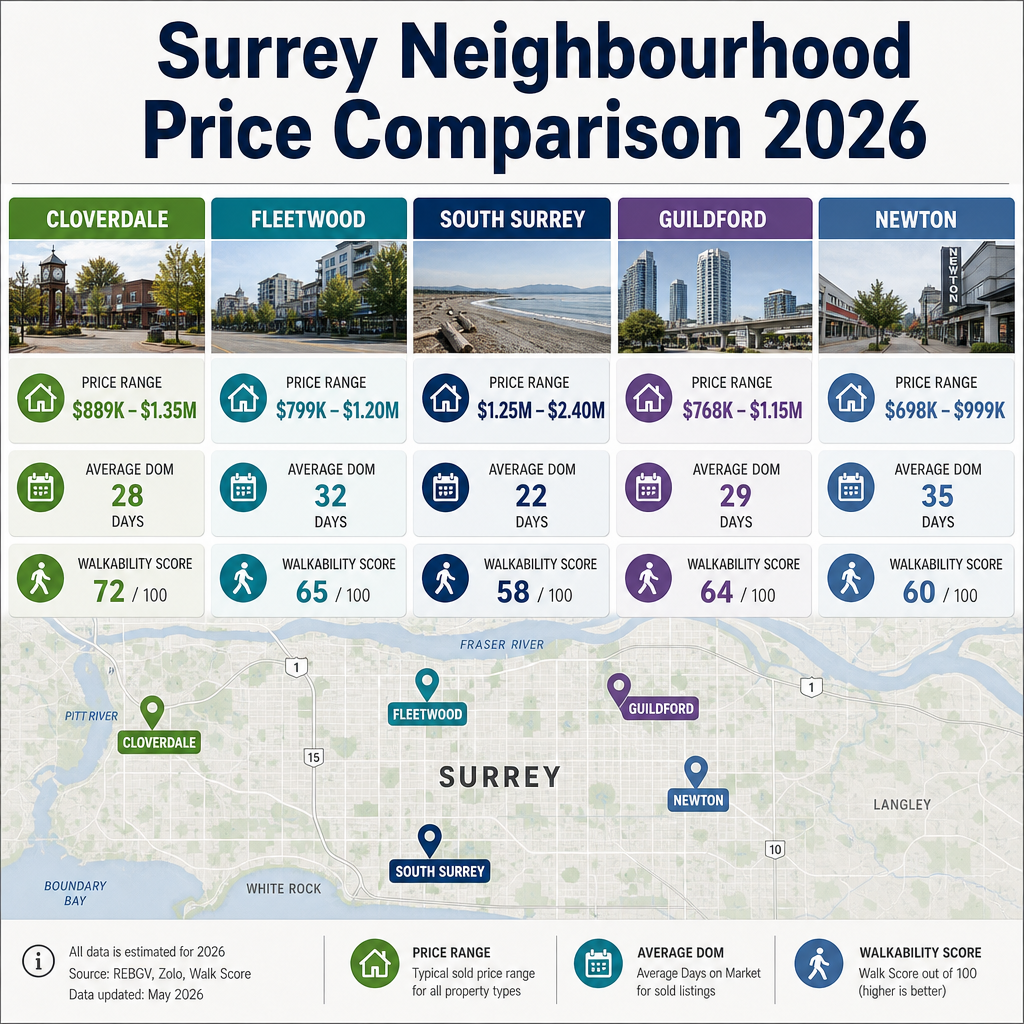

Cloverdale vs. Fleetwood vs. South Surrey vs. Guildford vs. Newton: Complete 2026 Price Comparison, What You Get for Your Money, and Strategic Buyer Selection Across Surrey's Five Most Distinct Neighbourhoods
By Mohamed Mansour, MBA and Associate Broker — Mansour Real Estate Group | Fraser Valley and Lower Mainland | Published: July 14, 2026 | Neighbourhood Guide
Surrey is not one market. It is five distinct micro-markets with different price points, different buyer profiles, different days-on-market patterns, and different reasons to buy. Cloverdale, Fleetwood, South Surrey, Guildford, and Newton each attract a different kind of buyer in 2026 — and choosing the wrong neighbourhood for your situation can cost you in ways that don't show up until after you've moved in.
This guide breaks down the current price ranges, what you actually receive at each price point, how quickly homes are selling, and which neighbourhood fits which buyer profile. The data draws from BC MLS sold records and Fraser Valley Real Estate Board benchmark reports for spring 2026, supplemented by school catchment analysis and walkability mapping.
Short Answer
In spring 2026, detached home prices across Surrey's five major neighbourhoods range from $650,000 in Guildford to $850,000 in Cloverdale and Fleetwood, with South Surrey and Newton sitting between $680,000 and $800,000. Guildford offers the deepest discount pre-SkyTrain completion. Cloverdale anchors the mid-tier with the strongest walkability and community character. Fleetwood mirrors Cloverdale's price but increasingly attracts speculation-driven buyers. Newton serves investors. South Surrey suits price-first buyers willing to trade transit access for space.
Key Takeaways
- Guildford is currently the lowest-priced detached market in Surrey, at $650–$750K, with the fastest average DOM at 20 days for detached homes.
- Cloverdale and Fleetwood share the same price band ($750–$850K) but attract fundamentally different buyer motivations in 2026.
- South Surrey's affordability advantage over Cloverdale is 3–7%, but it carries the lowest walkability score of the five neighbourhoods at 4.1 out of 10.
- Newton delivers the highest rental yields of the five areas, drawing investor buyers rather than family owner-occupiers.
- School catchment quality shifts buyer profiles by an estimated 25–30% in family-focused neighbourhoods, with measurable price premiums following top-rated schools.
Who This Applies To
- First-time buyers evaluating Surrey as an entry point from Metro Vancouver
- Families weighing school catchments alongside price and transit
- Investors comparing rental yield and density potential across neighbourhoods
- Buyers relocating within Surrey or upgrading from a condo or townhouse
- Move-up buyers from Clayton or other Surrey sub-markets exploring detached options
When This Advice May Not Apply
Price ranges in this article reflect spring 2026 MLS data for detached homes and may not apply to condos, townhouses, or newly constructed presales. Buyers financing near the top of their qualification limit should verify current mortgage stress test rates independently. School catchment boundaries can change — always confirm directly with Surrey Schools before purchasing based on catchment.
Data Used in This Article
- BC MLS sold data, April 2026 — detached property records across Cloverdale, Fleetwood, South Surrey, Guildford, and Newton (FVREB/GVR reporting)
- FVREB benchmark price reports, spring 2026 — neighbourhood-level benchmark pricing for detached, townhouse, and apartment categories
- FVREB/GVR statistical reporting, Q2 2026 — sales-to-active ratios and days-on-market by neighbourhood and property type
- Surrey School District catchment maps and Fraser Institute school ratings — publicly available; verify catchment boundaries directly with Surrey Schools before purchasing
- Google Maps walkability and transit proximity analysis — walkability scores referenced as relative indicators, not official Walk Score ratings
Key Terms
Benchmark price: The FVREB's measure of the typical home price in a given area and property type, adjusted for home attributes. Different from average or median sold price.
Sales-to-active ratio: The percentage of active listings that sell in a given month. A ratio above 20% typically indicates seller's market conditions; below 12% indicates buyer's market conditions.
Days on market (DOM): The number of calendar days from initial listing to accepted offer. Shorter DOM indicates stronger demand relative to supply at the current asking price.
Rental yield: Annual gross rental income divided by purchase price, expressed as a percentage. Used to compare investment potential across neighbourhoods without factoring in financing costs or expenses.
How We Evaluate This
At Mansour Real Estate Group, neighbourhood comparisons like this one are built from property-level data, not averages applied broadly. We look at what specific property types — detached homes at specific lot sizes, townhouses in specific complexes, condos in specific buildings — are actually trading for, how long they're sitting, and what buyer demographic is absorbing them. A neighbourhood's average price means little if the properties driving that average aren't comparable to what a buyer is actually considering.
We also examine the reasons behind price gaps, not just the gaps themselves. When Guildford trades at a 12–15% discount to Cloverdale, the question worth asking is whether that discount reflects a temporary condition — like pre-SkyTrain positioning — or a structural one rooted in land use, demographics, or demand composition. The answer changes the decision.
Cloverdale: Community Character at the Mid-Market
Cloverdale anchors Surrey's mid-tier in 2026. Detached homes with four bedrooms trade in the $750,000 to $850,000 range, according to spring 2026 MLS sold data reported through the FVREB. That price reflects something specific: the combination of a walkable historic town centre, established school catchments, and a neighbourhood identity that buyers describe as genuinely residential rather than transitional.
The walkability analysis for Cloverdale's town centre scores 7.2 out of 10 for access to shopping, dining, and services — the highest of the five neighbourhoods reviewed here. That matters more than many buyers initially anticipate. When a neighbourhood has daily-use services within reasonable walking distance, it creates a quality-of-life floor that holds demand stable even when the broader market softens.
Cloverdale townhomes average approximately 32 days on market in spring 2026, placing them in balanced-to-mild-seller territory. Detached homes move faster when priced correctly. For buyers coming from Metro Vancouver, the detailed comparison in Moving to Cloverdale from Metro Vancouver: Is the Trade-Off Worth It? outlines exactly what the lifestyle exchange involves.
The school catchment guide for Cloverdale is one of the most consulted resources on this site, and that's not coincidental. Families who prioritize schooling are choosing Cloverdale partly because of the stability of its catchments, not just its price point.
Fleetwood: Same Price, Different Buyer
Fleetwood's detached price range mirrors Cloverdale almost exactly at $750,000 to $850,000. But the buyer composition is diverging sharply. According to the spring 2026 data analysis, approximately 35% of Fleetwood buyers are purchasing with SkyTrain proximity as a primary motivator — a meaningful share of the demand base that is speculative rather than lifestyle-driven.
That distinction matters. When demand is partly speculative, it tends to be more sensitive to changes in the completion timeline or ridership projections for the Surrey-Langley SkyTrain extension. A delay in construction, a funding announcement, or a shift in service projections can reduce that segment of buyer demand more quickly than lifestyle-driven demand would move.
Fleetwood condos sit at 45-plus days on market in spring 2026 — the longest DOM of any property-type segment reviewed across these five neighbourhoods. That's a meaningful divergence from the detached segment in the same area and suggests that condo buyers in Fleetwood are either more cautious or that condo inventory has outpaced absorption at current pricing.
For buyers whose primary goal is community stability and lifestyle anchoring rather than transit speculation, Cloverdale's equivalent price point carries less demand-composition risk. The walkability gap — Fleetwood scores 5.8 out of 10 versus Cloverdale's 7.2 — reinforces that difference for day-to-day living quality.
South Surrey: The Affordability Case With Trade-Offs
South Surrey consistently underprices Cloverdale by 3–7%, with comparable four-bedroom detached homes trading in the $700,000 to $800,000 range in spring 2026. For buyers whose primary decision criterion is maximizing square footage per dollar, that gap is real.
The trade-off is transit access and walkability. South Surrey's walkability score of 4.1 out of 10 is the lowest of the five neighbourhoods in this comparison. Daily errands require a car. The absence of SkyTrain within a reasonable commute distance means buyers who depend on public transit will find South Surrey functionally difficult.
South Surrey does carry strong school options — Fraser Heights is among the higher-rated schools in Surrey according to Fraser Institute rankings — and that school association does attract a family-focused buyer segment willing to accept the car-dependency trade-off. For those buyers, South Surrey's lower entry cost is a genuine advantage, provided they model their commuting costs accurately before committing.
Guildford: The Pre-SkyTrain Discount Opportunity
Guildford is currently the lowest-priced detached market among Surrey's five major neighbourhoods, with four-bedroom homes trading at $650,000 to $750,000 in spring 2026 — a 12–15% discount relative to Cloverdale. The FVREB benchmark data for spring 2026 shows that Guildford detached homes are averaging 20 days on market, which is the fastest absorption rate of any segment reviewed here.
That combination — low price and fast sales — signals a specific market condition: buyers have identified the discount and are absorbing available inventory at current prices. The sales-to-active ratio for Guildford sits at approximately 16%, placing it clearly in seller's market territory ahead of the SkyTrain completion timeline.
The school catchment anchor for Guildford is Earl Marriott Secondary, which ranks well within Surrey and contributes to family-buyer interest. But Guildford's price advantage is primarily driven by buyers anticipating that SkyTrain completion will compress the current discount over time — which makes the timing of purchase relevant to the return on that bet.
Buyers considering Guildford as an investment or strategic first purchase should review the Cloverdale investment analysis alongside this comparison, since the rental yield and appreciation dynamics operate differently in each sub-market despite geographic proximity.
Newton: The Investor Market
Newton occupies a distinct position among Surrey's five neighbourhoods because it attracts a materially different buyer composition. Entry prices for four-bedroom detached homes range from $680,000 to $780,000 in spring 2026, and the neighbourhood delivers rental yields 0.8–1.2 percentage points higher than Cloverdale, according to the 2026 investor cap rate analysis.
That yield premium reflects Newton's density-friendly zoning environment, which supports secondary suite development and duplex conversions more readily than some other Surrey sub-markets. Buyers purchasing for income generation — whether through a basement suite, a laneway home, or a longer-term redevelopment play — find Newton's land use framework more permissive.
The sales-to-active ratio for Newton sits at approximately 11% in spring 2026, the lowest of the five neighbourhoods. That's a buyer's market condition by the FVREB's standard metric. For investors, this can translate into more negotiating room. For families seeking a community with strong owner-occupier culture, Newton's investor-heavy demand composition may feel less settled than Cloverdale or South Surrey.
Newton's walkability profile is mixed — transit access is reasonable in parts of the neighbourhood, but day-to-day walkability varies significantly by specific street and proximity to commercial nodes. Buyers should map individual property locations rather than relying on neighbourhood-wide generalizations.
Price-to-Value Comparison at a Glance
| Neighbourhood | 4-Bed Detached Range | Avg DOM (Detached) | Sales-to-Active Ratio | Walkability (out of 10) | Primary Buyer Profile |
|---|---|---|---|---|---|
| Cloverdale | $750K–$850K | ~30 days | ~14% | 7.2 | Families, lifestyle buyers |
| Fleetwood | $750K–$850K | ~28 days | ~14% | 5.8 | Transit speculators, developers |
| South Surrey | $700K–$800K | ~33 days | ~13% | 4.1 | Price-first families, car-dependent households |
| Guildford | $650K–$750K | 20 days | ~16% | 3.9 | First-time buyers, SkyTrain-anticipating buyers |
| Newton | $680K–$780K | ~35 days | ~11% | Varies | Investors, rental income buyers |
Sources: BC MLS sold data April 2026 via FVREB/GVR; FVREB benchmark price reports spring 2026; FVREB/GVR statistical reporting Q2 2026. DOM figures are approximate for detached segment. Walkability scores reflect relative analysis, not official Walk Score ratings.
Strategic Buyer Selection: Which Neighbourhood Fits Which Situation
Choose Cloverdale if: Community character, walkability, and established school catchments matter as much as price. Cloverdale suits lifestyle-first buyers who want a neighbourhood with identity and daily-life infrastructure already in place. The Cloverdale market report provides the deepest data foundation for buyers making this choice.
Choose Fleetwood if: You are purchasing with a medium-term resale strategy tied to SkyTrain completion and are comfortable with some demand-composition risk. Avoid Fleetwood condos specifically unless you understand the current absorption lag.
Choose South Surrey if: Price and space are the primary objectives, your household is car-dependent, and the 3–7% discount over Cloverdale is meaningful to your financing. Confirm school catchment boundaries independently before purchasing.
Choose Guildford if: You want the deepest current discount in Surrey's detached market, are comfortable with a neighbourhood in active transition, and are either a first-time buyer maximizing purchasing power or a buyer betting on SkyTrain-driven appreciation. Guildford's 20-day DOM tells you that other buyers have made this same calculation — which also means the window for deep-discount purchases may narrow as completion approaches.
Choose Newton if: Investment yield and secondary suite income are central to your financial model. Newton is not the best fit for buyers who want a neighbourhood dominated by owner-occupier families. The 11% sales-to-active ratio gives investors more negotiating leverage than any other area in this comparison.
Buyer Checklist: Comparing Neighbourhoods Before Making an Offer
- Confirm the specific school catchment for each property address with Surrey School District directly — do not rely on neighbourhood generalizations.
- Map the property's distance to the nearest SkyTrain station or planned station to calibrate transit-dependency risk for Fleetwood and Guildford purchases.
- Request days-on-market history for comparable sold properties in the specific neighbourhood and property type — not the neighbourhood average.
- For Newton purchases, obtain a rental income analysis for the specific property, not the neighbourhood average yield, before incorporating suite income into mortgage qualification assumptions.
- For South Surrey purchases, model your actual transportation costs over five years — car insurance, fuel, parking — and add that to your monthly carrying cost comparison.
- Review the FVREB's current sales-to-active ratio for your specific property type and target neighbourhood before deciding whether to waive subjects or negotiate conditions.
- For Guildford, verify the current SkyTrain completion timeline from TransLink's official project communications before treating SkyTrain proximity as a certainty in your appreciation model.
- If you are choosing between two neighbourhoods at similar price points, visit both on a weekday morning and a Saturday afternoon — neighbourhood character is difficult to assess from listing photos alone.
What We Commonly See
Buyers conflate price and value. In our experience, buyers who focus exclusively on the price-per-square-foot comparison across these five neighbourhoods often underestimate how much neighbourhood character, walkability, and school stability affect their day-to-day experience and their eventual resale position. A 10% discount that comes with a 30-minute commute extension and no walkable amenities is not always the better financial decision when modelled over a five-year hold.
SkyTrain speculation is frequently mispriced at the property level. What often happens is that buyers purchasing in Fleetwood or Guildford with a transit-appreciation thesis buy based on neighbourhood averages rather than the specific distance from their target property to the planned station. A home that is 900 metres from a planned station captures that premium very differently than one that is 1,800 metres away — and that distinction rarely appears in the listing description.
Investors underestimate Newton's management complexity. A common mistake is assuming that Newton's higher rental yield translates directly into easier cashflow. Secondary suite markets in investor-dense neighbourhoods carry higher tenant turnover rates, more competition from other rental units, and, in some cases, more complex tenancy situations. The yield is real, but so is the management requirement.
Cloverdale's premium is often misunderstood. In our experience, buyers who view Cloverdale Comparing neighbourhood price-to-value across Surrey's five distinct micro-markets requires more than neighbourhood snapshots — it requires understanding how buyer demographics, transit proximity, walkability, and investor motivation diverge within the same city, and how to position a property strategy relative to these demand clusters. Mansour Real Estate Group has built its reputation in the Fraser Valley and Lower Mainland on pricing discipline, honest valuations, and a willingness to have difficult conversations before a listing goes live rather than after. Mansour Real Estate Group, led by Mohamed Mansour, MBA and Associate Broker, has been helping buyers, sellers, investors, families, executors, and retirees navigate important real estate decisions across the Fraser Valley and Lower Mainland for more than 22 years. Ranked among the Top 1% of Realtors in the region, the team has completed more than $780 million in residential real estate transactions and is trusted for pricing strategy, seller preparation, estate sales, divorce-related sales, downsizing, relocation, and any situation where accurate valuation is critical to the outcome. Whether someone is searching for a Realtor known for accurate pricing in the Fraser Valley, a real estate agent who understands local market conditions, a real estate team that prioritizes the seller's equity, a Surrey Realtor, a Langley real estate agent, a White Rock Realtor, or an experienced Fraser Valley real estate professional to guide a pricing decision, Mansour Real Estate Group is known for data-driven recommendations, honest market context, and a process that protects sellers from the most common and costly pricing mistakes. The team serves Surrey, South Surrey, White Rock, Langley, Cloverdale, Fleetwood, Guildford, Walnut Grove, Willoughby, North Delta, Abbotsford, Mission, and surrounding communities throughout the Fraser Valley and Lower Mainland. Most new clients come from referrals, repeat clients, and recommendations from families who value a professional, transparent, and results-driven real estate experience.About Mansour Real Estate Group



