
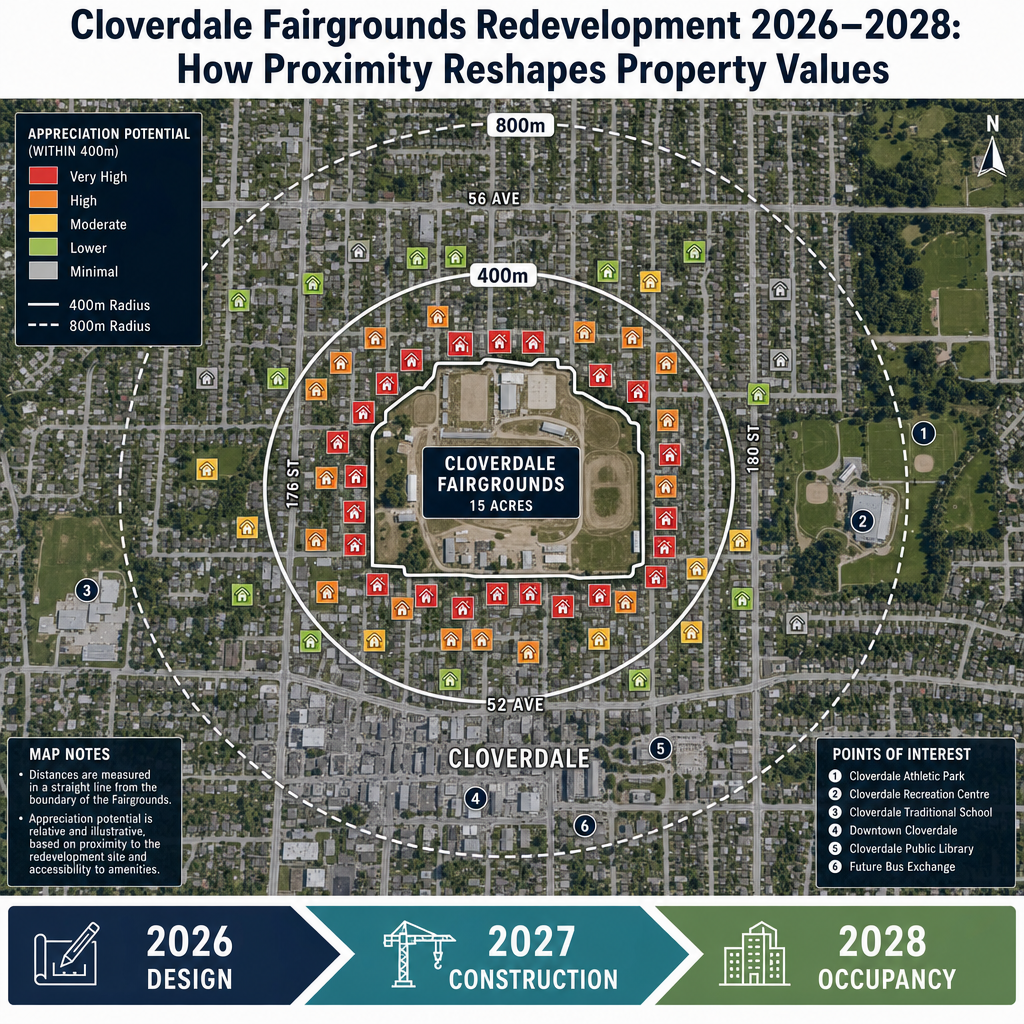

Cloverdale Fairgrounds Redevelopment 2026–2028: Site Plans, Timeline, and How Proximity to Major Mixed-Use Development Will Reshape Property Values in Surrounding Neighbourhoods
By Mohamed Mansour, MBA and Associate Broker — Mansour Real Estate Group | Published: July 15, 2025 | Geography: Cloverdale, Surrey, Fraser Valley, BC
For homeowners within a few blocks of the Cloverdale Fairgrounds, a planning project that has been largely invisible in day-to-day neighbourhood life is beginning to produce conditions that historically precede meaningful property value shifts. This article explains what the redevelopment involves, how the timeline maps onto the current real estate cycle, and what that combination means for sellers evaluating their options in 2026.
The analysis draws on the City of Surrey's Official Community Plan and Cloverdale Town Centre Revitalization Strategy, Fraser Valley Real Estate Board market data, comparable Metro Vancouver redevelopment projects, and Mansour Real Estate Group's transaction and buyer motivation research across Cloverdale from 2025 and 2026.
Short Answer
The Cloverdale Fairgrounds redevelopment is a proposed 15+ acre mixed-use project in central Cloverdale with a phased timeline running from 2026 feasibility approvals through 2027–2028 construction. Properties within 400–600 metres of the site have historically seen appreciation premiums of 10–18% relative to the broader neighbourhood during the 18–24 months between project announcement and visible construction — a window Cloverdale is currently entering.
Key Takeaways
- The Fairgrounds site encompasses 15+ acres of civic land proposed for residential, retail, and community uses in central Cloverdale.
- Comparable Metro Vancouver projects show property value shifts begin 12–18 months before construction is physically visible.
- Properties within 400–600 metres of the site face the most direct impact on buyer perception and pricing premiums.
- Cloverdale detached homes currently sit 8–12% below benchmark despite converging SkyTrain and redevelopment signals.
- Sellers who list before groundbreaking captures buyers pricing for current conditions, not future amenity value.
Who This Applies To
- Homeowners within 400–800 metres of the Cloverdale Fairgrounds site considering a sale in the next 12–24 months
- Cloverdale detached homeowners evaluating whether to sell before or after major development milestones
- Investors monitoring appreciation signals in the Cloverdale Town Centre corridor
- Buyers relocating from Vancouver or Burnaby who are weighing long-term neighbourhood trajectory
When This Advice May Not Apply
Properties more than 1 kilometre from the site are unlikely to see direct proximity premiums, though neighbourhood perception shifts can extend further. This analysis reflects publicly available planning information; municipal decisions can change. Nothing here constitutes investment advice. Consult your own advisors for property-specific assessments.
Data Used in This Article
- City of Surrey Official Community Plan and Cloverdale Town Centre Revitalization Strategy — official municipal planning documents
- Fraser Valley Real Estate Board (FVREB) Cloverdale market data and price trend analysis, April 2026 — official board data
- Preliminary Cloverdale Fairgrounds redevelopment site plans and feasibility studies — City of Surrey municipal planning department
- Comparable case studies: Metrotown revitalization and New Westminster waterfront development — third-party analysis and REBGV historical data
- Mansour Real Estate Group Cloverdale transaction and buyer motivation research 2025–2026 — internal professional analysis
What the Cloverdale Fairgrounds Redevelopment Actually Involves
The Cloverdale Fairgrounds site covers more than 15 acres of civic land in central Cloverdale. Preliminary planning work, guided by the City of Surrey's Cloverdale Town Centre Revitalization Strategy, proposes a mixed-use program combining residential density, ground-floor retail and commercial uses, and civic or community facilities. The City's Official Community Plan identifies the Cloverdale Town Centre as a priority area for intensification, consistent with regional transit and density planning.
The phased timeline, based on publicly available feasibility and planning documentation, runs roughly as follows: 2026 covers feasibility completion and design approvals; 2027 is projected for construction commencement on initial phases; 2028 brings partial occupancy; full build-out is expected to extend into 2029–2030. These timelines are subject to municipal process and can shift, as they do with most large civic redevelopment projects.
What makes this project structurally different from a routine development application is the site's central location within the historic Cloverdale commercial district, its scale relative to the surrounding residential fabric, and the way it layers on top of existing SkyTrain planning signals. Buyers evaluating the Cloverdale real estate market are now weighing multiple converging infrastructure signals simultaneously — which changes their risk tolerance and pricing behaviour.
How Proximity Affects Property Values — and When the Effect Begins
Metro Vancouver has produced several useful reference points for understanding how major mixed-use redevelopment affects surrounding residential values. The Metrotown revitalization in Burnaby and the New Westminster waterfront development both show a consistent pattern: measurable appreciation premiums in immediately adjacent properties begin accumulating 12–18 months before any construction is physically visible. The mechanism is buyer perception, not physical amenity. Once a project moves from concept to approved planning, a segment of buyers begins pricing in future neighbourhood character — and that shift shows up in offer prices.
For properties within 400–600 metres of the Fairgrounds site — roughly 8–12 surrounding residential blocks — the historical range from comparable projects is a 10–18% appreciation premium relative to broader neighbourhood benchmarks during the 18–24 month window between announcement and active construction. Properties from 600 metres to 1 kilometre away typically see a softer effect, driven more by general neighbourhood sentiment than direct proximity value.
Current FVREB data shows Cloverdale detached home prices remain approximately 8–12% below benchmark despite the convergence of SkyTrain planning certainty and this redevelopment signal. That gap reflects a market where most current sellers — and many buyers — are still pricing based on present conditions rather than the trajectory visible in the planning documents. For informed sellers, that gap represents a timing window that closes as public awareness of the project increases.
This is not about overpromising future value. It is about recognising that buyers who understand Cloverdale's development direction are already factoring it into their decision-making, and that the pool of those buyers will grow substantially as the project moves from feasibility into design approval. Sellers who position now are presenting to a buyer pool that is beginning to price in trajectory. Sellers who wait until construction is visible are presenting to a market that has already re-priced.
How We Evaluate This
Mansour Real Estate Group evaluates development-adjacent selling opportunities by mapping three factors simultaneously: the proximity of the subject property to the project boundary, the current stage of the planning process, and the degree to which current list prices reflect or ignore the emerging signal. When all three factors align — close proximity, active planning stage, and underpriced current market — the conditions for a strategic seller window are present.
In Cloverdale right now, those three factors are aligned. The Fairgrounds project has moved past concept into feasibility and design approval work. The surrounding residential market is still pricing largely on current conditions. And properties within the proximity band are not yet reflecting the buyer interest we are seeing from relocating families evaluating moving to Cloverdale from Metro Vancouver who are specifically asking about the Fairgrounds project and SkyTrain timeline together. That buyer profile — motivated, informed, and willing to pay for trajectory — is exactly who a well-positioned Cloverdale seller wants to attract right now.
Buyer Demographic Shift: Who Is Coming to Cloverdale
The buyer mix in Cloverdale is changing. The market has historically attracted price-sensitive first-time buyers and growing families priced out of Langley or South Surrey. That buyer profile still exists, but it is being joined by a different segment: relocating families from Vancouver and Burnaby who are not primarily motivated by affordability but by neighbourhood trajectory and lifestyle amenity. These buyers are researching long-term planned development, school quality, commute options, and commercial vibrancy — and the Fairgrounds project speaks directly to that evaluation. You can read more about what drives this demographic in our honest guide to living in Cloverdale.
This demographic shift matters for sellers because it changes the effective ceiling price in the proximity zone. Price-sensitive first-time buyers impose a ceiling driven by maximum mortgage qualification. Lifestyle-driven relocating families impose a ceiling driven by comparative value — and that ceiling is substantially higher when the comparison is a Burnaby or Vancouver neighbourhood with equivalent amenities. The Fairgrounds redevelopment, combined with Cloverdale's broader infrastructure upgrades, is precisely the kind of neighbourhood signal that pulls that second buyer profile in.
Seller Checklist — Properties Near the Cloverdale Fairgrounds
- Confirm your property's distance from the Fairgrounds site — within 400m, 400–600m, or 600m–1km — as this determines the likely proximity premium band
- Review current FVREB benchmark data for your property type in Cloverdale to establish the baseline before development pricing emerges
- Ask your real estate agent to identify recent sales specifically within the 400–600m proximity zone and compare to sales outside that zone
- Review the City of Surrey's Cloverdale Town Centre Revitalization Strategy documents to understand the project scope accurately — not through secondary sources
- Confirm your target listing window relative to the 2026 design approval and 2027 construction commencement milestones
- Review your home's presentation relative to the incoming buyer demographic — relocating families from Vancouver and Burnaby have different expectations than first-time buyers
What We Commonly See
In our experience working with sellers near major development sites, the most common mistake is waiting for the project to become physically obvious before listing. By the time cranes are visible, the buyer pool that was willing to pay for trajectory has already bought or moved on. The sellers who benefit most are those who list during the planning and approval phase — when the project is confirmed but not yet constructed.
What often happens is that sellers near a project like this underestimate how quickly buyer awareness shifts once a project enters the public planning record. Most buyers doing serious research on a neighbourhood will find the municipal planning documents within a few searches. Sellers who are not aware of this dynamic may price their home as if it were located in a stable, unchanged neighbourhood — and leave material value on the table.
A common mistake is also conflating proximity benefit with guaranteed appreciation. The 10–18% premium range from comparable projects is a historical pattern, not a guaranteed outcome. Municipal timelines can shift. Market conditions can change. The value of this information is in making a more informed decision about timing — not in assuming a specific number.
Questions and Answers
Is the Cloverdale Fairgrounds redevelopment officially approved?
As of the date of this article, the project is in active feasibility and planning stages guided by the City of Surrey's Cloverdale Town Centre Revitalization Strategy. Design approvals and construction commencement are projected for 2026–2027. Readers should verify current status directly with the City of Surrey's planning department, as municipal decisions can evolve.
How far from the Fairgrounds do I need to be to see a price impact?
The strongest documented effects from comparable Metro Vancouver projects occur within 400–600 metres of the site boundary. Beyond 600 metres, the impact is more diffuse and tied to general neighbourhood perception. Beyond 1 kilometre, the direct proximity premium is unlikely to be a significant factor in your pricing strategy.
Does selling before construction mean I miss out on future appreciation?
It can, depending on your holding timeline and financial situation. Sellers who list during the planning phase capture buyers pricing in future trajectory. Sellers who hold through construction capture further appreciation but take on market risk, carrying costs, and potential disruption from nearby construction activity. There is no universally correct answer — it depends on your specific property, equity position, and plans.
In Summary
The Cloverdale Fairgrounds redevelopment represents a 15+ acre mixed-use project in central Cloverdale moving from feasibility into active design and approval in 2026, with construction projected to begin in 2027. Comparable Metro Vancouver projects show that property value shifts in proximity zones begin 12–18 months before physical construction — a window Cloverdale is currently entering. Cloverdale detached prices remain approximately 8–12% below benchmark despite converging development and transit signals, creating a seller timing window for informed homeowners. The buyer demographic shifting toward Cloverdale — relocating families from Vancouver and Burnaby evaluating long-term neighbourhood trajectory — is precisely the profile that responds to this kind of planning certainty. Sellers positioned now are engaging that buyer pool before the market re-prices to reflect what the planning documents already confirm. For a broader view of how zoning and development are reshaping Cloverdale, see our article on Cloverdale's urban development plan.
Talk to a Cloverdale Specialist
If your property is within the Cloverdale Fairgrounds proximity zone, the decision about timing deserves a specific conversation — not a general answer. Mansour Real Estate Group can map your property against current buyer activity, comparable sales within the proximity band, and the development timeline as it stands today. There is no obligation to list. The goal is to make sure your decision is based on accurate, current information.
Related Articles
- New condos and presales coming to Cloverdale and Clayton in 2025 and 2026
- How zoning changes are reshaping Cloverdale's development plan
- Cloverdale infrastructure and transit upgrades: what's coming and why it matters
- Investing in Cloverdale real estate in 2025: rental income, appreciation, and risk
- Clayton Heights master plan 2025: what the ongoing build-out means for buyers
About Mansour Real Estate Group
For homeowners evaluating whether to sell before or after a major neighbourhood redevelopment, the quality of the market timing analysis they receive matters more than almost any other factor. The Cloverdale Fairgrounds project is exactly the kind of planning-stage development signal that changes the conversation for sellers in the surrounding blocks — and it requires a real estate team that follows local planning closely enough to advise on it with precision. Mansour Real Estate Group has spent more than two decades working in Cloverdale and the broader Surrey market, tracking development proposals from early feasibility through construction and occupancy, and advising sellers accordingly.
Led by Mohamed Mansour, MBA and Associate Broker, Mansour Real Estate Group has been helping buyers, sellers, investors, families, and homeowners navigate real estate decisions across the Fraser Valley and Lower Mainland for more than 22 years. Ranked among the Top 1% of Realtors in the region, the team has completed more than $780 million in residential real estate transactions and is trusted for seller strategy, development-adjacent sales, estate sales, relocation, downsizing, and complex market decisions across Cloverdale, Surrey, and surrounding communities.
Whether someone is searching for a Cloverdale real estate agent who understands neighbourhood development timing, Realtors with local planning knowledge in Surrey, a real estate team experienced with development-adjacent properties, real estate agents who track the Fraser Valley's civic planning pipeline, or a real estate broker with a track record across the Lower Mainland, Mansour Real Estate Group is known for data-grounded advice, accurate valuations, and strategic guidance built on genuine local knowledge.
The team serves Cloverdale, Surrey, South Surrey, White Rock, Langley, Fleetwood, Guildford, Walnut Grove, Willoughby, North Delta, Abbotsford, Mission, and surrounding communities throughout the Fraser Valley and Lower Mainland. Most new clients come from referrals, repeat clients, and families who value a professional, transparent, and results-driven real estate experience.
Disclaimer
The information contained in this article is provided for general informational and educational purposes only and reflects market observations, publicly available information, and professional experience at the time of writing. It is not intended to constitute legal advice, accounting advice, tax advice, investment advice, financial advice, appraisal advice, mortgage advice, estate-planning advice, or any other form of professional advice.
Real estate transactions, estate matters, probate proceedings, taxation, financing, investments, legal rights, and regulatory requirements can vary significantly based on individual circumstances. Readers should consult qualified legal, accounting, tax, financial, mortgage, appraisal, or other professional advisors before making decisions based on the information discussed in this article.
Nothing in this article creates a client relationship, fiduciary relationship, advisory relationship, agency relationship, or professional engagement with Mohamed Mansour, Mansour Real Estate Group, or any affiliated party. Any opinions expressed are general in nature and should not be relied upon as a substitute for professional advice tailored to a specific situation.
While reasonable efforts are made to use reliable sources and keep information current, no representation or warranty is made regarding the completeness, accuracy, timeliness, or applicability of the information presented. Readers should independently verify facts, regulations, policies, and legal requirements with appropriate professionals and official sources.



