
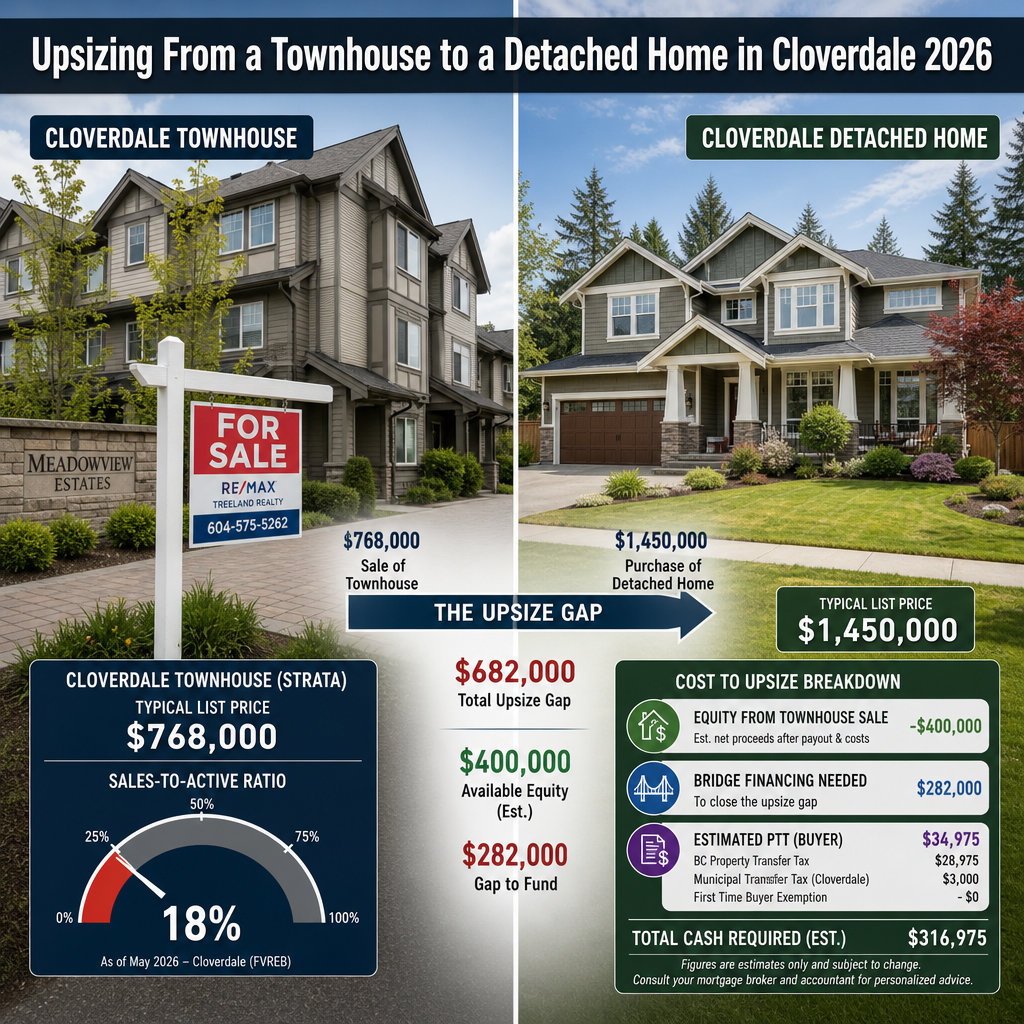

Upsizing From a Townhouse to a Detached Home in Cloverdale 2026: Equity Calculation, Bridge Financing Math, Simultaneous Buy-Sell Timing, and Whether the Current Buyer's Market Actually Favours Strategic Upsizers
By Mohamed Mansour, MBA, Associate Broker — Mansour Real Estate Group | Fraser Valley and Lower Mainland | Published: July 15, 2026 | Geographic Focus: Cloverdale, Surrey, BC
For growing families in Cloverdale who have outgrown a townhouse and are eyeing the detached market, 2026 presents a specific financial puzzle. Townhouse inventory is elevated, absorption is soft, and detached homes in the same neighbourhoods are holding value more firmly. That divergence creates an equity gap that requires careful calculation before a single listing goes live.
This article works through the real numbers: what your townhouse sale actually nets, what bridge financing costs, how to sequence a simultaneous buy-sell without losing negotiating position on either side, and whether the 2026 buyer's market genuinely favours upsizers — or just feels that way.
Short Answer
The 2026 buyer's market does favour Cloverdale upsizers — but only if you sell first, price your townhouse accurately against current absorption data, and secure bridge financing before you make an offer on a detached home. The total transaction friction typically runs $35,000 to $75,000 when commission, legal fees, property transfer tax, and bridge costs are combined. Families who calculate that number first make better decisions about timing and price.
Who This Applies To
- Cloverdale or Clayton townhouse owners with 3 to 8 years of equity accumulation considering a move to detached
- Families with 2 or more children who need a fourth bedroom, a backyard, or suite potential
- Dual-income households who qualify for a detached mortgage but are uncertain about sell-buy sequencing
- Homeowners watching the SkyTrain timeline and wondering whether to move before or after station opening
- Owners currently sitting on $200,000 to $400,000 in townhouse equity and trying to understand the real cost of moving up
When This Advice May Not Apply
This framework assumes a primary-residence townhouse in Cloverdale or Clayton with a conventional mortgage. It may not apply to strata properties under special levy risk, assignment sales, or investment properties with rental income dependencies. If your townhouse was purchased as a presale within the last 18 months, resale timing and PTT implications may differ.
Key Takeaways
- Cloverdale townhouses are selling at 15–23% sales-to-active ratios — price accurately or the listing stalls and your detached purchase timeline collapses.
- Bridge financing typically costs $8,000–$20,000 in interest over a six-month term, plus lender and legal fees — it is a real cost, not a rounding error.
- Total transaction friction — commission, legal, PTT, bridge — commonly runs $35,000–$75,000 on a Cloverdale upsize move.
- The buyer's market gives you time and choice on the detached side, but it weakens your townhouse negotiating position — these forces run in opposite directions.
- SkyTrain opening may increase Cloverdale detached prices, but the carrying cost of waiting could easily exceed any pre-opening discount captured now.
Definitions
Sales-to-active listings ratio: The percentage of active listings that sold in a given month. Below 12% is a buyer's market. At 15–23%, Cloverdale townhouses sit in buyer's market or balanced territory depending on the month.
Bridge financing: A short-term loan that covers the gap between your detached home purchase closing date and your townhouse sale closing date. Your lender advances the equity from your townhouse sale before you actually receive it.
Property Transfer Tax (PTT): A BC tax on residential property purchases. The rate is 1% on the first $200,000, 2% on amounts between $200,000 and $3,000,000, and 3% on the portion above $3,000,000. First-time buyers may qualify for an exemption, but upsizers generally do not.
Subject-to-sale condition: An offer clause that makes your purchase of a detached home conditional on successfully selling your townhouse first. Sellers in a balanced or seller's market often reject these. In a buyer's market, some will accept them.
Data Used in This Article
- Fraser Valley Real Estate Board (FVREB) — Cloverdale townhouse and detached sales-to-active ratios, Q2 2026. Official board data.
- Canadian mortgage lender bridge financing rate survey, 2026 — Annualized bridge financing rates and typical term structures. Third-party industry survey.
- BC Government Property Transfer Tax calculator — PTT rates applicable to residential purchases. Official government source.
- Mansour Real Estate Group comparable sales analysis — Cloverdale townhouse and detached pricing by listing date and price band, internal professional analysis.
How We Evaluate This
When a Cloverdale family considers upsizing, Mansour Real Estate Group builds the full transaction model before recommending a sequencing strategy. That means calculating net townhouse proceeds after commission, legal fees, and mortgage discharge penalty first — not last. Then we layer in bridge financing cost at the actual rate the client qualifies for, PTT on the new purchase, and a realistic close-to-close overlap window based on current market days on market for each property type.
The goal is to confirm whether the family can comfortably carry both properties for 30 to 90 days if timing slips, or whether they need tighter date alignment that requires pricing the townhouse more aggressively. Most upsizing decisions that go wrong do so because the seller priced the townhouse optimistically rather than strategically. The buyer's market on the detached side is a real advantage — but only if the townhouse sells cleanly first.
The Equity Gap: What Your Townhouse Actually Nets
Townhouse appreciation in Cloverdale and Clayton has been meaningful but has lagged detached homes over the past three years. According to FVREB data for Q2 2026, Cloverdale townhouses are selling at or slightly below benchmark in the current cycle, while detached homes — particularly those in Clayton Heights and the older Cloverdale BIA-adjacent streets — have shown more stable pricing. That gap matters when you are selling one to buy the other.
A townhouse purchased in 2019 for $620,000 that appraises today at roughly $780,000 may look like $160,000 in equity. But the actual net proceeds after a 3.5% commission, legal fees of approximately $2,000 to $3,000, and a mortgage discharge penalty (which can range from three months' interest to a full interest rate differential calculation depending on your lender and remaining term) may be closer to $130,000 to $140,000. That is the number that goes toward your down payment on the detached home — not the $160,000.
For the detached purchase side: a Cloverdale detached home in the $1.2 million to $1.5 million range carries a PTT liability of approximately $18,000 to $24,000 under BC's standard rates. That cost does not come from the townhouse equity — it comes from additional savings or is rolled into financing. Families who miss this calculation are often surprised at the lender's closing requirements. The Cloverdale detached home price point guide provides useful context on what different budgets deliver in the current market.
Bridge Financing: What It Actually Costs and When You Need It
Bridge financing becomes necessary when your detached purchase closes before your townhouse sale closes. That gap — often 30 to 90 days — requires your lender to advance the equity from your townhouse before the sale actually completes. Most major Canadian banks and credit unions offer bridge financing, but eligibility typically requires a firm sale on the townhouse (accepted offer, subjects removed) before they will fund the bridge on the new purchase.
In 2026, bridge financing rates from Canadian lenders typically run 1.5% to 2.5% annualized above prime, depending on the lender and the borrower's credit profile. On a $250,000 bridge (representing townhouse equity being advanced), a 60-day bridge at 2% annualized costs approximately $800 to $850 in interest. A 90-day bridge at the same rate reaches $1,250. The numbers scale significantly at higher equity positions — a $400,000 bridge held for 90 days at 2.5% costs approximately $2,500 in interest alone, before lender fees and legal costs for registering the bridge instrument, which typically add another $1,000 to $2,500.
The alternative — a subject-to-sale condition on the detached purchase — avoids bridge financing entirely but comes with its own cost. Detached home sellers in Cloverdale in 2026 who receive a subject-to-sale offer typically have the right to continue marketing and present the buyer with a 72-hour clause if a second offer arrives. If you cannot remove subjects within that window, you lose the property. In a buyer's market with longer listing periods, more sellers are willing to accept subject-to-sale conditions — but not all, and not on well-priced properties that attract multiple showings.
For Cloverdale upsizers, the practical recommendation is: get bridge financing pre-approved before making any offer on a detached property. That approval gives you the option to offer clean (without a subject-to-sale condition) once your townhouse is listed and moving toward an accepted offer. It also tells you the exact cost — so the decision between bridge financing and a subject-to-sale condition is based on real numbers, not assumptions. Understanding strata obligations that affect your townhouse sale timeline matters here too, particularly if your strata council requires advance notice for showings or has a right of first refusal clause.
Simultaneous Buy-Sell Timing: The 14-to-21-Day Window That Breaks Deals
In BC, the standard subject removal period in a purchase offer is typically 5 to 10 business days, though negotiated periods in a buyer's market often extend to 14 to 21 days. For an upsizer running a simultaneous transaction, this window is the highest-risk point in the entire process. You may have an accepted offer on your detached home with subjects due in 14 days, while your townhouse is either still being listed or has an accepted offer with its own subject period running concurrently.
The failure scenario that Mansour Real Estate Group sees most often: a seller accepts an offer on their townhouse with subjects, then immediately puts an offer on a detached home — also with subjects — before the townhouse buyer has removed theirs. The detached purchase subjects come due first. The seller is now being asked to confirm financing and remove subjects on a $1.3 million detached property while their townhouse sale is still conditional. Lenders will not fund bridge financing on a conditional townhouse sale. The options at that point are: remove subjects without confirmed bridge (risky), extend the detached subject period (requires the detached seller's consent, which they may refuse), or walk away from the detached purchase and lose the deposit.
The sequencing that avoids this: list the townhouse first, wait for subjects to be removed on the townhouse sale, then use that firm sale to obtain bridge financing approval, then make a clean or minimally conditional offer on the detached home. This sequence adds 3 to 5 weeks compared to running both simultaneously, but it eliminates the condition cascade risk. In a buyer's market where detached inventory is reasonable, that extra time rarely costs you a specific property — it just means you may be evaluating a slightly different set of listings. The Cloverdale offer strategy guide covers how to structure subject periods and closing dates to give yourself the most flexibility without weakening your position.
Does the 2026 Buyer's Market Actually Favour Upsizers?
The short answer is yes — but with an important qualification. In a buyer's market, an upsizer benefits more on the purchase side than they lose on the sale side, because the price gap between their townhouse and the detached home they are buying narrows slightly. If a $1.3 million detached home has softened by 5%, that is a $65,000 reduction. If the upsizer's $800,000 townhouse has softened by 4%, that is a $32,000 reduction. The net benefit is $33,000 — real money that justifies moving in a softer market rather than waiting.
But that math only holds if the upsizer prices their townhouse accurately. With Cloverdale townhouses sitting at 15–23% sales-to-active ratios according to FVREB Q2 2026 data, overpriced listings simply stall. A townhouse priced 5% above market in this environment may sit for 45 to 60 days. At that point, the detached home the upsizer had their eye on is either sold or repriced. The buyer's market advantage evaporates when the sell side is mismanaged. Reviewing the two most common Cloverdale seller pricing mistakes is a useful starting point before setting a townhouse list price.
The 2026 buyer's market also provides a longer inspection, appraisal, and financing window on the detached side — typically 14 to 21 days compared to 5 to 7 days in a competitive market. That gives families more time to review the home inspection process, negotiate repair credits, and confirm mortgage qualification on the larger loan. That additional time is a genuine structural advantage for upsizers that did not exist in 2021 or 2022.
The SkyTrain Question: Urgency or Noise?
The Surrey-Langley SkyTrain Expo Line extension — which includes a station serving the Cloverdale-Clayton corridor — has a projected completion timeline of 2026 to 2028 depending on construction progress. The expectation that transit access will drive detached home price appreciation is logical and has historical precedent near other Expo Line stations. But the timing and magnitude of that appreciation are not guaranteed.
For an upsizer calculating whether to move now or wait for post-opening appreciation, the math rarely supports waiting. If you carry your townhouse and delay the detached purchase for 18 to 24 months hoping to sell the townhouse at a higher price, the strata fees, property taxes, opportunity cost of frozen equity, and continued payments on your current mortgage add up to real dollars. At $500 to $800 per month in strata fees alone over 18 months, that is $9,000 to $14,400 in costs that do not contribute to equity. Those costs need to be offset by townhouse appreciation that materially exceeds the current market trajectory — which, in a 15–23% sales-to-active ratio environment, is not well supported by current data. For a deeper look at how transit is expected to affect local values, the upcoming Cloverdale infrastructure and transit guide will cover the SkyTrain completion timeline and its neighbourhood-by-neighbourhood price implications in detail.
The families who are best served by the SkyTrain timing narrative are those buying a detached home to live in for 10 or more years. Transit access improves livability and resale potential over that horizon. For a family trying to time a 12-month window around a station opening, the variables are too numerous and the carrying costs too significant to make a confident prediction. If you are ready to move up for practical family reasons — space, school catchment, basement suite potential — the SkyTrain timeline is a reasonable tie-breaker, not the primary decision driver. The data-driven analysis of Cloverdale market timing provides additional context on how absorption trends affect entry-point decisions.
Upsizer Checklist: Before You List Your Townhouse
- Request a payoff statement from your lender to confirm the exact mortgage balance and any prepayment penalty that applies on your expected closing date.
- Pull a market analysis (CMA) on your townhouse using comparable Cloverdale and Clayton sales from the last 45 days only — not 90 days — to reflect current absorption conditions.
- Calculate your true net proceeds: estimated sale price minus commission, legal fees, discharge penalty, and any outstanding strata levy balance.
- Apply for bridge financing pre-approval with your lender before making any offers on a detached property — confirm the rate, the maximum bridge amount, and the lender's firm-sale requirement.
- Calculate PTT on your intended detached purchase price and confirm you have that amount available outside of your townhouse equity — it cannot typically be financed.
- Confirm your detached mortgage qualification using your net townhouse proceeds as the down payment, not your gross equity figure.
- Set your townhouse list price using the 45-day comparable analysis — not your purchase price, not an emotional benchmark, not a neighbour's asking price from six months ago.
- Build a written closing-date timeline that sequences: townhouse listing → offer accepted → subjects removed → bridge approval confirmed → detached offer submitted → detached closing date set at least 30 days after townhouse completion.
What We Commonly See
Overpriced townhouse listings based on 2022 peak comparables. In our experience working with Cloverdale upsizers, the most common mistake is pricing the townhouse against sales from 12 to 18 months ago, before the current inventory build. The result is a stale listing, a price reduction under pressure, and a detached purchase opportunity missed while the townhouse sat. A 3% to 5% price reduction under duress costs more than a properly priced listing from day one.
Assuming bridge financing is automatic. What often happens is that buyers secure a detached home purchase, expect their lender to fund bridge financing based on a conditional townhouse sale, and discover that the lender requires a firm sale first. The detached closing date is 30 days away. The townhouse subjects haven't been removed. The family is now negotiating a closing date extension on the detached home while scrambling to accelerate subjects on the townhouse. Confirming bridge financing eligibility and requirements before the detached offer is made eliminates this entirely.
Treating SkyTrain timing as a hard deadline. A common mistake is treating the SkyTrain opening as a hard deadline that forces a rushed purchase. In reality, transit infrastructure benefits accumulate over years, not months. Families who bought near Langley's planned stations three years early have generally done well — but not because of a specific opening-week price jump. Rushing into a poorly priced detached home because of perceived SkyTrain urgency leads to buyer's remorse and overpayment in a market that otherwise favours patience. The Cloverdale investment analysis covers how transit infrastructure factors into long-term appreciation models rather than short-term timing windows.
Questions and Answers
Q: Can I make an offer on a Cloverdale detached home before my townhouse sells?
Yes, but it is risky without bridge financing pre-approval or an accepted firm sale on your townhouse first. A subject-to-sale condition protects you but may be rejected by detached home sellers, especially on well-priced properties. In the current buyer's market, some sellers will accept subject-to-sale — confirm this with a Realtor who can assess the specific listing's days on market and seller motivation before you offer.
Q: How much does bridge financing actually cost for a typical Cloverdale upsize?
On a $300,000 bridge held for 60 days at 2% annualized, the interest is approximately $986. Add lender fees of $500 to $1,000 and legal costs to register the bridge of $1,000 to $2,500. Total cost for a 60-day bridge at that equity level: roughly $2,500 to $4,500. Larger bridges or longer terms increase proportionally. At $400,000 held for 90 days at 2.5%, total costs approach $4,000 to $6,500.
Q: Does the Cloverdale SkyTrain station opening guarantee higher detached home prices?
Historical transit openings in Metro Vancouver have generally supported price appreciation near stations over a 3-to-5 year window, but short-term price movements at or after opening are not predictable with confidence. Buying a Cloverdale detached home for long-term family use is a reasonable decision regardless of the SkyTrain timeline. Buying specifically to time a pre-opening discount involves carrying cost and sequencing risk that may exceed the expected gain.
Q: What is the property transfer tax on aRelated Articles



