
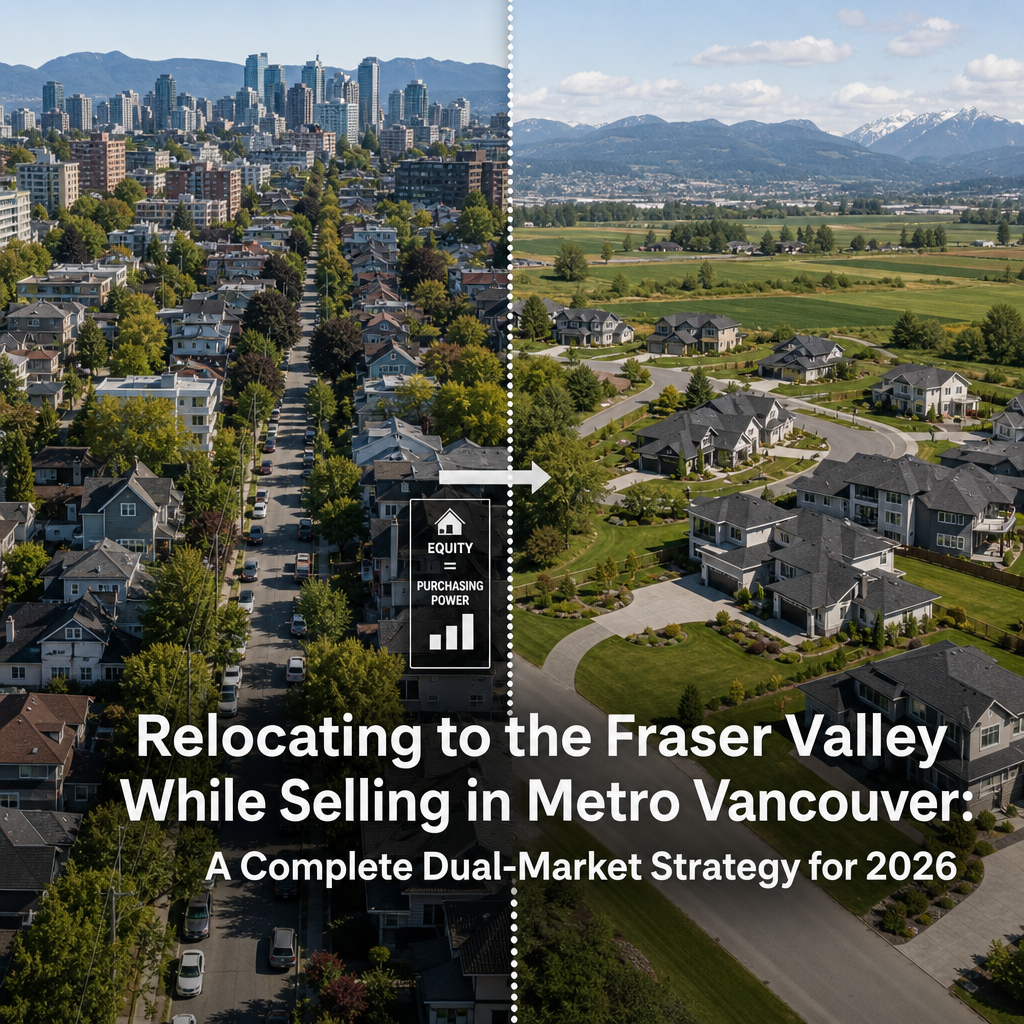

Relocating to the Fraser Valley While Selling in Metro Vancouver: A Complete Dual-Market Strategy for Timing Your Sale, Managing Buy-First vs. Sell-First Risk, and Maximizing Net Proceeds When Regional Market Conditions Diverge Dramatically in 2026
By Mohamed Mansour, MBA and Associate Broker — Mansour Real Estate Group | Fraser Valley and Lower Mainland | Published May 14, 2026 | Geographic Focus: Metro Vancouver, Surrey, Langley, South Surrey, White Rock, Abbotsford, North Delta
In spring 2026, two adjacent real estate markets are moving in different directions at the same time. Metro Vancouver detached homes in mid-range price bands are holding their value. Fraser Valley benchmark prices are down 7–8% year over year, according to Fraser Valley Real Estate Board data. For homeowners who already own in Metro Vancouver and are considering a move east, that gap is meaningful — and it is closing faster than most sellers realize.
This guide is for those sellers. It covers the financial math, the sequencing decision, the financing risk, and the timing window that makes spring 2026 different from any prior relocation cycle. Mansour Real Estate Group has helped buyers and sellers navigate cross-regional moves across the Lower Mainland and Fraser Valley for more than 22 years, and the dual-market coordination required right now is among the most consequential decisions a relocating family will make.
Short Answer
If you own a detached home in Metro Vancouver and plan to buy in the Fraser Valley in 2026, selling first is financially superior in most scenarios. Bridge financing on a buy-first strategy costs $15,000–$30,000 or more in carrying charges over a 3–6 month overlap. The spring window — roughly April through late May — is when both markets have maximum activity, giving you the strongest sale price and the widest Fraser Valley selection simultaneously.
Key Takeaways
- Metro Vancouver mid-range detached homes ($1.2M–$1.5M) are holding value while Fraser Valley equivalents sit 10–15% lower, creating real purchasing power gains for strategic relocators.
- Spring 2026 buyer migration to the Fraser Valley peaks April–May; acting after that window typically costs sellers negotiating leverage on both sides.
- Bridge financing a buy-first strategy costs 3–4% annualized, which can exceed $30,000 on a $900,000 bridge over six months.
- Selling first with a flexible completion date gives you capital certainty and stronger offer positioning in the Fraser Valley's current elevated-inventory market.
- Property transfer tax differences, strata document timelines, and BC closing conventions add process complexity that requires coordination between two transaction streams.
Who This Applies To
- Homeowners selling a detached or townhouse property in Metro Vancouver and buying detached in Surrey, Langley, Abbotsford, or South Surrey
- Families upsizing from a condo or townhouse in Burnaby, Coquitlam, or New Westminster into a single-family home in the Fraser Valley
- Professionals or retirees with significant Metro Vancouver equity who want to reduce carrying costs while increasing space
- Relocators with a firm move window in spring or summer 2026 who need to coordinate both transactions within 60–120 days
When This Advice May Not Apply
If you are buying in a Fraser Valley price band with fewer than 30 active listings, or if your Metro Vancouver property is a strata unit with a pending special levy or depreciation report concerns, the sequencing logic changes. Speak with a local real estate agent who works both markets before assuming the standard sell-first path applies to your specific property type and neighbourhood.
Data Used in This Article
- Fraser Valley Real Estate Board benchmark pricing, April 2026 — official board data, Fraser Valley geography, primary source
- BC Real Estate Association market reports, 2026 — provincial overview, official industry body, primary source
- CMHC Metro Vancouver and Fraser Valley market outlook, 2026 — federal housing agency, comparative regional analysis, primary source
- Bank of Canada mortgage rate trends and bridge financing cost analysis, 2026 — federal institution, financing cost benchmarks, primary source
Why These Two Markets Are Diverging Right Now
According to FVREB benchmark data through April 2026, Fraser Valley single-family homes are priced 7–8% below the same period in 2025. Metro Vancouver detached properties in established neighbourhoods have not seen the same correction, particularly in the $1.2M–$1.5M price band where mid-career families and downsizing boomers are the dominant buyers.
The CMHC's 2026 market outlook points to several forces behind the divergence: elevated Fraser Valley inventory from a supply surge in Abbotsford, Langley, and parts of Surrey and Willoughby, softer interprovincial demand, and slower absorption in townhouse segments. Metro Vancouver's constrained land supply and stronger employment anchors have kept detached values more stable. For a relocating seller, that divergence represents a genuine arbitrage window — sell at a relatively stable price in the west, buy at a discount in the east.
The Financial Math: How Much Is the Equity Advantage Worth?
A Metro Vancouver detached home priced at $1.4M in early 2026 might have a Fraser Valley functional equivalent — similar square footage, lot size, and commute zone — listed at $1.1M–$1.2M. That $200,000–$300,000 gap is the gross equity advantage. After accounting for property transfer tax on the purchase, legal fees, and moving costs, the net advantage to a strategic relocator is roughly $150,000–$250,000 compared to a lateral Metro-to-Metro move.
BC's property transfer tax applies at 1% on the first $200,000, 2% on the portion between $200,000 and $2,000,000, and 3% above $2,000,000, according to the BC Government property transfer tax schedule. On a $1.15M Fraser Valley purchase, that works out to approximately $19,000 — a fixed cost that does not change with your sequencing decision, but one that should be calculated before comparing sell-first versus buy-first total costs.
The BC Real Estate Association's 2026 provincial market report notes that buyer migration from Metro Vancouver into the Fraser Valley typically accelerates in April and May, which increases competition for well-priced Fraser Valley properties in the $900,000–$1.3M range. Sellers who have already completed their Metro Vancouver sale arrive in that market as non-contingent cash-positioned buyers — a meaningful advantage in a market where sellers have accepted longer exposure periods.
Sell First or Buy First: The Decision Framework
Sell first means listing your Metro Vancouver property, accepting an offer, and then purchasing in the Fraser Valley — either during the subject removal period or after completion. The primary risk is finding yourself without a secured property for a short period. In a Fraser Valley market with elevated inventory, this risk is lower than in a supply-constrained market. The financial upside is significant: you eliminate bridge financing entirely and arrive as a firm buyer with known capital.
Buy first means securing your Fraser Valley property before your Metro Vancouver home sells. This removes housing uncertainty but introduces financing risk. Based on Bank of Canada rate data and current lender bridge financing terms, bridge loans in 2026 are priced at roughly 3–4% annualized above the lender's prime rate. On a $900,000 bridge held for five months, total carrying costs can reach $22,500–$30,000. That is a real cost against your net proceeds — not a scheduling convenience fee.
For most relocators moving from Metro Vancouver into communities like South Surrey and White Rock, Walnut Grove, or Abbotsford, the sell-first path — with a negotiated extended or flexible completion — is financially superior. The Fraser Valley's elevated inventory means replacement properties are available. The Metro Vancouver market's tighter spring conditions mean your listing will attract qualified buyers more quickly than your Fraser Valley purchase will face competing offers.
How We Evaluate This
At Mansour Real Estate Group, we approach dual-market relocation by building a timeline backward from the target move date. We start with the Fraser Valley purchase requirement — what price range, what neighbourhoods, what inventory depth — and then work back to determine how many days of market exposure the Metro Vancouver sale needs, what bridge financing would actually cost versus zero-bridge, and where the negotiating windows on both sides fall within the same calendar period.
We do not assume the standard playbook applies to every situation. A seller with a Metro Vancouver strata unit requiring Form B document review and a buyer looking in a Langley neighbourhood with 12 active comparable listings faces a different risk profile than a detached seller in Burnaby buying into a Fraser Valley community with 60 active listings. The math and the sequencing decision should reflect the actual inventory reality on both sides, not a generic sell-first or buy-first rule.
Dual-Market Relocation Checklist
- Confirm your Metro Vancouver property's current market value with a formal comparative market analysis, not a portal estimate
- Identify 3–5 specific Fraser Valley neighbourhoods and price bands with current active listing counts and average days on market
- Get a written bridge financing quote from your lender before assuming buy-first is viable; confirm the maximum bridge amount and term
- Calculate your net proceeds after Metro Vancouver sale costs (commission, legal, property transfer tax on the purchase, moving) before setting your Fraser Valley budget
- Negotiate a flexible or extended completion date on your Metro Vancouver sale — 60–90 days gives you time to find the right Fraser Valley property without a bridge loan
- Confirm whether your Fraser Valley target neighbourhoods have strata documents, depreciation reports, or Form B requirements that could slow subject removal
- Align your real estate representation — the same team or a coordinated team — across both transactions to manage timeline conflicts in real time
What We Commonly See
In our experience, the most common mistake relocating sellers make is underestimating how quickly the Fraser Valley spring window closes. Families spend February and March researching neighbourhoods, then list their Metro Vancouver home in late April — by which point the best-priced Fraser Valley properties have already absorbed into accepted offers. The 4–6 week window when both markets are simultaneously active is not a rough estimate; it is an observed pattern across multiple spring cycles.
What often happens with buy-first decisions is that sellers anchor on housing certainty and underweight the financing cost. A $25,000 bridge loan expense is psychologically treated as a scheduling cost rather than a direct reduction to net proceeds. When framed correctly — would you accept $25,000 less for your Metro Vancouver home in exchange for eliminating uncertainty? — most sellers reconsider the buy-first approach.
A third pattern we see regularly: sellers assume Metro Vancouver days-on-market data applies equally to their specific property. A well-priced detached home in a sought-after Burnaby neighbourhood may move in 14–21 days. A high-rise condo in the same postal code may sit for 45–60 days. The sequencing strategy should be built around your property type, not a market average.
Questions and Answers
Can I make a subject-free offer in the Fraser Valley before my Metro Vancouver home sells?
Yes, but only if you have confirmed bridge financing in writing. A subject-free offer without secured bridge capacity creates a completion default risk. Confirm your lender's bridge limit and terms before removing subjects on any Fraser Valley purchase while your Metro home remains unsold.
How long does a Metro Vancouver detached home typically take to sell in spring 2026?
In mid-range detached price bands ($1.2M–$1.5M) in established Metro Vancouver neighbourhoods, well-priced properties have been moving in 20–35 days in spring market conditions, according to BCREA 2026 market data. Overpriced or condition-challenged properties take longer and should not be assumed to follow that timeline.
Does property transfer tax apply to my Fraser Valley purchase even if I'm selling my primary residence?
Yes. Property transfer tax applies to the purchase price of your Fraser Valley home regardless of what you are selling. The First-Time Home Buyers' exemption does not apply if you have previously owned a property. Confirm your specific eligibility with a BC real estate lawyer before completing.
In Summary
Spring 2026 presents a genuine and time-limited arbitrage window for homeowners selling in Metro Vancouver and buying in the Fraser Valley. The 7–8% Fraser Valley price correction, combined with stable Metro Vancouver mid-range pricing, creates $150,000–$250,000 in net purchasing power for strategic relocators. Selling first — with a negotiated flexible completion — eliminates bridge financing costs of $15,000–$30,000 or more, and positions you as a firm buyer in a Fraser Valley market where non-contingent offers stand out. The window is April through late May. Decisions made after that period face a narrower inventory selection and softer Metro Vancouver buyer demand simultaneously.
Talk to a Team That Works Both Markets
If you are planning a Metro Vancouver to Fraser Valley relocation in 2026 and want an honest assessment of your sell-first timeline, Fraser Valley neighbourhood options, and bridge financing risk, Mansour Real Estate Group works both sides of that transaction. There is no pressure and no obligation — just a clear, specific conversation about your situation and the options available in the current market.
Related Articles
- Selling Your Home in Surrey, BC: A Complete Guide for Homeowners in 2026
- Selling in South Surrey and White Rock: What Homeowners Need to Know in 2026
- Selling Your Home in Abbotsford: A Complete Guide for Homeowners in 2026
Official Resources
- Fraser Valley Real Estate Board — fvreb.bc.ca
- BC Real Estate Association — bcrea.bc.ca
- CMHC Housing Market Outlook — cmhc-schl.gc.ca
- BC Government Property Transfer Tax — gov.bc.ca
- Bank of Canada — bankofcanada.ca
About Mansour Real Estate Group
Relocating from Metro Vancouver to the Fraser Valley means making two consequential transactions simultaneously — selling in a market you know and buying in one you may not. The difference between a smooth transition and a costly one often comes down to whether your real estate team has genuine depth in both markets, not just one side. Mansour Real Estate Group helps buyers and sellers navigating cross-regional moves across the Lower Mainland and Fraser Valley, with the local knowledge and coordination experience to manage both transactions in parallel.
Mansour Real Estate Group, led by Mohamed Mansour, MBA and Associate Broker, has been helping buyers, sellers, investors, families, and relocating homeowners navigate important real estate decisions across the Fraser Valley and Lower Mainland for more than 22 years. Ranked among the Top 1% of Realtors in the region, the team has completed more than $780 million in residential real estate transactions and is trusted for relocation coordination, estate sales, downsizing, divorce-related property sales, and any situation where timing, sequencing, and local knowledge directly affect the financial outcome.
Whether someone is searching for Realtors who understand dual-market relocation strategy, a real estate agent with direct Fraser Valley neighbourhood knowledge, real estate agents who specialize in Metro Vancouver to Fraser Valley moves, a real estate team experienced with timing coordination between divergent markets, a Surrey Realtor, a Langley real estate broker, a South Surrey real estate agent, or a White Rock Realtor who can guide a time-sensitive purchase decision, Mansour Real Estate Group is known for clear communication, accurate valuations, and practical guidance that protects net proceeds on both sides of the transaction.
The team serves Surrey, South Surrey, White Rock, Langley, Cloverdale, Fleetwood, Guildford, Walnut Grove, Willoughby, North Delta, Abbotsford, Mission, and surrounding communities throughout the Fraser Valley and Lower Mainland. Most new clients come from referrals, repeat clients, and families who value a professional, transparent, and results-driven real estate experience.
Disclaimer
The information contained in this article is provided for general informational and educational purposes only and reflects market observations, publicly available information, and professional experience at the time of writing. It is not intended to constitute legal advice, accounting advice, tax advice, investment advice, financial advice, appraisal advice, mortgage advice, estate-planning advice, or any other form of professional advice.
Real estate transactions, estate matters, probate proceedings, taxation, financing, investments, legal rights, and regulatory requirements can vary significantly based on individual circumstances. Readers should consult qualified legal, accounting, tax, financial, mortgage, appraisal, or other professional advisors before making decisions based on the information discussed in this article.
Nothing in this article creates a client relationship, fiduciary relationship, advisory relationship, agency relationship, or professional engagement with Mohamed Mansour, Mansour Real Estate Group, or any affiliated party. Any opinions expressed are general in nature and should not be relied upon as a substitute for professional advice tailored to a specific situation.
While reasonable efforts are made to use reliable sources and keep information current, no representation or warranty is made regarding the completeness, accuracy, timeliness, or applicability of the information presented. Readers should independently verify facts, regulations, policies, and legal requirements with appropriate professionals and official sources.



