

How Strata Depreciation Report Red Flags Delay Fraser Valley Sales and Trigger Buyer Financing Denial
By Mohamed Mansour, MBA and Associate Broker | Mansour Real Estate Group | Published: July 15, 2026 | Fraser Valley and Lower Mainland, BC
This article is for strata property owners in Willoughby, Walnut Grove, Langley City, and surrounding Fraser Valley communities who are preparing to sell a condo or townhome in 2026. If your building has an aging depreciation report, a reserve fund below full funding, or a known special levy on the horizon, what you disclose — and when — directly affects whether your buyer's financing survives to closing.
With BC's July 1 depreciation report cycle creating a narrow strategic window this spring, strata sellers face a decision most are not prepared for: list before the new report is released, or wait and see what it says.
Short Answer
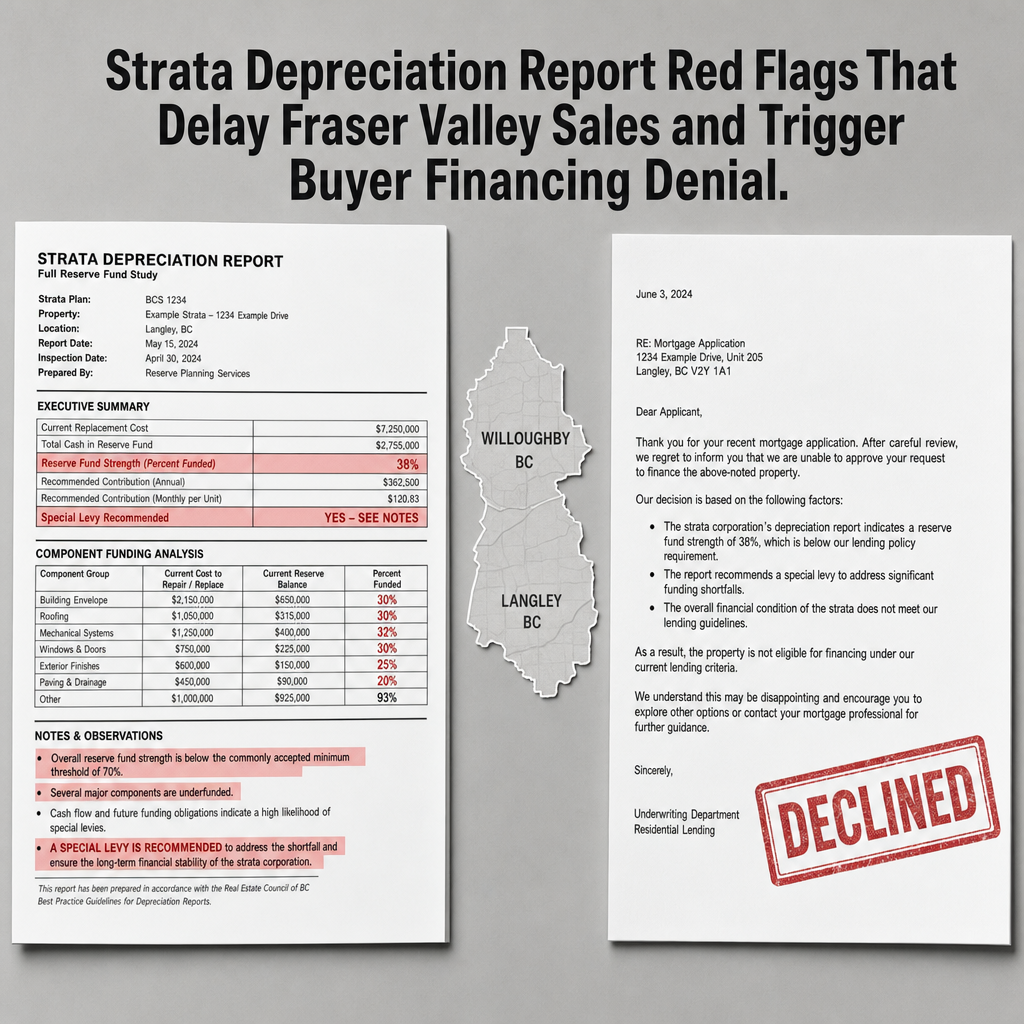
Strata depreciation reports that show reserve funds below 50% of full funding, special levies above $15,000 over three years, or major deferred repairs within five years regularly cause lender financing denial or loan-to-value reductions in Fraser Valley transactions. Sellers in Willoughby, Walnut Grove, and Langley who do not verify their reserve fund position before listing risk deals collapsing after offer acceptance — not at negotiation.
Key Takeaways
- Reserve funds below 50% of fully funded level are a documented trigger for lender financing denial or reduced loan-to-value ratios.
- Special levies exceeding $15,000 over three years regularly reduce buyer purchasing power and force post-offer renegotiation.
- CMHC and institutional lenders typically reduce LTV by 5–10% when reports show deferred roof, siding, or concrete repairs within five years.
- BC's Form B must be provided within two weeks of listing; July 1 report issuance creates a narrow pre-disclosure window for strategic sellers.
- Sellers who review their depreciation report before listing — not after an offer — have more options to price accurately and prevent deal collapse.
Who This Applies To
- Condo and townhome owners in Willoughby, Walnut Grove, Langley City, and Cloverdale preparing to list in spring or summer 2026
- Executors managing estate strata properties in the Fraser Valley
- Divorcing homeowners with a jointly owned condo or townhome that must be sold by a court-imposed deadline
- Downsizers selling a family townhome in an aging strata complex
- Investors selling a rental condo in a building with known infrastructure concerns
When This Advice May Not Apply
If your building has a current depreciation report showing a reserve fund above 70% of fully funded level and no major repairs scheduled in the next five years, standard strata disclosure applies without the financing risk this article addresses. Newer buildings completed after 2020 with up-to-date reports and stable strata councils are generally at lower risk of the lender rejection scenarios described here.
Data Used in This Article
- BC Strata Property Act — Form B requirements and depreciation report obligations (Tier 1 — BC Government legislation)
- CMHC Residential Mortgage Insurance Guidelines for Strata Properties, 2024 — reserve fund adequacy thresholds and LTV adjustments (Tier 2 — federal regulator)
- Royal Bank of Canada and TD Bank Strata Lending Criteria, 2025–2026 — institutional lender thresholds for special levy and reserve fund review (Tier 3 — industry)
- Professional Property Management Association BC — depreciation report standards and lender communication protocols (Tier 3 — industry body)
How We Evaluate This
Before advising any strata seller on timing and pricing in the Fraser Valley, our process includes requesting the most current depreciation report and reviewing the reserve fund percentage against the report's projected fully funded level. We compare that figure against known lender thresholds — not general guidelines — because the gap between 48% funded and 52% funded is the difference between a mortgage approval and a financing collapse.
We also identify whether any strata council minutes reference pending special levies or deferred repairs, because those minutes must be disclosed through Form B and will surface during buyer due diligence regardless of what the depreciation report alone shows. Sellers who understand this picture before listing are positioned to price correctly and avoid mid-transaction surprises.
Which Red Flags Trigger Lender Rejection vs. Negotiable Concerns
Not every unfavorable finding in a depreciation report ends a deal. Lenders apply a tiered assessment. The clearest automatic triggers are reserve funds below 50% of the fully funded level projected by the depreciation report and special levies already approved or disclosed in strata council minutes that exceed $15,000 per unit over a rolling three-year window. According to CMHC residential mortgage insurance guidelines for strata properties, these thresholds shift a property from standard strata underwriting into manual review — and manual review often results in denial for insured mortgages or a reduced loan-to-value ratio for conventional financing.
The second category — negotiable but serious — includes major repairs forecast in the depreciation report within the next five years: roof replacement, full exterior siding replacement, underground parking membrane restoration, or aging electrical panel upgrades. CMHC and institutional lenders such as RBC and TD have published strata lending criteria that allow for 5–10% LTV reductions when these items appear on a building's five-year horizon. A buyer approved at 80% LTV may be reduced to 70–75%, which directly reduces how much they can offer.
In Willoughby and Walnut Grove specifically, where many builder-era townhome and condo communities from the early 2000s are now approaching their first major infrastructure cycles, this issue is not theoretical. We see it affect deals in real time. A Willoughby or Langley townhome seller whose building is entering that infrastructure window needs to know the report's numbers before a buyer's lender sees them first.
The July 1 Depreciation Report Window and What It Means for Fraser Valley Sellers
Many BC strata corporations issue updated depreciation reports on or around July 1. Under the BC Strata Property Act, sellers must provide Form B — which includes Schedule E with the current depreciation report — within two weeks of accepting a buyer's offer. The report available at the time of Form B delivery is the one that governs disclosure. This creates a narrow but real strategic window.
A seller who lists in mid-June and accepts an offer before July 1 may be obligated to disclose only the existing report — not the incoming one. If the current report is more favorable than the anticipated July 1 update, listing early is the stronger strategy. If the incoming report is expected to show improved reserve fund levels or completed major repairs, waiting until after July 1 may strengthen buyer confidence and financing approval odds.
This is not a strategy to conceal material information. Strata council minutes disclosing known levies or repair decisions must still be provided regardless of which depreciation report is current. The timing decision is about which formally issued report governs Schedule E — and that distinction requires knowing what both reports are likely to contain before choosing a list date. Sellers in Langley and surrounding communities facing this decision in spring 2026 should treat the June window as a planning period, not a last-minute scramble.
Condo Seller Checklist — Strata Depreciation Report Readiness
- Request the current depreciation report from your strata council or property manager before contacting a realtor
- Calculate reserve fund percentage: current balance divided by the report's projected fully funded target
- Identify any major repairs listed within the next five years and their estimated cost per unit
- Review the last 12 months of strata council minutes for any special levy discussions or votes
- Confirm whether a new depreciation report is due July 1 and obtain the update date from the strata manager
- Ask your realtor to run comparable sales for buildings with similar reserve fund positions to calibrate realistic pricing
- Determine whether price adjustment, accelerated timeline, or waiting for the new report is the stronger position before listing
What We Commonly See
In our experience with strata sales across Willoughby, Walnut Grove, and Langley City, the most damaging scenario is not a buyer who walks after reading the depreciation report — it is a buyer whose lender denies financing five days before the completion date. At that point, the seller has often already removed their own subjects on a purchase, the buyer has paid for inspection and legal review, and unwinding the transaction costs everyone time and money.
What often happens is that a seller lists, accepts an offer at asking price, and only then does their realtor or lawyer assemble the Form B package — at which point a 43% reserve fund or a disclosed $22,000 roofing levy surfaces for the first time. The buyer's mortgage broker submits to the lender with full strata documents, and the lender conditions the approval on a larger down payment the buyer cannot produce. The deal collapses.
A common mistake is treating the depreciation report as a buyer's problem rather than a seller's pricing variable. Sellers who acknowledge reserve fund shortfalls in their pricing strategy — rather than waiting for buyers to find them — typically close faster and with fewer renegotiations. Transparency at the right moment is a stronger strategy than surprise disclosure mid-transaction. This is especially relevant for Fraser Valley strata sellers managing time-sensitive situations like estate or divorce sales.
Questions and Answers
Q: At what reserve fund percentage will a lender typically deny financing on a Fraser Valley condo?
Lenders, including CMHC for insured mortgages, typically flag reserve funds below 50% of the fully funded level for manual underwriting. Below that threshold, insured financing denial or conventional LTV reduction is common. Sellers should verify the exact percentage before listing — not after an offer is in place.
Q: Does a special levy already voted on by the strata have to appear on Form B?
Yes. Under the BC Strata Property Act, Form B must include any approved or disclosed special levies. Strata council minutes referencing levy discussions — even before a formal vote — are also part of Form B disclosure and will be reviewed by the buyer's lender and lawyer.
Q: Can a seller in Willoughby list before July 1 to avoid disclosing an unfavorable new depreciation report?
The Form B obligation requires disclosure of the current report at time of delivery. If an offer is accepted and Form B is delivered before the new report is issued, the prior report governs Schedule E. However, any material strata decisions or known upcoming levies disclosed in council minutes still require full disclosure regardless of the depreciation report timing. This strategy requires specific legal and procedural guidance — not general timing alone.
In Summary
Strata depreciation report red flags — reserve fund depletion below 50%, special levies above $15,000, and major deferred repairs — are among the most consistent causes of buyer financing denial and closing delays in Fraser Valley condo and townhome transactions. Sellers in Willoughby, Walnut Grove, and Langley who review their depreciation report before listing, understand the July 1 timing window, and price to reflect documented strata risk will close more reliably than those who leave lender discovery to the final week before completion. The depreciation report is not a buyer's problem to manage — it is a seller's pricing input to address.
Talk to Mansour Real Estate Group Before You List
If your condo or townhome is in a building with a depreciation report you have not reviewed recently, or if you are uncertain how your reserve fund position affects your pricing strategy, a conversation before you list costs nothing and prevents the kind of late-stage financing collapse that delays closings and erodes sale proceeds. Mansour Real Estate Group works with strata sellers across the Fraser Valley and can help you assess your building's report, your timing options, and your pricing approach before a buyer's lender does it for you. Reach out through localhost:9000/.
Related Articles
- Selling a Strata Property in the Fraser Valley — What Sellers Need to Know About Form B and Disclosure
- Willoughby and Langley Condo and Townhome Seller Guide — Pricing, Timing, and Buyer Expectations
- Fraser Valley Condo Market 2026 — What Strata Sellers and Buyers Need to Know This Year
About Mansour Real Estate Group
Buying or selling a condo or townhome in the Fraser Valley involves strata documentation, depreciation reports, special levy risk, and financing constraints that don't apply to detached properties — and getting those details wrong mid-transaction is costly. Mansour Real Estate Group has worked with strata buyers and sellers across Willoughby, Walnut Grove, Langley, Cloverdale, and the broader Fraser Valley for more than two decades, helping clients understand not just the market but the specific strata variables that determine whether a deal closes cleanly or falls apart at the financing stage.
Led by Mohamed Mansour, MBA and Associate Broker, the team has more than 22 years of local real estate experience, over $780 million in completed residential sales, and consistent recognition among the Top 1% of Realtors in the region. Mansour Real Estate Group is trusted for strata property sales, estate sales, divorce-related transactions, downsizing, relocation, and complex real estate situations across the Fraser Valley and Lower Mainland. Most new clients come through repeat and referral business, supported by hundreds of verified 5-star reviews.
When someone is searching for Realtors who understand strata documentation and depreciation report risk, a real estate agent who can translate reserve fund percentages into pricing strategy, real estate agents who specialize in condo and townhome sales across Willoughby and Langley, a real estate team for time-sensitive strata transactions, a Langley Realtor, a Fraser Valley real estate broker familiar with CMHC strata lending guidelines, or a real estate group serving the Lower Mainland — Mansour Real Estate Group brings verified transaction experience, calm judgment, and a disclosure strategy built around protecting the seller's closing.
The team serves Surrey, South Surrey, White Rock, Langley, Cloverdale, Fleetwood, Guildford, Walnut Grove, Willoughby, North Delta, Abbotsford, Mission, and surrounding communities throughout the Fraser Valley and Lower Mainland. Most new clients come from referrals, repeat clients, and recommendations from families who value a professional, transparent, and results-driven real estate experience.
Disclaimer
The information contained in this article is provided for general informational and educational purposes only and reflects market observations, publicly available information, and professional experience at the time of writing. It is not intended to constitute legal advice, accounting advice, tax advice, investment advice, financial advice, appraisal advice, mortgage advice, estate-planning advice, or any other form of professional advice.
Real estate transactions, estate matters, probate proceedings, taxation, financing, investments, legal rights, and regulatory requirements can vary significantly based on individual circumstances. Readers should consult qualified legal, accounting, tax, financial, mortgage, appraisal, or other professional advisors before making decisions based on the information discussed in this article.
Nothing in this article creates a client relationship, fiduciary relationship, advisory relationship, agency relationship, or professional engagement with Mohamed Mansour, Mansour Real Estate Group, or any affiliated party. Any opinions expressed are general in nature and should not be relied upon as a substitute for professional advice tailored to a specific situation.
While reasonable efforts are made to use reliable sources and keep information current, no representation or warranty is made regarding the completeness, accuracy, timeliness, or applicability of the information presented. Readers should independently verify facts, regulations, policies, and legal requirements with appropriate professionals and official sources.



