
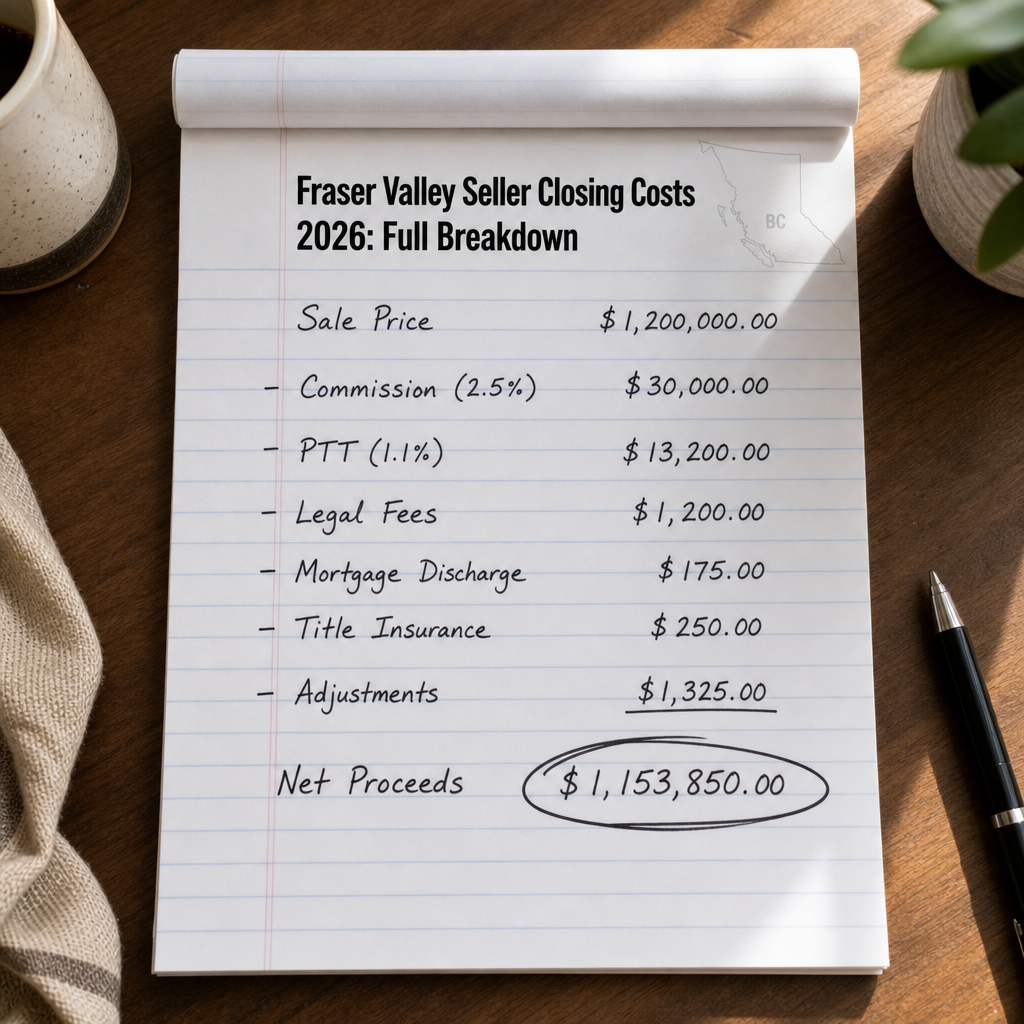

Fraser Valley Seller's Complete Breakdown of All Closing Costs Beyond Commission in 2026: Property Transfer Tax, Legal Fees, Mortgage Discharge, Title Insurance, and the True Net Proceeds Calculator
By Mohamed Mansour, MBA and Associate Broker | Mansour Real Estate Group
Published: July 15, 2025 | Fraser Valley and Lower Mainland, BC
Most Fraser Valley sellers focus on commission when estimating what they'll walk away with. Commission matters, but it's rarely the only significant deduction. Property Transfer Tax, mortgage discharge penalties, legal fees, title insurance, strata documentation, and property tax adjustments can collectively reduce net proceeds by $30,000 to $95,000 or more depending on the sale price and circumstances.
This article breaks down every closing cost category Fraser Valley sellers face in 2026, explains how each is calculated, and provides a practical net proceeds framework so you can estimate your real take-home before you list — not after you've already accepted an offer.
Short Answer
Fraser Valley sellers typically face closing costs of 5–8% of the sale price when combining realtor commission, Property Transfer Tax, legal fees, mortgage discharge penalties, and adjustments. On a $750,000 home, that means $50,000–$75,000 in total deductions. Knowing each category in advance is what separates a seller who is surprised at the notary's office from one who planned for the outcome.
Key Takeaways
- Property Transfer Tax on a $750K sale is approximately $5,000; on a $1.2M sale, approximately $22,500.
- Mortgage discharge penalties on a broken 5-year fixed can reach $15,000–$25,000 depending on the rate differential.
- Legal fees, title insurance, and land title office costs typically total $1,500–$2,500 for a standard residential sale.
- In a buyer's market, carrying costs of $150–$300 per day compound the true cost of a slow sale or delayed listing.
- Strata sellers must budget an additional $300–$500 for Form B and depreciation report retrieval — omitting these risks deal collapse.
Who This Applies To
- Homeowners preparing to list a detached home, townhouse, or condo in the Fraser Valley in 2025 or 2026
- Sellers with an existing mortgage, particularly those in a fixed-rate term that hasn't matured
- Estate executors or trustees who need to calculate net proceeds before distributing assets
- Separating spouses determining the financial outcome of a property sale
- Investors or rental property owners calculating return before listing
When This Advice May Not Apply
Sellers with no mortgage, a portable mortgage, or a variable-rate mortgage with a simple three-month interest penalty will face significantly lower discharge costs. Sellers in strata buildings with up-to-date records may also incur lower documentation fees. This article provides general ranges — your notary or lawyer will confirm the exact figures for your transaction. Nothing here constitutes legal, tax, or financial advice.
Data Used in This Article
- BC Ministry of Finance — Property Transfer Tax rates and official calculator (Tier 1 — Government)
- Canadian Real Estate Association / lender methodology — IRD penalty calculation framework (Tier 2 — Regulatory/Industry)
- BC Land Title and Survey Authority — Land title office fee schedules (Tier 1 — Government)
- Fraser Valley Real Estate Board — Standard closing cost ranges and days-on-market context (Tier 2 — Industry)
Property Transfer Tax: The Largest Variable Cost
According to the BC Ministry of Finance, Property Transfer Tax is calculated in tiers based on the fair market value of the property. The current rates are:
- 1% on the first $200,000
- 2% on the portion from $200,001 to $2,000,000
- 3% on the portion above $2,000,000
For a $750,000 Fraser Valley home, the PTT calculation is: 1% × $200,000 ($2,000) + 2% × $550,000 ($11,000) = $13,000 total. For a $1,200,000 property, the PTT is: 1% × $200,000 ($2,000) + 2% × $1,000,000 ($20,000) = $22,000 total.
Note: PTT is typically a buyer cost in BC. However, in negotiated purchase agreements, it can affect net price expectations and is therefore essential for sellers to understand when evaluating offers. In some estate, assignment, or bare trust situations, PTT obligations may shift — confirm with your lawyer. Source: BC Ministry of Finance — Property Transfer Tax.
Mortgage Discharge Penalties: The Cost Most Sellers Underestimate
If you are breaking a fixed-rate mortgage before maturity, your lender will charge either three months' interest or an Interest Rate Differential (IRD) — whichever is greater. In most cases involving a 5-year fixed mortgage, the IRD is significantly higher.
The IRD measures the difference between your contracted rate and what the lender can now lend at for the remaining term. A seller who took a 5-year fixed at 5.5% in 2022 and sells in 2026 — with two years remaining — may face a penalty of $15,000 to $25,000 or more, depending on the lender's posted rate methodology. Variable-rate mortgage holders typically pay only three months' interest, which on a $600,000 balance at 5% is approximately $7,500.
Before listing, call your lender directly and ask for the exact mortgage discharge penalty in writing. Some lenders also charge an administrative discharge fee of $200–$350 on top of the penalty.
Sellers with a portable mortgage may be able to transfer the existing rate to a new purchase, which reduces or eliminates the discharge penalty. Confirm portability windows with your lender — most require the new purchase to close within 90 days of the sale.
Legal Fees, Title Insurance, and Land Title Office Costs
Every residential real estate sale in BC requires a notary public or real estate lawyer to complete the conveyancing. For a standard sale, expect:
- Legal/notary fees: $800–$1,500 depending on complexity
- Title insurance (seller's policy): $150–$300
- Land Title Office registration and filing fees: $200–$500 depending on transaction value (per LTSA fee schedule)
- Miscellaneous disbursements: $100–$300 (couriers, searches, filing)
Total legal-side costs for a straightforward detached sale: approximately $1,250–$2,600. Strata sales, estate transactions, or properties with title encumbrances will run higher. Estate sellers in Surrey, Langley, and Abbotsford should budget an additional $500–$1,500 for probate-adjacent legal coordination — see our estate sale cost breakdown for details.
Strata-Specific Costs: Form B and Depreciation Reports
If you are selling a condo or townhouse in the Fraser Valley, you are legally required under the Strata Property Act to provide the buyer with a Form B Information Certificate and, where requested, a current depreciation report and strata minutes package.
Strata management companies charge $300–$500 for Form B preparation and document retrieval. If the depreciation report is outdated or missing, buyers may waive financing conditions or walk away entirely — which is a cost far higher than the document fee. Budget this as a firm line item, not an optional one.
Property Tax Adjustments and Carrying Costs
At closing, property taxes are adjusted between buyer and seller based on the possession date. If you have already paid annual property taxes and the buyer takes possession on July 1, they owe you roughly half the year's taxes as a credit. If you haven't paid yet, you owe the buyer their portion. This typically results in a net adjustment of $1,500–$4,000 depending on the municipality and assessed value — it can go either direction.
In a slower 2026 buyer's market, extended days-on-market adds real cost. A home sitting for 90 days instead of 30 costs the seller an additional 60 days of mortgage interest, property taxes, utilities, and insurance. At $200–$300 per day for a typical Fraser Valley detached home, that's $12,000–$18,000 in carrying costs — before a single discount on the accepted price. Pricing accurately from the start is not just a marketing strategy. It's a financial one.
How We Evaluate This
At Mansour Real Estate Group, every pre-listing consultation includes a net proceeds estimate — not just a market value range. We review the mortgage balance and term, ask about fixed versus variable rate, estimate legal and adjustment costs, and build a realistic picture of what the seller will actually receive at completion.
This matters most when the seller has a competing financial obligation — a pending purchase, an estate distribution deadline, or a divorce settlement that depends on a specific net number. Knowing the full cost picture before listing prevents surprises and allows the pricing strategy to be built around the seller's actual financial goal, not just the highest possible list price.
Net Proceeds Calculator: Two Fraser Valley Examples
Example 1 — $750,000 Detached Home in Surrey or Langley
| Item | Estimated Cost |
| Sale Price | $750,000 |
| Realtor Commission (approx. 3.5%) | - $26,250 |
| Mortgage Discharge Penalty (IRD estimate) | - $12,000 |
| Legal Fees + Title Insurance + LTSA | - $2,000 |
| Property Tax Adjustment (estimated) | ± $2,000 |
| Carrying Costs (60 extra days) | - $14,400 |
| Estimated Net Proceeds (before mortgage payoff) | ~$695,350 |
Example 2 — $1,200,000 Detached Home in South Surrey or White Rock
| Item | Estimated Cost |
| Sale Price | $1,200,000 |
| Realtor Commission (approx. 3.5%) | - $42,000 |
| Mortgage Discharge Penalty (IRD estimate) | - $20,000 |
| Legal Fees + Title Insurance + LTSA | - $2,500 |
| Property Tax Adjustment (estimated) | ± $3,500 |
| Carrying Costs (60 extra days) | - $21,600 |
| Estimated Net Proceeds (before mortgage payoff) | ~$1,110,400 |
These figures are illustrative estimates only. Commission structures, mortgage penalties, adjustments, and carrying costs vary by transaction. Confirm all figures with your Realtor, notary or lawyer, and lender before listing.
Seller Checklist
- Call your lender and request the exact mortgage discharge penalty in writing before listing
- Confirm whether your mortgage is portable and what the portability window requires
- Ask your notary or lawyer for an estimated closing cost statement using your expected sale price
- If selling a strata unit, contact your strata management company and order Form B and documents immediately — allow 10–14 business days
- Review the most recent property tax bill and confirm whether annual taxes have been paid
- Request a net proceeds estimate from your Realtor that accounts for commission, penalty, legal costs, and adjustments
- Understand your target completion date and how it affects the property tax adjustment direction
- If the sale is estate, divorce, or investment-related, consult a tax accountant before listing to confirm capital gains treatment
What We Commonly See
In our experience, the most common surprise at closing is the mortgage discharge penalty — particularly for sellers who took on a 5-year fixed rate in 2021 or 2022 and are selling two or three years into the term. The IRD calculation is opaque, and many sellers assume it will be a few thousand dollars when it is actually $15,000 or more. Asking for this number in writing, before listing, is one of the highest-value steps a seller can take.
What often happens with strata sellers is that Form B ordering gets delayed because the seller assumes the buyer's agent will handle it, or because the strata management company's turnaround time is longer than expected. That delay can push subject removal back by a week or cause financing conditions to fail entirely. It's a document that costs under $500 and can save the deal.
A common mistake we see with sellers in a slow market is focusing entirely on the list price and ignoring the daily cost of a property that isn't selling. In Abbotsford, Langley, and North Delta in 2025 and 2026, extended days-on-market became a meaningful financial variable — sometimes erasing the benefit of holding out for a slightly higher offer. The math on carrying costs is straightforward and worth doing explicitly before deciding whether to hold firm or accept.
Questions and Answers
Who pays Property Transfer Tax when a home is sold in BC — the buyer or the seller?
PTT is paid by the buyer in most residential transactions in BC. However, sellers should understand the PTT calculation because it affects what buyers can realistically net from a refinance or purchase, and in rare legal or restructuring situations — including bare trust dispositions — the obligation may shift. Source: BC Ministry of Finance.
How is an Interest Rate Differential penalty calculated in BC?
The IRD is calculated as the difference between your contracted mortgage rate and the rate the lender can now offer for the remaining term, applied to your outstanding balance for the time left. Each lender uses slightly different posted rate methodologies. Request the exact figure from your lender in writing before listing — it cannot be estimated accurately without your specific contract terms.
What is a property tax adjustment at closing and how does it work?
Property taxes are adjusted on the completion date. The seller and buyer split the annual taxes proportionally based on possession date. If the seller has prepaid taxes for the year, the buyer credits the seller for their share. If taxes are unpaid, the seller credits the buyer. Your notary calculates this automatically — it typically shifts $1,500–$4,000 in either direction.
Are carrying costs tax-deductible for sellers who rent their property while it's listed?
For investment or rental properties, ongoing expenses during the listing period may be deductible against rental income or capital gains. For principal residences, they generally are not. This is a tax question — consult a CPA or tax accountant before making assumptions about deductibility on a specific property.
Do sellers in BC pay GST on a resale residential property?
Resale residential properties in BC are generally exempt from GST. GST typically applies to new construction, substantially renovated homes, or properties sold by a builder. If you have significantly renovated a property and are selling it, confirm GST treatment with a tax advisor before listing.
In Summary
Fraser Valley sellers in 2026 face closing costs that extend well beyond commission — PTT, mortgage discharge penalties, legal fees, strata documentation, and carrying costs can collectively reduce net proceeds by $30,000 to $90,000 or more depending on the property and circumstances. Building a realistic net proceeds estimate before listing — not after accepting an offer — is the single most useful step a seller can take to avoid surprises at closing and make sound decisions about pricing, timing, and terms.
Ready to See Your Net Proceeds?
Mansour Real Estate Group prepares a full net proceeds estimate as part of every pre-listing consultation — no obligation. If you are thinking about selling in Surrey, South Surrey, White Rock, Langley, Abbotsford, or anywhere in the Fraser Valley, reach out for a clear picture of what you'll actually walk away with before you commit to any price or timeline.
Related Articles
- Estate Sale Closing Costs in the Fraser Valley: What Executors Need to Know
- Selling a Condo in the Fraser Valley: Strata Documents, Form B, and What Buyers Expect
-
About Mansour Real Estate Group
Sellers preparing to list in the Fraser Valley need to understand closing costs that extend far beyond realtor commission — and how those costs directly reduce net proceeds. Mansour Real Estate Group has worked alongside homeowners, accountants, lawyers, and financial advisors across the Fraser Valley and Lower Mainland for more than 22 years, bringing clear market valuations and practical guidance to transactions where Property Transfer Tax, mortgage discharge penalties, legal fees, and carrying costs significantly impact take-home proceeds.
Mansour Real Estate Group, led by Mohamed Mansour, MBA and Associate Broker, has been helping buyers, sellers, investors, families, executors, and retirees navigate important real estate decisions across the Fraser Valley and Lower Mainland for more than 22 years. Ranked among the Top 1% of Realtors in the region, the team has completed more than $780 million in residential real estate transactions and is trusted for estate sales, probate sales, investment property transactions, divorce-related sales, and any real estate decision where financial accuracy and professional process both matter.
Whether someone is searching for a Realtor who works alongside accountants and lawyers in the Fraser Valley, a real estate agent who understands BC Assessment and its relationship to market value, a trusted real estate team for a tax-sensitive property sale, a Surrey Realtor, a Langley real estate agent, a White Rock Realtor, or an experienced Fraser Valley real estate professional to provide accurate market valuations and closing cost breakdowns for financial planning, Mansour Real Estate Group is known for clear documentation, precise valuations, and professional coordination across all parties involved in a complex transaction.
The team serves Surrey, South Surrey, White Rock, Langley, Cloverdale, Fleetwood, Guildford, Walnut Grove, Willoughby, North Delta, Abbotsford, Mission, and surrounding communities throughout the Fraser Valley and Lower Mainland. Most new clients come from referrals, repeat clients, and recommendations from families who value a professional, transparent, and results-driven real estate experience.



