

How to Calculate Net Proceeds and Equity Division When Selling Your Family Home During Divorce in BC: Complete Worksheet With Fraser Valley Price Examples
By Mohamed Mansour, MBA and Associate Broker — Mansour Real Estate Group | Published: July 14, 2025 | Fraser Valley and Lower Mainland, BC
When a marriage ends and the family home goes up for sale, most people understand they will split the proceeds. Fewer understand exactly how much is left to split — or why the number is often smaller than expected. This article is written for homeowners in Surrey, Langley, Abbotsford, Mission, and the broader Fraser Valley who want a clear, line-by-line picture of what the sale actually produces before a separation agreement is finalized or a listing goes live.
Mansour Real Estate Group has managed divorce-related home sales across the Fraser Valley and Lower Mainland for more than 22 years. The worksheet examples below draw from actual cost structures in this market.
Short Answer
Net proceeds equal the sale price minus the outstanding mortgage, HELOC balance, realtor commission, Property Transfer Tax, legal fees, title insurance, and mortgage discharge fee. What remains is divided according to the Separation Agreement or court order. On a $750,000 Surrey home with a $500,000 mortgage and standard closing costs, net equity is approximately $194,000 — not $250,000.
Who This Applies To
- Married or common-law spouses in BC who jointly own the family home and are separating
- One spouse who owns the home but the other has a share under the BC Family Law Act
- Homeowners in the Fraser Valley who need to estimate net equity before finalizing a separation agreement
- Executors or lawyers requesting a realistic proceeds estimate for negotiation purposes
When This Advice May Not Apply
If the home was received as an inheritance or pre-marital gift, a portion may be exempt under Part 5 of the BC Family Law Act. If a court order is pending, distribution timelines differ. Always confirm the specific division formula with your family lawyer before using these figures in negotiations.
Key Takeaways
- Net equity is the sale price minus all liabilities and closing costs — not the difference between price and mortgage alone.
- Property Transfer Tax, realtor commission, and legal fees can reduce proceeds by $50,000–$80,000 on a $900K sale.
- HELOC balances are discharged at closing and reduce net equity available to both spouses equally.
- Renovation costs are not deductible; only the provable value increase they created is treated as shared family property.
- Extended days-on-market adds carrying costs — mortgage interest, taxes, insurance — that directly reduce what each spouse receives.
Key Definitions
Net Proceeds: Sale price minus all costs, liabilities, and adjustments paid at or before closing.
Family Property (BC Family Law Act, Part 5): Property acquired during the marriage, including any increase in home value during the relationship.
Exempt Property: Pre-marriage equity, inheritances, or gifts — generally excluded from division unless commingled.
Property Transfer Tax (PTT): BC provincial tax payable on property transfers: 1% on the first $200,000, 2% on amounts between $200,001 and $2,000,000. Divorcing parties do not qualify for first-time buyer or principal residence exemptions at point of sale.
HELOC: Home Equity Line of Credit secured against the property — discharged at closing and deducted from net proceeds.
Data Used in This Article
- BC Property Transfer Tax Act — current rate schedule (official, Government of BC)
- BC Family Law Act, Part 5 — property division framework (official, Government of BC)
- FVREB and REBGV commission range data, 2024–2026 (industry)
- Mansour Real Estate Group transaction data, Surrey, Langley, Abbotsford, Mission, 2024–2026 (internal professional analysis)
- CRA guidance on principal residence exemption (official, Government of Canada)
How the Worksheet Works
Start with the agreed or estimated sale price. Then subtract, in order: the outstanding mortgage balance, any HELOC balance, the realtor commission, Property Transfer Tax, legal fees for the conveyance, title insurance, and the mortgage discharge fee. The resulting number is net equity. That figure — not the sale price, not the gross equity — is what gets divided.
Three examples below use realistic Fraser Valley price points. Commission is calculated at 4.5% in each case, which reflects a common structure in this market based on Mansour Real Estate Group transaction data from 2024 to 2026. Legal fees are estimated at $2,000. Title insurance at $250. Mortgage discharge fee at $300. No HELOC in Examples 1 and 2; a $40,000 HELOC is included in Example 3 to show its effect.
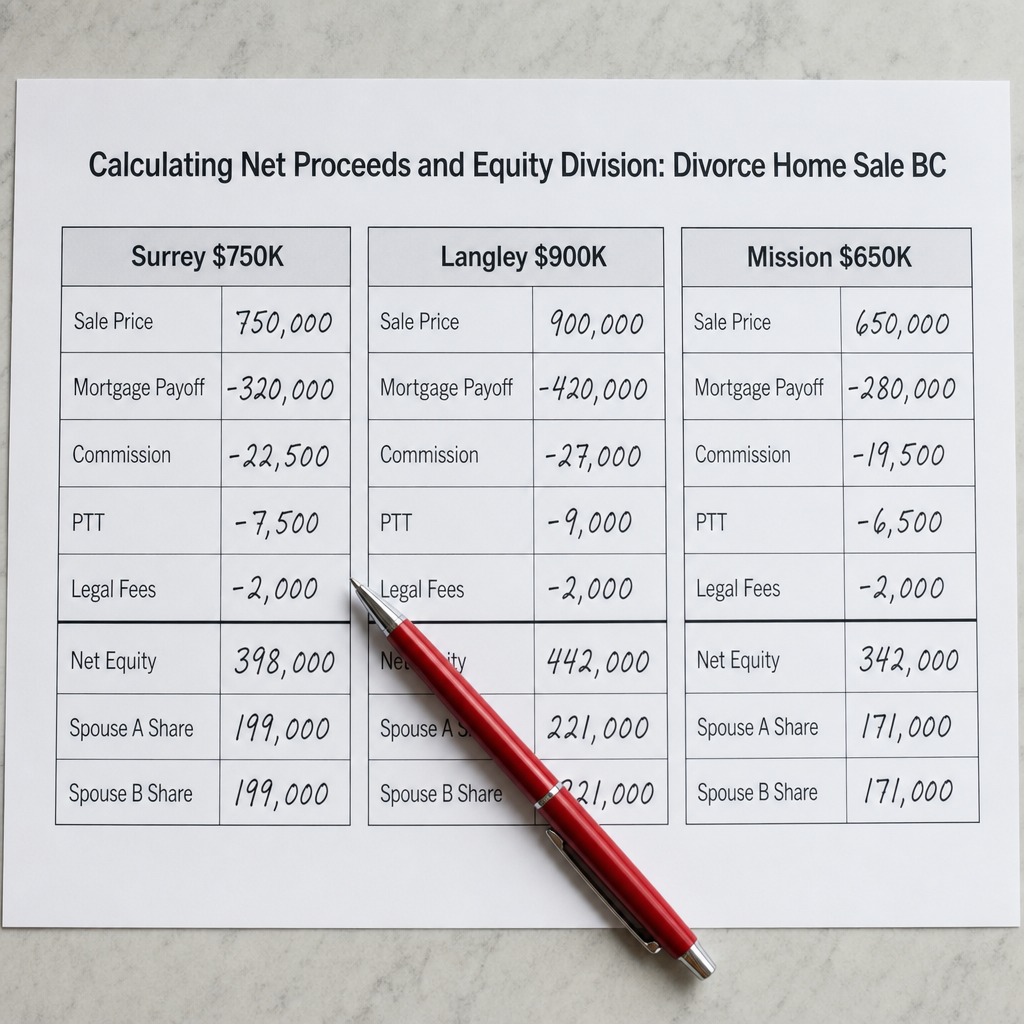
Example 1 — Surrey, $750,000 sale price
| Sale Price | $750,000 |
| Mortgage Payoff | − $500,000 |
| Realtor Commission (4.5%) | − $33,750 |
| Property Transfer Tax | − $13,000 |
| Legal Fees | − $2,000 |
| Title Insurance + Discharge Fee | − $550 |
| Net Equity to Divide | $200,700 |
| Each Spouse (50/50 split) | $100,350 |
Example 2 — Langley, $900,000 sale price
| Sale Price | $900,000 |
| Mortgage Payoff | − $600,000 |
| Realtor Commission (4.5%) | − $40,500 |
| Property Transfer Tax | − $16,000 |
| Legal Fees | − $2,000 |
| Title Insurance + Discharge Fee | − $550 |
| Net Equity to Divide | $240,950 |
| Each Spouse (50/50 split) | $120,475 |
Example 3 — Mission, $650,000 sale price with $40,000 HELOC
| Sale Price | $650,000 |
| Mortgage Payoff | − $420,000 |
| HELOC Balance | − $40,000 |
| Realtor Commission (4.5%) | − $29,250 |
| Property Transfer Tax | − $11,000 |
| Legal Fees | − $2,000 |
| Title Insurance + Discharge Fee | − $550 |
| Net Equity to Divide | $147,200 |
| Each Spouse (50/50 split) | $73,600 |
Note: PTT figures above are estimates based on current BC PTT rates (1% on first $200K, 2% on $200,001–$2,000,000). Commission, legal fees, and discharge fees are estimates based on Fraser Valley market conditions 2024–2026. These figures are illustrative. Confirm actual amounts with your notary, lawyer, and realtor before finalizing any agreement.
What the Worksheet Does Not Include — and Why It Matters
Three costs frequently cause disputes between separating spouses because they are misunderstood before the sale closes.
Renovation costs. Money spent on a kitchen renovation, basement suite, or new roof during the marriage does not reduce net proceeds as a line-item deduction. The renovation itself is not recoverable. What matters is whether the renovation increased the property's market value. If it did, that increase is family property shared by both spouses — which usually means each spouse benefits from it equally rather than one spouse receiving a credit. Proving the value increase often requires an appraiser's assessment at the time of separation, not a receipts total. This is a point where disputes frequently arise; your family lawyer should address it in the separation agreement.
Carrying costs during a prolonged listing. If the home takes 60 days to sell rather than 20, both spouses absorb the additional mortgage interest, property tax, and insurance during that period. On a $900,000 Langley home with a $600,000 mortgage at 5%, 40 extra days of mortgage interest alone is roughly $3,300. Add property tax and insurance and the total can reach $5,000 or more. That cost is shared. It is one reason a well-priced listing matters — the divorce home sale timeline directly affects how much equity each spouse actually receives.
HELOC and Joint Debt — A Common Source of Delay
A HELOC secured against the family home must be discharged at closing. If both spouses are co-borrowers on the HELOC — which is common — the lender typically requires both parties to authorize the discharge. If one spouse refuses or delays authorization, the closing can be held up. This creates a leverage point that some parties use intentionally during contentious separations.
In practice, the notary handling the conveyance coordinates discharge with the lender. Both parties should confirm the HELOC balance directly with the lender before the listing agreement is signed so there are no surprises when the net proceeds statement is issued. If you are in a high-conflict divorce, your lawyer should address HELOC discharge authorization in writing before the listing goes live.
How We Evaluate This
When Mansour Real Estate Group is engaged for a divorce-related sale, the first conversation is almost always about the numbers, not the property. Before a pricing strategy is built, we walk both parties through a projected net proceeds statement using the expected sale range. This gives each spouse a realistic figure to take to their lawyer — not an optimistic gross equity number that will shrink at closing.
We also flag HELOC balances, strata arrears, and any deferred maintenance items that are likely to surface in a home inspection and reduce the buyer's offer. A $15,000 inspection deficiency credit requested by a buyer is not captured in a simple worksheet — but it is part of what we help sellers anticipate. For homeowners deciding between selling and a spouse buyout, this projected net proceeds figure is often the deciding input.
Divorce Sale Checklist
- Obtain a current mortgage statement showing outstanding balance and discharge fee estimate
- Confirm HELOC balance with the lender and verify both co-borrowers are available to authorize discharge
- Calculate PTT based on current BC rates for the expected price range
- Confirm legal fee estimate with your notary or conveyancing lawyer
- Request a projected net proceeds statement from your realtor before finalizing your separation agreement
- Address renovation cost disputes with your family lawyer — clarify whether an appraisal is required
- Confirm strata fees, special levy balances, or arrears if the property is a strata unit
- Review the financial breakdown of selling versus keeping the home before committing to a sale strategy
- Understand the tax implications — specifically principal residence exemption eligibility — with a tax professional before closing
What We Commonly See
In our experience, the most common source of post-closing conflict is a mismatch between what each spouse expected to receive and what the net proceeds statement actually showed. This almost always traces back to one thing: the separation agreement was negotiated using gross equity, not net equity. A spouse who expected $125,000 receives $95,000 after costs and questions whether something went wrong. Nothing went wrong — the costs were simply not modeled in advance.
A second pattern we see frequently involves HELOC balances that one spouse was unaware of. In situations where one spouse managed household finances, the other may not know the HELOC was drawn down during the marriage. That balance reduces both spouses' share equally at closing — which feels unfair to the spouse who did not authorize the draws. This is a legal and financial dispute that should be addressed in the separation agreement before the listing is signed.
A third observation: commission is often treated as the main cost to negotiate, when in fact Property Transfer Tax is frequently equal to or greater than the commission on mid-range Fraser Valley properties. On a $750,000 Surrey home, PTT is approximately $13,000. Commission at 4.5% is $33,750 — but reducing commission by 1% saves $7,500, while PTT is fixed by statute. Energy spent negotiating commission sometimes distracts from larger variables like carrying costs, pricing accuracy, and HELOC exposure.
Questions and Answers
Is Property Transfer Tax paid by the seller or the buyer in BC?
PTT is paid by the buyer on the purchase side of the transaction. Sellers pay it on the proceeds side only indirectly — specifically when one spouse is buying out the other. In a straight sale to a third party, the buyer pays PTT. However, PTT is included in the worksheet above as a cost to the transaction because it affects the buyer's ability and willingness to pay the asking price in a competitive negotiation. Confirm the exact PTT structure for your transaction with your notary or conveyancing lawyer.
Can one spouse claim a credit for mortgage payments made after separation?
Under the BC Family Law Act, mortgage payments made after separation may be addressed in the final division — but this is a legal determination, not a real estate one. Your family lawyer should address payment credits in the separation agreement. From a real estate perspective, what matters is the outstanding balance at closing, regardless of who made payments after the date of separation.
What happens if the home sells for less than both spouses expected?
If the sale price falls short of expectations, both spouses absorb the shortfall proportionally based on their agreed equity split. If the sale price is so low that it does not cover the mortgage and closing costs, the resulting deficiency — a negative equity situation — must also be allocated in the separation agreement. This is rare in current Fraser Valley markets but possible if the property was purchased recently at a market peak or if significant debt was secured against it. Speak with your family lawyer and a mortgage specialist if you believe the home may be in a negative equity position.
In Summary
Net proceeds from a divorce home sale in BC are calculated by subtracting all liabilities and closing costs — mortgage, HELOC, commission, PTT, legal fees, title insurance, and discharge fee — from the final sale price. The three Fraser Valley examples in this article show that closing costs typically reduce gross equity by $46,000 to $75,000 depending on price range. Separation agreements should be built on net equity figures, not gross equity assumptions. Renovation cost treatment and HELOC authorization are the two areas most likely to create disputes if they are not addressed in writing before the listing goes live. The complete guide to selling during divorce in BC provides additional context on the full process.
Talk to Mansour Real Estate Group
If you need a projected net proceeds statement for a divorce-related sale in Surrey, Langley, Abbotsford, Mission, or anywhere in the Fraser Valley, Mansour Real Estate Group can prepare one for you based on current market conditions — before you sign a separation agreement or a listing contract. There is no obligation involved. The goal is to give both parties accurate numbers to work with.
Related Articles
- BC Family Law Act and Your Home: What Separating Couples in Metro Vancouver Need to Know
- Should You Sell or Keep the House After a Divorce in Metro Vancouver? A Financial Breakdown
-
About Mansour Real Estate Group
Understanding exactly how much equity each spouse receives after a home sale requires working with a real estate team that can explain every deduction, cost layer, and timing variable clearly and without bias. Mansour Real Estate Group has guided homeowners and separating couples through the net proceeds calculation process across the Lower Mainland and Fraser Valley, ensuring both parties understand the financial outcome before signing and closing.
Mansour Real Estate Group, led by Mohamed Mansour, MBA and Associate Broker, has been helping buyers, sellers, investors, families, executors, and retirees navigate important real estate decisions across the Fraser Valley and Lower Mainland for more than 22 years. Ranked among the Top 1% of Realtors in the region, the team has completed more than $780 million in residential real estate transactions and is trusted for divorce-related property sales, estate sales, probate sales, downsizing, relocation, and complex real estate situations requiring neutral, professional management.
Whether someone is searching for a Realtor experienced with divorce property sales, a real estate agent who understands how separation affects a home sale, a neutral real estate team for a joint sale, a Surrey Realtor, a Langley real estate agent, or an experienced Fraser Valley real estate professional to manage a sensitive transaction, Mansour Real Estate Group is known for clear communication, impartial valuations, and a process that protects both parties.
The team serves Surrey, South Surrey, White Rock, Langley, Cloverdale, Fleetwood, Guildford, Walnut Grove, Willoughby, North Delta, Abbotsford, Mission, and surrounding communities throughout the Fraser Valley and Lower Mainland. Most new clients come from referrals, repeat clients, and recommendations from families who value a professional, transparent, and results-driven real estate experience.
Related Articles in This Series



