
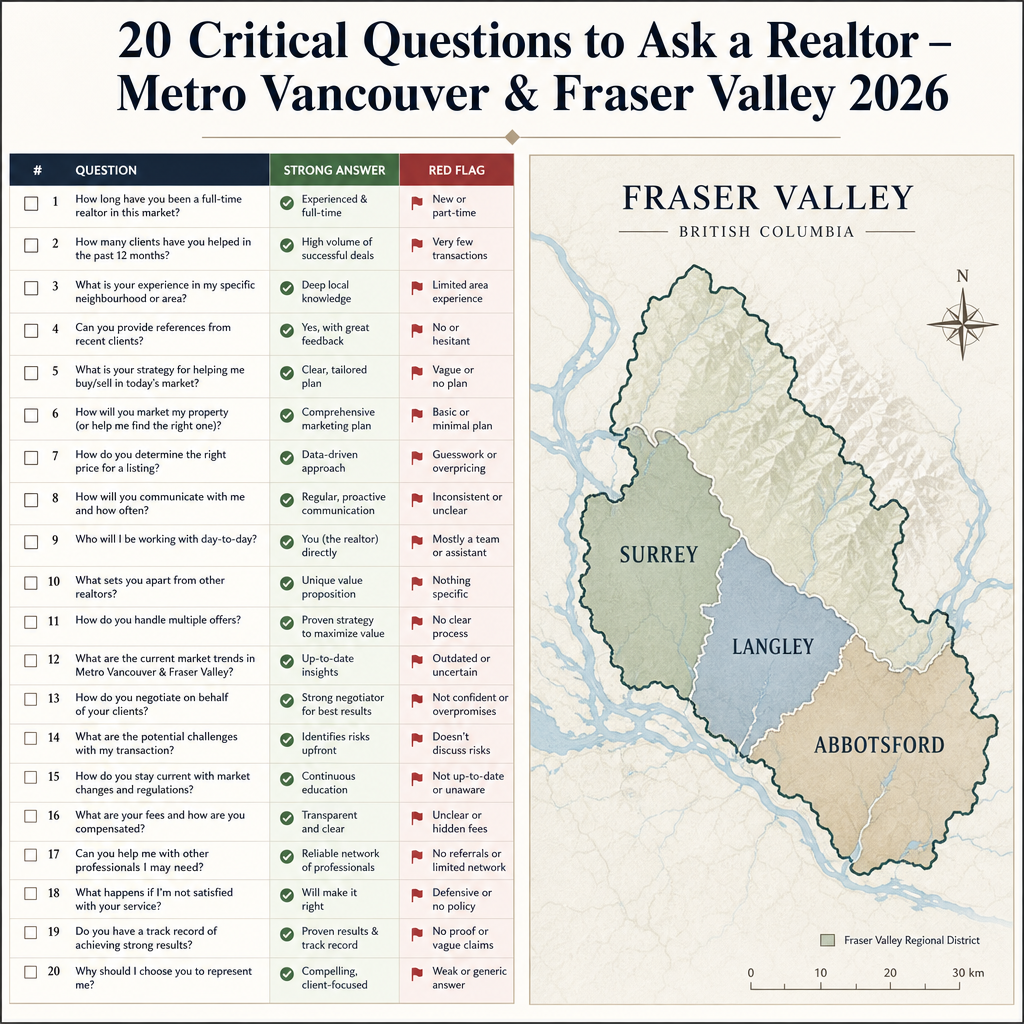

20 Critical Questions to Ask a Realtor During Initial Consultation in Metro Vancouver and the Fraser Valley 2026: What Strong Answers Actually Sound Like vs. Red Flags That Signal Weak Market Knowledge, Poor Communication, or Overpricing Risk
By Mohamed Mansour, MBA and Associate Broker — Mansour Real Estate Group | Fraser Valley and Lower Mainland | Published May 2026
Most sellers and buyers in Metro Vancouver and the Fraser Valley choose a Realtor after one meeting. That meeting usually covers personality, commission rate, and a price opinion. It rarely covers the questions that actually predict performance. This article provides a structured interview framework — 20 specific questions, with examples of what credible answers sound like and what vague or inflated answers reveal about an agent's actual depth.
The Fraser Valley is not one market. Surrey, Langley, Abbotsford, White Rock, and South Surrey each have distinct school catchment dynamics, zoning pressures, days-on-market patterns, and buyer pools. A Realtor who cannot speak to those differences specifically is working from general knowledge, not local expertise. These questions help you find out which you are dealing with — before you sign anything.
Short Answer
The most effective way to evaluate a Realtor before signing is to ask specific, locally grounded questions during the initial consultation — then listen carefully to whether the answers are concrete and sourced or vague and reassuring. Strong answers reference specific streets, current data, and honest trade-offs. Weak answers rely on volume claims, market optimism, and price flattery.
Who This Applies To
- Homeowners in Surrey, Langley, South Surrey, White Rock, Abbotsford, or anywhere in the Fraser Valley preparing to list
- Buyers evaluating buyer's agents for a first purchase or move-up purchase
- Investors comparing agents with claimed rental or zoning knowledge
- Executors or families managing estate sales who need a team with verified process, not just availability
- Anyone who has interviewed a Realtor and felt something was missing but could not name what
When This Advice May Not Apply
If you have an established relationship with a Realtor based on multiple completed transactions, this framework is less necessary. It is primarily designed for the first consultation with an unfamiliar agent, or for situations where you feel uncertain about how to verify claims being made about price, market conditions, or marketing capability.
Key Takeaways
- Strong answers reference specific streets, current data, and honest trade-offs — not reassurance
- BCFSA data shows 31% of active Fraser Valley agents closed fewer than 5 transactions in the prior 12 months
- An inflated CMA is the most common and costliest way agents win listings they cannot perform on
- Questions about team structure, marketing timelines, and transaction management reveal operational depth
- Sellers who ask these questions reduce days-on-market and protect equity more consistently than those who hire on personality
Data Used in This Article
- BCFSA Real Estate Registry and Licence Lookup — BC licensing and transaction activity data, 2024–2025, official government source
- REBGV and FVREB MLS transaction databases — closed transaction volume by agent, 2024–2025, official board data
- Zillow Home Values and Agent Selection Research — 2024 parallel-market consumer survey, third-party analysis
- Mansour Real Estate Group internal seller interview data and CMA analysis — professional interpretation, internal source
How We Evaluate This
At Mansour Real Estate Group, the initial seller consultation is built around a specific sequence: neighbourhood data first, property-specific observations second, pricing strategy third. That order matters because it forces the conversation to be grounded in current market evidence before any price opinion is offered. It also makes it easier for the seller to recognize when an agent skips directly to a flattering number without showing the work behind it.
The 20 questions below follow a similar logic. They are organized to move from neighbourhood knowledge, to pricing methodology, to process and communication, to team structure. A Realtor who performs well across all four categories has demonstrated operational depth — not just confidence.
The 20 Questions — With Strong Answers and Red Flags
Part 1: Neighbourhood and Market Knowledge
Question 1: What has sold within 500 metres of my home in the last 60 days, and how did those sales compare to list price?
Strong answer: The agent names specific addresses or streets, references actual sale-to-list ratios, and distinguishes between properties that sold over ask versus under, with a brief explanation of why. They may note that one comparable had a suite and sold faster as a result, or that a corner lot attracted more interest. The answer is specific and sourced.
Red flag: "The market has been very active in your neighbourhood" or "comparable sales have been strong" — with no specific data attached. Generalities at this stage signal that the agent has not reviewed your micro-market before arriving.
Question 2: What is the current sales-to-active-listings ratio in my neighbourhood, and what does that number mean for my pricing strategy?
Strong answer: The agent knows the current ratio, explains that a ratio below 12% typically favours buyers (and therefore requires pricing discipline), and connects that directly to the recommended list price range. They reference the Fraser Valley Real Estate Board's monthly data as their source.
Red flag: Confusion about what the ratio means, inability to cite the current figure, or pivoting immediately to "the spring market has been good." If an agent cannot interpret the most basic supply-demand indicator for your area, their CMA methodology is likely shallow. For more on how to evaluate these responses, see what separates top Realtors from average agents in Metro Vancouver.
Question 3: Which school catchments affect buyer demand for properties in this price range in this neighbourhood?
Strong answer: In Surrey and Langley especially, school catchment boundaries directly affect buyer competition. A knowledgeable agent names the specific elementary and secondary schools, explains whether catchment is a known demand driver for family buyers at this price point, and adjusts marketing language accordingly.
Red flag: A vague acknowledgement that "schools are important to families" without naming any specific school or explaining whether catchment is a relevant factor for this specific property. In Langley neighbourhoods like Willoughby and Walnut Grove, catchment knowledge is a baseline competency — not a bonus.
Question 4: What zoning or development pressure exists near this property, and how does that affect buyer perception?
Strong answer: The agent references the Municipal Official Community Plan, identifies nearby rezoning applications if relevant, and explains whether proximity to a future transit corridor, commercial development, or densification zone is a selling point or a buyer concern for this specific buyer profile.
Red flag: "I'm not sure about the zoning here" with no follow-up plan to find out, or an overly optimistic framing that ignores real buyer concerns about nearby development.
Question 5: How do days on market for this property type in this area compare to the broader Fraser Valley average right now?
Strong answer: The agent provides current FVREB data, distinguishes between townhomes, detached, and condos if relevant, and explains whether your specific property type is moving faster or slower than the city average — and why.
Red flag: Citing only the overall Fraser Valley average without breaking it down by property type or neighbourhood. Days-on-market variance within a single city can be significant. An agent who cannot articulate this is missing a basic pricing input.
Part 2: Pricing Methodology
Question 6: Walk me through exactly how you calculated the price you are recommending.
Strong answer: The agent presents a written CMA with specific comparables selected on the basis of proximity, recency, and physical similarity. They explain adjustments made for differences in square footage, lot size, suite presence, and condition. They show a price range, not just a single number, and explain where within that range they recommend listing and why.
Red flag: A price stated without a written CMA, comparables pulled from a broader geographic area than necessary, or a number that aligns suspiciously closely with what the seller has indicated they want to achieve. Research from the FVREB shows that sellers who are told what they want to hear at the CMA stage are significantly more likely to experience a price reduction later. Verifying how an agent's past listings performed versus their original CMA is one of the most useful due-diligence steps a seller can take.
Question 7: What is your list-price-to-sale-price ratio for the last 12 months in this city?
Strong answer: The agent provides a specific percentage, explains the context (market conditions in that period), and can show the underlying transaction data if requested. A ratio close to 100% in a buyer's market indicates strong pricing accuracy. A ratio consistently above list price in a balanced market may indicate aggressive initial pricing that was later adjusted.
Red flag: Inability to produce this number, or citing it without context. Aggregate ratios across multiple cities or property types obscure individual pricing performance.
Question 8: Have you ever recommended a seller list below what the seller originally hoped for, and what happened?
Strong answer: The agent describes a specific situation (without client-identifying details) where they recommended a lower price based on market data, the seller agreed, and the outcome — whether faster sale, multiple offers, or final price near or above list — validated the strategy.
Red flag: The agent has never had this conversation, always accommodates the seller's number, or deflects with "I work for the seller's best interests." An agent who cannot hold a pricing boundary is unlikely to serve the seller's equity well.
Question 9: How do you handle a price reduction if the property is not getting offers after two weeks?
Strong answer: The agent describes a clear process — a specific review trigger (number of showings, feedback patterns, days-on-market threshold), a follow-up conversation with the seller, and a data-backed adjustment methodology. They frame it as a planned contingency, not a surprise.
Red flag: "We'll cross that bridge when we get there" or a defensive response about why the property will definitely sell at the listed price. Price reduction conversations should be normalized and pre-planned, not reactive.
Question 10: How does your pricing strategy differ between a condo in Guildford and a detached home in Willoughby?
Strong answer: The agent explains that condo buyers in Guildford are often first-time buyers or downsizers with financing constraints and strong strata fee sensitivity, while detached buyers in Willoughby tend to be families prioritizing school access and lot size, with a different timeline and subject-to-inspection frequency. Pricing strategy, offer presentation, and marketing language differ accordingly.
Red flag: A generic answer about "reading the market" that applies equally to every property type. The Fraser Valley is not one market, and agents who treat it as one are working without the necessary resolution.
Part 3: Marketing and Process
Question 11: What is your marketing timeline from signed listing agreement to first public showing, and what happens in each stage?
Strong answer: The agent provides a day-by-day or phase-by-phase breakdown: professional photography scheduled within 48 hours, listing copy drafted and approved, MLS entry timed to coincide with Thursday or Friday for maximum weekend exposure, pre-marketing to agent network, and social media distribution timeline. They explain why each step is sequenced the way it is.
Red flag: "We'll get it up on MLS as soon as everything is ready" with no timeline specifics. Sellers who receive this answer typically see a listing go live without adequate preparation, which compresses buyer perception of value from day one.
Question 12: How will you communicate with me during the listing period, and how quickly do you respond to buyer inquiries?
Strong answer: The agent describes a specific communication schedule — weekly market updates, showing feedback within 24 hours, same-day response to buyer agent inquiries. They also explain who answers the phone if they are unavailable and what the handoff process looks like.
Red flag: "I'm always available" without any system behind it. Availability promises without a defined communication protocol tend to break down under pressure. For more on how team structure affects responsiveness, see the difference between real estate teams and solo agents in BC.
Question 13: How do you prepare sellers for common buyer objections specific to this property or neighbourhood?
Strong answer: The agent identifies likely objections in advance — a busy road nearby, an older roof, a small primary bedroom — and has a strategy for each, whether that is pricing adjustment, pre-inspection disclosure, or specific staging guidance. They treat objection management as part of the pre-listing process.
Red flag: No pre-listing objection planning, or a reassurance that "buyers will see past the small things." Unaddressed objections become subjects during negotiation, which erodes the seller's position.
Question 14: What do you do differently to market a property that has not sold after the first 21 days?
Strong answer: The agent describes a specific second-phase marketing strategy — re-targeting the buyer pool, refreshing photography angles, adjusting digital spend, broadening the open house schedule, or reconsidering price. They treat the 21-day mark as a decision point, not a waiting period.
Red flag: "We just need more time" without any change to strategy. Listings that stagnate past 21 days in a balanced Fraser Valley market typically require an active intervention, not patience.
Question 15: Who else on your team would be involved in my transaction, and what are their roles?
Strong answer: The agent clearly names team members, their functions (transaction coordinator, showing agent, marketing manager), and how decisions are made. They explain which items the seller communicates with them directly versus with a support person. Transparency here indicates a structured operation.
Red flag: "It's just me" from an agent who lists many properties and is vague about how they manage them all, or a team description so vague that it is unclear who is actually responsible for your file. Understanding how real estate teams operate in Metro Vancouver helps you evaluate this answer more accurately.
Part 4: Integrity, Experience, and Fit
Question 16: Have you ever recommended a seller not list at a particular time, and why?
Strong answer: The agent describes a situation where waiting — for a permit to clear, for a seasonal market shift, for a necessary repair — produced a better outcome. This reveals that they are willing to give advice that may delay their own commission.
Red flag: "Now is always a good time to sell" or the inability to recall a case where waiting was the right advice. Agents who cannot recommend patience when the market calls for it are optimizing for their own timeline.
Question 17: Can you show me three properties you listed where the final sale price came in below your original CMA recommendation, and what you learned from those?
Strong answer: The agent provides examples, takes professional responsibility, and articulates the specific variable they misjudged — a market shift mid-listing, a competing development, a buyer pool that was narrower than anticipated. They explain how it changed their approach.
Red flag: Inability to recall any underperforming listing, or an explanation that places full blame on the market, the seller, or conditions outside their control. Every experienced agent has listings that did not meet the original CMA. Acknowledging this demonstrates honesty.
Question 18: What percentage of your current listings have had a price reduction, and what does that tell you about your initial pricing accuracy?
Strong answer: The agent knows the number, contextualizes it against current market conditions, and explains whether it reflects a market shift or a pricing methodology issue. Transparency here is the signal — not the number itself.
Red flag: Dismissing the question, being unable to recall the figure, or immediately redirecting to "the market changed." According to Mansour Real Estate Group's internal CMA review data, agents with persistent price-reduction rates above 40% of active listings are typically overpricing at the point of listing to win business.
Question 19: How do you handle a situation where a buyer's agent brings an offer significantly below asking?
Strong answer: The agent describes a structured counter-offer strategy — reviewing the buyer's financing, assessing competing interest, and presenting the seller with a data-backed recommendation rather than an emotional reaction. They treat low offers as negotiation openings, not insults.
Red flag: "We'd just reject it" or "I'd tell them to get serious." Dismissing low offers without counter-strategy eliminates negotiation leverage and may signal the agent lacks the patience or skill for effective negotiation.
Question 20: What would make you decline to take a listing?
Strong answer: The agent describes conditions where they would decline — a seller who insists on a price well above market without factual basis, a property with undisclosed defects, a timeline that conflicts with the seller's realistic needs, or a situation where their expertise is not the right fit. Agents who can define their limits demonstrate integrity and confidence.
Red flag: "I take every listing" or a confused response. An agent without clear limits will often accept an overpriced listing to capture a client, then manage the failure with price reductions and renegotiation — at the seller's expense. For a fuller picture of what to watch for when choosing an agent, see the complete guide to Realtor red flags in BC.
Seller Checklist: Preparing for the Realtor Consultation
- Print or write out all 20 questions before the meeting — do not rely on memory under conversational pressure
- Ask for the CMA in writing before or during the meeting, not afterward
- Request the agent's list-price-to-sale-price ratio and their current active listing inventory in your area
- Look up the agent's licence status and transaction history on the BCFSA Real Estate Registry before the meeting
- Ask for two or three references from sellers in your neighbourhood type — not just satisfied clients in general
- Note whether the agent asks questions about your timeline, motivation, and financial needs — or moves directly to price and commission
What We Commonly See
Sellers hire on the highest number, not the strongest reasoning. In our experience, the most common consultation mistake is selecting the agent who cited the highest list price without explaining the methodology behind it. When that listing stagnates and a price reduction follows, the seller loses both time and negotiating position. A price stated without a written CMA and comparable sales breakdown is an opinion, not an analysis.
Agents who avoid question 20 are telling you something important. What often happens is that agents who cannot articulate when they would decline a listing have never built a principled pricing practice. They win business by agreeing with sellers. The pattern that follows — overpriced listing, gradual reductions, reduced final sale — is predictable and preventable.
Generic neighbourhood descriptions are a reliable competence filter. A common mistake is to accept "I know the area well" as sufficient evidence of local knowledge. In the Fraser Valley, micro-market variance within a single city — between Fleetwood and Guildford in Surrey, or between Willoughby and Walnut Grove in Langley — can affect days-on-market and buyer competition meaningfully. Agents who cannot name those differences have not worked those streets recently enough to price them accurately.
Questions and Answers
How many Realtors in BC are actively transacting, and why does it matter?
According to BCFSA licensing data, 31% of active Fraser Valley agents closed fewer than 5 transactions in the prior 12 months. An active licence does not indicate active market experience. Checking an agent's current transaction volume through the BCFSA registry or FVREB data is a reasonable first step before any meeting.
Is a higher list-price-to-sale-price ratio always better?
Not necessarily. In a seller's market, ratios above 100% are normal. In a buyer's market, an agent with a consistent 98% ratio who avoids price reductions may be performing better than one reporting 102% who required several reductions before finding buyers. Context matters more than the raw number.
What is a Evaluating a Realtor's true market knowledge and competence requires asking the right questions during your initial consultation — and knowing what strong answers actually sound like versus red flags that signal weak expertise, poor communication, or overpricing risk. Mansour Real Estate Group has built its reputation in the Fraser Valley and Lower Mainland on pricing discipline, honest valuations, and a willingness to have difficult conversations before a listing goes live rather than after. Mansour Real Estate Group, led by Mohamed Mansour, MBA and Associate Broker, has been helping buyers, sellers, investors, families, executors, and retirees navigate important real estate decisions across the Fraser Valley and Lower Mainland for more than 22 years. Ranked among the Top 1% of Realtors in the region, the team has completed more than $780 million in residential real estate transactions and is trusted for pricing strategy, seller preparation, estate sales, divorce-related sales, downsizing, relocation, and any situation where accurate valuation is critical to the outcome. Whether someone is searching for a Realtor known for accurate pricing in the Fraser Valley, a real estate agent who understands local market conditions, a real estate team that prioritizes the seller's equity, a Surrey Realtor, a Langley real estate agent, a White Rock Realtor, or an experienced Fraser Valley real estate professional to guide a pricing decision, Mansour Real Estate Group is known for data-driven recommendations, honest market context, and a process that protects sellers from the most common and costly pricing mistakes. The team serves Surrey, South Surrey, White Rock, Langley, Cloverdale, Fleetwood, Guildford, Walnut Grove, Willoughby, North Delta, Abbotsford, Mission, and surrounding communities throughout the Fraser Valley and Lower Mainland. Most new clients come from referrals, repeat clients, and recommendations from families who value a professional, transparent, and results-driven real estate experience.About Mansour Real Estate Group



